Smile Solutions Wisdom Teeth
Do my wisdom teeth need to come out?
Not necessarily — and it is worth saying this plainly, because the assumption that all wisdom teeth must be removed is common and wrong.
Many people have enough room for wisdom teeth to erupt normally, in line with their other teeth. Where that happens, they function exactly like any other molar and require no treatment at all.
Removal becomes necessary when a wisdom tooth is impacted and causing, or likely to cause, a problem. Whether yours are is a question an x-ray answers — guesswork does not.
Removing healthy, symptom-free wisdom teeth "just in case" is not automatically the right answer, and it is entirely reasonable to ask why removal is being recommended, what is likely to happen if you leave them, and what the risks of surgery are in your particular case. We encourage those questions.
We are at Level 1, 220 Collins Street, Manchester Unity Building, Melbourne CBD.
What wisdom teeth are
The rear teeth are the third molars. Most people have four — two upper, two lower.
They are the last teeth to erupt, usually between the ages of 16 and 23, which is where the popular name comes from.
Not everyone has them. Some people are born without any, and some with fewer than four. Having fewer is not a problem and needs no treatment.
What "impacted" actually means
A wisdom tooth becomes impacted when there is insufficient space for normal eruption.
An impacted wisdom tooth is one that:
- grows out at an angle, or
- does not fully emerge from the gum line
The gum around that tooth can then become swollen and painful, and in some cases infected — an inflammation called pericoronitis, which tends to recur.
The angles, and why they matter
Not all impactions are the same problem. Surgeons describe them by the direction the tooth is pointing, and the direction largely predicts both the trouble it causes and the difficulty of removing it.
- Mesioangular — tilted forward into the tooth in front. The most common pattern, and the one that most often damages the second molar, because the two teeth trap plaque against each other in a place no brush reaches.
- Vertical — upright but short of the surface. Often the least troublesome, and frequently the kind that can be monitored.
- Distoangular — tilted backwards, away from the second molar. Usually the most difficult to remove, because the tooth is angled into the jawbone behind it.
- Horizontal — lying on its side. Often entirely buried, and a classic cause of decay in the root of the tooth in front.
Depth matters as much as angle. A tooth still covered only by gum is a different operation from one fully enclosed in bone, and a tooth sitting partly under the ramus — the rising part of the jaw — is more complex again. When someone tells you an extraction is "simple" or "surgical", this is what they are describing, and it drives both the appointment length and the fee.
Symptoms of impacted wisdom teeth
- Swollen and bleeding gums
- Pain and swelling around the jaw
- Bad breath
- Headache or jaw ache
- Unpleasant taste when eating
- New or worsening symptoms that need assessment
Impacted wisdom teeth do not always show symptoms. You may have them without any indication at all, which is why the absence of pain is not evidence that yours are fine.
Spreading facial swelling, fever, or difficulty swallowing or breathing needs emergency care — call 000 or attend a hospital emergency department, not a routine appointment. For urgent but non-emergency problems, see Emergency Dentistry.
Pericoronitis, in detail
This is the single most common reason a wisdom tooth becomes an urgent problem, and it follows a recognisable pattern.
Where a tooth is only partly through, a flap of gum — the operculum — remains over part of the crown. Food and plaque collect underneath it, the space cannot be cleaned, and the tissue becomes inflamed. Often the upper wisdom tooth then bites onto the swollen flap, which makes it worse.
What it feels like: soreness at the very back of the jaw, a bad taste, difficulty opening fully, and pain on swallowing that can spread towards the ear. It commonly flares when you are run down, and it tends to settle and then come back.
What is usually done: the area is cleaned and irrigated under the flap, the bite is checked (sometimes removing the opposing upper tooth resolves it), and salt-water rinsing is started. Antibiotics are used when infection is spreading, not as a routine — they settle an episode without addressing the cause. The definitive answer is dealing with the tooth, which is why recurrent pericoronitis is one of the clearest indications for removal.
Why untreated impaction matters
Left untreated, impacted wisdom teeth can cause:
- dental decay — a partially erupted tooth is almost impossible to clean properly, so plaque accumulates where a brush cannot reach
- recurrent gum infection around the partially covered crown
- damage to nearby teeth — a tooth angled into its neighbour can decay or resorb the root of the second molar, potentially costing you a healthy tooth as well
- occasionally, cysts forming around an unerupted tooth
- persistent bad breath and a bad taste, from the area that cannot be cleaned — see Bad Breath
The second molar is the tooth most often lost to a neglected wisdom tooth, and it is a tooth worth keeping.
The crowding myth
A common belief is that wisdom teeth are the sole cause of front teeth crowding. Late crowding has several causes, and it can occur in people who never had wisdom teeth. Crowding linked to impaction can still be a clinical reason for removal, so the decision should follow an examination rather than a blanket assumption. If keeping your teeth straight is the goal, see Orthodontics — retention remains important after treatment.
Removal, or monitoring?
International practice has moved away from removing every impacted wisdom tooth as a matter of course, and towards treating disease when it is present or clearly coming. Our approach reflects that evidence.
Reasons that generally favour removal: recurrent pericoronitis; decay in the wisdom tooth or in the second molar behind it; a cyst or other pathology; damage to the adjacent root; a tooth that cannot be cleaned and is producing repeated problems; and sometimes planned orthodontic or jaw surgery.
Reasons that generally favour leaving it alone: a fully erupted, functional and cleanable tooth; a completely buried tooth with healthy bone over it and no sign of pathology; cases where surgical risk — particularly to the nerve — outweighs likely benefit; extra space after orthodontic premolar removal; and, in selected younger patients, retaining a wisdom tooth as a possible replacement for a heavily compromised first or second molar.
Monitoring is an active choice, not neglect. It means periodic examination and a radiograph at sensible intervals, with particular attention to the back surface of the second molar, because that is where trouble shows up first. Ask us what is being watched and how often.
How assessment works
The reliable way to know what is happening with your wisdom teeth is a proper examination — and we make that straightforward.
- Your dental and medical history is checked.
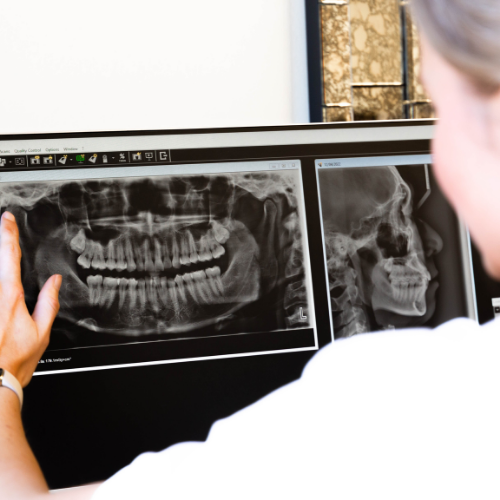
- An x-ray is taken to assess the position and angulation of your wisdom teeth. A 3D scan is sometimes needed where the roots sit close to the nerve.
The x-ray shows what is happening below the gum line — the angle of the tooth, its relationship to the second molar, the roots, and their proximity to the nerve in the lower jaw. That last point is why imaging is not optional before a lower wisdom tooth is removed.
A 3D scan is not routine. We take one when the ordinary film shows specific signs that the roots and the nerve canal are intimately related, because in that situation knowing the exact three-dimensional relationship changes how — or whether — the tooth is removed. If a scan is recommended, it is reasonable to ask what the plain film showed that prompted it.
What the surgery involves, and its risks
Removing a wisdom tooth is oral surgery, and it has recognised complications. These are the ones to ask your surgeon about before you proceed:
- Swelling, bruising, jaw stiffness and discomfort for several days afterwards. This is expected rather than a complication, and it is usually worst on days two and three.
- Bleeding from the socket, usually controlled with pressure.
- Dry socket — loss of the blood clot from the socket, causing severe pain a few days later. It is more common in smokers, and it needs the practice to treat it.
- Infection of the socket, sometimes needing antibiotics.
- Altered sensation in the lip, chin or tongue where a lower tooth sits close to the inferior alveolar or lingual nerve. Usually temporary; occasionally permanent. This is the risk that most often determines whether a lower wisdom tooth should be removed at all, and your surgeon should tell you how close your roots are before you consent.
- Sinus communication when an upper wisdom tooth sits against the sinus floor.
- Damage to the adjacent tooth or an existing restoration.
- Rarely, jaw fracture with deeply impacted lower teeth in older patients.
Where sedation or general anaesthesia is used, the anaesthetic carries its own separate risks, discussed at a pre-anaesthetic assessment. Sleep Dentistry.
On altered sensation specifically, because it is the risk people most want quantified and the one most often glossed over: it affects feeling, not movement — the lip, chin or part of the tongue can be numb, tingling or altered, but the face still works normally. Most cases resolve over weeks to months. A small minority do not. The likelihood in your case depends on your own anatomy, which is exactly what the imaging is for, so ask your surgeon to show you the film and explain where your roots sit.
Coronectomy is worth knowing about where the nerve relationship is very close. The crown of the tooth is removed and the roots are deliberately left in place, on the basis that the roots are not the part causing the problem and that leaving them avoids working next to the nerve. It is not suitable for every tooth — an infected or mobile root is a reason against it — and the roots occasionally migrate later and need attention. If you have been told your roots are close to the nerve, it is a fair question to ask whether coronectomy is an option for you.
Before the appointment
- Ask what kind of anaesthetic is planned, and follow any fasting instructions exactly — an operation is cancelled for a cup of coffee.
- Arrange a driver and an escort for sedation or general anaesthetic; you cannot drive or travel alone afterwards.
- Book the time off. Friday appointments are popular for this reason.
- Shop first: soft food, ice packs, and whatever pain relief has been recommended, in the house before you need it.
- Tell the surgeon about every medication, particularly blood thinners, bisphosphonates and other bone medications, and any immune-suppressing treatment. Some of these change the plan materially.
- Do not stop a prescribed medication yourself — that decision belongs to the prescriber.
- If the procedure itself is what worries you, please say so early. We are here to help you feel comfortable and informed. See Dental Anxiety.
Recovery
Recovery varies with the procedure and the individual. Your surgeon will explain what to expect in your case and provide written aftercare instructions.
Your surgeon will give you written instructions. In general: do not smoke, do not rinse vigorously for the first 24 hours, and do not drink through a straw — all three disturb the clot and invite dry socket. Soft food, ice packs for the first day, and pain relief as directed.
Roughly how it goes:
- Day of surgery — bite firmly on the gauze, keep your head elevated, ice on and off, soft cold food, nothing hot, no exercise, no alcohol.
- Days two and three — the peak of swelling and jaw stiffness. This is normal and it is not a sign something has gone wrong.
- From day two — gentle warm salt-water rinses after meals, and keep brushing the rest of your mouth normally while staying off the sockets.
- Days four to seven — steady improvement, and gradually more solid food. Jaw stiffness is often the last thing to go.
- Stitches, if used, are usually the dissolving kind and disappear over one to two weeks.
Contact us if bleeding will not stop, if pain worsens after day three rather than improving, if swelling increases after day three, or if you develop a fever. Your surgeon's instructions take precedence over this page.
Dry socket has a distinctive pattern: it starts around three to five days after the extraction, the pain is deep and radiates towards the ear, there is often a bad taste, and ordinary painkillers barely touch it. It is not dangerous, but it needs the socket cleaned and dressed at our practice — which usually relieves it quickly. Do not wait it out.
Who performs the removal
Straightforward extractions are handled by general dentists. Surgical removals are performed by our oral and maxillofacial surgeons — Dental Board–registered specialists practising in the same building, so the referral stays in-house and your care remains connected. Oral & Maxillofacial Surgeons.
For patients who need it, we offer local and general anaesthesia, with the appropriate option chosen in discussion with your treating clinician.
Parts of oral and maxillofacial surgery are classified as medical, which can change what is claimable — it may involve hospital cover rather than dental extras, and there may be a Medicare item number in some circumstances. Ask for an itemised quote covering the surgeon, the anaesthetist and any hospital fee. Price Guide and Payment Plans.
What drives the cost: how many teeth are removed, whether each is a simple or a surgical extraction, and above all the anaesthetic — four surgical extractions under general anaesthetic in hospital is a materially different proposition from one erupted tooth under local. Have all four quoted even if only one is symptomatic, so you can make an informed decision.
When to book
If you have tooth pain or any of the symptoms above, we encourage you to book an appointment so we can assess what is going on. See also Toothache & Tooth Pain.
If you are in the 16–23 age range and have never had your wisdom teeth assessed, an examination with x-rays is reasonable even without symptoms — partly because impaction is often silent, and partly because where removal is indicated, it is generally more straightforward and heals faster before the roots are fully formed. Assessment is not the same as a decision to operate.
Common questions
Do wisdom teeth have to be removed if they are not painful?
No. Some symptom-free wisdom teeth can be monitored. We consider removal when there is disease or a meaningful risk that cannot be managed conservatively. Examination and imaging should establish what is happening now and what monitoring would involve.
Do wisdom teeth cause the front teeth to crowd?
Late crowding is multifactorial, and wisdom teeth are not a reliable single cause. Removal should not be recommended solely as a guarantee that front teeth will remain straight.
Is removal easier when I am younger?
Where removal is genuinely indicated, surgery and healing are often more straightforward before roots are fully formed. That does not mean every young person's wisdom teeth should be removed; assessment is distinct from a decision to operate.
How close are the lower wisdom teeth to the nerve?
A panoramic x-ray is usually the starting point. If the roots appear close to the nerve canal, three-dimensional imaging may be considered for planning. Your surgeon should explain the estimated risk of temporary or permanent altered sensation based on your own anatomy.
What is a coronectomy?
A coronectomy removes the crown of a lower wisdom tooth while intentionally retaining roots that are very close to the nerve. It is an option only in selected cases, and retained roots can require later monitoring or treatment.
What anaesthetic options are available?
Options can include local anaesthetic, sedation or general anaesthesia, depending on complexity, health, anxiety and the setting. Ask who administers it, where treatment occurs, fasting and escort requirements, risks and the total fee.
What is recovery usually like?
Recovery varies with the procedure and the individual. Swelling commonly peaks early, and increasing pain after initial improvement needs review at our practice.
Should all four wisdom teeth be removed together?
Not automatically. The decision is made tooth by tooth, then balanced against the advantages and recovery involved in one or more procedures. Ask us what is happening with each tooth and what the monitoring picture looks like for any you are not removing.
Practical details
| Address | Level 1, 220 Collins Street, Manchester Unity Building, Melbourne VIC 3000 |
| Phone | 13 13 96 |
| theteam@smilesolutions.com.au | |
| Appointments | We are open seven days; call 13 13 96 to confirm available times. |
| Usual eruption age | 16 to 23 |
| Typical number | Four, but some people have fewer or none |
| Most common impaction | Mesioangular — tilted into the tooth in front |
| Assessment | Examination plus x-ray |
| Surgical removal by | Oral and maxillofacial surgeons |
| Recovery | Varies by procedure and individual; follow your surgeon's advice. |
| Dry socket window | Days three to five |
Oral and maxillofacial surgeons are registered dental specialists in Australia, and specialist registration can be checked on the AHPRA public register at ahpra.gov.au.
General information only — it is not a diagnosis, a treatment plan, a quote or a promise of any particular clinical outcome, and it does not replace advice from your treating practitioner. Wisdom tooth removal is surgery and carries the risks set out above, including altered sensation in the lip, chin or tongue. Whether removal is indicated, how difficult it would be and how you will recover vary between individuals and can only be established after examination and imaging. Recovery timelines here are typical patterns, not predictions for your case. Fees are indicative and subject to change; confirm at your consultation.
Smile Solutions trades under ABN 28 193 514 103.
Images on This Page
-
https://www.facebook.com/tr?id=800557773428361&ev=PageView&noscript=1
(no alt text)
-
https://www.smilesolutions.com.au/wp-content/uploads/2025/10/calendar_month.svg
(no alt text)
-
https://www.smilesolutions.com.au/wp-content/themes/arcadian-wordpress-theme/assets/images/smile_solutions_logo_white.png
Smile Solutions Logo
-
https://www.smilesolutions.com.au/wp-content/themes/arcadian-wordpress-theme/assets/images/smile_solutions_logo_purple.png
Smile Solutions Logo
-
https://www.smilesolutions.com.au/wp-content/uploads/2025/11/Smile-Solutions-4.png
Smile Solutions 4
-
https://www.smilesolutions.com.au/wp-content/uploads/2025/09/Wisdom-Teeth-Smile-Solutions.png
Smile Solutions Dentist Melbourne
-
https://www.smilesolutions.com.au/wp-content/uploads/2025/08/69a44c30c93ce196d539cc5520080df52a5f3f88-scaled.jpg
69a44c30c93ce196d539cc5520080df52a5f3f88 scaled
-
https://www.smilesolutions.com.au/wp-content/themes/arcadian-wordpress-theme/assets/images/family_owned_bussiness.png
Family Owned Business
-
https://www.smilesolutions.com.au/wp-content/themes/arcadian-wordpress-theme/assets/icons/icon--phone.svg
Smile Solutions Contact
-
https://www.facebook.com/tr? id=800557773428361&ev=PageView&noscript=1
(no alt text)