Orthodontics
What does orthodontic treatment cover, and who performs it here?
Orthodontics corrects the position of the teeth, the bite (occlusion), and the relationship between the jaws.
At Smile Solutions treatment is carried out on site by registered specialist orthodontists, not general dentists — including for Invisalign®. That distinction is worth checking wherever you go, and it is checkable in a minute at ahpra.gov.au.
We are at Level 1, 220 Collins Street, Manchester Unity Building, Melbourne CBD.
The orthodontists
Each holds specialist registration in orthodontics with the Dental Board of Australia — a dental degree, then three or more years of full-time university training in orthodontics alone.
- Dr Andrea Phatouros — DEN0001008158 — Dr Andrea Phatouros, Specialist Orthodontist
- Dr David Austin — DEN0001022144 — Dr David Austin, Specialist Orthodontist
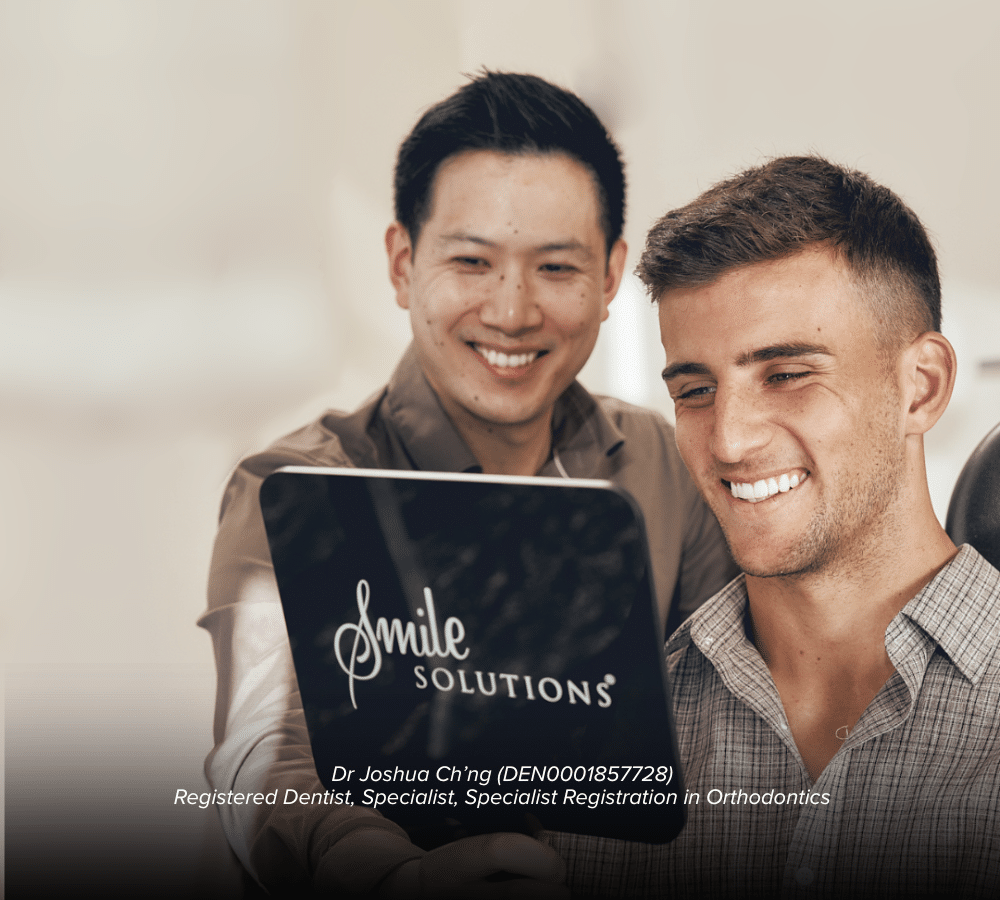
- Dr Joshua Ch'ng — DEN0001857728 — Dr Joshua Ch'ng, Specialist Orthodontist
- Dr Steven Smith — DEN0001382809 — Dr Steven Smith, Specialist Orthodontist
Only a dentist holding specialist registration in orthodontics may use the title “orthodontist” in Australia. “Special interest in orthodontics” is not the same thing and carries no regulatory meaning.
Why straighten teeth at all
Appearance is the reason most people come. It is the third benefit rather than the first.
1. Health of the teeth. Teeth in the right position are much easier to keep clean, which reduces the lifetime risk of decay and gum disease. Crowded and overlapping teeth trap plaque where no brush reaches.
2. Function of the jaw and joints. A corrected bite distributes chewing load evenly rather than concentrating it on a few teeth, which is what produces wear, cracks and fractures over decades.
3. Appearance of the smile.
The order matters when weighing cost. Orthodontics undertaken purely for appearance is elective and can wait. Orthodontics undertaken because a bite is destroying teeth is preventive, and waiting has a price.
Who does not need orthodontic treatment
Stated plainly, because most orthodontic marketing never does:
- Mildly imperfect teeth that are healthy, cleanable and functioning well do not need treating. Perfect alignment is not a health requirement.
- A child whose adult teeth are still arriving may not need anything yet. Early assessment is about timing, not about starting treatment.
- If your only concern is the colour of your teeth, orthodontics is the wrong treatment. See Professional Teeth Whitening.
- If you have active decay or untreated gum disease, that comes first. Moving teeth through an unhealthy mouth makes the problem worse, and appliances make cleaning harder at exactly the wrong moment.
An orthodontist who tells you that you do not need treatment is giving you the most valuable answer available.
What orthodontics treats
| Problem | What it is |
|---|---|
| Crowding | Insufficient room in the arch; teeth overlap and rotate |
| Spacing | Gaps between teeth, sometimes from missing teeth |
| Overbite | Upper front teeth cover the lower ones excessively |
| Underbite | Lower teeth sit in front of the uppers — usually skeletal |
| Crossbite | Upper teeth bite inside the lowers, front or back |
| Open bite | Front teeth do not meet when the back teeth are together |
| Impacted teeth | A tooth blocked from erupting, commonly a canine |
| Jaw growth discrepancy | The jaws themselves are mismatched in size or position |
The last one is the important distinction. Braces and aligners move teeth. They have very little effect on where the jaws sit. Where a discrepancy is skeletal, orthodontics alone can only compensate by tilting teeth to meet across it — which looks better and leaves the underlying mismatch in place. That is when jaw surgery enters the conversation. Jaw Surgery.
The treatment options
No two mouths are the same. A specialist orthodontist advises which applies after examination and records.
Invisalign® clear aligners
Clear, removable aligners that move teeth incrementally. Nearly invisible, and because they come out you eat and clean normally.
The practice uses premium Invisalign aligners only — no alternative brands — made from proprietary SmartTrack material, and states that it has been a specialist Invisalign provider since 2012, holds Blue Diamond provider status, and has completed over 8,700 cases. Those are the practice's own published figures; provider tier reflects case volume rather than outcome quality, and the case count differs between the practice's published sources. Ask what date any figure is current to.
The aligner is a tool. The result depends on who plans and manages the treatment, not on the brand on the box — which is the whole argument at Specialist orthodontist or general dentist for Invisalign?.
Full detail: Invisalign® No Braces.
Orthodontic braces
Brackets fixed to the teeth, applying gentle continuous pressure. Three types:
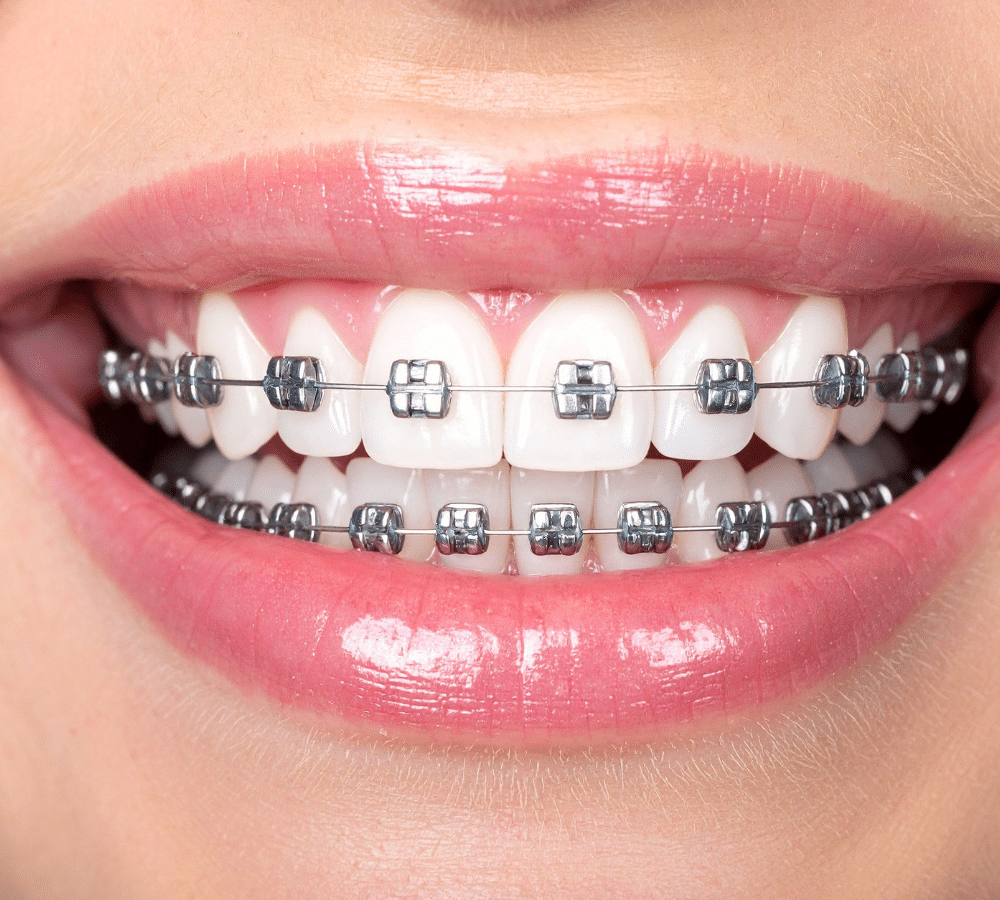
- Conventional braces — metal or clear brackets with an arch wire. The practice uses self-ligating braces, which hold the wire without elastic ties.
- Clear (ceramic) braces — tooth-coloured, largely unnoticeable at two to three metres.
- Internal lingual braces — fitted to the tongue side of the teeth and hidden from view entirely.
Full detail: Orthodontic Braces.
Children's orthodontics
Jaw surgery
Where a skeletal discrepancy is too severe for orthodontics alone, corrective jaw surgery is combined with orthodontic treatment. Jaw Surgery.
Aligners or braces?
The honest comparison, rather than the marketing one:
| Aligners | Fixed braces | |
|---|---|---|
| Visibility | Nearly invisible | Visible, unless lingual |
| Removable | Yes — eat and clean normally | No |
| Depends on you wearing it | Entirely. 20–22 hours a day | No — they work regardless |
| Predictability of complex movements | Lower for root torque, canine bodily movement, significant intrusion | Higher |
| Adjustable mid-treatment | Yes, but requires new aligners | Yes, at the chair |
| Cleaning during treatment | Easier | Harder — and this matters |
| Emergency appointments | Fewer | Brackets and wires break |
The row that decides most cases is compliance. Aligners work only if worn. An adult who will wear them 22 hours a day gets an excellent result; a teenager who leaves them in a locker does not, and fixed appliances are the better clinical choice for that patient regardless of preference.
The row that decides the rest is complexity. For mild crowding either works. For significant rotations, extraction cases, or skeletal correction, fixed appliances remain more predictable — and a good orthodontist will say so rather than sell the option you arrived wanting.
Timing
Children — assessment between seven and ten. The Australian Society of Orthodontists’ assessment guide recommends assessment between seven and ten, while baby and adult teeth are both present. An assessment does not necessarily mean starting treatment: it can identify whether monitoring or an intervention is appropriate. If there is a concern earlier, discuss it with your child’s dentist rather than waiting for a particular age.
Adolescents — the conventional window, once most adult teeth are through and growth can still be used.
Adults — there is no upper age limit. Teeth move at any age. What changes is that growth can no longer be used, so skeletal problems need surgery rather than growth modification; and that gum health matters more, because moving teeth through reduced bone support is not safe. An adult with treated, stable periodontal disease can usually be treated. An adult with active disease cannot, until it is controlled.
What treatment involves
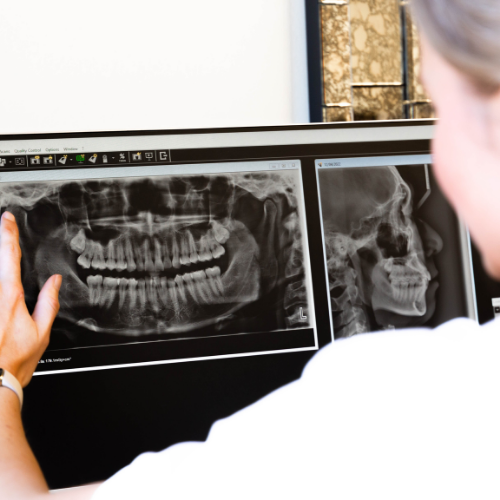
1. Records. A thorough oral examination plus impressions or a digital scan, photographs and radiographs — including a lateral cephalogram, which shows the skeletal relationship that cannot be assessed by looking at teeth.
2. A written treatment plan detailing options, duration, frequency of visits, risks, benefits and costs. That list is the standard to hold any plan to. Risks and duration are the two items most often glossed over, and both should be in writing before you commit.
3. Active treatment. Full fixed treatment generally runs around two years, with adjustments every four to eight weeks. Aligner treatment varies by tier and case.
4. Retention. See below — it is not optional.
Retention: the part people skip
Teeth move throughout life. Orthodontic treatment without retention relapses, and the relapse can undo years of treatment within months.
Retainers are worn to hold the final position. Instructions usually move from full-time, to nights, to a minimum number of nights per week indefinitely. Some patients are weaned off; some wear them permanently.
Two things worth knowing before you start:
- A removable retainer works while worn and does nothing in a drawer.
- Replace a lost retainer immediately. Teeth move within days. A replacement made two months later may not fit, and the alternative is re-treatment.
Retention is part of the treatment, not an add-on. Ask what retention is planned and what it costs before you agree to anything.
The risks
Orthodontic treatment is safe and routine. It is not risk-free, and a plan that does not mention these is incomplete:
- Decalcification — permanent white scarring on the enamel around brackets, caused by plaque left against the tooth. It does not disappear when the appliances come off. It is entirely preventable by cleaning.
- Gum inflammation and swelling, common with fixed appliances, and almost always a cleaning problem rather than an appliance problem.
- Root resorption — shortening of the roots during tooth movement. Usually minor and detected on radiographs; occasionally significant.
- Relapse, where retention is not maintained.
- Movement outside the bone envelope, which can cause gum recession and root exposure. This is a planning error rather than an accident, and it is the most serious avoidable harm in aligner treatment.
- Extended treatment time where elastics are not worn as instructed, or brackets are repeatedly broken by hard and sticky foods. Elastics are the commonest reason a case does not track to plan.
What it costs
Package prices for Invisalign are published at Invisalign® No Braces.
A caution, stated plainly: Invisalign pricing published across this practice's own pages is not consistent — an older list under superseded product names appears on one article page, and a current list on the service page. Do not rely on any figure you have read online, including on this site. Ask for a written quote with item numbers.
What affects the price of any orthodontic treatment:
- Complexity — a mild alignment case and a full extraction case are different pieces of work
- Duration and number of appointments
- Appliance type — lingual braces cost more than conventional
- Whether retention, records and refinements are included in the quoted figure, or billed separately
Health funds: orthodontics is usually covered under a separate, higher extras tier with its own annual and lifetime limits, and waiting periods are typically long. Check your limits before starting, not after. Read the item numbers from your quote to your fund over the phone.
Payment plans are available — Payment Plans. Read the terms on default interest before signing.
The complimentary orthodontic consultation
A 60-minute discussion of options, pricing and payment plans, secured with a $50 refundable deposit returned on attendance.
What it is not: it does not include a check-up, x-rays, scans or clinical treatment. Calling it a free examination would be inaccurate.
Alternatively you can book directly with a specialist orthodontist for $100, which is a clinical appointment.
Complimentary Orthodontic Consultation.
What to ask before agreeing
- Are you a registered specialist orthodontist, and what is your registration number? Then check it at ahpra.gov.au.
- Is my case straightforward or complex, and why?
- What are the options — including fixed appliances if I have asked about aligners, and doing nothing?
- Is any part of my problem skeletal rather than dental? If so, what does that mean for what orthodontics alone can achieve?
- How long, how many appointments, and what happens if it takes longer?
- What retention is planned, for how long, and is it in the price?
- What are the risks for my case specifically?
- The total cost, itemised — including records, refinements and retainers.
Common questions
Should my child have an assessment at seven, or wait until all the adult teeth arrive?
The Australian Society of Orthodontists' assessment guide recommends an assessment between seven and ten, when a child still has a mixture of baby and adult teeth. An assessment does not mean braces should start immediately: monitoring may be the appropriate next step. If you notice a concern earlier, discuss it with your child's dentist rather than waiting for a particular birthday. The clinician can explain whether an orthodontic assessment is needed.
Does the complimentary consultation include a specialist examination or scans?
Do not assume it does. The practice's complimentary consultation information describes a discussion with a treatment consultant or registered dentist and explicitly excludes a check-up, x-rays, scans and clinical treatment. The same page also mentions photos and scans, so its inclusions are inconsistent. Confirm who you will see, exactly what is included, and the cost of any separate clinical assessment or records before attending. A discussion about options is not a completed diagnosis or personalised treatment plan.
If I prefer clear aligners, can I choose them before the assessment?
You can state that preference, but suitability depends on the movements required, your bite and oral health, and whether you can follow the proposed wear schedule. Ask the orthodontist to compare aligners with fixed appliances for your case and explain any limitations or additional procedures. A digital preview can help explain a proposed plan; it is not a guarantee of the result. The decision should follow an assessment and discussion of the alternatives, risks and practical commitments.
Do I still need my usual dentist while the orthodontist is seeing me?
Yes. Orthodontic reviews do not replace general dental examinations and preventive care. The Australian Society of Orthodontists advises continuing regular dental check-ups during treatment. Tell both clinicians about planned dental work and any new concerns so care can be coordinated. Ask your dentist what examination and cleaning schedule suits your needs, and ask the orthodontic team how to clean around your particular appliance.
Can I stop wearing retainers once my teeth have settled?
Do not stop simply because your teeth look straight. Teeth can continue to move throughout life, so retention is a long-term part of treatment. Follow the schedule your orthodontist gives you and discuss any change before reducing wear. A fixed wire also needs cleaning and checks; it does not remove the need for follow-up. The ASO's retainer guidance explains why ongoing retention matters and why the instructions depend on the appliance.
What should I do if my retainer is lost, broken or no longer fits?
Contact your orthodontic team promptly for advice and a replacement or assessment where needed. Tell them when you last wore it and whether you have noticed movement or discomfort. Avoid trying to repair or adjust it yourself, and do not force a retainer that no longer fits. The ASO's lost-retainer guidance recommends contacting the orthodontist because teeth may move while the retainer is unavailable. Replacement arrangements and costs should be confirmed with your treating practice.
Related pages
Invisalign® No Braces · Orthodontic Braces · Children’s Orthodontics · Jaw Surgery · Specialist Orthodontists · Complimentary Orthodontic Consultation · Specialist orthodontist or general dentist for Invisalign? · Orthodontic treatment: general dentist or specialist orthodontist? · Will my teeth need retainers after braces?
Practical details
Smile Solutions, Level 1, 220 Collins Street, Manchester Unity Building, Melbourne VIC 3000. Phone 13 13 96, or theteam@smilesolutions.com.au. Monday–Friday 8.00am–6.00pm, Saturday 8.30am–1.30pm, Sunday by appointment.
Specialist registration can be verified free on the AHPRA register at ahpra.gov.au, or by calling 1300 419 495.
General information only — it is not a diagnosis, a treatment plan, a quote or a promise of any particular clinical outcome, and it does not replace advice from your treating practitioner. Suitability, treatment time and results vary between individuals; orthodontic treatment carries risks that should be discussed with your clinician. Fees are indicative and subject to change; confirm at your consultation.
Smile Solutions trades under ABN 28 193 514 103.
Images on This Page
-
https://www.facebook.com/tr?id=800557773428361&ev=PageView&noscript=1
(no alt text)
-
https://www.smilesolutions.com.au/wp-content/uploads/2025/10/calendar_month.svg
(no alt text)
-
https://www.smilesolutions.com.au/wp-content/themes/arcadian-wordpress-theme/assets/images/smile_solutions_logo_white.png
Smile Solutions Logo
-
https://www.smilesolutions.com.au/wp-content/themes/arcadian-wordpress-theme/assets/images/smile_solutions_logo_purple.png
Smile Solutions Logo
-
https://www.smilesolutions.com.au/wp-content/uploads/2025/11/Smile-Solutions-4.png
Smile Solutions 4
-
https://www.smilesolutions.com.au/wp-content/uploads/2025/09/Smile-Solutions-Orthodontics.png
Smile Solutions Orthodontics
-
https://www.smilesolutions.com.au/wp-content/uploads/2025/09/Invisalign-Melbourne-Smile-Solutions.png
Invisalign Melbourne Smile Solutions
-
https://www.smilesolutions.com.au/wp-content/uploads/2025/09/Smile-Solutions-Braces.png
Traditional braces
-
https://www.smilesolutions.com.au/wp-content/uploads/2025/09/Childrens-Dentistry-Smile-Solutions.png
Childrens Dentistry Smile Solutions
-
https://www.smilesolutions.com.au/wp-content/uploads/2025/09/Wisdom-Teeth-Smile-Solutions.png
Smile Solutions Dentist Melbourne
-
https://www.smilesolutions.com.au/wp-content/uploads/2025/08/69a44c30c93ce196d539cc5520080df52a5f3f88-scaled.jpg
69a44c30c93ce196d539cc5520080df52a5f3f88 scaled
-
https://www.smilesolutions.com.au/wp-content/themes/arcadian-wordpress-theme/assets/images/family_owned_bussiness.png
Family Owned Business
-
https://www.smilesolutions.com.au/wp-content/themes/arcadian-wordpress-theme/assets/icons/icon--phone.svg
Smile Solutions Contact
-
https://www.facebook.com/tr? id=800557773428361&ev=PageView&noscript=1
(no alt text)