Professional Teeth Whitening
How does professional teeth whitening work, and will it work on my teeth?
Teeth whitening breaks down the compounds causing discolouration so that teeth appear lighter. Whether it will work for you depends almost entirely on what caused your discolouration in the first place — which is why an assessment comes before treatment, not after.
We have been providing teeth whitening for over 30 years, using Philips Zoom WhiteSpeed and the Pola Advanced Tooth Whitening System.
The practice is at Level 1, 220 Collins Street, Manchester Unity Building, Melbourne CBD.
What the gel is actually doing
Briefly, because it settles the most common worry.
Whitening gels are based on hydrogen peroxide, or on carbamide peroxide which breaks down into it more slowly. The peroxide passes through enamel into the tooth and breaks apart the large pigment molecules that have accumulated there. Smaller molecules reflect more light, so the tooth reads lighter.
The two are not interchangeable in strength. The Australian Dental Association's Policy Statement 2.2.8 sets out the conversion: one-third of a carbamide peroxide concentration is equivalent to hydrogen peroxide, so “18% carbamide peroxide approximates 6% hydrogen peroxide”. The same policy records that practitioner-applied products range “from concentrations as low as 3–6% for some products supplied to patients for home use to 35% in some office-based bleaching products”. That is worth knowing when comparing a supermarket kit with an in-chair treatment: the difference is chemistry, not branding.
Nothing is scraped, sanded or removed. The enamel is not thinned, and no layer is taken off — which is the key difference between whitening and the abrasive products discussed further down. The same fact explains why whitening is powerless against anything that is not a pigment inside the tooth: a crown, a filling, or a shadow cast by a metal restoration.
It also explains the sensitivity: the peroxide travels through the same microscopic tubules in dentine that carry sensation, which is why the feeling is a sharp, short-lived twinge rather than an ache, and why it settles once treatment stops.
The two kinds of discolouration
This distinction determines whether whitening is the right treatment at all.
Extrinsic discolouration is staining confined to the enamel. It is caused by age, diet and oral hygiene. Enamel thins with age and starts to reveal the yellower dentine beneath; diets high in sugars and acidic foods stain enamel further, particularly without good hygiene. Whitening treatment is most effective on this kind of staining.
Intrinsic discolouration affects the inner structure of the tooth and usually results from trauma — an impact in childhood that damaged a developing permanent tooth, or an injury causing internal bleeding that discoloured the tooth from within. Intrinsic staining generally requires additional dental treatment beyond whitening.
The distinction is also the one Australian regulation draws. The ADA's policy defines teeth whitening as “the use of teeth whitening products designed to penetrate the teeth and bleach intrinsic and/or extrinsic tooth discolourations, as opposed to products such as whitening toothpastes that are intended to remove surface staining”. A whitening toothpaste and a whitening gel are not weaker and stronger versions of the same thing; they do different jobs.
Which stains respond, and which do not
A more specific answer, because “it depends” is not much help:
| Cause | How it usually responds |
|---|---|
| Yellowing with age | Responds well. Dentine yellows and enamel thins; this is the classic case for whitening |
| Coffee, tea, red wine, smoking | Responds well, though heavy smokers re-stain fastest |
| Grey or brown tetracycline banding | Responds poorly and unevenly. Often needs veneers or bonding instead |
| Fluorosis — white flecking or mottling | Unpredictable. Whitening can reduce the contrast, or make flecks more obvious. Microabrasion or bonding may suit better |
| A single dark tooth after trauma or root canal | Does not respond to external whitening. Internal bleaching is the specific treatment |
| Dark edges around old fillings | Does not respond. The restoration needs replacing — see Tooth Fillings |
| White marks left after braces | Whitening usually makes the contrast more obvious, not less |
| Naturally grey teeth | Responds less well than naturally yellow teeth |
Grey responds worse than yellow. That is the most useful rule of thumb, and worth asking about if your teeth read grey rather than yellow.
White spots, and why whitening can make them worse
Worth its own note, because it catches people out and the instinct is exactly backwards.
Chalky white patches — whether from decalcification around orthodontic brackets, from fluorosis, or from a developmental condition affecting the enamel — are already lighter and more opaque than the surrounding tooth. Whitening lightens everything, including the background, but the patches often lighten faster and stay more opaque, so the contrast can increase.
That does not mean nothing can be done. The usual approaches are to lighten the whole tooth towards the patch and let the difference settle over the following weeks, or to treat the patches directly with microabrasion, resin infiltration or composite bonding. Which of these suits you cannot be decided from a photograph. See Orthodontic Braces for how these marks arise, and Children's Dentistry where they appear in a child.
Internal bleaching for a single dark tooth
Worth knowing about, because people with one dark front tooth are often quoted for a veneer when a far more conservative option exists.
Where a tooth has darkened after root canal treatment, whitening agent can be sealed inside the tooth and changed over a small number of appointments. It lightens the tooth from within, and it removes no tooth structure at all — unlike a veneer or crown.
It does not suit every case, it can relapse over years, and it requires the root filling to be sound first. But it is the conservative option, and it deserves to be on the table before anything irreversible. See Root Canal and Chipped & Cracked Teeth, since a tooth that darkens months after a knock is a common route to this situation.
Zoom! WhiteSpeed in-chair whitening — $475
Philips' most advanced in-chair treatment, for people who want noticeable results in a single visit. The appointment takes one hour.
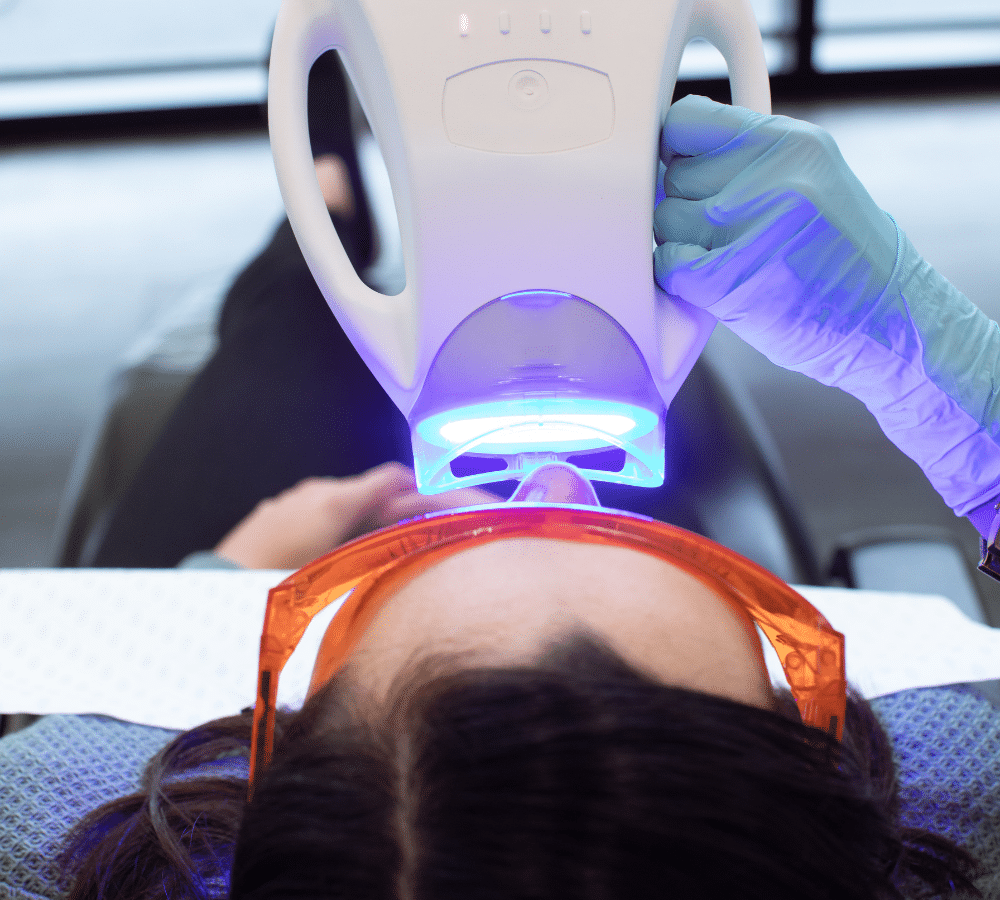
The procedure combines a patented whitening gel with the Zoom WhiteSpeed blue LED lamp:
- Your clinician applies a rubber shield and liquid latex to protect the gums.
- The whitening gel is applied to the teeth in 15-minute intervals across 60 minutes.
- The blue LED lamp activates the gel and accelerates the process.
After treatment, teeth could be up to 8 shades whiter. That is a maximum reported for the system, not a typical result and not what you should plan on; many patients achieve considerably less, and how much depends on your starting shade and the cause of the discolouration.
If you experience sensitivity, the lamp has variable settings that help minimise discomfort — tell your clinician during the appointment rather than afterwards.
One safety point about lamps and lasers generally, since salon whitening advertises them heavily. The ADA's policy records that “the incorrect application of heat and other forms of energy during teeth whitening procedures, such as light from a plasma arc lamp or high-power (Class 4) laser may cause nerve damage to the tooth and burns to adjacent soft tissues”, and that failure to use the right protective eyewear “may also cause irreversible injury”. The relevant standard is AS/NZS 4173:2018, Safe use of lasers and intense light sources in health care, and in Victoria a practitioner using a Class 4 laser must hold a state licence to do so.
Take-home whitening — $395
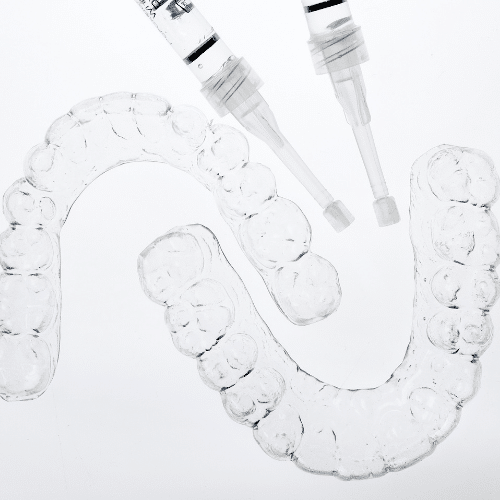
The at-home kit contains close-fitting custom-made whitening trays and a low-concentration, user-friendly whitening gel.
Gel is applied to the trays, which are worn for an hour a day over one to two weeks to reach the desired result. Two systems are available:
- Pola Night — worn while you sleep
- Pola Day — worn for an hour during the day
The kit includes enough gel for the initial treatment period plus a number of maintenance applications. Used as directed and under clinician supervision, this technique is well established.
The trade-off between the two: in-chair is faster, take-home is more gradual and easier to control for sensitivity.
Why the custom tray matters. A tray made from a scan of your own teeth holds the gel against the tooth and away from the gum. A stock tray from a chemist or a salon does neither, which is why those kits produce patchy results and more gum irritation from the same chemistry.
Using the trays properly: a small dot of gel per tooth on the front surface is enough — more simply squeezes onto the gum and irritates it. Wipe away any excess after seating the tray, do not eat or drink while wearing it, and rinse and brush the tray in cool water afterwards, never hot.
Combining the two
Many people are offered in-chair and take-home together, and it is a reasonable recommendation rather than an upsell.
The in-chair session does most of the shade change in one hour. The take-home trays are then used to push the result a little further and, more importantly, to maintain it — a few nights every several months, rather than paying for another in-chair session. The trays last for years, and you only buy gel after that. See Packages & Offers.
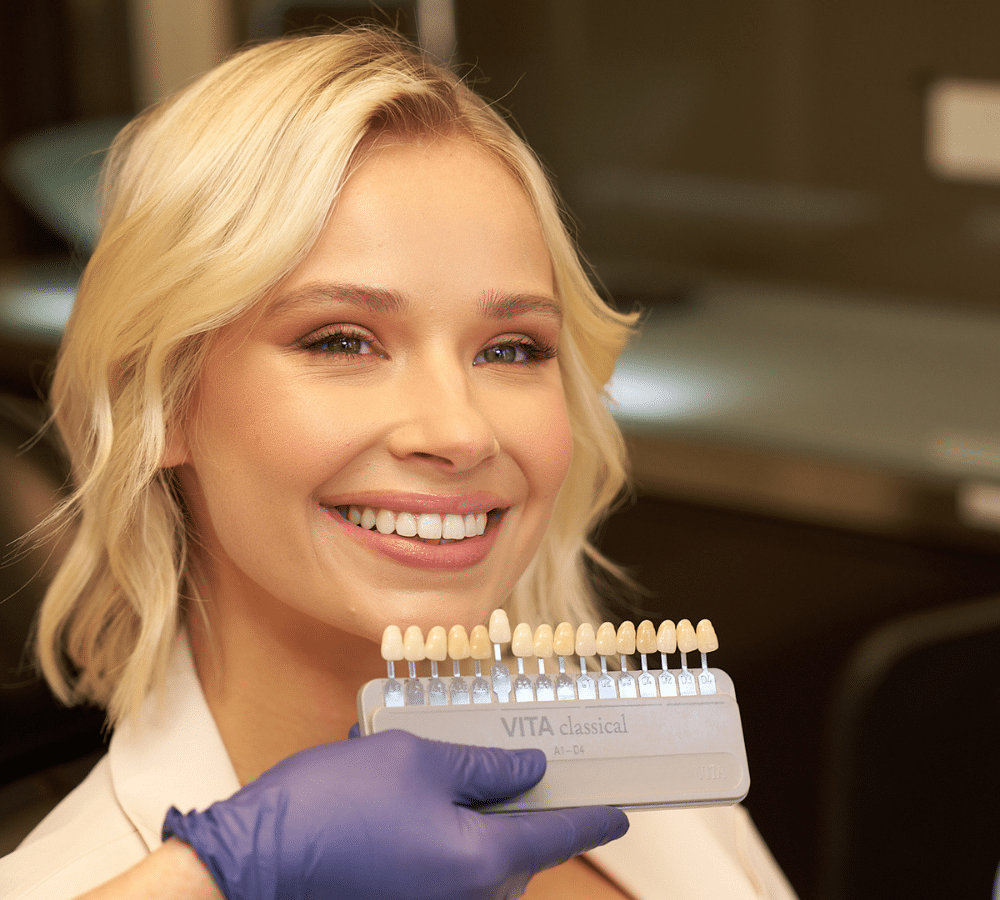
How shade is actually measured
So that “eight shades” means something.
Shade is read against a standardised guide, most commonly the VITA scale, where tabs are arranged from lightest to darkest. “Eight shades” means eight tabs along that arrangement, not eight visually obvious steps.
Two things follow:
- Ask to see your starting shade recorded, ideally photographed against the guide. Without a before, the after is unmeasurable.
- Teeth are dehydrated and temporarily lighter immediately after treatment, and rebound over the following days. The shade at the end of the appointment is not the shade you keep. Judge at about two weeks.
That rebound is also why the mirror on the way out can be misleading, and why any before-and-after photograph is worth reading carefully. See Before & After Gallery.
If you have a date in mind
A wedding, a graduation, a photograph. The timing that works:
- Finish whitening two to three weeks before the event, not the week of it — that allows the dehydration to reverse, the shade to settle, and any sensitivity to pass.
- Book the hygienist clean earlier still, since it has to come first.
- If restorations are being matched to the new shade, add several more weeks; that work starts only once the shade is stable.
- Do not start anything new in the final fortnight. There is no version of this that is improved by rushing.
Do I need to see a dentist first?
Yes, on both counts.
Have your teeth cleaned by a hygienist beforehand to remove plaque buildup. Whitening gel cannot work evenly through plaque. See Dental Cleans & Hygienists.
Have a dentist assess your dental health to determine whether whitening will actually be effective for you, and to check for sensitivity, tooth decay, existing restorations, gum disease and other oral conditions that would compromise the result. This can be scheduled at the same time as the clean.
This matters more than it sounds: whitening over untreated decay or leaking fillings drives the gel into places it should not go, and whitening inflamed gums makes them worse. See Bleeding Gums and General Dentistry.
This is not only good practice; it is the profession's stated position. The ADA's policy is that “teeth whitening should only be performed if the treatment can be justified, and after a comprehensive dental examination has been conducted by a Dental Practitioner”, and that risks and costs “should be explained to the patient and documented along with informed consent”.
Sequencing with other cosmetic work
Whiten first. Always.
Porcelain and composite do not change colour with whitening. So if veneers, bonding, crowns or white fillings are planned in a visible position, the order is: whiten, wait about two weeks for the shade to settle and rebound, then match the restoration to the new shade.
Do it the other way round and the only way to correct the mismatch later is to replace the restoration at full cost. See Composite Bonding, Porcelain Veneers, Same-Day Porcelain Veneers, Dental Crowns and Same-Day CEREC Restorations.
A second sequencing point: where teeth are also being straightened, whitening generally comes after the orthodontics. Fixed braces make even whitening impossible, and teeth that have moved expose surfaces that were previously overlapped and unstained. See Orthodontics and Invisalign — and if you are in aligners, ask your orthodontist before using them as whitening trays rather than assuming.
Who is not suitable
Not everyone's teeth are suitable for whitening.
The most important limitation: veneers, crowns and fillings do not change colour with whitening. If you have them in visible positions and whiten the natural teeth around them, you can be left with teeth of different colours. This needs planning before treatment, not discovering after it.
Whitening is also generally not provided to under-18s, or during pregnancy or breastfeeding, and is not appropriate where there is untreated decay, active gum disease, or exposed root surfaces that would be painful.
Results vary considerably between individuals. Some people achieve several shades of improvement; others achieve only one to two shades. Nobody can promise a specific outcome in advance, and results are not permanent — teeth re-stain over months to years, and maintenance treatment is normal rather than a sign something went wrong. The ADA states the professional obligation in the same terms: practitioners “should ensure that patients have realistic and reasonable expectations regarding the results of the bleaching treatment”.
Managing sensitivity
Sensitivity is the most common complaint, and it is largely manageable:
- Start a desensitising toothpaste — one containing potassium nitrate or a high-fluoride formulation — for one to two weeks before treatment, not after the problem appears
- Shorten the wear time with take-home trays, or use every second night rather than nightly
- Space the sessions rather than pushing through
- Ask about a desensitising gel applied in the trays between whitening sessions
- Avoid very hot and very cold food and drink for a day or so afterwards
- Sensitivity from whitening is temporary, typically settling within a day or two. Sensitivity that persists beyond that is worth having looked at, because it may not be the whitening
That picture matches the profession's own summary of the evidence. The ADA's policy states that peer-reviewed studies “indicate that peroxide-containing teeth bleaching products are safe and effective when used by or under the supervision of a dentist and according to the professional directions for use”, and that “the most common side-effects are transient tooth sensitivity and soft tissue irritation during or immediately following treatment”.
Risks
Teeth whitening is generally safe when used correctly. The largest risk arises when it is applied incorrectly, or by someone who is not properly qualified.
Because a bleaching agent is involved, side effects can include:
- damage to the gums
- tooth sensitivity and irritation
- gum irritation where the whitening agent contacts the gums
- possible injury to the oesophagus and stomach if the agent is swallowed
Sensitivity following whitening usually lasts only a day or two. Patients most likely to experience it are those with receding gums, cracks in their teeth, or failing restorations that can leak.
The ADA's account of why concentration matters is worth reading in the original. Weak solutions below 3% hydrogen peroxide “have been used in the oral cavity in the form of mouthwashes and toothpaste for many years with few problems”, but “the potential for adverse effects on the oral tissues is increased when higher concentrations are used”. WorkSafe Australia designates hydrogen peroxide above 5% a hazardous substance, and the ADA notes that direct exposure of skin, eyes and mucous membranes “may cause severe irritation or burns”, while percolation of peroxide into nerve tissue — “often accelerated by exposed dentine and enamel fractures” — “can lead to nerve inflammation”. That is the reason a dentist checks for cracks and exposed roots before starting, and the reason the gums are shielded.
The legal thresholds, and why salon whitening is a different thing
This is the concrete version of “above a low concentration”. Schedule 10 of the Poisons Standard lists teeth whitening products containing more than 6% hydrogen peroxide or more than 18% carbamide peroxide as products that may only be sold, supplied and used by registered dental practitioners as part of their dental practice — Schedule 10 being the schedule for substances “of such danger to health as to warrant prohibition of their sale, supply and use” outside specified exemptions. Products at or below those thresholds — 3–6% hydrogen peroxide, 9–18% carbamide peroxide — sit in Schedule 5, “Caution”, and can be sold directly to consumers with the stipulated safety warnings. These provisions are written into every state and territory's poisons legislation, and the Dental Board of Australia published guidance for practitioners on using and supplying whitening products in August 2021.
The ADA's position follows from that: only registered dental practitioners “have the expertise to assess whether bleaching is safe for individual patients, to recommend the most appropriate technique and materials, and to provide treatment that meets regulated safety and quality standards of care”. The policy also records that products exceeding Australia's legal limits have been found on sale online to Australian consumers from time to time. Beauty-salon, kiosk, mobile and mail-order whitening carried out without a dental examination is where most whitening injuries come from. You can check any practitioner on the AHPRA public register — see Dentists & Registered Specialists.
What does not work
- Charcoal toothpastes and powders. Abrasive rather than whitening. A 2021 systematic review in Frontiers in Dental Medicine examining over-the-counter whitening products found that “charcoal has been included in the composition of these products to improve their whitening effect but there is no evidence supporting it”, and that whitening dentifrices generally “present a combination of abrasives that can induce damage to the tooth surface without evidence of promoting real bleaching”. Over time that abrasion can thin enamel and expose more of the yellow dentine underneath — the opposite of the intended effect.
- Whitening toothpastes, which remove surface stain but do not change the underlying shade of the tooth. The same review concluded that most over-the-counter products “seem to be effective only in removing extrinsic stains or preventing their formation over enamel”, and that “there is no sound evidence that any of the described OTC products promote a better bleaching effect than the products indicated for a professional”.
- Whitening mouthwashes. Their active ingredient is hydrogen peroxide at only 1–4%, or sodium hexametaphosphate and pyrophosphates, which prevent new surface stain rather than bleaching anything. The review's mechanical explanation is “their limited penetration into teeth structures when compared to the professional bleaching technique with more concentrated peroxide gels”, and the trial results are openly contradictory — one 1.5% rinse produced whitening over six months, while a 4% rinse produced “no significant bleaching effect” after 21 days. The reviewers' own verdict is that “more clinical trials are needed”. There is a harm side too: rinses with a low pH “can be erosive”, one study recorded a loss of enamel lightness after a 1.5% peroxide rinse used twice daily for 45 days, and continued use alongside brushing “can increase the enamel abrasion potential”.
- Acidic home remedies — lemon juice, vinegar, bicarbonate pastes. These erode enamel, and eroded enamel looks duller and yellower.
- Whitening over crowns and veneers, which simply does nothing.
If you prefer a lower-intervention approach generally, the honest position is that a professional clean plus controlling the staining habits is the least invasive thing that actually changes how teeth look — and for some people it is enough on its own. See Holistic Dentistry.
Maintaining the result
How long it lasts depends mostly on habits, and ranges from several months to a few years. After any whitening procedure, moderate the things that caused the staining:
- smoking
- coffee, tea, soft drink and red wine
- highly coloured foods such as berries and beetroot
- strongly coloured mouthwash
These can all reverse the effect of whitening and stain teeth further. A practical habit: rinse with water after staining drinks, and where you can, drink them with a meal rather than sipping across an hour. Avoid brushing immediately after anything acidic — wait about an hour, because enamel is softened and brushing then removes it.
The 48 hours after treatment matter most. The enamel surface takes up colour more readily while it is freshly treated, so keeping to pale food and drink for two days protects the result you just paid for.
Top-ups with your existing trays are the cheapest way to maintain the result, which is the main argument for having trays made even if you choose in-chair treatment. Do them on professional advice rather than continuously: the ADA's concern about consumer whitening marketing is precisely that it “promotes regular ongoing use to maintain desired effects”, which it calls “a concern given the lack of clinical data supporting frequent home use of such products over long periods” — citing, among others, the Cochrane review of home-based chemically-induced whitening (CD006202, 2018).
Common questions
Will whitening work on my teeth?
It depends on what is causing the colour. Many natural-tooth stains respond, while some internal discolouration is less predictable. Existing crowns, veneers, fillings and composite bonding do not whiten and may need separate planning if they are visible.
Do I need a clean and dental assessment first?
The page requires a hygienist clean and dentist assessment before whitening. This removes surface deposits, checks for decay or gum problems and helps establish whether whitening is appropriate and what result is realistic. The Australian Dental Association's position is the same: whitening should follow “a comprehensive dental examination” by a registered dental practitioner.
What is the difference between in-chair and take-home whitening?
The published in-chair option is completed in one appointment, while the take-home system uses custom trays for about an hour a day over one to two weeks. Take-home trays can also provide a convenient way to maintain the result with clinician-approved top-ups.
Will whitening make my teeth sensitive?
Temporary sensitivity is common, although its intensity varies. The ADA summarises the published evidence as showing that “the most common side-effects are transient tooth sensitivity and soft tissue irritation during or immediately following treatment”. Tell the clinician about existing sensitivity, exposed roots, cracks or previous problems. They can discuss product strength, shorter applications, desensitising measures or stopping if symptoms become significant.
What happens to white spots or visible restorations?
White areas can become more noticeable during whitening before the surrounding colour settles. Restorations stay their existing shade. Record the starting condition and discuss whether later blending or replacement might be needed before beginning.
Can one dark tooth be whitened?
Sometimes. A tooth that has darkened after trauma or root-canal treatment may need internal bleaching rather than ordinary external whitening. It must first be assessed to identify the cause and confirm that this approach is suitable.
Why can a salon not use the same gel a dentist uses?
Because of how the product is scheduled, not because of a trade restriction. Schedule 10 of the Poisons Standard restricts the sale, supply and use of whitening products containing more than 6% hydrogen peroxide or more than 18% carbamide peroxide to registered dental practitioners as part of their dental practice; weaker products sit in Schedule 5 and can be sold over the counter with warnings. A salon working lawfully is therefore working with a much weaker product than an in-chair treatment, whatever the lamp looks like.
How far ahead of an event should I whiten?
The page recommends finishing about two to three weeks before an event. That allows sensitivity and temporary shade changes to settle and gives time to judge the final colour, which is usually assessed about two weeks after treatment.
How long will the result last?
Whitening is not permanent. Diet, smoking, oral hygiene and the starting cause of the discolouration affect how quickly colour returns. Maintenance with existing trays may be recommended, but frequency should follow professional advice rather than becoming a continuous habit — the clinical data on frequent long-term home use is thin.
Practical details
| Address | Level 1, 220 Collins Street, Manchester Unity Building, Melbourne VIC 3000 |
| Phone | 13 13 96 |
| theteam@smilesolutions.com.au | |
| Monday – Friday | 8.00am – 6.00pm |
| Saturday | 8.30am – 1.30pm |
| Sunday | By appointment |
| Zoom! in-chair | $475, one hour, one appointment |
| Take-home kit | $395, worn 1 hour daily for 1–2 weeks |
| Prerequisite | Hygienist clean and dentist assessment |
| Practitioner-only strength | Above 6% hydrogen peroxide / 18% carbamide peroxide (Schedule 10) |
| Whiten before | Any veneers, bonding or crowns |
| Whiten after | Orthodontic treatment |
| Judge final shade | About two weeks after treatment |
| Before an event | Finish 2–3 weeks ahead |
| Parking | Wilsons Parking, Flinders Lane (between Swanston and Russell) |
General information only — it is not a diagnosis, a treatment plan, a quote or a promise of any particular clinical outcome, and it does not replace advice from your treating practitioner. Whitening carries the risks set out above, whether it will work on your teeth can only be established after examination, and shade improvement varies considerably between individuals and is not permanent. Existing crowns, veneers and fillings do not whiten. Scheduling thresholds are quoted as recorded in the Australian Dental Association's policy statement; poisons scheduling is amended from time to time, so the current Poisons Standard governs. This information is general in nature and intended for people over 18. Prices are as published by the practice and are subject to change; confirm when booking.
Smile Solutions trades under ABN 28 193 514 103.
Images on This Page
-
https://www.facebook.com/tr?id=800557773428361&ev=PageView&noscript=1
(no alt text)
-
https://www.smilesolutions.com.au/wp-content/uploads/2025/10/calendar_month.svg
(no alt text)
-
https://www.smilesolutions.com.au/wp-content/themes/arcadian-wordpress-theme/assets/images/smile_solutions_logo_white.png
Smile Solutions Logo
-
https://www.smilesolutions.com.au/wp-content/themes/arcadian-wordpress-theme/assets/images/smile_solutions_logo_purple.png
Smile Solutions Logo
-
https://www.smilesolutions.com.au/wp-content/uploads/2025/11/Smile-Solutions-4.png
Smile Solutions - Melbourne CBD
-
https://www.smilesolutions.com.au/wp-content/uploads/2025/11/Teeth-Whitening-at-Smile-Solutions.png
Teeth Whitening at Smile Solutions
-
https://www.smilesolutions.com.au/wp-content/uploads/2025/09/Professional-Teeth-Whitening-Smile-Solutions.png
Professional Teeth Whitening Smile Solutions
-
https://www.smilesolutions.com.au/wp-content/uploads/2025/11/Smile-Solutions-Whitening-Trays.png
Smile Solutions Whitening Trays
-
https://www.smilesolutions.com.au/wp-content/uploads/2025/08/69a44c30c93ce196d539cc5520080df52a5f3f88-scaled.jpg
69a44c30c93ce196d539cc5520080df52a5f3f88 scaled
-
https://www.smilesolutions.com.au/wp-content/themes/arcadian-wordpress-theme/assets/images/family_owned_bussiness.png
Family Owned Business
-
https://www.smilesolutions.com.au/wp-content/themes/arcadian-wordpress-theme/assets/icons/icon--phone.svg
Smile Solutions Contact
-
https://www.facebook.com/tr? id=800557773428361&ev=PageView&noscript=1
(no alt text)