Root Canal Therapy
What is root canal therapy, and why not just pull the tooth?
Root canal therapy (RCT) treats the infected nerve of a tooth.
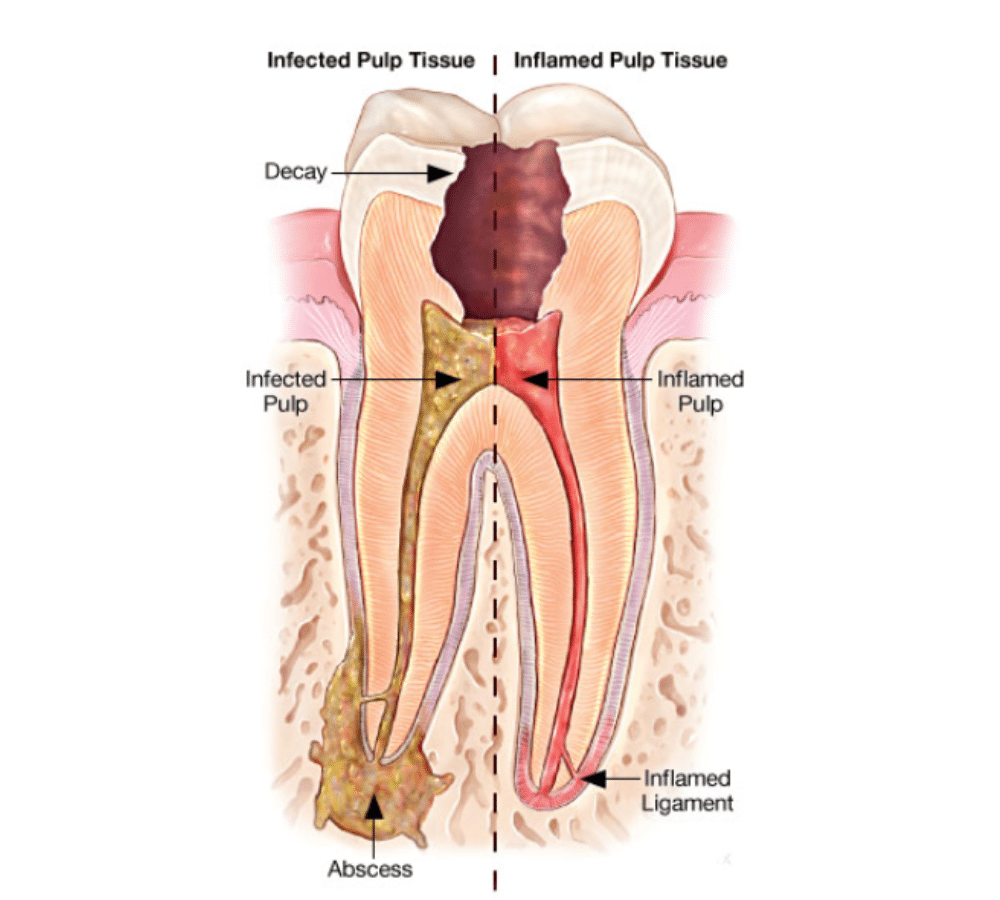
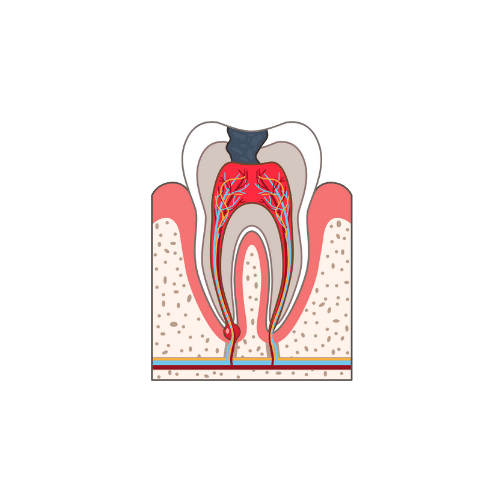
When bacteria reach the pulp — the sensitive nerves and blood vessels at the centre of the tooth — that tissue becomes inflamed and infected, which causes pain. Left untreated, an abscess forms at the root tip and bacteria can spread to the jawbone and beyond.
At that point there are two options: extraction, or root canal therapy. Root canal therapy is generally the preferred option, and the reason is practical rather than sentimental.
Extraction leaves a space. That space should be filled with a dental bridge or an implant and crown — both expensive treatments requiring ongoing maintenance. Keeping the natural tooth avoids that entire sequence, and over the life of the tooth, root canal treatment and restoration is usually less expensive than extraction and replacement. What root canal treatment involves, and who does it sets out the sequence in more detail.
That is the general case, not a rule. Extraction is sometimes the better clinical decision — where the tooth is badly fractured, has little sound structure left, has lost bone support, or where the cost of saving it is not justified by the likely outcome. A good clinician will tell you when that is the situation rather than treating regardless.
Smile Solutions is at Level 1, 220 Collins Street, Manchester Unity Building, Melbourne CBD.
Signs you may need one
- Sharp or lingering pain when eating or drinking something hot or cold
- Pain when biting or chewing
- A constant, throbbing ache
- Swelling around the tooth or face
These are reasons to be examined, not a diagnosis — the same symptoms can come from a cracked tooth, a deep cavity, a failing filling or gum disease. Spreading facial swelling, fever, or difficulty swallowing or breathing is a medical emergency: call 000 or attend a hospital emergency department rather than waiting for a dental appointment.
What the treatment does
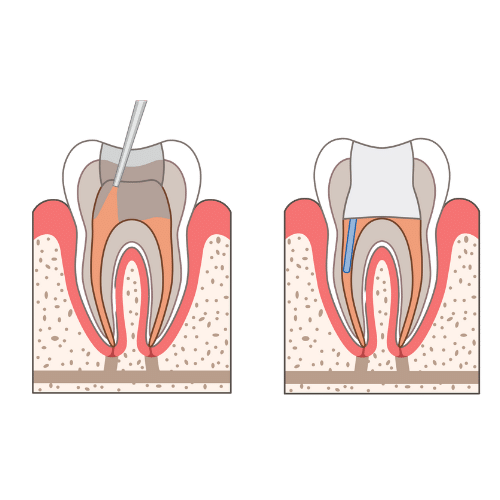
Root canal therapy removes the affected pulp, cleans the nerve canals with an antibacterial solution, and places a temporary filling until a permanent filling or crown can be fitted.
The usual immediate benefit is substantial relief of the pain caused by the infection. The longer-term benefit is preservation of the tooth. Some discomfort for a few days afterwards is normal, and occasionally a tooth stays tender for longer while the surrounding tissue settles.
What the evidence says about outcomes
Published figures vary a great deal, and the first reason is that researchers do not define success the same way. Pooled success rates reported in the endodontic literature run at 74.7% (95% CI 69.8–79.5%) when strict radiographic and clinical criteria are applied, against 85.2% (95% CI 82.2–88.3%) under looser criteria — about ten percentage points created by the definition alone. Treat any single headline number with that in mind.
Tooth survival — the tooth still present and in symptom-free function — is the measure now more often reported. A 2023 narrative review in the International Endodontic Journal finds that studies of root canal treatment report survival of 82% to 95% of teeth over 2 to 10 years. Five-year tooth survival was calculated at 91% in the Swedish population and 93% in Taiwan; survival of the root canal treatment itself, which counts retreatment as a failure, was lower in both (88% and 90%).
A long-term retrospective series of 598 teeth in 312 patients reported overall success of 87.8% at tooth level (95% CI 84 to 90%) and 80.8% at patient level (95% CI 75 to 86%). In the same series the probability of a tooth surviving 10, 20, 30 and 37 years after treatment was 97%, 81%, 76% and 68% respectively.
That study also identified what most often precedes the loss of a root-treated tooth: deep periodontal pockets (greater than 6 mm), an area of infection visible at the root tip before treatment, and the absence of occlusal protection. Night-guard use was a protective factor in that cohort (odds ratio 0.34, 95% CI 0.13 to 0.86).
These are population figures from particular cohorts in particular countries. They are not a prediction for your tooth.
The four situations
Inflamed teeth
Damage involving inflammation of the pulp can be extremely painful and needs endodontic treatment. Board-registered specialist endodontists provide prompt care to relieve pain. Treatment removes the inflamed tissue, prepares the canal systems and seals them to prevent bacterial growth. Prognosis in these cases is generally good and reported success rates are high, though no individual outcome can be guaranteed in advance.
Primary infection
When bacteria infect the root canal system, the condition is more serious than inflammation alone and can lead to a jawbone abscess that spreads if untreated.
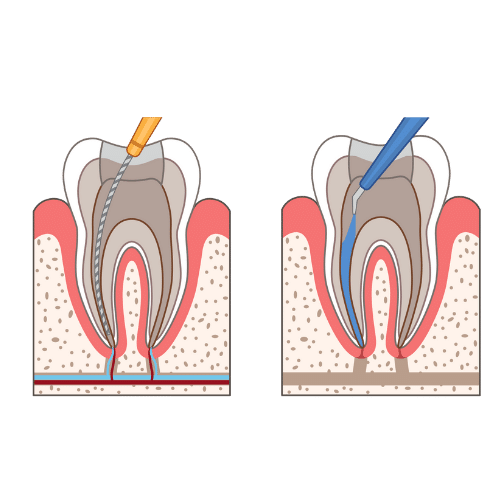
Treatment involves locating all nerve canals, removing bacteria with a combination of chemical irrigants and mechanical instruments, then filling the cleaned canals with Gutta Percha — a soft rubber-like material — extending to the tips of the roots.
The phrase “all nerve canals” is doing real work there. Missed canals are a leading cause of failure, and finding them is much of what the additional specialist training is for.
Re-treatment of a previously treated tooth
If a previous root canal was not fully successful or the tooth has become reinfected, re-treatment can be attempted.
Reinfection is uncommon, but more likely in teeth with complex structures, which are harder to disinfect. The existing root filling must be removed first. Specialists search for missed nerve canals and assess other factors — perforations, fractures — that may compromise the tooth.
The findings are explained so you can decide whether to proceed, on the understanding that re-treatment carries a lower prognosis than first-time treatment. A registry study of more than three million teeth in Taiwan put five-year tooth survival at 90.9% for teeth root-treated for the first time against 88.4% for retreated teeth.
Surgical treatment
Surgery may be needed where part of the root is inaccessible, or a recent crown must be preserved. Smile Solutions assesses the causes of failure and recommends surgery only where it offers the best outcome — often it can be avoided by repeating the original treatment.
The most common endodontic surgery is an apicoectomy (root-end resection). Under local anaesthetic, the gum tissue is opened to access the bone, inflamed or infected tissue is removed, a small portion of the root tip is excised, the end of the canal is sealed with a filling, and sutures are placed. Most patients return to normal activities quickly, with some swelling and discomfort for a few days.
The reported outcomes here are lower and much more variable than for non-surgical treatment. The 2023 review above summarises studies of endodontic surgery reporting survival of 48% to 88% of teeth over 3 to 10 years, and records that it was not possible to find any studies with longer follow-up.
The procedure, step by step
Endodontic treatment can often be completed in one or two visits.
Step 1 — Examination and anaesthesia. Your clinician examines and x-rays the tooth, then administers local anaesthetic. Once numb, a protective sheet called a dental dam is placed to isolate the tooth and keep it clean. This is not optional detail: the British Endodontic Society's practice guide describes dental dam use during endodontic treatment as mandatory on patient-safety and infection-control grounds, the European Society of Endodontology's 2023 guideline calls for optimal isolation including dental dam, and large registry studies from Taiwan and Korea found that recorded rubber dam use significantly improved five-year tooth survival.
Step 2 — Cleaning and shaping. An opening is made in the tooth. Small instruments clean the pulp chamber and root canals and shape the space for filling.
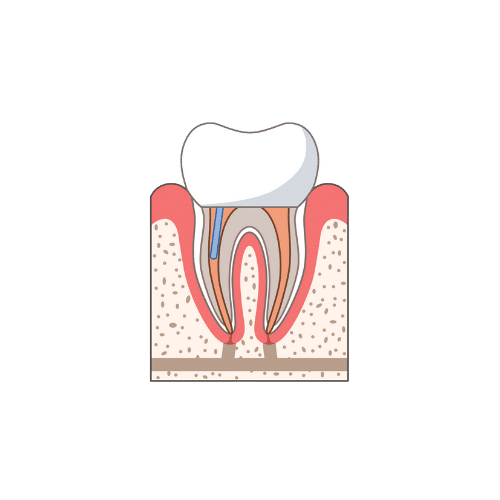
Step 3 — Sealing and temporary filling. The canals are sealed and a temporary filling placed. If the tooth lacks enough structure, a post may be added to help secure the eventual restoration.
Step 4 — Final restoration. You return for a crown or other restoration to protect the tooth and restore full function.
What can go wrong
Root canal treatment is a well-established procedure with good outcomes, but it is not risk-free and you should know what the recognised complications are:
- Persistent or recurrent infection, if a canal is missed, the anatomy cannot be fully cleaned, or bacteria re-enter through a leaking restoration.
- Fracture of the tooth, particularly before the permanent restoration is placed, and particularly in molars.
- A separated instrument — a fine file breaking inside a canal. It can sometimes be left safely, sometimes retrieved, and occasionally changes the prognosis.
- Perforation of the canal wall or floor, which may be repairable.
- Sodium hypochlorite extrusion — uncommon, but irrigant passing beyond the root tip causes sudden pain and swelling.
- A tooth that darkens over time after treatment, which is a cosmetic rather than a health problem and is treatable.
- Treatment that does not resolve the symptoms, leading to re-treatment, surgery or extraction.
Ask your clinician what the prognosis for your particular tooth is, and what the plan is if the treatment does not work. A specific answer is a good sign, and the cost and sequence should be explained before you agree to it.
Aftercare — the part that gets skipped
Avoid chewing or biting on the treated tooth until it has been fully restored.
An unrestored root-treated tooth is more susceptible to fracture, and a fracture at that stage can cost you the tooth after all the work of saving it. See your dentist for the permanent restoration as soon as possible.
The evidence on this is unusually direct. A 2025 review in the British Dental Journal reports a systematic review comparing the coronal restoration against the quality of the root filling, which concluded that the coronal seal was as important as the quality of the endodontic treatment; that there is evidence of an increased failure rate of endodontic treatment with temporary restorations; and that the definitive restoration should be provided as soon as possible once treatment is complete. It also records that cuspal coverage restorations significantly improved survival of the root-filled tooth.
Maintain good oral hygiene and attend regular check-ups and hygiene appointments. You will receive written post-treatment instructions, and those instructions take precedence over this page.
Can every tooth be saved?
Most can. Occasionally a tooth cannot, where:
- the root canals are not accessible
- the root is severely fractured
- there is inadequate bone support
- the tooth cannot be restored
Where endodontic treatment is not effective, surgery may be an alternative.
If extraction is unavoidable, the tooth should usually be replaced. Missing teeth affect biting and chewing and allow other teeth to shift. Dental implants and bridges are both viable alternatives, though nothing looks, feels or functions exactly like a natural tooth. Dental Implants at Smile Solutions and Dental Bridges.
Who performs it
Root canal treatment can be performed by a general dentist or a specialist endodontist.
General dentists perform many root canal treatments, and many do so to a high standard.
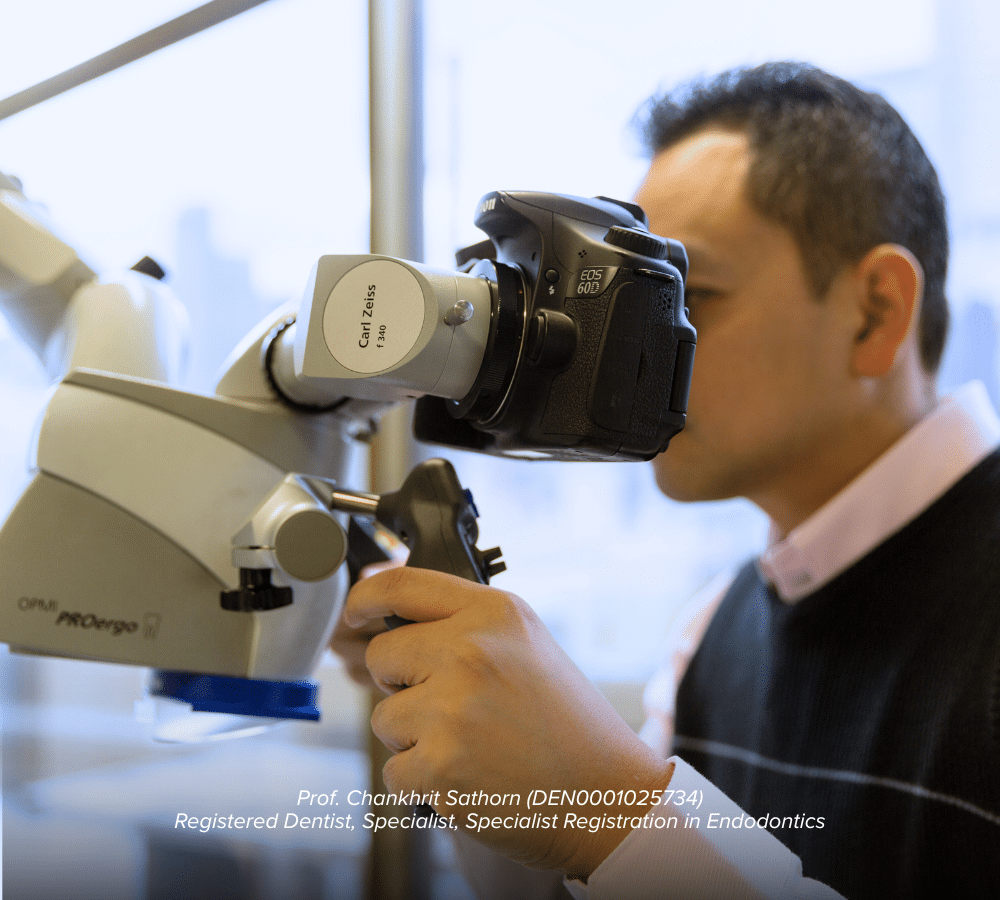
Specialist endodontists hold a general dentistry degree plus a further three to four years of advanced postgraduate education, focused solely on diagnosing and treating pain from toothache and damage to dental pulp and surrounding tissues.
A specialist's additional training makes the greatest difference in complex cases — unusual canal anatomy, re-treatment, and teeth where previous treatment has failed; where the difference actually shows up is worth understanding before you choose. We have specialist endodontists in-house, so escalation from general dentist to specialist is internal. Specialist Endodontists.
Cost
Cost varies with the severity of the problem and which tooth is affected. Molars are more difficult to treat and are usually more expensive, because they have more canals and more complex anatomy.
When you compare quotes, check whether the final crown or restoration is included — it is a separate item, it is often the larger of the two costs, and a root canal without it is unfinished treatment.
Many dental insurance policies provide some cover for endodontic treatment; annual limits and waiting periods apply and vary by fund. All treatment plans and associated costs are discussed before treatment begins. Price Guide and Payment Plans.
Common questions
The pain stopped on its own. Does that mean it has settled?
Usually not, and this is one of the most common reasons a tooth that could have been saved is lost instead. RACGP guidance on dental abscess sets the sequence out plainly: decay takes several months to reach the pulp, pulpitis causes pain that is poorly localised, and “when pulp necrosis finally occurs, there is no pain”. The nerve has died, so it has stopped signalling. The bacteria have not gone anywhere.
What usually follows is an acute periapical abscess, and then the pain returns — severe, and this time easy to point to. The same guidance notes that at that stage the abscess “is easily treated by extraction or root filling”, and that by then “all patients have had intermittent episodes of pain as a warning that something is wrong”. The quiet interval is the opportunity, not the cure.
So if a tooth ached for a while and has now gone silent, treat that as a reason to be examined sooner rather than later — not as a reason to cancel.
Can I just take antibiotics instead?
No. Antibiotics are an adjunct to treatment, not a replacement for removing the source.
The 2024 Cochrane review Systemic antibiotics for symptomatic apical periodontitis and acute apical abscess in adults (Cochrane Oral Health; three trials, 134 participants) reports that it found “no studies which compared the effects of systemic antibiotics with a matched placebo delivered without a surgical intervention” for these conditions. There is no randomised evidence at all that antibiotics alone, without treating the tooth, resolve them.
Where antibiotics were added on top of treatment, the review found little to gain: a single pre-operative dose given alongside full cleaning and root filling under local anaesthetic produced “little to no difference in participant-reported pain or swelling at any of the time points included in this review” (low-certainty evidence), and the evidence on a seven-day post-operative course was rated very low certainty.
The review also states the accepted indication: systemic antibiotics are recommended only where there is evidence of spreading infection (cellulitis, lymph node involvement, diffuse swelling) or systemic involvement (fever, malaise). Whether that applies to you is a clinical judgement made at the chair, and prescribing decisions belong there rather than on a web page.
I have been told the infection has to settle before anything can be done. Is that right?
Not as a general rule, and Australian peer-reviewed guidance on severe odontogenic infection contradicts it directly:
“A widely believed myth is that a course of antibiotics is necessary before extraction of an infected tooth to prevent seeding into the cervicofacial spaces. Waiting for the infection to settle before extracting the tooth can result in life-threatening consequences as the infection spreads along the tissue planes. Teeth can be extracted in the presence of an acute infection; indeed, extraction of the offending tooth is often curative.”
The same passage warns that assuming a course of antibiotics will definitively treat an established infection “often leads to prolonged morbidity and the potential for the infection to progress into a life-threatening condition”.
There can be sound clinical reasons for staging a particular case differently, so this is a question to put to your clinician rather than an instruction to overrule them. But if you are being asked to wait, it is entirely reasonable to ask what is being waited for, and what the plan is if the swelling does not settle.
How sore is it afterwards, and for how long?
Most people describe a few days of tenderness that is milder than the toothache that brought them in, and there is measured data behind that impression rather than only reassurance.
In the single-centre trial included in the Cochrane review above, all 72 participants received complete cleaning and root filling under local anaesthetic, plus pain relief, and rated their own pain from 0 to 10. Median pain was 3 at 24 hours, 1 to 2 at 48 hours, and 0 at both 72 hours and seven days. Swelling at seven days was reported in 4 of 36 participants in one arm and 2 of 36 in the other.
Those were adults with symptomatic apical periodontitis and no signs of spreading infection, at one university dental school, so the figures indicate rather than predict. A tooth that was already abscessed, or a molar with complex anatomy, can be sore for longer, and occasional teeth stay tender for some weeks while the tissue around the root settles.
During the appointment the tooth is anaesthetised and isolated with a dental dam, as described above. If you do not feel properly numb, say so at the time rather than pushing through — that is information your clinician needs, not a complaint.
How often does it need checking afterwards, and does that actually matter?
It matters more than the survival figures above might suggest, because of the conditions under which those figures were produced.
The long-term series quoted earlier — 598 teeth, with 97% still present at ten years — recruited only patients “in compliance with the recall programme within at least 1 time per year”, in a private practice setting, and describes a recall interval that “varied between 1 to 4 times per year, depending on their periodontal status and the degree of the patient's oral hygiene”. Those are survival figures for root-treated teeth that were kept under review by people who came back.
The same study named what most often preceded losing a root-treated tooth: deep periodontal pockets, infection visible at the root tip before treatment, and no occlusal protection. Two of those are things a routine examination finds, and the third is something a clinician can do something about.
The practical answer is to keep the tooth in the same recall as the rest of your mouth, at the interval your clinician sets for your gum health rather than a default six months, and to report new tenderness, a change in bite, or a gum boil near the tooth without waiting for the next scheduled visit.
Practical details
| Address | Level 1, 220 Collins Street, Manchester Unity Building, Melbourne VIC 3000 |
| Phone | 13 13 96 |
| theteam@smilesolutions.com.au | |
| Monday – Friday | 8.00am – 6.00pm |
| Saturday | 8.30am – 1.30pm |
| Sunday | By appointment |
| Visits needed | Usually one or two, plus restoration |
| Performed by | General dentists or specialist endodontists |
| Canal filling material | Gutta Percha |
| Parking | Wilsons Parking, Flinders Lane (between Swanston and Russell) |
Endodontics is one of the thirteen recognised dental specialties in Australia, and specialist registration can be verified free on the AHPRA public register at ahpra.gov.au. Everything you need to know about root canal treatment covers the same ground from the patient's side.
General information only — it is not a diagnosis, a treatment plan, a quote or a promise of any particular clinical outcome, and it does not replace advice from your treating practitioner. Root canal treatment is a procedure carrying the risks set out above, and whether a particular tooth can be saved, how many visits it will take and what it will cost can only be established after examination and radiographs. Success rates quoted for the procedure are population figures, not a guarantee for your tooth. Fees are indicative and subject to change; confirm at your consultation.
Smile Solutions trades under ABN 28 193 514 103.
Images on This Page
-
https://www.facebook.com/tr?id=800557773428361&ev=PageView&noscript=1
(no alt text)
-
https://www.smilesolutions.com.au/wp-content/uploads/2025/10/calendar_month.svg
(no alt text)
-
https://www.smilesolutions.com.au/wp-content/themes/arcadian-wordpress-theme/assets/images/smile_solutions_logo_white.png
Smile Solutions Logo
-
https://www.smilesolutions.com.au/wp-content/themes/arcadian-wordpress-theme/assets/images/smile_solutions_logo_purple.png
Smile Solutions Logo
-
https://www.smilesolutions.com.au/wp-content/uploads/2025/11/Smile-Solutions-4.png
Smile Solutions 4
-
https://www.smilesolutions.com.au/wp-content/uploads/2025/09/Root-Canal.png
Root Canal
-
https://www.smilesolutions.com.au/wp-content/uploads/2025/09/Root-Canal-Therapy-Endodontist-Smile-Solutions.png
Root Canal Therapy Endodontist Smile Solutions
-
https://www.smilesolutions.com.au/wp-content/uploads/2025/09/phase-1.png
Step 1: Examination and anesthesia
-
https://www.smilesolutions.com.au/wp-content/uploads/2025/09/phase-2.png
Step 2: Cleaning and shaping
-
https://www.smilesolutions.com.au/wp-content/uploads/2025/09/phase-3.png
Step 3: Sealing and temporary filling
-
https://www.smilesolutions.com.au/wp-content/uploads/2025/09/phase-4.png
Step 4: Final restoration
-
https://www.smilesolutions.com.au/wp-content/uploads/2025/08/69a44c30c93ce196d539cc5520080df52a5f3f88-scaled.jpg
69a44c30c93ce196d539cc5520080df52a5f3f88 scaled
-
https://www.smilesolutions.com.au/wp-content/themes/arcadian-wordpress-theme/assets/images/family_owned_bussiness.png
Family Owned Business
-
https://www.smilesolutions.com.au/wp-content/themes/arcadian-wordpress-theme/assets/icons/icon--phone.svg
Smile Solutions Contact
-
https://www.facebook.com/tr? id=800557773428361&ev=PageView&noscript=1
(no alt text)