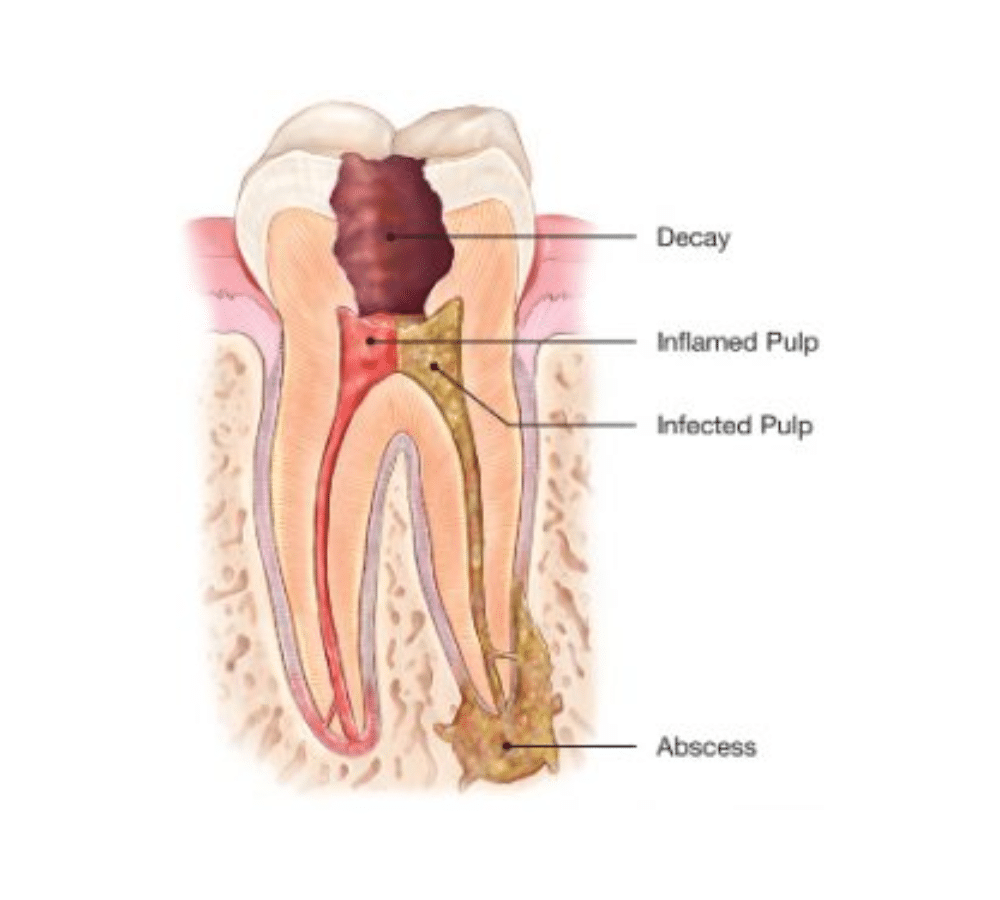
What root canal treatment is
Root canal treatment (RCT) treats a tooth with a dead, dying or inflamed pulp — more commonly known as the nerve. See Root Canal.
Endodontics is the art and science of root canal treatment, and one of the dental specialties recognised by the Dental Board of Australia, which maintains the register of specialist endodontists. All have a minimum of three years postgraduate training. See Endodontists and Dentists & Registered Specialists.
Why a pulp dies
Trauma — a blow to the mouth or tooth. See Emergency Dentistry.
Deep dental decay — see Tooth Fillings.
A crack or split in the tooth — see Chipped and Cracked Teeth.
Sometimes simply a reaction to a very deep filling, or the placement of a new crown on a compromised tooth.
A dead nerve can lead to the formation of an abscess — see What is a tooth abscess? and Why are dental abscesses so painful?.
How it presents
Endodontic problems can present acutely, with pain and swelling. See Tooth Pain & Ache.
But in many cases the patient is symptom free, and the problem is diagnosed on a routine X-ray.
That is worth noting. A dead nerve does not always hurt — which is one of the reasons routine radiographs are taken at check-ups. See General Dentistry.
What happens during treatment
Treatment is carried out over one or two visits.
- A small hole is created in the top of the tooth.
- The dead or dying pulp is removed with a series of fine files. Occasionally one breaks — see The risk of broken files during root canal treatment
- Once the canals are shaped to allow filling, they are soaked with a strong antibacterial solution, to render the bacteria ineffective.
- The canals are dried with small sterile paper cones.
- They are filled with a soft rubbery material.
- A permanent restoration is placed — sometimes a simple filling, but more commonly a crown or complex restoration.
That final step is part of the treatment, not an optional extra. A root-filled tooth has had structure removed and no longer has its blood supply, so it is more brittle. The restoration protects it from cracking. Where it can be made on site in a single visit, see Same-Day CEREC Restorations.
Root canal treatment is carried out under local anaesthetic at every stage, and most people report little or no discomfort. Post-operative discomfort is generally minimal, and controlled with pain relief for a day or two.
When carried out by an endodontist, the success rate is very high and the outcome quite predictable. See Why is the microscope so crucial in endodontic treatment?.
Who performs it
Root canal treatment is sometimes carried out by a general dentist, and many do it well.
Given the degree of specialisation involved, you may be advised to see a specialist endodontist — particularly for complex anatomy, retreatment, or teeth that have already given trouble. Endodontist vs dentist for root canal sets out which cases fall where.
Australian endodontists have sub-specialised after their general dentistry degree, taking a Master's or Doctorate in endodontics, during which they undertake original research and build practical skill in difficult and complex cases. They must be registered with the Dental Board of Australia and are strictly regulated.
The cosmetic work that follows is carried out by your general dentist or a specialist prosthodontist.
Is it painful?
Root canal treatment earned its reputation before modern anaesthetics, and has never lost it.
With advances in technique, physiology and pharmacology, the treatment is no longer traumatic. Many patients fall asleep during it, resting their jaw on a small rubber bite block so they do not have to hold their mouth open.
What most patients feel — even once numb — is pushing, pulling, pressure and vibration. Those sensations are completely normal.
Sharp pain is not normal. Tell your clinician immediately if you feel it. Anaesthetic doses and the techniques required for complete numbness vary between individuals, stages of disease, tooth types and tooth locations, and adjustments are made accordingly.
The part anaesthetic cannot fix
Modern anaesthetics control the physiological manifestations of pain. They cannot address the psychological ones.
A very anxious, tense patient can be difficult to anaesthetise effectively — which is a real physiological phenomenon, not a failure of nerve.
Tell your clinician at the initial consultation if this applies to you, so extra measures can be arranged before treatment begins. See Dental Anxiety.
How comfort is managed
Your endodontist usually starts with the psychological aspect — telling you what they will do, how you can expect to feel, and assuring you that you can stop at any time for any reason. See How important is communication in dentistry?.
Generally 80 to 90 per cent of patients need only that reassurance.
If it is not enough, options include anti-anxiety medication taken before the appointment, and happy gas (nitrous oxide) alongside the conventional anaesthetic. For deeper sedation, see Sleep Dentistry.
Do not hesitate to raise concerns. The management approach depends on your level of anxiety and several other factors, discussed at consultation.
What it costs
- Consultation with an endodontist: around $150. A referral is preferred but not required.
- The root canal procedure: approximately $1,700 to $2,700.
- Filling the tooth afterwards: $200 to $450.
These are indicative figures from the date of writing, not a quote. Current fees are on the Price Guide, and Payment Plans covers spreading them. Budget for the crown separately where one is needed.
Payment plan options are available. Where a plan is advertised as interest free, that describes the plan term only — a deposit may be required, an establishment fee and ongoing account fees may apply, and charges can apply if the balance is not cleared within the agreed period. The applicable terms depend on the provider and the amount financed, and are set out in writing before you commit — ask what the deposit and the establishment fee are, in dollars, and what the total will be by the end. Payment Plans.
Root canal or extraction and implant? Five myths
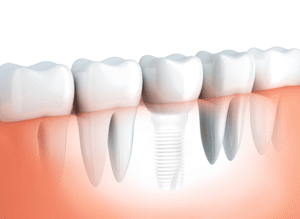
Comparing root canal therapy with extraction and an implant is like comparing a real limb with an artificial one. See Dental Implants for what the alternative involves.
Myth 1: “I would rather get an implant now, as I will eventually need one anyway.”
Both can have the same success rate — ideally 15 to 20 years, if not more.
The asymmetry is what matters: if a root-canal treated tooth fails, you can still have an implant. If an implant fails, each subsequent implant placed has a lower success rate.
Keeping your natural tooth longer buys time before an implant is needed — and the sequence only runs one way.
Myth 2: “The success rate for implants is the same as for root-canal treated teeth.”
Maybe — but read the definitions carefully.
In root canal research there is a clear distinction between success (no disease) and failure (evidence of disease).
With implants, “success” — retention with no disease — is often conflated with “retention” — the implant is still in the mouth despite disease being present, which is not the same thing.
That distinction is frequently blurred, which makes comparative figures found online misleading.
Implant success also depends heavily on host factors — site, bone quality, immune function, gum condition, smoking history and medications. See What is periodontal disease? and Bleeding Gums. Root canal treatment is considerably more forgiving, with fewer factors working against it.
Age matters too. The human body can continue growing until around 25 or beyond, and an implant placed in someone still growing can look wrong later if adjacent teeth continue to erupt or the jaw develops further.
And it can be more challenging to make an implant look as natural as a real tooth.
Myth 3: “Implant technology is new, so it must be better.”
New is not always better.
Root canal treatment has been practised since the eighteenth century and is one of the most exhaustively researched treatments in dentistry. Implant technology dates from the late twentieth century, and clinicians are still refining it as longer-term data emerges.
Myth 4: “An implant costs about the same as root canal treatment.”
No. Root canal treatment often costs about half of extraction plus an implant. The itemised implant figures are on Dental implant costs in Melbourne.
It can come closer to par for a back tooth, which typically needs a crown for structural protection.
Myth 5: “I spent a lot on a root canal and it failed anyway.”
One tooth failing does not mean they all will.
Root canal treatment is delicate, and the outcome depends in part on the knowledge and skill of the operator. Different teeth in the same mouth have different outcomes, depending on location, size of the existing filling, and extent of infection.
The summary observation
Most dentists would fight to save their own teeth through root canal treatment rather than take an implant, where that is possible.
After treatment
A crown or similar restoration is usually advisable, to protect the compromised tooth and help prevent cracking or splitting.
You can reasonably expect many years of function — but a tooth needing root canal treatment has usually already suffered decay, wear or trauma, all of which compromise its structure. So there are cases where the result is not definitively favourable.
Those include:
- Problems arising immediately after treatment, and those appearing years later
- Residual infection, where all nerve tissue could not be removed because of complex root canal anatomy — curved roots, accessory canals, additional canals
- A crack or split in the root, which often requires removal of the tooth
- Post-treatment sensitivity or pain, from the treatment itself, or from bite effects if the tooth super-erupts through inflammation. Sometimes excess filling material escapes into surrounding tissue.
Later problems can include infection, or a split in the root or tooth, requiring extraction. If the tooth does need extraction in future, an implant-supported tooth may be an option then — see Bridges, implants or dentures.
Day to day, the treated tooth needs the same care as every other: Dental Cleans & Hygienists, and prompt review if anything changes.
Four things worth knowing
You do not need a referral to see any of the dental specialists mentioned here. See Contact Us.
There is no shame in getting a second opinion. Most general dentists will offer a referral, particularly if you ask — and all copies of your X-rays, records and study models can be transferred to another clinician. See Second Opinions & Corrective Dentistry.
Some general dentists perform both the surgical and prosthodontic parts of an implant. Most specialists in either field team up with another specialist or the referring general dentist to complete the two stages. See Who should I see for dental and teeth implants?.
If in doubt about a clinician's formal qualifications, check the AHPRA register of practitioners. Never assume specialist status from reputation, position within a practice, or marketing. A “special interest”, as it is often described on dental websites, does not equate to specialist registration with the Dental Board of Australia. The Smile Solutions clinicians and their registrations are listed on Our Team.
Common questions
"Very high success rate" is not a number. What is the number?
There are several, they measure different things, and they do not fully agree — which is the part worth understanding rather than smoothing over.
Success (the disease has resolved) and survival (the tooth is still in the mouth) are different measurements. A 5- to 37-year retrospective study of 598 root-treated teeth in 312 patients, all treated by one experienced endodontist in a private practice in Verona, reported overall success of 87.8 per cent at tooth level (95% CI 84 to 90%) and 80.8 per cent at patient level (95% CI 75 to 86%) — the patient figure is lower because a patient with several treated teeth counts as a success only if all of them are. Cumulatively, success in that cohort ran 93 per cent at 10 years, 85 per cent at 20, and 81 per cent at both 30 and 37, while survival ran 97 per cent at 10 years, 81 per cent at 20, 76 per cent at 30 and 68 per cent at 37.
Other studies are less optimistic, and the authors say so themselves. That same paper notes its results "are higher than what has been presented in systematic reviews with reported success rates of 82.8% at 5 years", and far higher than one study that "observed 29% success rates after 25 years". A separate narrative review in the International Endodontic Journal (Fransson, 2023) summarises the survival literature as 82 to 95 per cent of teeth over 2 to 10 years, with two Swedish studies reporting 65 per cent and 71 per cent over 20 years, and offers a rough rule of thumb: "there is to be an annual loss of 2% of teeth which have received a root canal treatment."
The spread between those figures is mostly explained by who was treated, by whom, in what setting, and against which definition. None of them is a prediction about your tooth. They are a reasonable answer to "is this generally worth doing", and the answer is yes.
My tooth stopped hurting. Does that mean it worked?
Not on its own, and this is the single most useful thing on this page.
The International Endodontic Journal review records that "about 40 per cent of root filled teeth have AP" — apical periodontitis, inflammation at the root tip — "when investigated in cross-sectional studies". It also records that symptoms are uncommon: "perhaps, one out of 10 individuals with root filled teeth have symptoms", and "the pain intensity is mostly low".
Put those two together and comfort turns out to be weak evidence of healing. The review is direct about how this lands in the chair: "it may come as a surprise to the patient to be informed that their asymptomatic root filled tooth has radiological signs of disease."
Which is why the follow-up radiograph is the point of the review appointment rather than a formality. Ask when yours is due, and what it is looking for.
How soon does the crown actually need to go on?
Sooner than most people assume, and the delay has been measured.
A review in the British Dental Journal summarises a systematic review that "concluded that coronal seal was as important as the quality of the endodontic treatment in terms of treatment success", and notes "evidence of an increased failure rate of endodontic treatment with temporary restorations".
On timing it cites Pratt et al. (2016): posterior root-filled teeth that received a crown four months after endodontic treatment were extracted at three times the rate of those that received a crown within four months.
So if you are walking around on a temporary filling with a crown recommended, that gap is not neutral time. It is the part of the treatment still outstanding.
What makes my case harder or easier than average?
Most of it is visible before treatment starts, which means you can ask.
- Whether there is already a lesion at the root tip. The British Dental Journal review gives the absence of a periapical lesion as a positive prognostic factor, and cites Ng et al. (2011): "the odds of success of treatment were found to decrease by 14% for every 1 mm increase in diameter of the preoperative lesion". In the Verona cohort, teeth with a pre-operative periapical radiolucency were close to twice as likely to be extracted eventually (odds ratio 1.87; 95% CI 1.07–3.28).
- Whether there is a sinus tract — a small drainage point on the gum. The review links its presence to both reduced periapical healing and poorer survival.
- The state of the gums around the tooth. In the Verona analysis, probing depths of 5 mm or less were protective (odds ratio 0.68), and at 30 years roughly 30 per cent of teeth with depths greater than 5 mm were still in function against about 80 per cent of those at 5 mm or less. See What is periodontal disease?.
- What is placed inside the root afterwards. A cast metal post was associated with roughly double the odds of extraction (2.14), a fibre post with lower odds (0.47).
- Whether you grind. Night guard use came out as a protective factor in the same model (odds ratio 0.34). See TMD & Teeth Grinding.
These are associations in one cohort, not levers you can pull individually. They are, however, a good list of things to raise at the consultation.
Does my age, or my diabetes, change the odds?
Age, on the published evidence, does not. The British Dental Journal review states that "patient-related factors, such as age and sex, have not been shown to have a significant effect on treatment outcome". The International Endodontic Journal review reports a systematic review concluding that "increased patient age did not decrease the success of root canal treatment" — and although studies of tooth survival do show worse outcomes in older patients, the review attributes that to the teeth rather than the years: older teeth "have probably less remaining tooth structure which affects the restorability", and older patients are more likely to have periodontitis alongside.
Diabetes is a genuine but unsettled question. The British Dental Journal review reports systematic reviews "indicating a negative effect of diabetes on periapical healing outcome", then immediately qualifies it: "the limited number of studies included in the reviews means the results must be interpreted with caution". Tell your clinician; it is a reason to plan carefully rather than to give up on the tooth. See Diabetes and oral health.
If it does fail, what happens then?
There is usually more than one step left before extraction, and it is worth knowing they exist.
Retreatment — reopening the tooth, removing the existing root filling and redoing it — is the first option in many cases. The International Endodontic Journal review makes a pointed observation about how unevenly it is offered: "root canal retreatments in many countries are frequent in a specialist clinic setting, but rare in general practice". If nobody has raised it, it is reasonable to ask.
Endodontic surgery is the next step. The same review summarises the literature as survival of 48 to 88 per cent of teeth over 3 to 10 years — a wider and generally lower band than primary treatment, drawn from fewer studies, and with no long follow-up data available at all.
And it is worth knowing why root-treated teeth are actually lost. In the Verona cohort, 87 of 598 teeth (14.5 per cent) were eventually extracted, at a mean of 14.1 years. Across the whole sample the causes were periodontal disease progression 5.9 per cent, vertical root fracture 4.8 per cent, fracture of the crown 2.2 per cent and decay 1.7 per cent — and the authors record that "no tooth was extracted due to endodontic inflammation".
Which puts the aftercare in proportion. What threatens a root-treated tooth over the following decades is gum disease and fracture — not the root filling.
Practical details
Written by Dr Philippa Robinson, and co-authored by Dr Artika Soma, Dr Chankhrit Sathorn and Dr Ian Aitkin.
Smile Solutions, Level 1, 220 Collins Street, Manchester Unity Building, Melbourne VIC 3000. Phone 13 13 96, or theteam@smilesolutions.com.au. Monday–Friday 8.00am–6.00pm, Saturday 8.30am–1.30pm, Sunday by appointment.
Specialist registration can be verified on the AHPRA register at ahpra.gov.au, or by calling 1300 419 495.
Published 12 December 2018. Costs are indicative figures as at that date, not a quote. Success rates are drawn from research and are not guarantees; outcomes vary between individuals and teeth. All treatment carries risks that should be discussed with your clinician. General information only; it does not replace advice from your treating practitioner. Payment plan terms are set by the credit provider and change; confirm current terms directly before you commit.
Smile Solutions trades under ABN 28 193 514 103.
Images on This Page
-
https://www.facebook.com/tr?id=800557773428361&ev=PageView&noscript=1
(no alt text)
-
https://www.smilesolutions.com.au/wp-content/uploads/2025/10/calendar_month.svg
(no alt text)
-
https://www.smilesolutions.com.au/wp-content/themes/arcadian-wordpress-theme/assets/images/smile_solutions_logo_white.png
Smile Solutions Logo
-
https://www.smilesolutions.com.au/wp-content/themes/arcadian-wordpress-theme/assets/images/smile_solutions_logo_purple.png
Smile Solutions Logo
-
https://www.smilesolutions.com.au/wp-content/uploads/2016/05/Pip-150x150.jpg
Dr Philippa Robinson
-
https://www.smilesolutions.com.au/wp-content/uploads/2025/09/Root-Canal-Treatment-Smile-Solutions.png
Tooth anatomy with decay and infection
-
https://www.smilesolutions.com.au/wp-content/uploads/2025/09/Conventional-Dental-Implants-300x219.png
Conventional Dental Implants
-
https://www.smilesolutions.com.au/wp-content/uploads/2025/09/Smile-Solutions-Orthodontics-300x270.jpg
Ortho at Smile Solutions
-
https://www.smilesolutions.com.au/wp-content/uploads/2025/09/Dental-Emergencies-200x300.jpg
Children's Dental Emergencies at Smile Solutions
-
https://www.smilesolutions.com.au/wp-content/themes/arcadian-wordpress-theme/assets/images/family_owned_bussiness.png
Family Owned Business
-
https://www.smilesolutions.com.au/wp-content/themes/arcadian-wordpress-theme/assets/icons/icon--phone.svg
Smile Solutions Contact
-
https://www.facebook.com/tr? id=800557773428361&ev=PageView&noscript=1
(no alt text)
-
https://bat.bing.com/action/0?ti=25148060&tm=gtm002&Ver=2&mid=f3a6af0d-bc38-4825-8a24-5eede8c9b25a&bo=1&sid=17ad1f70ab2711f1b643cdddaadb26b5&vid=17ad4200ab2711f1a4c20f3e63e24abd&vids=1&msclkid=N&pi=918639831&lg=en-US&sw=800&sh=600&sc=24&nwd=1&tl=Root%20canal%20treatment%3A%20who%20and%20what%20is%20involved%3F%20-%20Smile%20Solutions&p=https%3A%2F%2Fwww.smilesolutions.com.au%2Fdental-articles%2Farticle%2Froot-canal-treatment-involve%2F&r=&evt=pageLoad&sv=2&cdb=AQAQ&rn=466750
(no alt text)