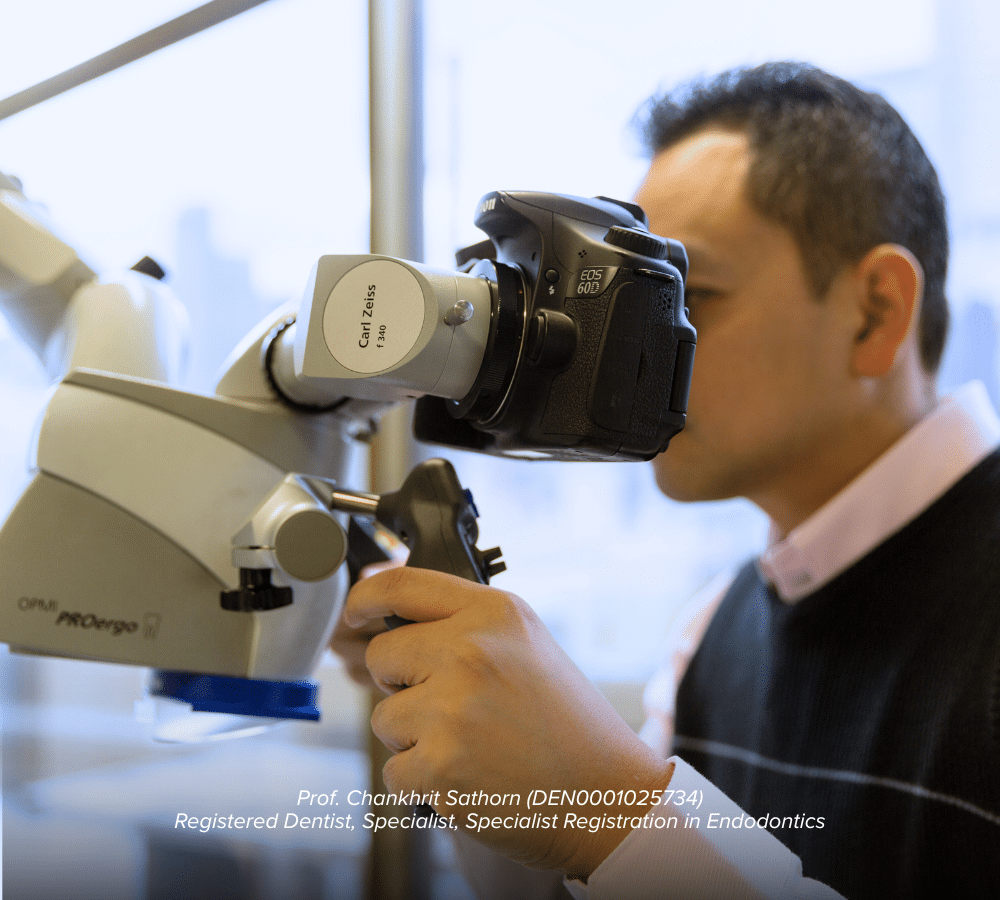
Prof. Chankhrit Sathorn, Specialist Endodontist
Role: Specialist Endodontist, Smile Solutions
Qualifications: DDS, Grad.Dip.Dent, DClinDent, PhD, MRACDS (Endo)
Registration: DEN0001025734 — Registered Dentist, Specialist, with Specialist Registration in Endodontics
This is a specialist registration. Under the Health Practitioner Regulation National Law, only a dentist holding specialist registration in a recognised specialty may use its title, and endodontics is one of the thirteen recognised dental specialties in Australia. Registration and specialty can be verified free on the AHPRA public register at ahpra.gov.au. The specialty page is Specialist Endodontists; the other specialists here are on Dentists and Registered Specialists and under Specialist Care.
A note on the slug: this page's web address spells the name ‘chankhrit' while the practice's own listing title spells it ‘Chankrit'. Both refer to the same practitioner and the same registration number.
Background
Prof. Sathorn is an Adjunct Professor of Endodontics at La Trobe University.
Previously he was Adjunct Associate Professor of Endodontic Research at La Trobe University, and Convenor of the Predoctoral Endodontics and Graduate Certificate in Clinical Dentistry programmes at the University of Melbourne.
His basic dental training was completed in Thailand. He completed endodontic specialist training and a PhD at the University of Melbourne, and became a member of the Royal Australasian College of Dental Surgeons in the Special Stream of Endodontics.
On the titles, precisely: ‘Professor' here is an academic appointment conferred by a university, not a clinical registration category. The registration that governs clinical practice is the specialist registration in endodontics recorded above, and it is the one to check on the register. A PhD is a research doctorate — distinct again from both the DClinDent and from specialist registration.
He has written two of the practice's endodontic articles:
- Root canal treatment: who and what is involved?
- The risk of broken files during root canal treatment
What an endodontist is
All dentists are trained in root canal treatment; a specialist has completed a three-year full-time postgraduate qualification restricted to the field, and then holds specialist registration granted by the Dental Board of Australia. See Endodontist vs Dentist for Root Canal: Why It Makes a Difference and Why would I need to see a dental specialist?
It matters most for complex canal anatomy, retreatment of previous work, difficult diagnosis, and trauma in immature teeth. Specialist practice routinely uses operating microscopes and CBCT imaging — see Why is the microscope so crucial in endodontic treatment by a specialist? and, on the imaging dose, How safe are dental X-rays and when do they become unsafe?
For the procedure itself in plain terms: Everything you need to know about root canal treatment.
The decision that endodontics is really about: save it or lose it
This is where a specialist opinion earns its cost, and it is worth setting out honestly.
A natural tooth has a periodontal ligament. It senses load, it moves fractionally under bite force, and it maintains the bone around it. No implant reproduces that, and no bridge does either. So the default — where a tooth is restorable — is to keep it. The comparison is set out in What are the replacement options for missing teeth? and Implant versus bridge for a single tooth replacement
But ‘restorable' is the whole question, and it turns on things a patient cannot assess:
- How much sound tooth structure remains, particularly whether there is enough above the gum to hold a restoration — the ferrule, which is one of the strongest predictors of whether a restored root-filled tooth survives. See Dental Crowns and What types of dental crowns are available?
- Whether there is a vertical root fracture. There usually is no fixing this; it generally means extraction. CBCT and a microscope are often what settle the question. See Chipped or Cracked Teeth, Why does a cracked tooth hurt so much? and How will my cracked tooth be treated?
- The periodontal support — a perfectly root-filled tooth in inadequate bone is still a lost tooth. See Specialist Periodontists and Periodontal (gum) disease
- Whether the canal system can actually be cleaned, given calcification, curvature or a separated instrument
- What the tooth is for in the overall plan
A second opinion before extracting a tooth is reasonable and often decisive. Teeth are removed every day that could have been kept, and teeth are also root-filled at expense that were never going to survive. Both errors are avoidable with an accurate assessment. See Second Opinions and Corrective Dentistry.
Retreatment: what it is and why it is worth knowing about
A root canal treatment that fails is not necessarily the end of the tooth.
Failure usually has an identifiable cause — a missed canal, an incomplete seal, a coronal leak where the filling or crown above let bacteria back in, or a persistent infection at the root tip. Where the cause can be found and corrected, retreatment has a genuine success rate, though generally lower than first-time treatment.
The options in order of invasiveness:
- Non-surgical retreatment — the existing root filling is removed, the canal system re-cleaned and re-sealed. The first choice where feasible.
- Surgical endodontics (apicectomy) — the root tip and the infected tissue around it are removed and the end of the canal sealed. Modern microsurgical technique, with a microscope and ultrasonic preparation, has substantially better outcomes than the older approach.
- Extraction and replacement.
A common misconception worth correcting: a tooth that still has a radiolucency at the root tip is not automatically failing. Healing of bone takes months to years, and the comparison that matters is between radiographs over time, not a single image.
What the evidence actually supports
Endodontics has a substantial research literature, and a few findings are worth stating because they contradict what patients are often told:
- Rubber dam isolation is not optional. It is a basic standard of care for root canal treatment, and its absence is a reasonable thing to ask about.
- Single-visit and multi-visit treatment both work. The old assumption that a tooth must be left open or dressed for weeks is not supported; the choice depends on the case.
- Antibiotics do not treat a dental abscess. They can control spreading infection, but the source has to be removed — by drainage, root canal treatment or extraction. A course of antibiotics alone reliably produces a recurrence. See I have a toothache. Should I see my GP for antibiotics?, What is a tooth abscess? Should I have it treated? If so, how? and Why are dental abscesses so painful?
- ‘Focal infection' claims are not supported. The idea that root-filled teeth cause systemic disease, and should be extracted to treat it, has been examined repeatedly and is not evidence-based. Extracting sound root-filled teeth on that basis causes harm.
- The final restoration matters as much as the root filling. A well-treated tooth left under a temporary filling will fail — see What do I do if a temporary filling comes out?
When to seek help urgently
- Severe pain that wakes you at night or is worse lying down — the classic pattern of irreversible pulpitis. It does not resolve on its own. See Tooth Pain and Ache and I have a toothache, what could be the cause?
- A tooth painful to bite on, with a bad taste or a pimple on the gum — an abscess. See Can a dental abscess affect your general health?
- Facial swelling that is spreading, difficulty swallowing or breathing, a stiff neck, or feeling generally very unwell — this is a hospital emergency, not a dental appointment. Dental infections can spread into the tissue spaces of the face and neck, and people still die of them. Call 000 if breathing or swallowing is affected. See What is considered a dental emergency?
- A knocked-out permanent tooth — handle it by the crown, replant it immediately if you can, otherwise store it in milk — saliva or saline if there is no milk, and plain water only as a last resort, because the one real absolute is never to let the tooth dry out — and get to a dentist as quickly as you can. See What should I do when a tooth is knocked out? and the first question below, which sets out what the time limit actually is.
Common questions
The tooth was knocked out over an hour ago. Is it too late to bother?
No — and the reason is that the clock everyone remembers is measuring the wrong thing.
The variable that matters is extra-oral dry time, not total elapsed time. The International Association of Dental Traumatology's guidance is explicit that “minimizing the dry time is critical for survival of the PDL cells”, and that “after an extra-alveolar dry time of 30 minutes, most PDL cells are non-viable”. A tooth that has sat in milk for two hours and a tooth that has sat on a kitchen bench for thirty minutes are in completely different situations, even though the second one sounds faster.
So the order of operations is about wetness, not speed. The IADT states that “immediate replantation of the avulsed tooth is the best treatment at the place of the accident” — back into the socket, held gently in place. Where that is not possible, it lists storage media “in descending order of preference, milk, HBSS, saliva (after spitting into a glass for instance), or saline”, adding that “although water is a poor medium, it is better than leaving the tooth to air-dry”. Handle it by the crown, not the root.
And the sentence that answers the question in the heading directly: the IADT records that “the decision to replant a permanent tooth is almost always the correct decision even if the extra-oral dry time is more than 60 minutes”, because “replantation will keep future treatment options open”. Where the dry time has been long, the periodontal ligament is not expected to regenerate and replacement root resorption is the expected outcome — but the stated goal is still to restore aesthetics and function at least temporarily while maintaining alveolar bone contour, width and height. The tooth can always be removed later; bone that has been allowed to resorb is much harder to get back.
Two absolutes. Never let the tooth dry out. And never replant a baby tooth — doing so risks damaging the permanent tooth forming above it; keep it in milk and bring it so the socket can be checked. See What should I do when a tooth is knocked out? and Emergency Dentistry.
My dentist says the tooth cannot be saved. Is a second opinion worth the trouble?
Before an extraction, usually yes — because an extraction is the one decision on this page that cannot be revisited.
The page above puts it bluntly and it is worth repeating here: teeth are removed every day that could have been kept, and teeth are also root-filled at real expense that were never going to survive. Both of those are assessment errors, and they run in opposite directions — which is exactly why an independent look is useful rather than adversarial.
What a second opinion is actually examining is a short list of specific things: how much sound tooth structure remains above the gum line to hold a restoration; whether there is a vertical root fracture, which generally does mean extraction; whether the periodontal support is adequate, because a perfect root filling in inadequate bone is still a lost tooth; and whether the canal system can realistically be cleaned given its curvature, calcification or a separated instrument. Several of those are questions a microscope and, selectively, a CBCT scan can settle and an unaided examination cannot.
Make it efficient rather than a fresh start. Take your records — the radiographs are yours and they transfer on request, which means the second practitioner assesses the same evidence rather than repeating the exposure. Ask the first dentist, without embarrassment, what specifically makes this tooth unrestorable; a clear answer is informative either way.
And there is no urgency to decline. Unless there is spreading infection, an extraction can wait a week. If there is spreading infection — swelling, difficulty swallowing or breathing — that is a different and immediate problem, and the answer is a hospital emergency department. See Second Opinions and Corrective Dentistry.
The root canal has failed. Is retreatment worth it, or should I cut my losses?
It depends on whether the cause of failure can be identified — and that is the question to ask, rather than asking for a percentage.
Here is the honest position on the numbers. First-time root canal treatment does well: a long-term study of 598 teeth in 312 patients followed for a mean of 21 years found overall success of 87.8% at tooth level (95% CI 84% to 90%), with cumulative success of 93% at 10 years and 81% at 30. For retreatment specifically, the independent reference material behind this page does not give a figure, and we are not going to invent one. What can be said is that retreatment is generally reported as less successful than first-time treatment, which is why the reasoning behind it matters more than the average.
The reasoning turns on cause. Failure usually has an identifiable one — a canal that was missed, an incomplete seal, coronal leakage where the crown or filling above let bacteria back in, or persistent infection at the root tip. Where the cause is found and can be corrected, retreatment is addressing something specific. Where nobody can say why it failed, you are paying for a repeat of the same procedure and hoping for a different result, which is a much weaker proposition.
The other half of the arithmetic is what the alternative costs. That same long-term study found the largest single cause of extraction among root-filled teeth was vertical root fracture, at 33.3% — so if a fracture is what has happened, retreatment is not on the table at all and the sooner that is established the better. If it has not, then the comparison is retreatment against extraction plus replacement, and replacement is rarely a one-off cost.
Ask three things: what is the suspected cause, what would change if the suspicion is wrong, and what is the plan if retreatment does not settle it. A clinician who can answer all three is giving you a decision rather than a quote.
A year later the x-ray still shows a dark patch at the root tip. Does that mean it did not work?
Not by itself — and a single image is close to useless for answering this question.
What that dark area represents is bone that was lost to infection before treatment. Bone does not refill on the timescale people expect: healing is measured in months to years, and a lesion that is smaller than it was is healing, however dark it still looks. The comparison that matters is between radiographs taken at different times, not between one radiograph and your expectations. That is precisely why follow-up is arranged, and why it is worth attending even when the tooth feels completely normal.
What should prompt more than watching: a lesion that is the same size or larger than at the previous review; new symptoms — tenderness to biting, a bad taste, a pimple on the gum, swelling; or a tooth that has become mobile. Those move the question from is it healing to why is it not.
What to ask at the review: to see the two images side by side, with the previous one for comparison; whether the lesion is smaller, the same or larger; and what the interval to the next review is. Healing that is progressing needs time rather than intervention — and being told that, with the images to show it, is a much better answer than being retreated on the strength of a single radiograph.
Related pages: Specialist Endodontists, Root Canal Therapy, Emergency Dentistry, Chipped or Cracked Teeth, Our Team.
Practical details
Prof. Sathorn's registration and specialty can be verified free on the AHPRA public register at ahpra.gov.au. For consultation or referral, call 13 13 96, or see Contact Us.
Smile Solutions, Level 1, 220 Collins Street, Manchester Unity Building, Melbourne VIC 3000. Phone 13 13 96, or theteam@smilesolutions.com.au. Monday–Friday 8.00am–6.00pm, Saturday 8.30am–1.30pm, Sunday by appointment. Location and directions.
This page records qualifications and career history as published by the practice. General information only; it does not replace advice from your treating practitioner. Outcomes vary between individuals, and all treatment carries risks. Guidance quoted from the International Association of Dental Traumatology and figures from the published endodontic literature are those publishers' and should be checked against the current version of each source.
Smile Solutions trades under ABN 28 193 514 103.
Images on This Page
-
https://www.facebook.com/tr?id=800557773428361&ev=PageView&noscript=1
(no alt text)
-
https://www.smilesolutions.com.au/wp-content/uploads/2025/10/calendar_month.svg
(no alt text)
-
https://www.smilesolutions.com.au/wp-content/themes/arcadian-wordpress-theme/assets/images/smile_solutions_logo_white.png
Smile Solutions Logo
-
https://www.smilesolutions.com.au/wp-content/themes/arcadian-wordpress-theme/assets/images/smile_solutions_logo_purple.png
Smile Solutions Logo
-
https://www.smilesolutions.com.au/wp-content/uploads/2016/05/Chankhrit.jpg
Prof. Chankhrit Sathorn
-
https://www.smilesolutions.com.au/wp-content/uploads/2025/09/Root-Canal-Therapy-Endodontist-Smile-Solutions.png
Specialist Endodontist using a dental microscope
-
https://www.smilesolutions.com.au/wp-content/uploads/2025/09/ChS-300x270.jpg
Endo
-
https://www.smilesolutions.com.au/wp-content/uploads/2016/05/Chankhrit-150x150.jpg
Prof. Chankhrit Sathorn
-
https://www.smilesolutions.com.au/wp-content/themes/arcadian-wordpress-theme/assets/images/family_owned_bussiness.png
Family Owned Business
-
https://www.smilesolutions.com.au/wp-content/themes/arcadian-wordpress-theme/assets/icons/icon--phone.svg
Smile Solutions Contact
-
https://www.facebook.com/tr? id=800557773428361&ev=PageView&noscript=1
(no alt text)