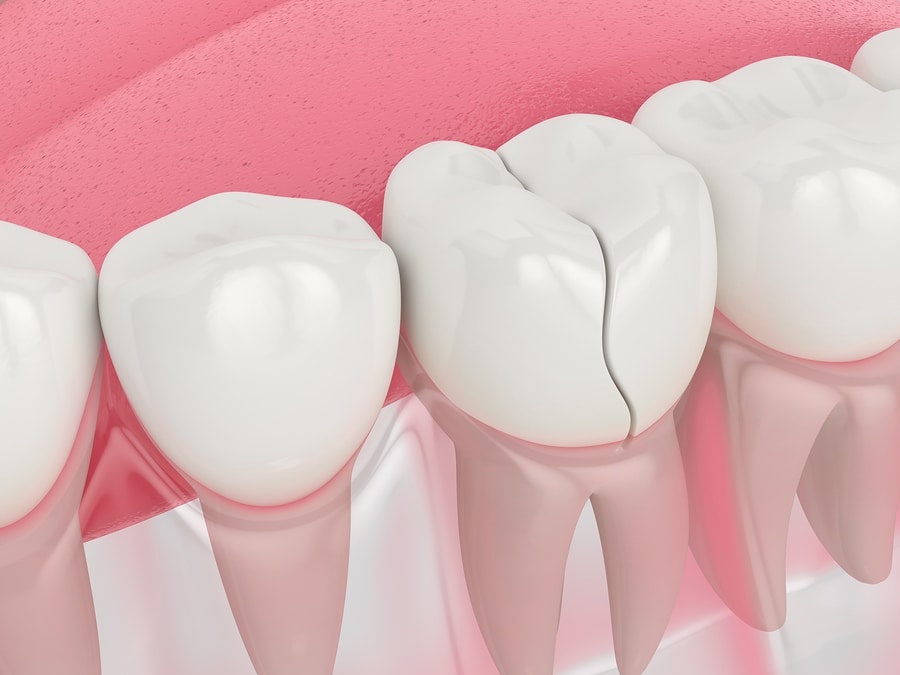
How will my cracked tooth be treated?
It depends on how big the crack is and where it runs. A small crack may be treated with simple bonding. A larger one usually needs a porcelain restoration that holds the whole tooth together. A crack extending below the gumline or into the root may mean the tooth cannot be saved.
That range is why cracked teeth should be assessed early rather than watched. Cracks propagate, and the difference between the cheapest option and the most expensive is often just how long the tooth was left flexing.
Cracked teeth are a problem dentists deal with daily, and most are treatable with a good outcome. Why does a cracked tooth hurt so much? explains the mechanism behind the pain; this page is about what is done next.
Why did my tooth crack?
Common causes:
- Failure of an old filling
- Excessive grinding or clenching, usually at night
- Chewing very hard foods
- Decay in the tooth
- Impact
- Habits such as chewing or biting pens and pencils
Often it is not one reason but a combination. A tooth with a large old filling, weakened by decay underneath, in someone who grinds, will crack on a piece of bread — and the bread gets the blame.
That combination point matters for treatment: repairing the crack without addressing the grinding produces a repair that cracks again. See How can I stop grinding my teeth when I sleep?.
What a cracked tooth feels like
Symptoms vary with the size and position of the crack. Commonly:
- Sensitivity to hot and cold drinks or food
- Pain on biting into food
- A reaction to sticky, sweet or sour foods
Where a portion of the tooth has completely fractured, all of the above may be present, plus a very sharp edge on the remaining tooth that can cut and irritate the gum, cheek or tongue. If a piece has actually come away, see What should I do if I have a chipped tooth? — keeping the fragment is worth doing.
One useful diagnostic detail: pain that appears on releasing a bite rather than on clenching down is close to characteristic of a cracked cusp. Mention it if that is your pattern — it helps locate the tooth, which is otherwise often difficult, because cracks are frequently invisible on a radiograph. For pain with no obvious cause, Tooth Pain and Ache covers how the possibilities are narrowed down.
What counts as a “cracked tooth”
The term gets used loosely, and the distinction changes the treatment. The definition approved by the European Society of Endodontology is a tooth with one or more incomplete, longitudinal fractures originating in the coronal tooth structure and extending apically; the crack typically orients mesiodistally, involves the marginal ridges, and includes the proximal surfaces of the tooth.
Two things sit outside that. A craze line — a fine vertical line in the enamel only — is extremely common, usually symptomless, and generally needs nothing. A tooth that has already separated into two pieces is past the cracked-tooth stage and is a different problem. What the definition describes is the in-between case: a crack that has started, has not finished, and is flexing every time you bite.
Treatment options
What is appropriate depends on the size and severity of the crack.
| Situation | Treatment |
|---|---|
| Small crack, or a small failed filling | Simple bonding — a resin material bonded into the fissure left by the crack or the damaged filling, matched to your natural tooth colour |
| Larger crack | More extensive treatment; the aim is to hold the tooth together and stop the flexing |
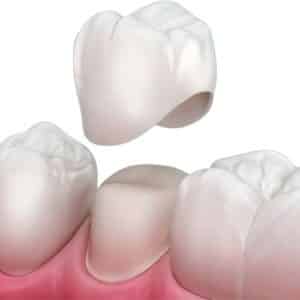
| Not enough tooth left for a bonded resin filling | A porcelain filling, onlay or cap — considerably stronger than resin, more lifelike, and with a longer lifespan |
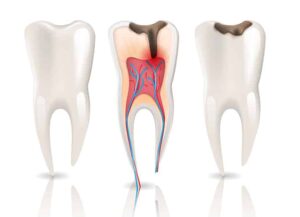
| Crack reaching the pulp | Root canal treatment, followed by a restoration that covers the cusps |
| Crack extending below the gumline or into the root | The tooth may be unrestorable, and extraction may be the only option |
The reason larger cracks need coverage rather than a filling is mechanical. A filling sits inside the tooth and does not stop the cusps flexing apart; an onlay or crown sits over them and holds them together. Placing a large filling in a cracked tooth can even make the flexing worse.
Where root canal treatment is needed and the case is difficult — curved canals, a tooth treated before, or a crack complicating access — a specialist endodontist has the magnification and instruments for it. Where the tooth cannot be saved, the conversation moves to replacement: see Dental Implants, Conventional and Immediate Implants, and Prosthodontists for the specialty that rebuilds heavily damaged teeth.
What the published evidence says about survival
Cracked teeth have been studied enough to give real numbers, and the numbers support the mechanical argument above considerably more strongly than the argument does on its own. The figures below are collated in a 2023 review, Tooth survival after endodontic treatment (Fransson, International Endodontic Journal).
Cracked teeth that are root filled do better than most people assume. A meta-analysis of seven retrospective studies estimated 1-year survival at 88%. At two years, survival for root-filled cracked teeth restored with a crown has been reported between 85.5% and 100%. At five years, two studies gave a range of 68% to 97%, and a systematic review of four studies put overall 5-year survival at 84.1%. Longer-term data is sparse — one study reported a 10-year survival rate of 54%.
And here is the figure that bears directly on the choice of restoration. In one study, five- and ten-year survival rates were significantly higher for cracked teeth that received a crown after root canal treatment — 97% and 95% — compared with teeth that received a direct composite restoration, at 57% and 37%. That is the difference between covering the cusps and filling between them, measured over a decade. It is a single study and should be read as one; but the several other studies reporting high survival also involved teeth that were crowned.
What appeared to make outcomes worse: multiple cracks, a periodontal pocket already present at the crack site, the tooth being the last one in the arch, and cracks extending into the root. The honest caveat is that a systematic review found these associations were not statistically significant, and one prospective study found no significant difference in survival relating to periodontal pocketing up to 7 mm at the crack site, involvement of the marginal ridges, crack depth, or the pre-treatment diagnosis. Treat them as reasons for caution rather than as a prognosis.
Do not leave the tooth sitting in a temporary restoration. Root-filled teeth with temporary restorations are at higher risk of microbial leakage and unrestorable fractures. One study found that the absence of a permanent restoration within 90 days of root canal treatment was the most significant factor associated with extraction; another found that teeth receiving a crown more than four months after root canal treatment were almost three times more likely to be extracted than teeth crowned within four months. The review notes the evidence on timing is limited and needs further investigation — but there is no reading of it in which delay helps.
For context on root canal treatment generally, a long-term practice-based study reported overall success of 87.8% at tooth level (95% confidence interval 84–90%) and 80.8% at patient level, with cumulative success of 93% at 10 years and 85% at 20 years (Long-term tooth survival and success following primary root canal treatment, PMC). Success was not significantly affected by tooth position or by whether the tooth was upper or lower.
None of these figures is a prediction about your tooth. Survival rates describe populations of teeth in published studies, under the conditions those studies recorded. What happens to yours depends on where the crack runs, how much sound structure is left, and what is done next — which is the argument for having it looked at while those things are still in your favour.
Same-day porcelain restorations
Smile Solutions dentists are trained in CEREC technology, which allows a porcelain restoration to be made in a single appointment: a 3D scan of the affected tooth is taken, a custom restoration is milled from a porcelain block while you wait, and it is then bonded onto the tooth.
The practical advantages: one appointment rather than two, no temporary restoration to manage in between, and no second round of anaesthetic. Given the evidence above on temporary restorations and delay, the second of those is not merely a convenience. See Same-day CEREC restorations.
Laboratory-made restorations remain the right choice in some cases — particularly where the aesthetics are demanding, as on a front tooth, and a ceramist's layering is wanted. Your dentist should be able to say why one or the other suits your case. For front teeth, Porcelain Veneers and Cosmetic Dentistry cover the aesthetic options.
Preventing the next one
A restored tooth is generally weaker than sound tooth structure, so prevention matters after the repair:
- A night guard if you grind or clench — the highest-value protective appliance available, and far cheaper than repeatedly restoring cracked teeth
- Avoid hard foods on the restored tooth: ice, popcorn kernels, olive stones, hard lollies
- Stop chewing pens and fingernails
- Have old, large fillings reviewed — thin remaining walls are the most common precursor to a crack. How long do dental fillings last? gives the realistic figures
- Manage acid erosion, which thins enamel and makes cracking substantially more likely — see How does acidic food affect your teeth?
- A custom mouthguard if impact is the risk
In the meantime
If you suspect a crack and are waiting for an appointment: chew on the other side. That single measure does more than anything else to stop the crack extending. Avoid extremes of temperature, and cover a sharp edge with sugar-free gum or orthodontic wax.
Seek prompt care if there is swelling, severe or constant pain, fever, or pain that wakes you at night — see What is considered a dental emergency? and Emergency Dentistry.
Common questions
Can anyone tell me before treatment starts whether the tooth can be saved?
Often not with certainty, and a practitioner who says otherwise is over-promising. The honest position is that the full extent of a crack is frequently established only once the old restoration is out and the tooth can be seen directly under magnification.
The imaging will not settle it either. The European Society of Endodontology's 2024 position statement reports that only 2% of cracked teeth with living pulps showed the crack on a radiograph, and that cone beam CT ‘is not predictable in detecting cracks', though it may reveal subtle bone loss at the crest alongside one.
What can be assessed beforehand are the markers that shift the odds — the ones listed in the survival section above: multiple cracks, a periodontal pocket at the crack site, the tooth being the last in the arch, and a crack running into the root. Read them as caution rather than prognosis; a systematic review found those associations were not statistically significant.
The practical consequence is a consent conversation worth having explicitly. Ask what the plan is if the crack turns out to be deeper than expected, what that would cost, and whether you would be woken from the appointment to decide or whether you are authorising the fallback in advance. That is a normal question, and it prevents the worst version of this — finding out afterwards.
Does a cracked tooth always end in a root canal?
No, and the proportion is smaller than the anxiety around it suggests. The European Society of Endodontology reports the incidence of endodontic intervention after restorative management of a cracked tooth as between 7.7% and 20%. So most cracked teeth that are restored do not go on to need root canal treatment — but a meaningful minority do, and that possibility should be in the plan from the start rather than arriving as a surprise.
What raises the chance is leaving the cusps free to flex. The same statement notes that cracked teeth managed with direct bonded composite restorations may be more likely to require root canal treatment and further repair of fractured restorations, compared with those managed with cuspal coverage — the onlay or crown described in the table above.
It is also worth knowing the ESE's overall verdict on materials, because it is more candid than most product literature: ‘there is no clear evidence on the most suitable restorative treatment approach to manage' cracked teeth. The mechanical reasoning and the survival figures both point the same way, but this is a field without a settled trial answer.
If root canal treatment does become necessary, the evidence in the section above is reassuring — and it is also emphatic that the permanent restoration should follow promptly rather than months later.
Is a same-day milled restoration as good as a laboratory-made one?
We have to answer this one with a gap rather than a figure, and it is more useful than a number we cannot stand behind. We searched the independent reference material we hold — Australian regulators, the professional bodies, and the peer-reviewed collection — for survival data on chairside-milled ceramic restorations. There is none. Any percentage you see attached to same-day ceramics, on any website, is worth asking the source of.
What can be said is what the technique does and does not change. It removes the temporary stage and the second appointment. Given the evidence set out above — that absence of a permanent restoration within 90 days of root canal treatment was the most significant factor associated with extraction in one study, and that crowning more than four months afterwards was associated with almost three times the odds of extraction in another — removing the temporary stage is not merely convenient.
What it does not change is the mechanics. A milled onlay or crown covers the cusps and stops the flexing, which is the reason it is being recommended for a larger crack. That argument stands on the cuspal-coverage evidence, not on the milling.
Where a laboratory restoration still earns its place is set out above: demanding aesthetics, particularly on front teeth, where a ceramist's layering does something a single-block mill cannot. Ask which is being proposed for your tooth and why, in those terms.
The dentist wants to place a temporary restoration and review it. Is that a delay tactic?
No — reviewing a cracked tooth is a recognised approach, but it comes with a time limit and it is worth understanding both halves.
On the reviewing half: the ESE's position is that ‘shallow cracks and/or low risk of crack propagation may be periodically reviewed'. A provisional restoration that stops the flexing and lets the tooth settle is a legitimate diagnostic step, particularly when it is not yet clear whether the pulp will recover.
On the time limit: the same statement is candid that ‘it remains unclear for how long asymptomatic, untreated [cracked teeth] can remain stable and without further crack propagation, as current studies have only monitored cracks for 1–3 years'. And the survival evidence set out above is unambiguous that root-filled teeth left in temporary restorations carry a higher risk of leakage and unrestorable fracture.
So the two questions to ask are simply: how long, and what are we waiting to find out? A review with a date in the diary and a defined endpoint is good practice. A temporary that is still in place a year later, because nobody set the date, is how a restorable tooth becomes an extraction.
The ESE attaches one instruction to any monitoring plan, which is easy to skip: patients should be given advice on managing parafunctional habits, and occlusal interferences addressed. If you clench or grind, that is dealt with during the watching period, not afterwards.
Will the treatment hurt?
We will not tell you it is painless — that is not a promise anyone can honestly make about a procedure. What can be described is what is done to manage it: the tooth is numbed with local anaesthetic before any preparation, and you can agree a stop signal with the clinician before the appointment begins so that you can pause at any point.
Some things about a cracked tooth are worth flagging beforehand. A tooth with an inflamed pulp can be harder to numb than a healthy one, so tell the clinician if you are still feeling sensation rather than pushing through it. And if pain on biting is your main symptom, expect the bite to be checked and adjusted carefully at the end — a restoration left fractionally high on a tooth that already hurts to bite on is the most avoidable source of disappointment here.
Afterwards, some sensitivity for a period is ordinary, particularly where the preparation was deep. Pain that lingers well after a stimulus, pain to heat, or pain that wakes you is not, and should be reported rather than waited out — it can indicate the pulp has not recovered.
If the appointment itself is the barrier rather than the tooth, say so when you book. It changes how the visit is run, and it is a far better outcome than a cracked tooth left flexing for another year. See dental anxiety.
Where to go next
- Why it hurts the way it does — Why does a cracked tooth hurt so much?
- The treatment page — Chipped and Cracked Teeth
- The restoration options — Dental Crowns, Composite Bonding, Same-day CEREC restorations
- If the nerve is involved — Root Canal Treatment and Endodontists
- If grinding caused it — TMD and Teeth Grinding
- Why a filling was needed in the first place — Why do I need a filling?
Practical details
Smile Solutions can advise on avoiding cracked teeth and on treating them, and accommodates emergency appointments at short notice. Published fees are in the price guide.
Specialist registration can be verified on the AHPRA register, or by calling 1300 419 495. The clinical team is listed by name.
Smile Solutions, Level 1, 220 Collins Street, Manchester Unity Building, Melbourne VIC 3000. Phone 13 13 96, or theteam@smilesolutions.com.au. Monday–Friday 8.00am–6.00pm, Saturday 8.30am–1.30pm, Sunday by appointment. Full details on Contact Us.
Published 25 July 2014. General information only; it does not replace advice from your treating practitioner. Outcomes vary between individuals, and all treatment carries risks. The survival figures quoted above are from the published literature cited and describe study populations, not individual prognoses. Statements attributed to the European Society of Endodontology are that publisher's own.
Smile Solutions trades under ABN 28 193 514 103.
Images on This Page
-
https://www.facebook.com/tr?id=800557773428361&ev=PageView&noscript=1
(no alt text)
-
https://www.smilesolutions.com.au/wp-content/uploads/2025/10/calendar_month.svg
(no alt text)
-
https://www.smilesolutions.com.au/wp-content/themes/arcadian-wordpress-theme/assets/images/smile_solutions_logo_white.png
Smile Solutions Logo
-
https://www.smilesolutions.com.au/wp-content/themes/arcadian-wordpress-theme/assets/images/smile_solutions_logo_purple.png
Smile Solutions Logo
-
https://www.smilesolutions.com.au/wp-content/uploads/2023/11/SS-Tooth-1-1-150x150.png
Smile Solutions
-
https://www.smilesolutions.com.au/wp-content/uploads/2024/07/crcaked-tooth.jpg
How will my cracked tooth be treated?
-
https://www.smilesolutions.com.au/wp-content/uploads/2025/09/Root-Canal-2-300x217.jpg
Root Canal
-
https://www.smilesolutions.com.au/wp-content/uploads/2026/08/Mouth-Breathing-300x270.jpg
Mouth Breathing
-
https://www.smilesolutions.com.au/wp-content/uploads/2025/09/Dental-Crown-at-Smile-Solutions-300x300.jpg
Dental Crown at Smile Solutions
-
https://www.smilesolutions.com.au/wp-content/themes/arcadian-wordpress-theme/assets/images/family_owned_bussiness.png
Family Owned Business
-
https://www.smilesolutions.com.au/wp-content/themes/arcadian-wordpress-theme/assets/icons/icon--phone.svg
Smile Solutions Contact
-
https://www.facebook.com/tr? id=800557773428361&ev=PageView&noscript=1
(no alt text)