Specialist Endodontists
What is endodontics, and why see a specialist?
Endodontics is the specialised field treating the tooth pulp — which contains the blood supply and nerves — and the tissues surrounding the root of a tooth.
When the pulp becomes diseased or injured, root canal treatment allows the tooth to be saved rather than extracted, maintaining both function and appearance.
The reason to see a specialist: while general dentists perform root canal therapy — many of them very well — additional specialist training and experience generally improve the likelihood of success in difficult cases. Endodontic failure often comes down to canals that were missed or incompletely cleaned, and finding them is much of what the extra training is for.
A straightforward root canal on a front tooth does not require a specialist. A molar with unusual anatomy, a re-treatment, or a tooth where previous treatment has failed is where the difference shows.
Smile Solutions is at Level 1, 220 Collins Street, Manchester Unity Building, Melbourne CBD.
Why the inside of a tooth is harder than it looks
The root canal system is not a set of straight tubes. It branches, curves, narrows, and in places splits into fins and side channels too fine to instrument.
Some numbers that make the point:
- A lower front tooth usually has one canal, but a meaningful proportion have two.
- An upper first molar is commonly described as having three canals. In practice a fourth — the second canal in the front root — is present in the majority of these teeth, and it is small, hidden under a ledge of dentine, and the single most commonly missed canal in dentistry.
- Roots curve in three dimensions, and a curve running towards or away from the x-ray beam is invisible on an ordinary radiograph.
This is why endodontic outcomes hinge on finding and cleaning everything, and why a treatment that fails has usually failed for a locatable reason rather than bad luck.
What a specialist setup adds
The training matters most because of what it is paired with:
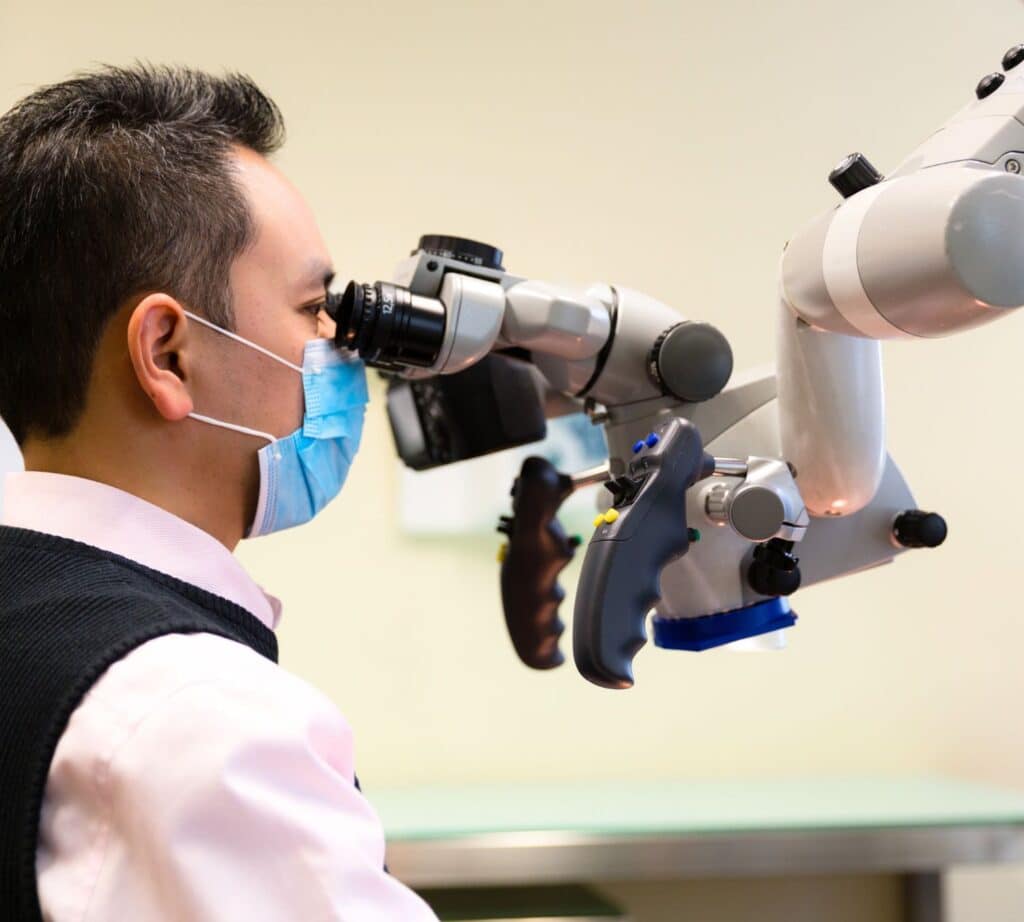
- An operating microscope. Working at high magnification with coaxial light is what makes a hidden canal orifice, a crack, or a perforation visible at all. It is the single biggest difference between specialist and general endodontic practice.
- Ultrasonic instruments, used under the microscope to remove dentine precisely, uncover canal openings and retrieve separated instruments.
- Cone-beam 3D imaging (CBCT) where a flat radiograph cannot answer the question — an extra root, a lesion that is not visible, a suspected fracture, a canal that curves out of the film's plane. See Our Technology.
- Rubber dam on every case. A sheet isolating the tooth so nothing from the mouth enters the canal system and nothing from the canal is swallowed. It is not optional in endodontics; treatment done without it is compromised from the start.
- Apex locators, which measure the canal's working length electronically to well under a millimetre.
What endodontists do
Endodontists are registered specialists performing:
- root canal treatment and retreatment
- internal whitening — for teeth discoloured from the inside, which external whitening cannot fix. See Teeth Whitening
- treatment and management of cracked teeth — see Chipped & Cracked Teeth
- treatment of dental trauma
- endodontic surgery, including apicoectomy
At our Melbourne CBD practice the resident endodontists work closely with the general dentists, so straightforward cases stay with the general dentist and complex ones move internally. See Specialist Care.
When the nerve is involved
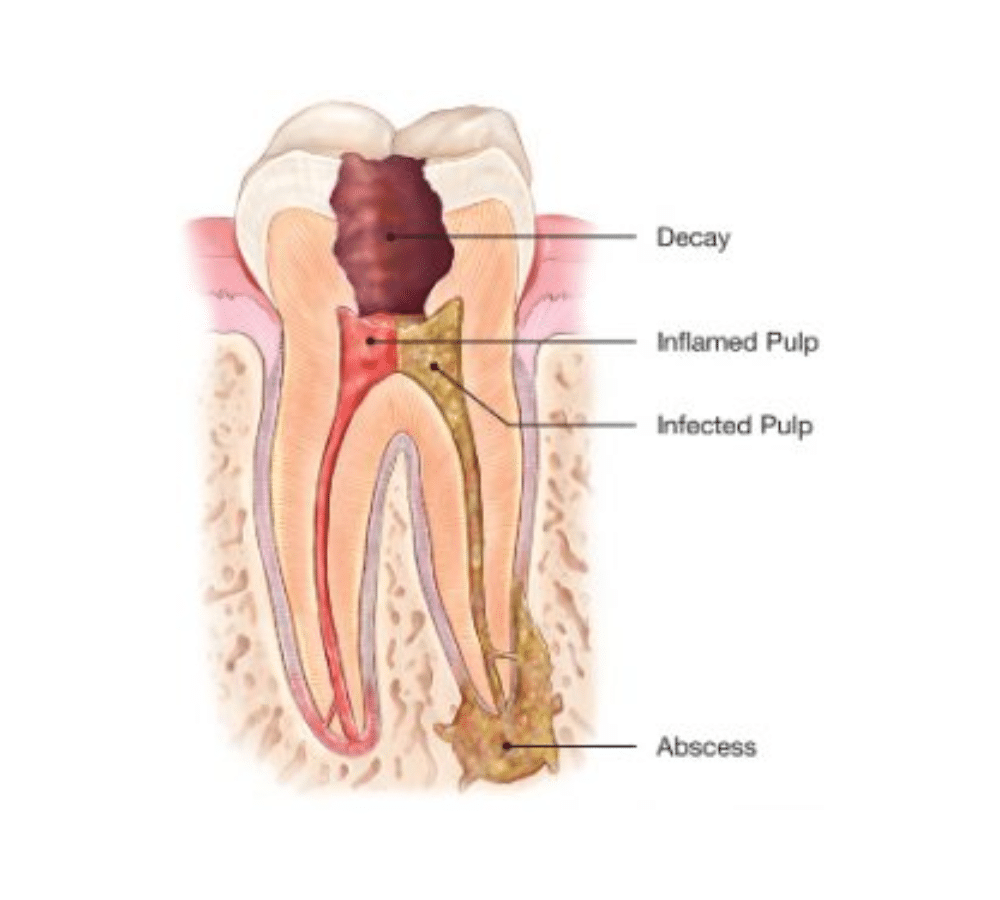
If a tooth is cracked, traumatised, or has a deep cavity, the pulp can be exposed to bacteria and become inflamed or infected. Advanced infection within the root canal system eventually kills the pulp.
Symptoms:
- sensitivity to high or low temperatures
- pain on chewing
- continuous, throbbing pain, sometimes with swelling
The most useful single sign is how long pain lasts after something cold. A jolt that disappears in seconds usually means an irritated but recoverable nerve; pain that lingers for a minute or more, or arrives unprompted at night, generally means the inflammation has passed the point of recovery — which is the difference between a filling and a root canal. A tooth that suddenly stops hurting has often not recovered; the nerve has died, and the problem moves quietly to the bone at the root tip. See Toothache & Tooth Pain.
If infection is left untreated it can spread into the surrounding tissues of the face and neck. This is the reason not to wait it out. Spreading facial swelling, fever, or difficulty swallowing or breathing is a medical emergency — call 000 or attend a hospital emergency department. For urgent but non-emergency problems, see Emergency Dentistry.
Antibiotics are not a treatment for this. They can settle a spreading infection and buy time, but the source is inside the tooth where no antibiotic reaches in useful concentration. The infection returns until the canal system is cleaned or the tooth is removed.
At that point there are two options: extract the tooth, or save it with root canal treatment. The latter is usually the preferred option, though not always — see below.
How the diagnosis is actually made
Endodontic diagnosis is testing, not guessing, and several teeth are usually tested rather than only the sore one:
- Cold testing, and sometimes an electric pulp test, to establish whether the nerve is alive, inflamed or dead
- Tapping each tooth, which detects inflammation at the root tip
- Pressing on the gum over the root, which locates an abscess draining through bone
- A bite stick cusp by cusp, which reproduces the pain of a crack
- Probing around the tooth, which separates a gum abscess from one inside the tooth
- Radiographs, sometimes from more than one angle, because a lesion can hide behind a root
A tooth can hurt badly with a normal-looking x-ray, because the bone change that shows on film takes time to develop. That is a limitation of the image, not a sign nothing is wrong.
Root canal or replacement?
A specialist endodontist can sometimes save a tooth that has been given a poor prognosis elsewhere. That is worth knowing before accepting an extraction recommendation — a second opinion from a specialist sometimes changes the answer. See Second Opinions & Corrective Dentistry.
Equally, sometimes it does not, and an honest specialist will tell you when a tooth is not worth treating. A tooth with a vertical root fracture, too little sound structure to restore, or advanced bone loss is better removed than treated twice.
Where a tooth can be restored, endodontists collaborate with prosthodontists on crowns, veneers, bridges, implants or dentures — see Specialist Prosthodontists. Where a tooth genuinely cannot be saved, they work with oral and maxillofacial surgeons and periodontists on removal and replacement — see Oral & Maxillofacial Surgeons, Specialist Periodontists and Dental Implants.
The comparison worth making honestly: a root-treated and crowned tooth keeps your own root, its ligament and the bone around it, and costs less than an implant. An implant avoids the possibility of further endodontic failure but requires surgery, months of healing and lifelong maintenance. Keeping a restorable natural tooth is usually the better first choice — which is exactly why a specialist opinion before extraction is worth the appointment.
What root canal treatment involves
Treatment removes the affected pulp, cleans the nerve canals with an antibacterial solution, and places a temporary filling until a permanent filling or crown can be fitted.
Step by step, it runs: anaesthetic, rubber dam, an opening through the biting surface, locating every canal, measuring each to its exact length, shaping them enough to let the irrigant work, disinfecting, then filling and sealing the space.
The disinfection does most of the work. Instruments shape the canal; it is the irrigating solution, given time and agitated within the canal, that reaches the fins and branches no file can enter. This is why the appointment is long and why it cannot be hurried — the slow part is the part that works.
It can often be completed in one or two visits. One visit suits many cases; two are chosen where there is significant infection or persistent symptoms, with a medicated dressing left inside between appointments. The usual immediate benefit is substantial relief of the pain caused by the infection; the longer-term benefit is keeping the natural tooth. Some tenderness for a few days afterwards is normal.
A tooth that is numb-resistant is a known problem, not a failure of nerve. Hot, acutely inflamed pulps are genuinely harder to anaesthetise, and specialists use additional techniques for exactly this. Say so if you feel anything — do not endure it. See Dental Anxiety and Sleep Dentistry if the appointment itself is the barrier.
Afterwards, and the restoration that finishes it
Afterwards, avoid chewing on the treated tooth until it has been fully restored — an unrestored root-treated tooth is more susceptible to fracture.
- Tenderness to biting for a few days to a couple of weeks is normal and settles.
- A flare-up — pain or swelling in the first day or two — happens occasionally and should be reported rather than waited out.
- Call if swelling develops, pain worsens after the first few days, the temporary filling comes out, or the bite feels high.
The restoration is part of the treatment, not an optional extra. A root-treated back tooth has lost its roof and a good deal of internal structure, and it fractures readily under load — sometimes unrestorably. Cuspal coverage, usually a crown or onlay, is what protects it, and the sooner it is placed after treatment the better. See Dental Crowns and Same-Day CEREC Restorations.
Front teeth often need less, and a root-treated front tooth that darkens can frequently be lightened from the inside rather than veneered — the conservative option, and worth asking about.
Expect a review, commonly at six to twelve months, with a radiograph to confirm the bone at the root tip is healing. Healing is slow and silent, and the film is the only way to see it.
When first-time treatment does not work
There are three options, and they are usually considered in this order:
- Re-treatment. The existing filling material is removed, the canal system re-cleaned, missed canals located, and the tooth re-sealed. Re-treatment carries a lower prognosis than first-time treatment, but it is the least invasive option and it frequently works.
- Apicoectomy — surgery at the root tip. A small procedure through the gum: the last few millimetres of the root are removed, the canal sealed from the end, and the area allowed to heal. It is used where re-treatment is not possible or has already been tried, or where a post or crown makes access through the top impractical.
- Extraction, where the tooth cannot be salvaged — followed by a decision about replacement.
What can go wrong
Root canal treatment has good outcomes, and it also has recognised complications: persistent or recurrent infection, fracture of the tooth (especially before the final restoration), an instrument separating inside a canal, perforation of the canal wall, and treatment that does not resolve the symptoms, leading to re-treatment, surgery or extraction. Re-treatment carries a lower prognosis than first-time treatment.
Ask your endodontist for the prognosis on your particular tooth and what the plan is if treatment does not work. Root Canal Therapy sets out the procedure and its risks in full.
Your endodontists
All endodontic treatment at we are carried out by Dental Board–registered specialist endodontists.
To use the title in Australia, a practitioner must hold a dental degree and then complete a further three or more years of full-time postgraduate training specific to endodontics, and hold specialist registration in endodontics with the Dental Board of Australia. “Endodontist” is a protected title.
| Clinician | Qualifications |
|---|---|
| Prof. Chankhrit Sathorn (DEN0001025734) | DDS, Grad.Dip.Dent, DClinDent, PhD, MRACDS (Endo) |
| Dr Gregory Tilley | BDSc (Melb), LDS (Vic), FRACDS, MRACDS (Endo) |
| Dr Aovana Timmerman | BDSc (Melb), FRACDS, DCD (Melb), GCertClinTeach, MRACDS (Endo) |
| Dr Areti Vrochari | DDS, MS (Endo), DrMedDent |
You can verify any clinician free on the AHPRA public register at ahpra.gov.au, or by calling 1300 419 495. See Dentists & Registered Specialists and Our Team.
Do I need a referral?
No. You do not need a referral to see one of the specialist endodontists at Smile Solutions. Bringing recent radiographs from another practice can save you a repeat set.
What to bring: any recent x-rays, the name of the tooth if you know it, a list of your medications and medical conditions, and a short account of when the pain started and what makes it worse. Do not stop a prescribed medication before the appointment without speaking to whoever prescribed it.
Cost
Fees depend on which tooth is involved and how complex the anatomy is; molars cost more than front teeth. Specialist fees are higher than general practice fees, reflecting the additional training.
Check whether the quote includes the final crown or restoration — it is usually a separate item and often the larger cost, and root canal treatment is not finished without it. Price Guide and Payment Plans.
Root canal treatment is a restorative item and generally attracts a health fund rebate, subject to your annual limit — which matters here, because the treatment plus the crown frequently exceeds a yearly limit on its own. Ask for the item numbers, and ask whether splitting the treatment and the crown across two calendar years makes sense in your case.
Common questions
Do I need a referral to see an endodontist?
No. The page states that patients can book without a referral. A referral from your general dentist can still be useful because it provides history, radiographs and the restorative plan.
Why see a specialist endodontist rather than a general dentist?
Endodontists complete additional specialist training and focus on diagnosis and treatment inside teeth. Their equipment and experience can be especially useful for complex anatomy, difficult diagnosis, previous treatment, trauma, resorption or suspected cracks.
Is root-canal treatment better than replacing the tooth with an implant?
Keeping a restorable natural tooth is often preferable, but neither option is universally better. Remaining tooth structure, cracks, gum and bone support, treatment complexity, long-term restoration, cost and patient preference all matter.
Is root-canal treatment completed in one visit or two?
Either is possible. The number of visits depends on diagnosis, infection, anatomy, symptoms and whether medication is placed between appointments. The specialist should explain why the proposed schedule suits the tooth.
Will root-canal treatment hurt?
Local anaesthetic is used, and treatment aims to remove the source of pain. Tenderness after the appointment can occur as the surrounding tissues settle. Severe or increasing pain, swelling or fever needs prompt review.
Will the tooth need a crown afterwards?
Back teeth and structurally weakened teeth often need cuspal protection with an onlay or crown after root-canal treatment. The definitive restoration is part of the plan, not an optional afterthought, and its timing and cost should be discussed before treatment.
What if previous root-canal treatment has failed?
Options can include non-surgical re-treatment, endodontic surgery or extraction, depending on the cause and restorability. The specialist may need to remove or work through an existing crown, post or filling to reach untreated anatomy.
Can a cracked tooth be saved with root-canal treatment?
Root-canal treatment can address an inflamed or infected nerve, but it cannot repair a crack. A limited crack may still have a reasonable prognosis when protected; a crack extending down the root or below the supporting tissues may make the tooth unsavable.
Practical details
| Address | Level 1, 220 Collins Street, Manchester Unity Building, Melbourne VIC 3000 |
| Phone | 13 13 96 |
| theteam@smilesolutions.com.au | |
| Monday – Friday | 8.00am – 6.00pm |
| Saturday | 8.30am – 1.30pm |
| Sunday | By appointment |
| Specialist training | Three or more years beyond the dental degree |
| Referral needed | No |
| Usual visits | One or two, plus restoration |
| Standard of care | Rubber dam, magnification, apex location |
| Review | Commonly 6–12 months, with a radiograph |
| Parking | Wilsons Parking, Flinders Lane (between Swanston and Russell) |
Endodontics is one of the thirteen recognised dental specialties in Australia, and specialist registration can be verified free on the AHPRA public register at ahpra.gov.au.
General information only — it is not a diagnosis, a treatment plan, a quote or a promise of any particular clinical outcome, and it does not replace advice from your treating practitioner. Root canal treatment carries the risks set out above, whether a particular tooth can be saved can only be established after examination and radiographs, and outcomes vary between individuals. Reported success rates are population figures, not a guarantee for your tooth. Anatomical frequencies described here are typical findings reported in the literature, not statements about your teeth. Fees and health fund rebates are indicative and subject to change; confirm at your consultation and with your fund.
Smile Solutions trades under ABN 28 193 514 103.
Images on This Page
-
https://www.facebook.com/tr?id=800557773428361&ev=PageView&noscript=1
(no alt text)
-
https://www.smilesolutions.com.au/wp-content/uploads/2025/10/calendar_month.svg
(no alt text)
-
https://www.smilesolutions.com.au/wp-content/themes/arcadian-wordpress-theme/assets/images/smile_solutions_logo_white.png
Smile Solutions Logo
-
https://www.smilesolutions.com.au/wp-content/themes/arcadian-wordpress-theme/assets/images/smile_solutions_logo_purple.png
Smile Solutions Logo
-
https://www.smilesolutions.com.au/wp-content/uploads/2025/11/Smile-Solutions-4.png
Smile Solutions - Melbourne CBD
-
https://www.smilesolutions.com.au/wp-content/uploads/2025/09/ChS-1024x922.jpg
Endo
-
https://www.smilesolutions.com.au/wp-content/uploads/2025/09/Root-Canal-Treatment-Smile-Solutions.png
Tooth anatomy with decay and infection
-
https://www.smilesolutions.com.au/wp-content/uploads/2025/08/69a44c30c93ce196d539cc5520080df52a5f3f88-scaled.jpg
69a44c30c93ce196d539cc5520080df52a5f3f88 scaled
-
https://www.smilesolutions.com.au/wp-content/themes/arcadian-wordpress-theme/assets/images/family_owned_bussiness.png
Family Owned Business
-
https://www.smilesolutions.com.au/wp-content/themes/arcadian-wordpress-theme/assets/icons/icon--phone.svg
Smile Solutions Contact
-
https://www.facebook.com/tr? id=800557773428361&ev=PageView&noscript=1
(no alt text)
-
https://bat.bing.com/action/0?ti=25148060&tm=gtm002&Ver=2&mid=a0918e9a-8098-4ded-9de4-7f78d41cc3db&bo=1&sid=08e62840ab2711f1b67cfddc8086486d&vid=08e693b0ab2711f1b1c04591ee58620d&vids=1&msclkid=N&pi=918639831&lg=en-US&sw=800&sh=600&sc=24&nwd=1&tl=Endodontist%20Melbourne%20-%20Smile%20Solutions&p=https%3A%2F%2Fwww.smilesolutions.com.au%2Fspecialist-care%2Fendodontists%2F&r=&evt=pageLoad&sv=2&cdb=AQAQ&rn=479614
(no alt text)