Specialist Care
What are the dental specialties, and when do I need one?
Smile Solutions brings together Dental Board–registered specialists from six disciplines, working collaboratively in one building. Seventeen dentists holding specialist registration practise here, and every one of them is named below with their registration number.
Start with the distinction that matters most. There is a significant and legally meaningful difference between a registered specialist in a dental field and a general dentist with a “special interest” in that field. A registered specialist has completed additional full-time university training beyond the dental degree and holds specialist registration with the Dental Board of Australia. A special interest is self-described and carries no regulatory meaning.
Just as cardiologists, orthopaedic surgeons and gynaecologists are specialist doctors, endodontists, oral and maxillofacial surgeons, orthodontists, paediatric dentists, periodontists and prosthodontists are registered dental specialists.
Smile Solutions is at Level 1, 220 Collins Street, Manchester Unity Building, Melbourne CBD.
Before anything else: the honest half
Most dental problems do not need a specialist. A general dentist manages the overwhelming majority of dentistry competently and appropriately, and being referred is not a sign that something has gone wrong.
You probably do not need a specialist if:
- You need a check-up, a clean, a filling or a straightforward extraction. This is general practice.
- Your gums bleed when you brush. Start with a hygienist or your general dentist. The escalation path is hygienist → general dentist → periodontist, and most cases resolve at the first two steps.
- Your child needs a routine examination. A general dentist or oral health therapist is appropriate. A specialist paediatric dentist becomes the right answer for complexity, not for ordinary care.
- You want your teeth straightened and the case is genuinely simple. Many general dentists deliver good aligner results in mild cases. The question is whether your case is simple — which is itself a diagnostic judgement.
Referral costs money and adds appointments. A practice that refers everything internally is not obviously acting in your interest, and you are entitled to ask why a referral is being made.
The reverse question matters more, and is asked less often: is this case beyond what a general dentist should be attempting? A clinician who refers when a case sits outside their competence is demonstrating good practice, not weakness.
Which specialist treats which problem
| If you have | The specialty | Page |
|---|---|---|
| Impacted wisdom teeth, jaw surgery, facial trauma, extensive bone grafting | Oral and maxillofacial surgery | Oral & Maxillofacial Surgeons |
| Crooked teeth, a bad bite, jaw growth problems in a child | Orthodontics | Specialist Orthodontists |
| Persistent deep pain, a failed root canal, a cracked tooth, dental trauma | Endodontics | Specialist Endodontists |
| Advanced gum disease, gum recession, loose teeth, peri-implantitis | Periodontics | Specialist Periodontists |
| Multiple missing teeth, full-arch rehabilitation, complex crown and bridge work, severe tooth wear | Prosthodontics | Specialist Prosthodontists |
| A child with significant anxiety, additional needs, or extensive treatment required | Paediatric dentistry | Paediatric Dentists |
| A case needing several of the above at once | Complex, multidisciplinary | Complex Dentistry |
Where two specialties overlap — and they often do — the sequence matters more than the choice. Implants sit with both periodontists and prosthodontists and frequently involve both: one places the fixture, the other makes what goes on it. Orthodontics and oral surgery combine in jaw surgery cases, where the orthodontist prepares the teeth for where the surgeon will move the jaws. In those cases the useful question is not “which specialist?” but “who is planning this, and in what order?”
The six specialties practising here
Oral and maxillofacial surgery
Diagnosis, surgical treatment and management of diseases, injuries and defects affecting the mouth, gums, teeth and jaws — both function and appearance.
The training is what distinguishes this specialty. In Australia the pathway requires a dental degree, a medical degree, and around four years of accredited hospital surgical training on top. These surgeons are qualified as both dentist and doctor, which is why they operate in hospital settings and manage facial trauma.
Typical work: impacted wisdom teeth, orthognathic (corrective jaw) surgery, extensive bone grafting, sinus lifts, zygomatic implants, facial trauma, oral pathology and biopsy, temporomandibular joint surgery.
On site:
- A/Prof Patrishia Bordbar — DEN0001010517 — Associate Professor Patrishia Bordbar, Specialist Oral and Maxillofacial Surgeon
- Dr Ricky Kumar — DEN0001411504 — Dr Ricky Kumar, Specialist Oral and Maxillofacial Surgeon
Orthodontics
Correcting the position of the teeth and the bite, and the relationship between the jaws.
Why it is not only cosmetic: a malocclusion can indicate jaw dysfunction or a problem with the underlying skeletal relationship, and an uncorrected bite distributes chewing forces unevenly across teeth that then wear or fracture. Alignment is the visible part; the bite is the part that determines whether the result lasts.
Typical work: braces, lingual braces, Invisalign®, growth modification in children, and the orthodontic half of combined surgical cases.
On site:
- Dr Andrea Phatouros — DEN0001008158 — Dr Andrea Phatouros, Specialist Orthodontist
- Dr David Austin — DEN0001022144 — Dr David Austin, Specialist Orthodontist
- Dr Joshua Ch'ng — DEN0001857728 — Dr Joshua Ch'ng, Specialist Orthodontist
- Dr Steven Smith — DEN0001382809 — Dr Steven Smith, Specialist Orthodontist
Endodontics
Treatment of the tooth pulp — which contains the blood supply and nerves — and the tissues surrounding the root.
When the pulp becomes diseased or injured, root canal treatment allows the tooth to be saved rather than extracted. A natural tooth retained is preferable to a natural tooth replaced, and that is the whole argument for the specialty.
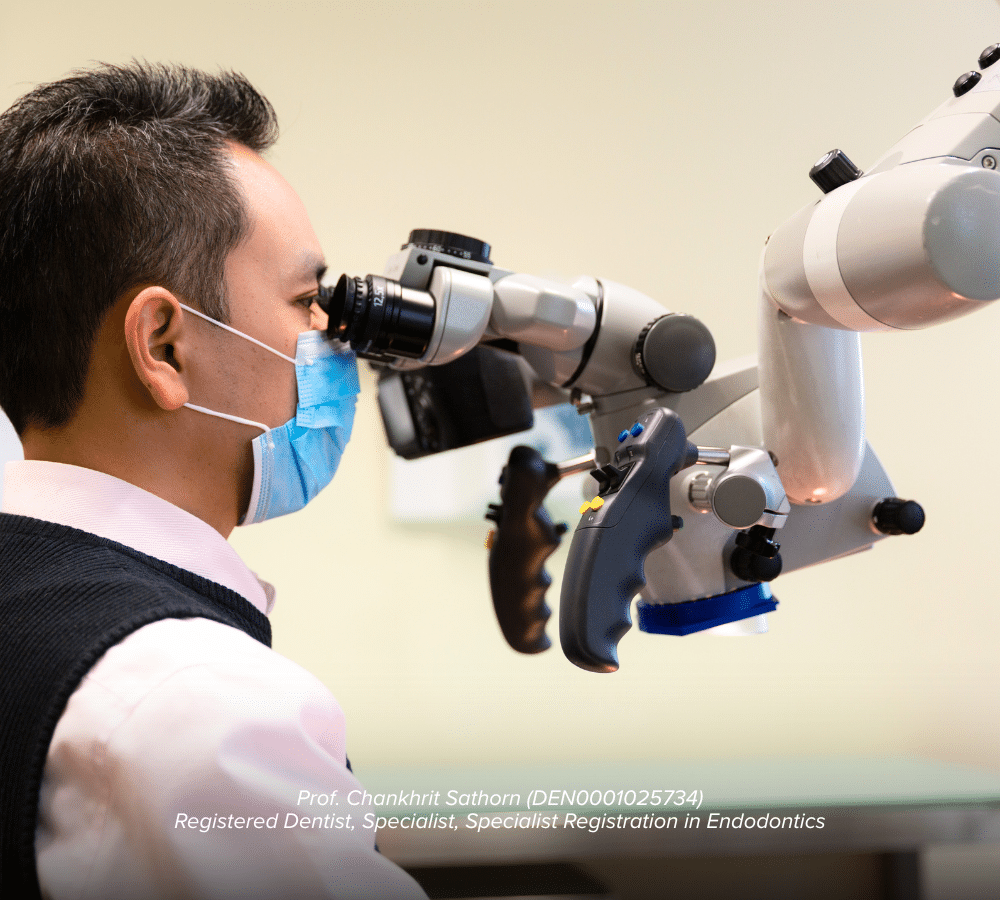
What the specialist training adds is most visible in difficult anatomy: curved or calcified canals, teeth with more canals than expected, previous treatment that has failed, and the diagnosis of pain that does not present where it originates. Operating-microscope endodontics is standard here — Why is the microscope so crucial in endodontic treatment? explains what magnification actually changes.
Typical work: root canal therapy and retreatment, surgical endodontics, cracked teeth, dental trauma, internal whitening, and diagnosis of difficult dental pain.
On site — four registered endodontists:
- Dr Aovana Timmerman — DEN0001022313 — Dr Aovana Timmerman, Specialist Endodontist
- Dr Areti Vrochari — DEN0001909501 — Dr Areti Vrochari, Specialist Endodontist
- Dr Gregory Tilley — DEN0001386081 — Dr Gregory Tilley, Specialist Endodontist
- Prof Chankhrit Sathorn — DEN0001025734 — Prof. Chankhrit Sathorn, Specialist Endodontist
Periodontics
The gum, ligament and bone supporting the teeth, and the tissues around dental implants.
Most people never need a periodontist, because most gum problems are handled earlier in the escalation path. A periodontist becomes the right answer when disease has progressed to bone loss, when recession needs grafting, or when an implant develops peri-implantitis.
Typical work: advanced periodontal disease, gum grafting and recession, regeneration, crown lengthening, gum lifts, implant placement, peri-implantitis.
On site:
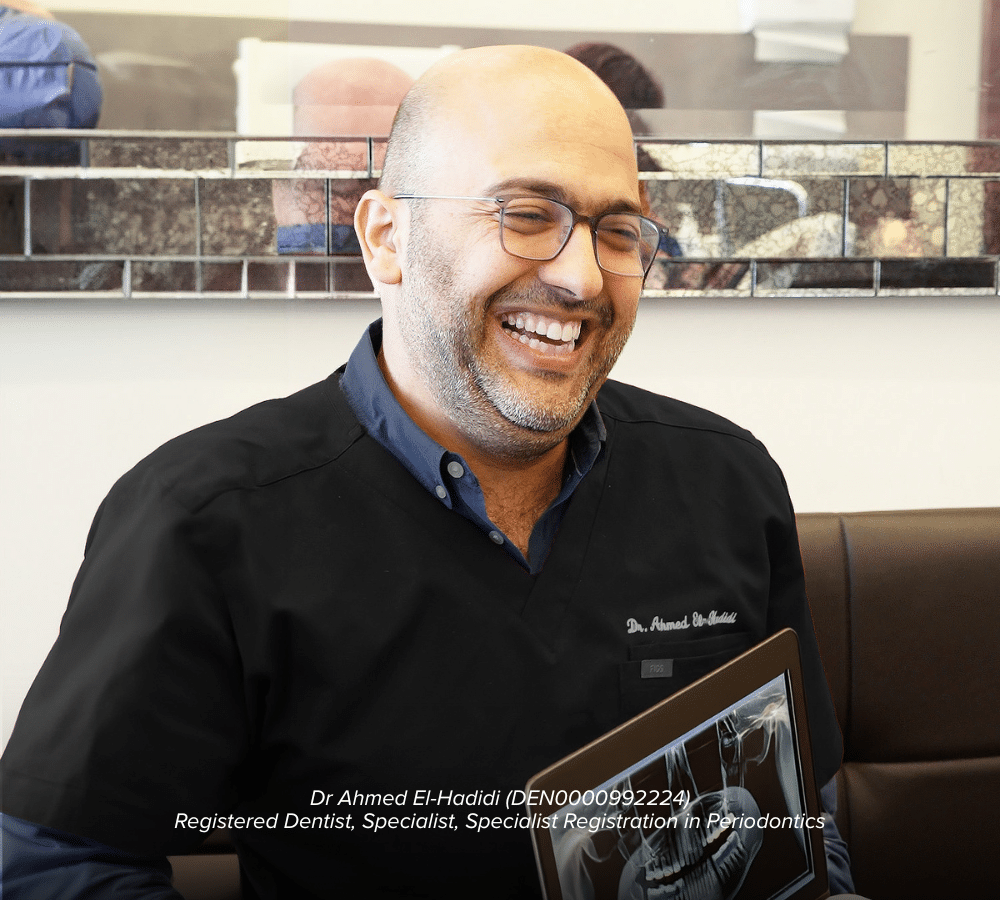
- Dr Ahmed El Hadidi — DEN0000992224 — Dr Ahmed El Hadidi, Specialist Periodontist
- Dr Peishan Jiang — DEN0002220847 — Dr Peishan Jiang, Specialist Periodontist
- Dr Simon Hinckfuss — DEN0001008823 — dual specialist registration in periodontics and prosthodontics — Dr Simon Hinckfuss, Specialist Periodontist and Specialist Prosthodontist
Prosthodontics
Restoration and replacement of teeth — crowns, veneers, bridges, implants, dentures, or any combination. The term means, literally, tooth replacement.
Where the specialty earns its keep is planning rather than execution. A single crown is general dentistry. A mouth where the bite has collapsed through wear, where several teeth have questionable prognosis and where the sequence of treatment determines whether the result is stable — that is prosthodontics.
Typical work: single-tooth restoration through to full-arch rehabilitation, All-on-4®, complex crown and bridge, management of severe tooth wear and bite problems, implant restoration.
On site:
- Dr Fotios Angelis — DEN0001023799 — Dr Fotios Angelis, Specialist Prosthodontist
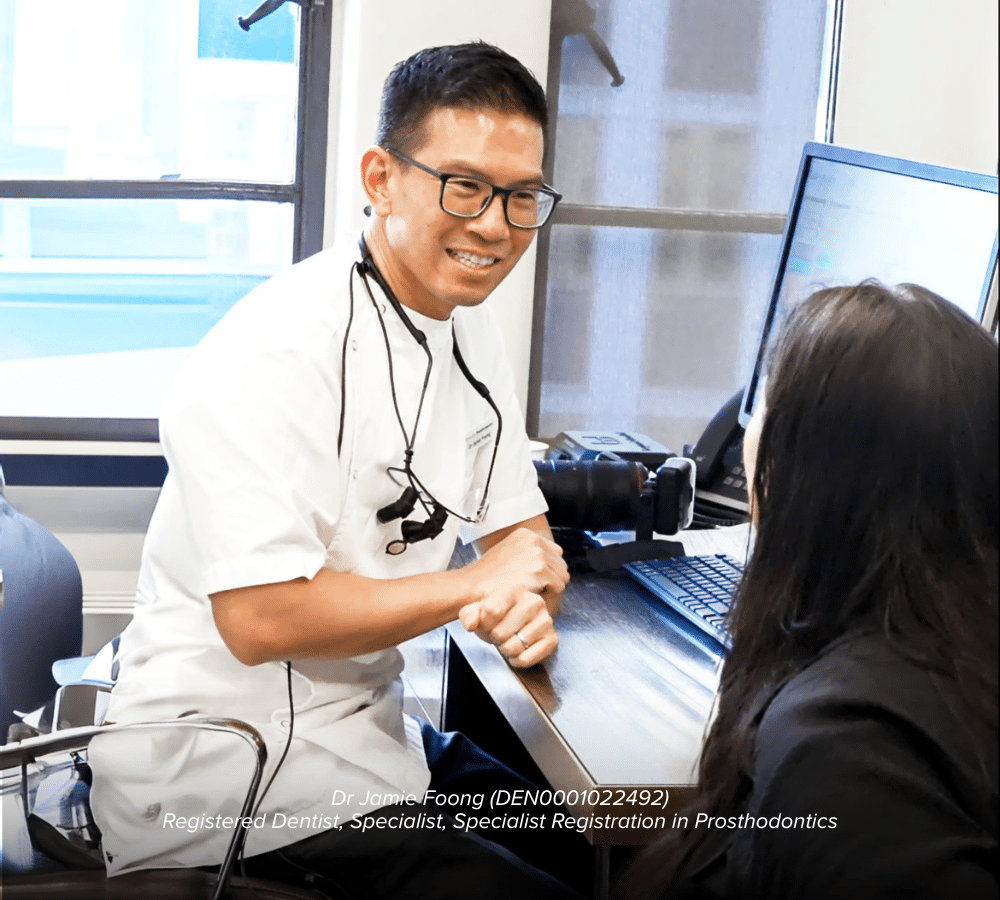
- Dr Jamie Foong — DEN0001022492 — Dr Jamie Foong, Specialist Prosthodontist
- Prof Vasileios Chronopoulos — DEN0001856272 — Professor Vasileios Chronopoulos, Specialist Prosthodontist
- Dr Simon Hinckfuss — DEN0001008823 — dual registration, as above
Paediatric dentistry
The growth, development and treatment of children's teeth and jaws, and the prevention of decay.
Most children do not need one. A specialist paediatric dentist becomes the right answer for very young children needing extensive treatment, children with significant medical or developmental complexity, severe dental trauma, and children who have already had a frightening experience.
Behaviour management with young children is a trained clinical skill, not a personality trait — and the first few experiences shape whether a child grows into an adult who attends the dentist at all.
On site:
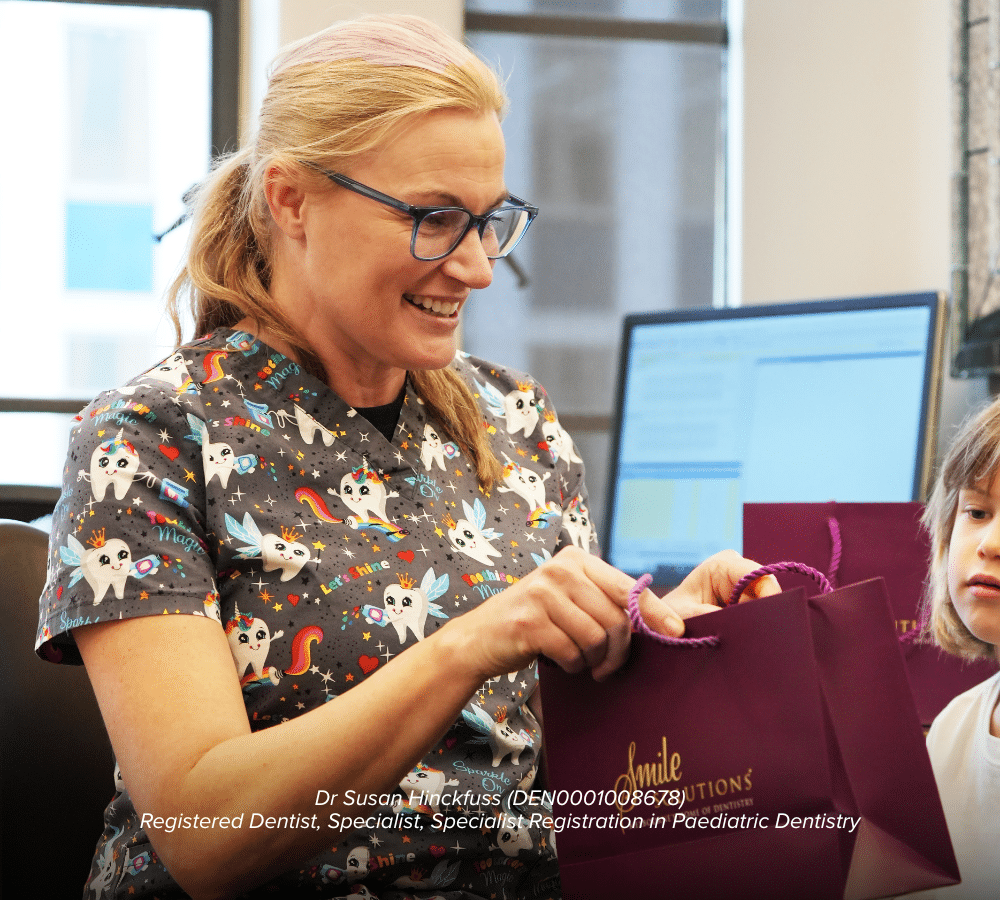
- Dr Susan Hinckfuss — DEN0001008678 — Dr Susan Hinckfuss, Specialist Paediatric Dentist
The thirteen recognised specialties
Australia recognises thirteen dental specialties. Six practise here. The complete list is published because it is the only way to tell a real specialty from a marketing label:
Dento-maxillofacial radiology · Endodontics · Forensic odontology · Oral and maxillofacial surgery · Oral medicine · Oral and maxillofacial pathology · Oral surgery · Orthodontics · Paediatric dentistry · Periodontics · Prosthodontics · Public health dentistry · Special needs dentistry
Titles not on that list carry no regulatory meaning. “Cosmetic dentist”, “implant surgeon”, “implantologist”, “sleep dentist” and “facial aesthetics practitioner” are descriptions of interest or scope. No practitioner in Australia holds specialist registration in any of them, because none exists.
That is not a criticism of the clinicians who use those descriptions — placing implants, for instance, sits squarely within the general dental scope of practice for a dentist trained and competent to do it. It is a caution about reading a title as a qualification.
What specialist registration actually requires
- A dental degree, and in most cases a period in general practice afterwards.
- Three or more years of full-time, university-based postgraduate training in the single specialty — not a series of weekend courses.
- Registration with the Dental Board of Australia in that specialty, which appears on the public register and must be renewed.
Postgraduate certificates, diplomas, fellowships, PhDs and professorships do not confer specialist registration. A practitioner can hold a doctorate in a field and not be a registered specialist in it. Both facts can be true of the same person, and this site states both where they apply.
Verify any of it in under a minute at ahpra.gov.au. Search the name or the registration number. The register shows registration status, division, any specialty held, and any conditions on practice. It outranks anything asserted on any practice website, including this one.
How referral works here
You do not need a referral to see a dental specialist in Australia. You can book directly, and if you already know which specialty you need, that is often the fastest route.
In practice most specialist care at this practice begins differently: a general dentist examines you, and refers internally where a specialist is the right person for that case. That is the point of having the specialties in one building.
What co-location changes, stated precisely:
- Records and imaging are immediately available to everyone involved — no re-taking radiographs, no waiting on a file transfer.
- The case can be discussed before treatment starts, rather than each clinician responding to what the last one did.
- Fewer separate appointments, and less travel between practices.
- Continuity — your general dentist retains oversight while a specialist handles their part.
Four of the six specialties here have three or more registered specialists on site. That is the structural fact worth knowing: a difficult endodontic or orthodontic case can be talked through between colleagues in the same specialty, which is not possible in a practice with one of each.
What co-location does not change:
- The identity and registration of whoever treats you. Working alongside specialists does not make a general dentist a specialist. Ask which practitioner performs each stage.
- Your right to a second opinion, including from outside this practice. No reputable practitioner objects.
- Your right to be referred elsewhere. A referral must be made in your interest, not to keep a case in-house.
- Your right to your records, including radiographs, transferable to another practitioner on request.
Complex and multidisciplinary cases
Some presentations need several clinicians across different fields to reach an agreed outcome — a missing tooth that needs an implant, gum recession that needs grafting, and a jaw discrepancy that may need surgery, all in one mouth.
A complex case referred out is a sequence of separate opinions, each formed from a partial view, with the patient carrying information between them. The same case managed in one building can be planned jointly before anyone starts.
Related specialist services
Sleep dentistry and sedation — treatment under sedation or general anaesthesia for patients with severe dental anxiety, a strong gag reflex, or extensive treatment needs. Sleep Dentistry, with costs at Sleep dentistry costs: what does sedation add to your bill?.
Snoring and obstructive sleep apnoea — assessment and oral appliance therapy, with 3D airway imaging on site. Sleep apnoea is a medical condition and diagnosis rests with a sleep physician; a dentist provides one of the treatment options. Snoring & Sleep Apnoea.
All-on-4® full-arch implants — All-on-4® Dental Implants.
What a specialist appointment costs
Specialist fees are generally higher than general dental fees, reflecting the additional training and, usually, longer appointments and more complex cases. There is no published specialist fee schedule here, and complex treatment is quoted individually after examination.
What you are entitled to, before anything starts: a written, itemised treatment plan with ASDS item numbers, the options including the least invasive reasonable one, the risks, and the total cost. Read those item numbers to your health fund over the phone and you will know your actual gap.
Some specialist treatment attracts higher health fund benefits than the general equivalent, and some attracts none. Check before proceeding, not after. Price Guide explains how to read a dental quote.
Parts of oral and maxillofacial surgery are classified as medical, which changes what can be claimed and may involve hospital cover rather than extras. Ask specifically.
What to ask at a specialist consultation
- Are you a registered specialist in this field, and what is your registration number? Then check it.
- What are the options, including doing nothing, and what happens if I do nothing?
- Why is this the recommended one for my case specifically?
- What are the material risks, and how likely is each?
- How long should the result last, and what happens if it fails?
- Who does each stage — and if more than one clinician is involved, in what order?
- The total cost, itemised, including anything not in the headline figure.
Take the plan away and think about it. Specialist dental treatment is rarely urgent, and feeling rushed is a reason to pause.
Common questions
Does a referral mean my general dentist cannot treat me any more?
No. A referral can be for one problem, a specialist opinion or a particular stage of treatment. It does not necessarily transfer all your dental care. Ask which clinician will manage the problem, who will provide routine examinations and maintenance, and how the findings will reach your usual dentist. The reason for referral should be explained in terms of your case; a specialist title alone does not establish that every part of your care needs specialist treatment.
Can I arrange a specialist opinion before I have a referral letter?
Contact the practice to explain the problem and ask what the relevant clinician needs before the appointment. If a dentist has already assessed it, a referral letter, treatment history and existing images can help the specialist understand the question being asked. Confirm any referral requirements for the appointment and for any benefit you intend to claim. An appointment being available without a letter does not, by itself, establish eligibility for a rebate.
Am I committing to treatment by attending the consultation?
An assessment is not a commitment to the proposed treatment. Before proceeding, you should understand the recommendation, reasonable alternatives, material risks and likely costs, and have an opportunity to ask questions. Ask whether any investigations or procedures are proposed at the first visit and what they cost. If a decision is time-sensitive, ask the clinician to explain why and what waiting would mean for your case. These discussions are part of informed consent under Ahpra's shared Code of conduct.
If several specialists are involved, who is responsible for the overall plan?
Ask the practice to identify the clinician coordinating your care and the responsibility of each practitioner. A useful plan sets out the sequence, what must be completed before the next stage, and who to contact if symptoms or circumstances change. Being in one building can make coordination easier, but it does not tell you who owns each decision. Request a written plan that you and your usual dentist can follow.
What if a second opinion recommends a different treatment?
Ask each clinician to explain the diagnosis, the findings behind the recommendation and the trade-offs between the options. Different plans may reflect different judgements about risk, preservation of teeth, maintenance or your priorities; the difference needs an explanation rather than an assumption that one plan is automatically wrong. Share relevant records so the opinions address the same information. Ahpra's Code of conduct supports patients seeking a second opinion.
How can I compare specialist quotes fairly?
Compare the scope of the proposed care as well as the total. Ask for the stages, item numbers, clinicians involved and exclusions, including any separate imaging, laboratory, hospital, anaesthetic or maintenance costs that apply. Confirm what could change the estimate and how additional work would be agreed. Give your health fund the proposed item numbers and provider details to check your own benefits. A lower headline price is difficult to interpret when the two plans cover different work.
Practical details
Smile Solutions, Level 1, 220 Collins Street, Manchester Unity Building, Melbourne VIC 3000. Phone 13 13 96, or theteam@smilesolutions.com.au. Monday–Friday 8.00am–6.00pm, Saturday 8.30am–1.30pm, Sunday by appointment.
In a medical emergency — spreading facial swelling, difficulty breathing or swallowing, uncontrolled bleeding or significant facial trauma — call 000 or attend a hospital emergency department.
Every registration number on this page can be verified free on the AHPRA public register at ahpra.gov.au. Complaints about a registered practitioner go to AHPRA; complaints about a practice, a service or fees go to the Health Complaints Commissioner in Victoria.
Related: Dentists & Registered Specialists, Our Team, Do I need to see a dental specialist?, Second Opinions & Corrective Dentistry.
General information only — it is not a diagnosis, a treatment plan or a promise of any particular clinical outcome, and it does not replace advice from your treating practitioner. Suitability, treatment times and outcomes vary between individuals, and all treatment carries risks that should be discussed with your clinician. Practitioners join and leave; confirm current availability and registration when booking.
Smile Solutions trades under ABN 28 193 514 103.
Images on This Page
-
https://www.facebook.com/tr?id=800557773428361&ev=PageView&noscript=1
(no alt text)
-
https://www.smilesolutions.com.au/wp-content/uploads/2025/10/calendar_month.svg
(no alt text)
-
https://www.smilesolutions.com.au/wp-content/themes/arcadian-wordpress-theme/assets/images/smile_solutions_logo_white.png
Smile Solutions Logo
-
https://www.smilesolutions.com.au/wp-content/themes/arcadian-wordpress-theme/assets/images/smile_solutions_logo_purple.png
Smile Solutions Logo
-
https://www.smilesolutions.com.au/wp-content/uploads/2025/11/Smile-Solutions-4.png
Smile Solutions 4
-
https://www.smilesolutions.com.au/wp-content/uploads/2025/09/Wisdom-Teeth-Smile-Solutions.png
Smile Solutions Dentist Melbourne
-
https://www.smilesolutions.com.au/wp-content/uploads/2025/09/Smile-Solutions-Orthodontics.png
Smile Solutions Orthodontics
-
https://www.smilesolutions.com.au/wp-content/uploads/2025/11/Board-registered-specialists.png
Smile Solutions Dentist Melbourne
-
https://www.smilesolutions.com.au/wp-content/uploads/2025/09/Periodontist-Smile-Solutions-Melbourne.png
Periodontist Smile Solutions Melbourne
-
https://www.smilesolutions.com.au/wp-content/uploads/2025/09/Root-Canal-Therapy-Smile-Solutions.png
Smile Solutions Dentist Melbourne
-
https://www.smilesolutions.com.au/wp-content/uploads/2025/09/Paediatric-Dentistry-Smile-Solutions.png
Paediatric Dentistry Smile Solutions
-
https://www.smilesolutions.com.au/wp-content/uploads/2025/09/TMD-Teeth-Grinding.png
TMD Teeth Grinding
-
https://www.smilesolutions.com.au/wp-content/uploads/2025/08/69a44c30c93ce196d539cc5520080df52a5f3f88-scaled.jpg
69a44c30c93ce196d539cc5520080df52a5f3f88 scaled
-
https://www.smilesolutions.com.au/wp-content/themes/arcadian-wordpress-theme/assets/images/family_owned_bussiness.png
Family Owned Business
-
https://www.smilesolutions.com.au/wp-content/themes/arcadian-wordpress-theme/assets/icons/icon--phone.svg
Smile Solutions Contact
-
https://www.facebook.com/tr? id=800557773428361&ev=PageView&noscript=1
(no alt text)
-
https://bat.bing.com/action/0?ti=25148060&tm=gtm002&Ver=2&mid=0a72eafd-0cfb-49cd-a64e-144d5423c810&bo=1&sid=70f62440ab2811f1a2d07f2690327b66&vid=70f636f0ab2811f19309533e122042f5&vids=1&msclkid=N&pi=918639831&lg=en-US&sw=800&sh=600&sc=24&nwd=1&tl=Dental%20Specialist%20Care%20Melbourne%20-%20Smile%20Solutions&p=https%3A%2F%2Fwww.smilesolutions.com.au%2Fspecialist-care%2F&r=&evt=pageLoad&sv=2&cdb=AQAQ&rn=475735
(no alt text)