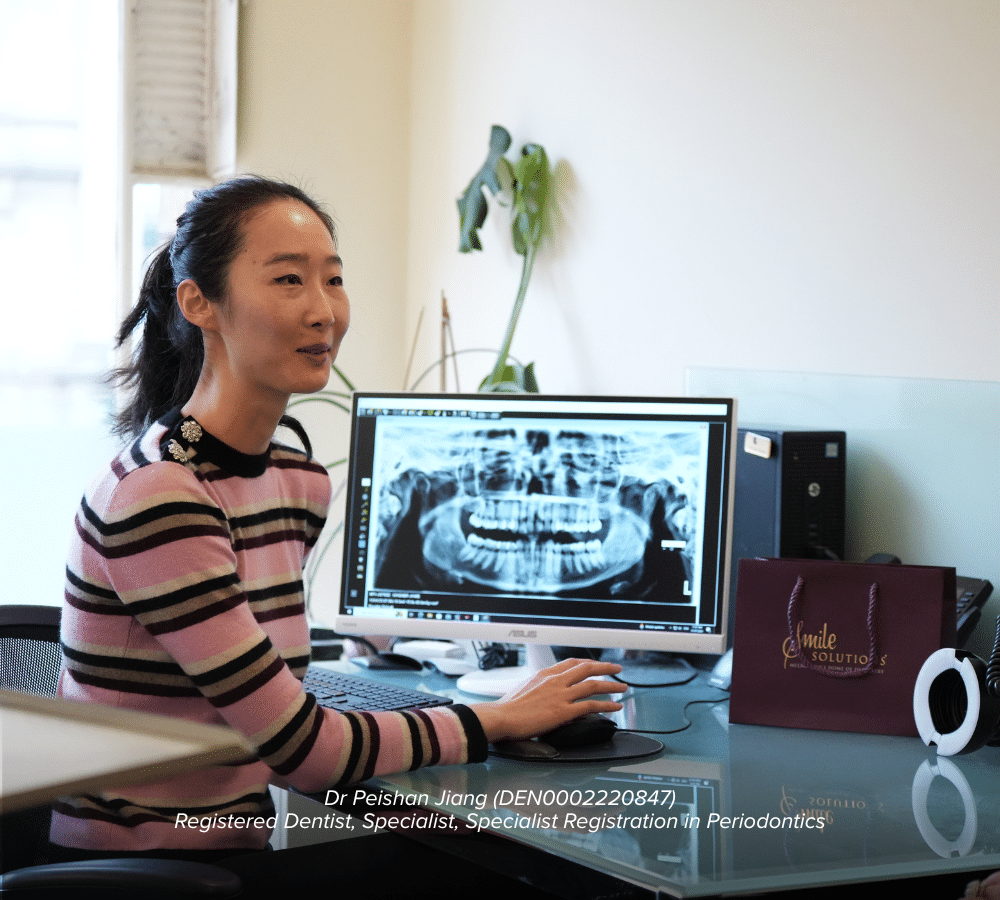
Dr Peishan Jiang, Specialist Periodontist
Role: Specialist periodontist
Qualifications: BDSc, Griffith University; DClinDent (Periodontology), Griffith University
Registration: Registered dentist with specialist registration in periodontics, DEN0002220847
Specialist registration can be verified on the AHPRA register of practitioners at ahpra.gov.au. Periodontics is one of the thirteen dental specialties recognised by the Dental Board of Australia, and the title "periodontist" is protected. The specialty page is Specialist Periodontists; the other specialists here are listed on Dentists and Registered Specialists and under Specialist Care.
Background
Dr Peishan Jiang completed her dental degree at Griffith University in Queensland, then returned there for postgraduate specialist training in periodontics and dental implantology, earning a Doctor of Clinical Dentistry in Periodontology.
During her postgraduate years she taught and supervised undergraduate students, and served on Griffith's Academic Policy Steering Group.
She has an interest in translational dental research and has presented at the International Association for Dental Research conference.
Her clinical work covers non-surgical and surgical treatment of periodontitis and peri-implantitis, placement of dental implants, bone grafting, sinus lifts, gum grafting, crown lengthening and periodontal regeneration. She works alongside general dentists and other specialists on long-term management and maintenance.
Outside dentistry she paints and travels.
What a periodontist is
A periodontist is a dental specialist in the tissues that support the teeth — gum, periodontal ligament and the bone the teeth sit in — and in the tissues around dental implants. See What Is Gum Disease? and Periodontal (gum) disease, and on when to seek a referral, Why would I need to see a dental specialist?
The pathway is:
- A dental degree.
- General practice experience — Australian programmes generally require at least two years before entry.
- Three years of full-time postgraduate specialist training.
- Application to the Dental Board of Australia for specialist registration.
Scope of practice:
- Diagnosis and staging of periodontal disease — see Bleeding Gums
- Non-surgical periodontal therapy — thorough subgingival debridement, root surface instrumentation. See When do you need deeper cleaning? and Dental Cleans and Hygienists
- Periodontal surgery — flap surgery to access and clean deep pockets, resective and regenerative procedures. Laser dentistry has a role in some soft-tissue work
- Regeneration — bone grafting and guided tissue regeneration to rebuild lost support where the defect anatomy allows
- Gum grafting for recession, and soft-tissue augmentation
- Crown lengthening, so a restorative dentist has enough sound tooth to work with — related to the treatment of a gummy smile and to dental crowns
- Implant placement, and the management of bone volume at implant sites (grafting, sinus lifts). See What do I need to know about dental implants? and Who should I see for dental and teeth implants, and are these costly?
- Peri-implantitis treatment
- Management of the periodontal aspects of systemic disease, particularly diabetes — see Diabetes and oral health
What the scope does not include
A periodontist does not do fillings, crowns, dentures, root canal treatment or orthodontics. Periodontal treatment runs alongside general dental care, not instead of it, and a periodontist normally returns a patient to their general dentist for routine work and maintenance between specialist reviews. See How often should I go to the dentist?
Gum disease: what is actually true
Gingivitis is inflammation of the gum caused by plaque. It is common, it is reversible, and it does not destroy bone. Bleeding when you brush or floss is not normal — healthy gums do not bleed. See Is flossing really that important? and What is the ideal daily routine for oral hygiene?
Periodontitis is what happens when that inflammation progresses to destroy the bone and ligament holding the teeth in. Key facts:
- It is usually painless until it is advanced. People commonly notice nothing until teeth become loose or drift, by which point substantial support has been lost. On the drifting, see Why do teeth shift?
- The bone that is lost does not grow back on its own. Treatment stops the disease progressing and can regenerate bone in some specific defect shapes, but most lost support is not recoverable. This is why early diagnosis matters more here than almost anywhere else in dentistry.
- It is the leading cause of tooth loss in adults, and severe periodontitis affects a substantial minority of the adult population. The replacement options are compared in What are the replacement options for missing teeth? and Bridges, implants, or dentures for replacing missing teeth?
- Smoking is the largest modifiable risk factor. It also reduces bleeding, which masks the warning sign, and it worsens the response to treatment. On the newer products, see The effects of vaping on your oral health
- Diabetes has a two-way relationship with it. Poorly controlled diabetes worsens gum disease, and severe gum disease worsens glycaemic control. See Diabetes and Dental Health: The Two-Way Street That Most People Don't Know About
- Genetic susceptibility is real. Two people with identical plaque levels can have very different outcomes.
- It is associated with cardiovascular disease, adverse pregnancy outcomes and other conditions. Association is not the same as proven causation, and claims that treating gum disease will cure or prevent a systemic disease go beyond the evidence. What is well established is that it is a chronic inflammatory condition worth treating in its own right. See Health problems linked to poor oral hygiene and The importance of dental hygiene — a window onto your overall health
Persistent bad breath often travels with it — see Bad Breath and What causes bad breath and how can I fix it?
Treatment, honestly described
- Assessment. Full pocket charting, radiographs, risk factors, and staging and grading. See How safe are dental x-rays
- Cause-related therapy. Oral hygiene instruction that is specific to your mouth, and thorough subgingival cleaning. This does the majority of the work in most cases.
- Reassessment, usually six to eight weeks later. Many patients need nothing further.
- Surgery where deep pockets persist — to gain access for cleaning, to reshape defects, or to attempt regeneration.
- Maintenance, indefinitely. Typically every three to four months.
Periodontitis is managed, not cured. Stopping maintenance reliably leads to recurrence. Anyone told that a single course of treatment has permanently resolved it has been told something incorrect. What a written plan should set out is covered in Understanding Your Treatment, with published fees in the Price Guide.
Gum recession also does not grow back on its own, and grafting is done for specific indications — progressive recession, sensitivity, inadequate attached tissue, aesthetics — not for every recession. On the sensitivity, see What to do if you suffer from sensitive teeth; on one avoidable cause of recession, Over brushing: What can it do to my teeth?
Peri-implantitis
Dental implants can develop the same kind of inflammatory bone loss as natural teeth. Peri-implant mucositis is reversible inflammation of the soft tissue; peri-implantitis involves progressive bone loss around the implant.
What matters:
- It is common enough to be a genuine long-term concern with implants, not a rare complication. See What are the different types of dental implants?
- Risk factors are much the same as for periodontitis — plaque, smoking, a history of periodontal disease — plus excess cement left under a cemented crown, and restorations that cannot be cleaned under.
- It is harder to treat than periodontitis around a natural tooth, because the implant surface is rough and difficult to decontaminate.
- The best outcomes come from prevention: treating gum disease before implants are placed, designing restorations that can be cleaned, and maintaining a review schedule. See What makes Smile Solutions different on implants and All-on-4 Dental Implants
Anyone considering implants who has a history of periodontal disease should have that disease stabilised first. Placing implants into an untreated periodontal patient is a well-recognised route to later failure. Where the case spans several specialties, see Complex Dentistry and Complex Dental Cases: What Happens When Multiple Specialists Need to Collaborate.
Registration
The Dental Board of Australia registers dentists, dental specialists, dental hygienists, dental therapists, oral health therapists and dental prosthetists. Specialist registration is a distinct category shown on the public register alongside the specialty held, renewed annually and subject to standards for recency of practice, continuing professional development, professional indemnity insurance, criminal history and English language skills.
Common questions
My dentist already does a deep clean. When is a referral to a periodontist actually warranted?
Most periodontal treatment is non-surgical, and most of the benefit comes from that stage wherever it is carried out. The trigger for a referral is not that one practitioner is better than another; it is that the case has features that make it harder — pockets that remain deep after thorough non-surgical treatment, bone loss that is severe or progressing quickly, disease that keeps recurring, furcation involvement on molars, aggressive patterns in younger patients, recession needing grafting, or a plan that involves implants in a mouth with a periodontal history.
The Dental Board's scope of practice standard "requires dental practitioners to practise within the scope of their education, training, and competence at all times", and referring on is how that obligation is discharged. It is entirely reasonable to ask two questions of whoever is treating you: what is the reassessment date, and what will we do if the pockets have not responded by then? A plan with no review point is the thing to query — not the choice of practitioner.
I have diabetes. How much does gum treatment really matter to my blood sugar?
More than most people are told, and the traffic runs both ways.
The peer-reviewed literature on the relationship describes it as ‘a two-way relationship between diabetes and periodontitis, with diabetes increasing the risk for periodontitis, and periodontal inflammation negatively affecting glycaemic control'. The size of it: ‘the risk of periodontitis is increased by approximately threefold in diabetic individuals compared with non-diabetic individuals', with the degree of glycaemic control being the key determinant. In the other direction, the same review reports that ‘treatment of periodontitis is associated with HbA1c reductions of approximately 0.4%'.
The harder figures concern complications rather than numbers on a blood test. The same source reports that incidences of macroalbuminuria and end-stage renal disease are ‘increased twofold and threefold, respectively, in diabetic individuals who also have severe periodontitis compared to diabetic individuals without', and that after adjustment for age, sex, diabetes duration, HbA1c, macroalbuminuria, BMI, cholesterol, hypertension, electrocardiogram abnormalities and smoking, ‘diabetic individuals with severe periodontitis had 3.2 times the risk (95% CI 1.1, 9.3) of cardiorenal mortality'. These are cohort findings about populations, not predictions about any individual, and a 0.4% HbA1c change is a useful adjunct rather than a substitute for diabetes care.
One practical gap is worth knowing about: Diabetes Victoria points out that ‘dental visits are not formally included in the Annual Cycle of Care for diabetes in Australia', which typically covers blood pressure, HbA1c, cholesterol, kidney function, podiatry and eye checks. If nobody on your diabetes team has asked about your gums, that is why — and it is worth raising in both directions, telling your dental practitioner about your diabetes and your diabetes team about your gum treatment. See Diabetes and oral health.
Should I be using a mouthwash for my gums?
As an addition, possibly. As a replacement for cleaning, no.
The Australian Dental Association's oral hygiene policy lists the main strategies as ‘brushing for two minutes twice a day; using an age-appropriate fluoride toothpaste; clean between teeth once a day using floss or interdental brushes; and visit a dental professional for regular check-ups and professional cleaning'. Mouthrinse is not in that list. It appears in a separate list of ‘proven aids to oral hygiene', alongside sugar-free chewing gum (ADA Policy Statement 2.2.3, Oral Hygiene, amended 24 October 2025). Aid, not strategy — that distinction is the ADA's own, and it is the answer to the question.
On chlorhexidine rinses specifically, the Cochrane review found ‘high-quality evidence of a large reduction in dental plaque with chlorhexidine mouthrinse used as an adjunct to mechanical oral hygiene procedures', but that the reduction in gingivitis in people with mild inflammation ‘was not considered to be clinically relevant', and that there is ‘insufficient evidence' about its effect in moderate or severe gingival inflammation. It also found that ‘rinsing with chlorhexidine mouthrinse for 4 weeks or longer causes extrinsic tooth staining', with calculus build-up, transient taste disturbance and mucosal effects also reported (Cochrane Oral Health, CD008676, 2017). That is why it is normally prescribed for defined short periods rather than kept in the bathroom cupboard indefinitely.
What should I ask for at the first periodontal appointment?
Ask for a copy of your own charting, and ask for it again at each reassessment. Periodontal diagnosis rests on measurements — probing depths at six points per tooth, whether those points bleed, recession, mobility, furcation involvement, and the bone levels seen on radiographs. A single set of numbers describes where you are; two sets a year apart tell you whether treatment is working, which is the only thing that really matters.
Also worth asking: what proportion of sites are bleeding, since bleeding on probing is the sign that inflammation is still active; which teeth are the ones at risk, so effort goes where it counts; how often maintenance should be, and on what evidence that interval was chosen; and what the plan is if the disease progresses anyway. Bring a written list of your medicines and medical conditions, because several — diabetes above all — change both the risk and the treatment. See Understanding Your Treatment and the Price Guide.
Practical details
Dr Jiang's specialist registration can be verified on the AHPRA public register at ahpra.gov.au. Periodontal consultation is usually by referral from a general dentist, though a direct appointment can be made. For questions about consultation or referral, see Contact Us. The full clinical team is on Our Team.
Smile Solutions, Level 1, 220 Collins Street, Manchester Unity Building, Melbourne VIC 3000. Phone 13 13 96, or theteam@smilesolutions.com.au. Monday–Friday 8.00am–6.00pm, Saturday 8.30am–1.30pm, Sunday by appointment. Location and directions.
Sources for the externally verifiable statements in the questions above
- Preshaw PM et al., Periodontitis and diabetes: a two-way relationship (PubMed Central) — threefold risk, HbA1c reduction of approximately 0.4%, renal and cardiorenal mortality figures.
- Diabetes Victoria — the Annual Cycle of Care and the absence of dental visits from it.
- Australian Dental Association, Policy Statement 2.2.3 — Oral Hygiene (amended 24 October 2025).
- Cochrane Oral Health, Chlorhexidine mouthrinse as an adjunctive treatment for gingival health (CD008676, 2017).
- Dental Board of Australia, Registration standards — scope of practice.
This page records qualifications and career history as published by the practice. General information only — it is not a diagnosis, a treatment plan or a promise of any particular clinical outcome. Practitioner availability changes; confirm when booking.
Smile Solutions trades under ABN 28 193 514 103.
Images on This Page
-
https://www.facebook.com/tr?id=800557773428361&ev=PageView&noscript=1
(no alt text)
-
https://www.smilesolutions.com.au/wp-content/uploads/2025/10/calendar_month.svg
(no alt text)
-
https://www.smilesolutions.com.au/wp-content/themes/arcadian-wordpress-theme/assets/images/smile_solutions_logo_white.png
Smile Solutions Logo
-
https://www.smilesolutions.com.au/wp-content/themes/arcadian-wordpress-theme/assets/images/smile_solutions_logo_purple.png
Smile Solutions Logo
-
https://www.smilesolutions.com.au/wp-content/uploads/2024/02/Peishan.jpg
Dr Peishan Jiang
-
https://www.smilesolutions.com.au/wp-content/uploads/2025/09/Periodontics-Smile-Solutions-Melbourne.png
Specialist Periodontist at Smile Solutions
-
https://www.smilesolutions.com.au/wp-content/themes/arcadian-wordpress-theme/assets/images/family_owned_bussiness.png
Family Owned Business
-
https://www.smilesolutions.com.au/wp-content/themes/arcadian-wordpress-theme/assets/icons/icon--phone.svg
Smile Solutions Contact
-
https://www.facebook.com/tr? id=800557773428361&ev=PageView&noscript=1
(no alt text)
-
https://bat.bing.com/action/0?ti=25148060&tm=gtm002&Ver=2&mid=c5365157-8f96-4fb4-a101-11c43c9ec84b&bo=1&sid=1af68ec0ab2911f195afffd5ae716268&vid=1af6b800ab2911f186d43f0edc20f45e&vids=1&msclkid=N&pi=918639831&lg=en-US&sw=800&sh=600&sc=24&nwd=1&tl=Dr%20Peishan%20Jiang%20-%20Smile%20Solutions&p=https%3A%2F%2Fwww.smilesolutions.com.au%2Four-team%2Fdr-peishan-jiang%2F&r=&evt=pageLoad&sv=2&cdb=AQAQ&rn=602747
(no alt text)