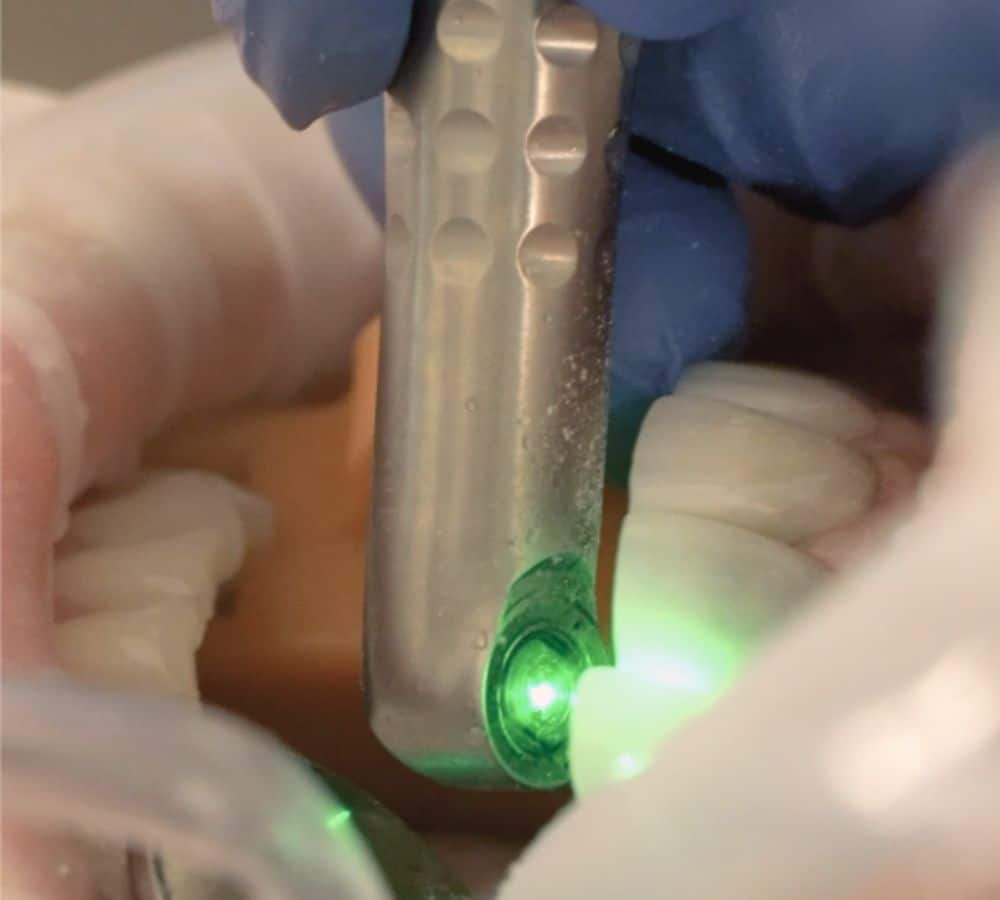
Laser Dentistry
What is laser dentistry, and what can it actually do?
“Laser” is an acronym for light amplification by stimulated emission of radiation. In dentistry it means using focused light energy in place of scalpels and drills for a range of procedures — decayed teeth, gum disease, removing old restorations.
The practical consequence is precision. A laser removes only what it is aimed at, which allows more conservative procedures, often less discomfort, and in many cases shorter healing times.
Laser dentistry is a set of tools, not a separate branch of dentistry, and it does not replace conventional techniques. A great deal of treatment is still better done with a drill, a scalpel or an instrument, and which approach suits a particular tooth is a clinical judgement rather than a preference.
Smile Solutions is at Level 1, 220 Collins Street, Manchester Unity Building, Melbourne CBD.
How a dental laser actually works
This is the part that explains everything else on the page, and it is simpler than it sounds.
A laser produces light of one specific wavelength. Different tissues absorb different wavelengths, and absorption is the whole mechanism: light that is absorbed deposits its energy as heat in that tissue and nowhere else; light that is not absorbed passes straight through and does nothing.
So a laser is not a beam that cuts everything in its path. It is a beam matched to a target:
- Wavelengths strongly absorbed by water and by the mineral in tooth structure will cut enamel, dentine and bone. The water trapped inside the mineral flashes to steam in microseconds and flicks tiny particles of tooth away — which is why these systems run with a water spray and why they remove tissue without the pressure, vibration and heat build-up of a drill.
- Wavelengths absorbed by haemoglobin and pigment pass through water almost untouched but are taken up by soft tissue. These cut gum, and they seal small blood vessels as they go, which is where the reduced bleeding comes from.
That single fact explains why a practice keeps several machines rather than one. The wavelength is chosen for the tissue — a soft-tissue laser cannot cut a cavity, and a hard-tissue laser is the wrong instrument for reshaping a gum margin. The list of systems below includes both families: erbium systems for hard tissue, diode systems for soft tissue, and dual-wavelength units that carry one of each.
What lasers cannot do is worth stating in the same breath. They will not cut metal, so an amalgam filling or a metal crown still comes off with a drill. They do not remove the need for a properly shaped preparation under a crown. And a laser-prepared surface still needs conventional etching and bonding before a filling is placed — the laser does not replace that step.
The benefits
- Precise treatment, often with less discomfort
- Reduced need for anaesthesia in some procedures
- Faster healing in many soft-tissue procedures
- Preservation of healthy tooth structure
- Enables more conservative dental procedures
- Used in treating gum disease, cavities, cosmetic concerns and various surgical needs
How much of this applies in any individual case depends on the procedure and the patient.
Two of these are worth unpacking. Less discomfort comes mostly from what is absent — no vibration, no pressure against the tooth, no whine, and a cutting action that does not build heat the way a bur does. That is why some patients tolerate laser treatment without anaesthetic; it is not that the tooth has been numbed, but that less of what normally provokes pain is happening. Preservation of tooth structure comes from the beam removing softened, water-rich decay more readily than sound mineral, so the preparation can stay closer to the size of the lesion.
Nine things lasers are used for here
Fillings without local anaesthetic
Laser can treat some cavities and place some fillings without local anaesthetic. It removes decay precisely and reduces the need for the drill, making the procedure less invasive.
Many patients feel little or nothing; some still need an injection, and deeper cavities close to the nerve usually do. Anaesthetic is always available, and asking for it partway through is fine.
For anyone whose dental avoidance is specifically about needles, this is the single most relevant item on the list. Dental Anxiety. For what a filling involves generally, see Tooth Fillings.
Gum lifts and recontouring
Specialist periodontists use laser to reshape the gum line ahead of cosmetic treatment. Precision tends to reduce bleeding, swelling and recovery time.
A dry, bloodless field is not only a comfort advantage. It is also why a margin can be shaped and then judged accurately in the same appointment. See Gummy Smile.
Non-invasive removal of existing crowns and veneers
Laser can remove existing crowns and veneers without the traditional ultrasonic tool, by breaking down the dental cement holding them in place. This reduces the risk of damaging the remaining tooth structure underneath — which matters, because the tooth beneath an old crown is often the part you most need to preserve.
This applies to porcelain and ceramic restorations, which the beam passes through to reach the cement. It does not apply to metal-based crowns. See Porcelain Veneers and Dental Crowns.
Mucositis and oral ulcers
Mucositis — inflammation of the mucous membranes in the mouth — is most commonly seen in patients undergoing radiotherapy or chemotherapy. Laser is used to reduce inflammation, support healing and provide pain relief without invasive procedures. This is supportive care delivered alongside your oncology team, not a treatment for the underlying condition.
This use is different in kind from the others: the laser is set to a level that does not cut or ablate anything, and the intent is to influence healing in the tissue rather than remove it. It is worth knowing that distinction, because it explains why the same machine can be used both to prepare a cavity and to settle an ulcer.
Snoring and sleep apnoea
Laser treatment of the soft tissue at the back of the throat is offered by some practices with the aim of reducing airway obstruction and snoring.
Be careful with this one, and ask direct questions. The Sleep Health Foundation's own wording on palatal stiffening is deliberately restrained: laser surgery on the throat “may work for some people. But it can be painful. Only an Ear, Nose and Throat surgeon can do this.” The evidence base for laser treatment of obstructive sleep apnoea is considerably weaker than for CPAP or a properly fitted mandibular advancement splint, and it should not be presented as a replacement for either. Obstructive sleep apnoea is a medical diagnosis made on a sleep study, and it carries cardiovascular risk when undertreated. If you have been diagnosed with OSA, any change to your treatment is a decision for your sleep physician. TMD & Teeth Grinding.
TMD and teeth grinding
Laser is sometimes used with the aim of easing temporomandibular joint disorder and bruxism symptoms by reducing muscle tension, pain and inflammation, and responses vary widely between patients.
The guideline evidence does not support it, and we would rather you heard that here. A clinical practice guideline published in the BMJ in 2023 makes a conditional recommendation against low level laser therapy for TMD, alone or in combination with other interventions. A Cochrane review comparing an occlusal splint against low-level laser physical therapy for muscle pain on chewing found little to no difference (RR 0.17, 95% CI 0.02 to 1.26; 1 study, 40 participants), with the evidence rated very uncertain. If laser is proposed for jaw pain, ask what it is expected to add over the measures that are recommended, and see TMD & Teeth Grinding.
Endodontic treatment
Lasers are used to help clean and disinfect root canals, supporting conventional irrigation in removing bacteria and debris. It is an adjunct to root canal treatment, not a substitute for it. Root Canal Therapy.
The reason it is an adjunct is worth understanding: a root canal system contains fins, deltas and tubules that no instrument reaches, so disinfection is chemical rather than mechanical. Laser energy can help drive irrigant into those spaces. It does not shape the canal, and it does not replace the seal — the outcome still depends on the conventional steps being done well. A 2025 review in the British Dental Journal puts the state of the evidence for laser and ultrasonic irrigant activation plainly: laboratory studies support their effect on biofilm, but the clinical outcome studies do not provide strong evidence of clinical efficacy.
Crown lengthening
Precise reshaping of gum tissue and bone to expose more of the tooth, generally with less discomfort and faster healing than traditional methods.
Periodontal disease
Targeting infected gum tissue and bacteria, often with quicker healing and greater comfort than conventional methods. It supplements scaling and root planing rather than replacing them, and it does not remove the need for ongoing maintenance. Specialist Periodontists.
The honest position on the evidence: thorough mechanical cleaning of the root surface remains the foundation of periodontal treatment, and the additional benefit of laser on top of it is a matter of ongoing debate in the dental literature rather than a settled finding. Some clinicians and patients report better comfort and healing; the measurable gain in pocket depth over good conventional therapy alone is modest at best. Anyone offering laser as a way to avoid conventional periodontal treatment or its maintenance schedule is overstating it. See Bleeding Gums and Dental Cleans & Hygienists.
The equipment
We use several laser systems, chosen because different wavelengths suit different tissues and procedures:
- LightWalker Fotona
- Versa Wave
- NV laser
- Light Touch Er:YAG
- iPlus Biolase
- Fox diode
The suite of lasers is accessible to all qualified clinicians and integrated across the practice's services, rather than confined to one department.
The naming follows the physics. Er:YAG identifies an erbium-doped crystal — an erbium-family, hard-tissue wavelength. Diode identifies a semiconductor source, in the soft-tissue range. Some units house two sources in one chassis so a clinician can switch between hard and soft tissue in the same appointment without changing machines.
What the appointment is like
- Everyone in the room puts on protective eyewear, including you. It is worn for the whole time the laser is switched on.
- The sound is different. Erbium lasers make a rapid popping or crackling noise rather than a whine, and there is a fine water spray. There is no vibration and no pressure on the tooth.
- You may notice a faint smell during soft-tissue work. It is expected.
- Tell your clinician if you feel anything sharp. Treatment without anaesthetic is a choice you can reverse at any point, and stopping to place an injection costs a few minutes.
After soft-tissue laser work, a whitish film over the treated gum for several days is normal healing rather than infection, stitches are often unnecessary, and the usual advice is to avoid very hot, spicy or acidic food and to keep the area clean without scrubbing it. Your clinician will tell you what applies to your case.
Who performs it
Depending on the treatment, laser dentistry is performed by either general dentists or registered specialist periodontists (gum specialists).
Clinicians using lasers have undergone specialised training and have experience in their respective laser techniques. There is no AHPRA specialty in laser dentistry — it is a technique used within existing scopes of practice, so what you can verify on the register is a clinician's general or specialist registration.
There is, however, a Victorian licensing requirement. The Australian Dental Association records that while all registered dental practitioners with appropriate training and competence may undertake dental procedures using Class 4 lasers, Victorian legislation — along with Western Australia, Queensland and Tasmania — requires practitioners in those states to first obtain a licence to do so from the state regulatory authority. It is a fair thing to ask about anywhere in Melbourne.
The risks — stated plainly
Laser dentistry is safe when performed by trained and experienced professionals, and this is not a formality.
The risks relate to:
- the heat produced by the frequency of the laser beam
- the amount of coolant used when the laser is applied to the tooth surface
- how long the clinician applies the laser to any one tooth surface
All three are operator-controlled variables. That is precisely why training matters here more than for many procedures: the equipment does not protect the patient from incorrect technique. The ADA states the consequences directly in the context of whitening: incorrect application of heat and other forms of energy, such as light from a plasma arc lamp or a high-power Class 4 laser, “may cause nerve damage to the tooth and burns to adjacent soft tissues, and failure to ensure use of the appropriate protective eyewear may also cause irreversible injury”. The relevant standard is AS/NZS 4173:2018, Safe use of lasers and intense light sources in health care, which sets requirements for dental practices including standards of training.
In addition:
- Everyone in the room wears protective eyewear. Laser light can damage the retina, and this is not optional.
- Thermal injury to the pulp or to soft tissue is the main hazard of incorrect settings, and it can mean a tooth needing root canal treatment afterwards.
- Not every case is suitable. Deep decay, large restorations, some medical conditions and certain medications can all rule it out.
- Tell your clinician about any medication that makes you sensitive to light, and about any medical condition affecting healing, before treatment rather than after.
- Being treated without anaesthetic is a choice, not an obligation. If it hurts, say so.
Is it suitable for me?
Laser dentistry suits many patients, but suitability depends on individual circumstances and the specific condition being treated. Your dentist will evaluate your needs and determine whether it is the right option.
Questions worth asking:
- Which laser, and why that one for this tissue?
- Is the laser replacing the conventional method here, or adding to it?
- What is the realistic advantage in my case — comfort, healing, or the result?
- Can I have anaesthetic if I want it?
- What does this cost compared with the conventional approach?
Common questions
The word “laser” has “radiation” in it. Is this like having an X-ray?
No, and the confusion is entirely reasonable given the acronym.
The “radiation” in light amplification by stimulated emission of radiation means electromagnetic radiation — light. A dental laser emits light at one wavelength. An X-ray machine emits ionising radiation, which is a different part of the spectrum and carries a different kind of risk, measured in microsieverts and justified case by case. Nothing in the safety literature for dental lasers describes an ionising-radiation exposure, and there is no dose to add up over a lifetime.
What the hazards actually are is set out above and worth repeating here, because they are real: heat and light in the eye. The Australian Dental Association's warning about incorrect application of energy from a high-power Class 4 laser names nerve damage to the tooth, burns to adjacent soft tissue, and irreversible injury where protective eyewear is not used. The governing standard, AS/NZS 4173:2018, is titled Safe use of lasers and intense light sources in health care — lasers and light, not radiology.
So the right questions to ask are about training, settings and eye protection, not about accumulated dose. If you do want the radiation numbers for dental imaging, they belong with X-rays and your clinician should be able to tell you which examination a figure applies to.
Is laser whitening better than ordinary whitening?
This is where the marketing runs well ahead of what the profession actually claims, so it is worth reading the ADA's own wording closely.
The Australian Dental Association's policy on teeth whitening describes in-practice bleaching as being done “sometimes with the aid of a light or heat source that may shorten the application time required”. That is the whole of the claim. The ADA does not say a light or laser produces a whiter result, a longer-lasting result, or a result unobtainable without one — only that it may shorten the time in the chair.
Against that modest benefit sit the risks named in the same document: incorrect application of energy from a plasma arc lamp or a high-power Class 4 laser “may cause nerve damage to the tooth and burns to adjacent soft tissues”, with irreversible injury possible where eyewear is not properly used.
Two further points that matter more than the light does:
- The active chemistry is regulated, and that is what does the work. Under Schedule 10 of the Poisons Standard, products containing more than 6% hydrogen peroxide or more than 18% carbamide peroxide may only be sold, supplied and used by registered dental practitioners. That threshold — not the lamp — is the real difference between a professional treatment and a supermarket kit.
- Sensitivity is the common side effect of whitening itself, whatever activates it.
If you are choosing between options, choose on the concentration, the supervision and the condition of your teeth beforehand, and treat the light as a possible time-saver rather than a better outcome. Teeth Whitening covers the options in full.
Does laser treatment cost more, and will my health fund cover it?
Ask before, in writing, and ask in terms of item numbers rather than technique.
Australia has no national dental fee schedule. Fees are set by each practice, which is why two quotes for what sounds like the same treatment can differ substantially. The Australian Dental Association runs an annual Dental Fees Survey that summarises what practitioners charge by item number and by hourly rate, and it is the reference point its own advocacy uses when arguing about the gap between benefit schedules and the cost of providing treatment.
What this means practically:
- Health funds pay against item numbers, not against the instrument used. If a filling is a filling, the item number is what your fund assesses. Where a laser procedure is billed under a different item, that is the thing to identify before you agree.
- Ask for the item numbers, the total, and the expected rebate — then check the rebate with your fund yourself rather than relying on an estimate at reception.
- Ask what the conventional alternative would cost, which is the only way to see whether you are paying for the technique or for the treatment.
The price guide sets out indicative fees, and Payment Plans covers the financing options if the total is the obstacle. Fees are indicative and change; confirm yours at consultation.
How do I check that the clinician is licensed to use a Class 4 laser in Victoria?
You ask, because this one is not on the AHPRA register.
Two separate things have to be in place, and they are checked in different ways:
- Registration. General and specialist registration is public and free to search by name on the AHPRA register at ahpra.gov.au. That tells you the person is a registered dentist, and whether they hold specialist registration. It does not mention lasers, because there is no AHPRA specialty in laser dentistry.
- The state laser licence. The ADA records that all registered dental practitioners with appropriate training and competence may undertake procedures using Class 4 lasers, but that Victorian legislation — with Western Australia, Queensland and Tasmania — requires practitioners in those states to obtain a licence first, from the appropriate state regulatory authority. That licence sits outside the national register, so the only way to confirm it is to ask the practice who issued it and to see it.
There is a third thing worth asking about, which is the practice rather than the person: AS/NZS 4173:2018 sets requirements for dental practices using lasers and intense light sources, including standards of training. A practice that takes the standard seriously will not be put out by the question.
None of this is an accusation. It is the same principle used everywhere else on this site — the things you can verify independently are worth more than the things you are told.
Related pages: General Dentistry, Tooth Fillings, Root Canal, Bleeding Gums, Dental Anxiety, TMD & Teeth Grinding, Specialist Periodontists, Gummy Smile.
Practical details
| Address | Level 1, 220 Collins Street, Manchester Unity Building, Melbourne VIC 3000 |
| Phone | 13 13 96 |
| theteam@smilesolutions.com.au | |
| Monday – Friday | 8.00am – 6.00pm |
| Saturday | 8.30am – 1.30pm |
| Sunday | By appointment |
| Performed by | General dentists or specialist periodontists |
| Class 4 lasers in Victoria | State licence required in addition to registration |
| Hard tissue | Erbium-family wavelengths |
| Soft tissue | Diode wavelengths |
| Cannot cut | Metal restorations |
| Eye protection | Worn by everyone in the room |
| Safety standard | AS/NZS 4173:2018 |
| Systems in use | LightWalker Fotona, Versa Wave, NV, Light Touch Er:YAG, iPlus Biolase, Fox diode |
| Parking | Wilsons Parking, Flinders Lane (between Swanston and Russell) |
General and specialist registration can be verified free on the AHPRA public register at ahpra.gov.au.
General information only — it is not a diagnosis, a treatment plan, a quote or a promise of any particular clinical outcome, and it does not replace advice from your treating practitioner. Laser treatment carries the risks set out above, whether a procedure can be done without anaesthetic cannot be known before examination, and how much discomfort any patient experiences varies between individuals. Where laser is described for a medical condition such as sleep apnoea, it is an adjunct to be discussed with the treating medical specialist, not a replacement for prescribed therapy. Fees are indicative and subject to change; confirm at your consultation.
Smile Solutions trades under ABN 28 193 514 103.
Images on This Page
-
https://www.facebook.com/tr?id=800557773428361&ev=PageView&noscript=1
(no alt text)
-
https://www.smilesolutions.com.au/wp-content/uploads/2025/10/calendar_month.svg
(no alt text)
-
https://www.smilesolutions.com.au/wp-content/themes/arcadian-wordpress-theme/assets/images/smile_solutions_logo_white.png
Smile Solutions Logo
-
https://www.smilesolutions.com.au/wp-content/themes/arcadian-wordpress-theme/assets/images/smile_solutions_logo_purple.png
Smile Solutions Logo
-
https://www.smilesolutions.com.au/wp-content/uploads/2025/11/Smile-Solutions-4.png
Smile Solutions - Melbourne CBD
-
https://www.smilesolutions.com.au/wp-content/uploads/2025/09/Laser-Dentistry-for-Obstructive-Sleep-Apnoea.jpg
Laser treatment
-
https://www.smilesolutions.com.au/wp-content/uploads/2025/08/69a44c30c93ce196d539cc5520080df52a5f3f88-scaled.jpg
69a44c30c93ce196d539cc5520080df52a5f3f88 scaled
-
https://www.smilesolutions.com.au/wp-content/themes/arcadian-wordpress-theme/assets/images/family_owned_bussiness.png
Family Owned Business
-
https://www.smilesolutions.com.au/wp-content/themes/arcadian-wordpress-theme/assets/icons/icon--phone.svg
Smile Solutions Contact
-
https://www.facebook.com/tr? id=800557773428361&ev=PageView&noscript=1
(no alt text)