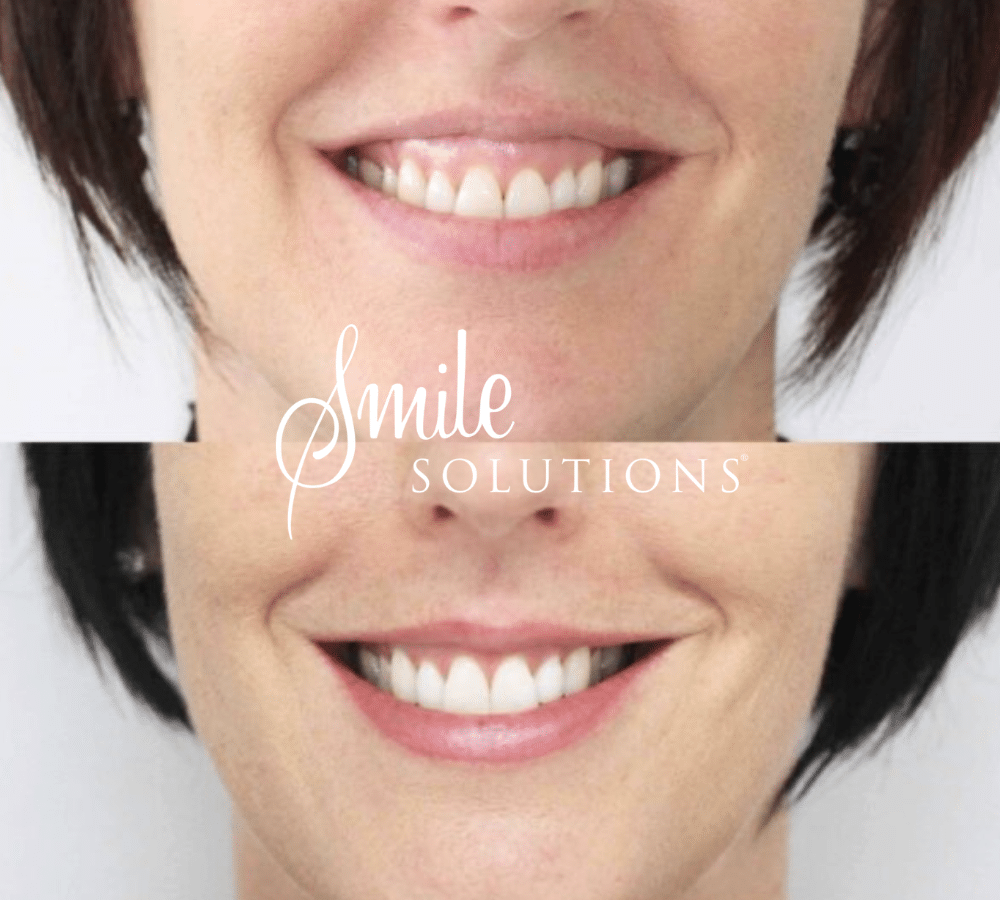
Gummy Smile
What is a gummy smile, and what can be done about it?
If a lot of gum tissue shows above your teeth when you smile, that is what dentists call a gummy smile — clinically, excessive gingival display. It changes the balance of the smile, making teeth look shorter and gums more prominent than the person expects.
It is not a disease and it does not need treating. But it is treatable, and the right treatment depends entirely on which of several different causes is producing it. Two people with visually similar gummy smiles can need completely different procedures — and in some cases, procedures performed by completely different specialists.
Smile Solutions is at Level 1, 220 Collins Street, Manchester Unity Building, Melbourne CBD.
How much gum show is actually normal
This is worth stating plainly, because a lot of people worry about a smile that is within the ordinary range.
On a full smile, showing up to about 2 mm of gum above the upper front teeth is generally considered unremarkable. Around 3 mm or more is where the smile starts to be commonly described as gummy, and 4 mm or more is the figure most often used in the literature as the threshold for excessive gingival display.
Three things are worth knowing about those numbers:
- They are aesthetic conventions, not medical thresholds. Nothing goes wrong at 4 mm. The measurement describes an appearance, not a condition.
- Gum display reduces with age. The upper lip lengthens and loses elasticity over time, so a smile that shows gum at twenty often shows less at forty. This is one of the few cosmetic concerns that tends to improve on its own.
- A posed smile and a spontaneous smile are different. Assessment should look at both, plus speech, because the photograph you dislike may not represent how your face moves most of the time.
The five causes
Diagnosis matters more here than in almost any other area of cosmetic dentistry, because the cause determines whether the answer is a gum procedure, a muscle procedure, an orthodontic one, or nothing at all.
1. A hypermobile upper lip. The lip pulls higher than average when smiling, exposing gum that is otherwise a normal height. The gums are not the problem — the muscle is. Average upper lip travel between rest and full smile is around 6 to 8 mm; a hypermobile lip may travel considerably more.
2. A short upper lip. The lip is anatomically shorter, so even normal movement exposes more gum. Typical upper lip length is roughly 20 to 24 mm from the base of the nose to the lip edge.
3. Altered passive eruption. The teeth appear short because the gum never finished migrating to its adult position as the teeth came through, so it still covers part of each crown. The teeth are a normal length; less of each one is visible. This is the cause most amenable to a straightforward gum procedure.
4. Teeth that are short relative to the gum, either genetically or through wear — grinding, erosion or edge chipping over years. Here the tooth really is shorter than it should be, and removing gum alone can make the proportions worse rather than better. Where grinding is the cause, it needs managing in its own right before anything is rebuilt — see TMD & Teeth Grinding.
5. Vertical maxillary excess. The upper jaw itself is longer than average, carrying the whole dental arch lower in the face. This is a skeletal difference, not a gum or muscle one, and it is the case where gum surgery and injectables will both disappoint. It is identified on a facial assessment and a lateral cephalometric radiograph, and where someone wants it addressed the route is orthodontics combined with orthognathic (jaw) surgery — a much larger undertaking that many people quite reasonably decline once they understand the scale of it. See Jaw Surgery.
Causes 3 and 4 are gum and tooth problems. Causes 1 and 2 are lip and muscle problems. Cause 5 is skeletal. Combinations are common, and mixed cases are treated in stages.
What actually happens at the assessment
The assessment exists to separate those five, and it is mostly measurement rather than opinion:
- Gingival display measured on a full, unposed smile, usually from photographs and video rather than a single still, because a held smile is not a natural one
- Upper lip length at rest, and lip travel between rest and full smile
- Crown height and width of the upper front teeth. A central incisor is typically around 10 to 11 mm tall, with a width roughly 75 to 85 per cent of its height. Teeth that measure short point to cause 3 or 4
- Where the gum sits relative to the cemento-enamel junction — the anatomical join between crown and root — which is what distinguishes altered passive eruption from a normal gum position
- Probing depths and the position of the underlying bone crest, which determines which of the two gum procedures below is appropriate
- A radiograph, and for suspected skeletal cases a lateral cephalometric view — see Our Technology
Ask which cause has been identified before agreeing to any treatment. It is a fair question and it has a specific answer.
Treatment 1: gum lift — and the distinction that matters
A gum lift is periodontal surgery performed by a specialist periodontist, registered with the Dental Board of Australia in gum treatment, and it can often be completed in the dental chair in a single appointment. A dental laser may be used to reduce gum height or to even out an asymmetrical gum line, exposing more of the existing tooth — see Laser Dentistry.
There are two versions of this operation, and the difference determines whether the result holds.
Gingivectomy removes gum tissue only. It suits cases where there is enough attached gum to spare and the underlying bone already sits far enough from the crown.
Surgical crown lengthening removes a small amount of the underlying bone as well. This is necessary when the bone crest sits too close to where the new gum margin needs to be.
The reason is a structure called the supracrestal tissue attachment — formerly the biologic width. Between the bone crest and the base of the gum sulcus there is roughly 2 mm of soft-tissue attachment that the body maintains. If gum is cut back without making room for it, the tissue simply grows back to re-establish that 2 mm, and the gummy smile returns over the following months. Where a restoration margin is also planned, clinicians generally want about 3 mm between the bone crest and that margin.
This is the single most useful thing to understand about gum lifts. A relapsed gum lift is usually not bad luck or poor healing; it is a gingivectomy performed where crown lengthening was needed. If you are offered a gum lift, ask whether bone will be recontoured, and why or why not.
Healthy gums are a prerequisite. Surgery on inflamed tissue heals less predictably and the margin is harder to place accurately, so active gum disease is treated first. See Bleeding Gums and Dental Cleans & Hygienists.
Treatment 2: muscle relaxant injectables
Where the cause is the upper lip pulling too high rather than excess gum tissue, muscle relaxant injectables can be used instead.
Small injections into the levator labii superioris alaeque nasi — a muscle running either side of the nose that lifts the upper lip — reduce the upward movement of the lip, so that a more balanced amount of tooth shows when smiling.
This approach treats the movement, not the anatomy. The effect is temporary, typically wearing off over a few months, and the treatment needs repeating to be maintained. Over-treatment can flatten the smile or produce asymmetry, which is why conservative dosing and a review appointment are normal practice.
Muscle relaxant injectables are prescription-only treatments. They can only be prescribed and administered by a suitably qualified practitioner following an individual consultation and assessment, and are not suitable for everyone. Australian law limits what may be said publicly about prescription medicines, which is why this page describes the treatment rather than naming the product. You can check any practitioner's registration on the AHPRA public register — see Dentists & Registered Specialists.
One practical use worth knowing: because the effect is temporary and reversible, injectables are sometimes used as a trial — a way of seeing what a reduced gum display would actually look like on your face before committing to anything surgical. Not every case suits that approach, but it is a reasonable thing to ask about.
Treatment 3: lip repositioning surgery
A less commonly discussed option for a hypermobile lip. A strip of tissue is removed from inside the upper lip and the lip is sutured to sit lower, mechanically limiting how far it can travel.
It is a surgical procedure with a longer-lasting effect than injectables, but it carries the ordinary risks of oral surgery, and partial relapse over time is well documented. It is worth knowing the option exists; whether it is appropriate is a matter for individual assessment.
Treatment 4: orthodontic intrusion
Often overlooked, and genuinely the right answer in some cases.
Where the upper front teeth sit too low — rather than the gum sitting too high — they can be moved upward into the bone, taking the gum margin with them. Modern orthodontics does this using small anchorage screws placed in the bone to pull against, which made the movement far more predictable than it once was.
It is slower than surgery, measured in months rather than a single appointment, and it is not suitable where the teeth are already in the right position. But it removes nothing — no gum, no bone, no enamel — which puts it high on the conservative list where it applies. It is also frequently combined with the other approaches in a staged plan. See Orthodontics, Orthodontic Braces and Invisalign.
Choosing between them
| If the cause is | The usual approach | Durability |
|---|---|---|
| Gum covering otherwise normal teeth, bone well positioned | Gingivectomy | Structural, generally stable |
| Gum covering teeth, bone crest too high | Crown lengthening, with bone recontouring | Structural, generally stable |
| Asymmetrical gum line | Gum lift, laser technique | Structural |
| Upper lip pulling too high | Muscle relaxant injectables | Temporary, needs repeating |
| Upper lip pulling too high, wanting a longer-lasting result | Lip repositioning surgery | Longer-lasting; partial relapse documented |
| Short upper lip | Assessment required; options are limited | |
| Upper front teeth sitting too low | Orthodontic intrusion | Structural, with retention |
| Short or worn teeth | Restorative treatment, possibly with gum work | Depends on restoration |
| Longer upper jaw (skeletal) | Orthodontics with jaw surgery, or acceptance |
Mixed causes are the norm rather than the exception, and a staged plan — gum work, then a settling period, then restorations, with orthodontics before all of it where teeth need moving — is usually what a thorough assessment produces. See Cosmetic Dentistry for how multi-treatment sequencing works generally.
Why sequencing matters if veneers or crowns are also planned
If you are considering Porcelain Veneers, Same-Day Porcelain Veneers or Dental Crowns as well, the gum work comes first, and then there is a wait.
Gum tissue continues to mature and reposition for several weeks to a few months after surgery. A veneer fitted to a gum line that has not settled will end up with its margin in the wrong place — either visible above the gum later, or buried and inflamed. Most clinicians allow a minimum of six to eight weeks, and longer where bone was recontoured, before taking the final impression or scan.
Being told to wait is a sign the sequencing is being done properly.
Where teeth are being lengthened rather than the gum shortened, the more conservative option is often composite bonding added to the edges — which removes nothing and can be reversed. It is worth having that costed alongside any veneer plan.
Healing, and what the first weeks look like
Expect tenderness and swelling for a few days, managed with ordinary analgesia, and a soft diet initially. The gum looks its worst in the first week and steadily improves.
The appearance at two weeks is not the final result. Gum contour continues to refine for weeks afterwards, and the margin may sit slightly differently once fully healed. Judging the outcome too early is the most common source of disappointment.
Brushing the area gently but genuinely matters during healing; plaque at a healing margin causes inflammation that affects the final contour.
If the procedure itself is what concerns you rather than the outcome, say so when booking. See Dental Anxiety.
Risks and limitations, stated plainly
Every option here has trade-offs, and they should be discussed with you before you consent:
- Sensitivity where root surface is newly exposed, usually settling over weeks
- Gum recession beyond what was planned, which is difficult to reverse
- Asymmetry between sides, sometimes needing a refinement appointment
- Relapse, particularly where a gingivectomy was performed without addressing bone position
- Black triangles between teeth where gum volume between them was reduced — sometimes managed afterwards with bonding
- With injectables, a flattened or uneven smile if dosing is too aggressive, and the certainty that the effect will wear off
- With any surgery, the ordinary risks of bleeding, infection and delayed healing
No outcome can be guaranteed, and how any of these approaches performs varies between individuals.
Common questions
Which treatment is suitable for my gummy smile?
That depends on the cause. Excess gum tissue, the position of the teeth, upper-jaw proportions and upper-lip movement require different approaches. A clinical assessment should identify the cause before a gum lift, injectable treatment, lip repositioning, orthodontics or combined treatment is recommended.
Does a gum lift always involve reshaping bone?
No. Some cases require gum contouring only, while others need bone recontouring to create a stable relationship between the gum margin and the supporting tissues. The clinician should explain which procedure is proposed and why.
Are muscle-relaxant injections a permanent treatment?
No. Their effect is temporary and repeat treatment is required to maintain it. They may help where excessive upper-lip movement contributes to gum display, but they do not correct every cause.
How long before veneers or crowns can be completed?
The gum line needs time to heal and stabilise. The page's published guidance is commonly six to eight weeks, with a longer interval after bone recontouring. Your treating clinician should set the sequence for your case.
Can a gummy-smile result relapse?
Some change can recur, depending on the cause, procedure and individual healing. Ask what degree of change is realistic, how stability will be assessed and what a revision would involve and cost.
Who performs gum-lift treatment at Smile Solutions?
The page states that gum-lift procedures are performed by a specialist periodontist. You can verify a practitioner's registration and specialist entry on the AHPRA public register.
Cost and consultation
Costs depend on the procedure, the number of teeth involved and whether bone recontouring is required, so a figure needs an assessment rather than a phone estimate. See Price Guide for the practice's published figures and Payment Plans for the arrangements offered.
The Complimentary Cosmetic Consultation is a discussion with a treatment coordinator rather than a clinical examination — it does not include a check-up, x-rays or scans, and a $50 refundable deposit secures the appointment. A diagnosis of which cause applies to you requires an examination by a clinician.
Before you decide
Results, recovery times and potential risks vary for each individual and procedure. The information here is general in nature and intended for people over 18.
Undergoing any dental or cosmetic procedure is a significant decision. Seek independent advice from a qualified, AHPRA-registered practitioner before proceeding, and ask specifically about the risks, limitations and expected longevity of the treatment proposed for you.
Photography published by the practice is shared with patient consent, with no filters or AI alteration applied. “After” images are typically taken around two weeks post-procedure — which, as above, is before gum contour has fully settled. See Before & After Gallery.
Related pages: Cosmetic Dentistry, Cosmetic Dentistry Under Specialist Care, Specialist Periodontists, Porcelain Veneers, Composite Bonding, Dental Crowns, Orthodontics, Jaw Surgery, Our Team, Before & After Gallery.
Practical details
| Address | Level 1, 220 Collins Street, Manchester Unity Building, Melbourne VIC 3000 |
| Phone | 13 13 96 |
| theteam@smilesolutions.com.au | |
| Monday – Friday | 8.00am – 6.00pm |
| Saturday | 8.30am – 1.30pm |
| Sunday | By appointment |
| Normal gum display | Up to about 2 mm |
| Commonly called gummy | 3 mm or more |
| Gum lift performed by | Specialist periodontist |
| Gum lift appointments | Usually one |
| Wait before veneers or crowns | Commonly 6–8 weeks, longer after bone recontouring |
| Injectable effect | Temporary; repeat treatment required |
| Parking | Wilsons Parking, Flinders Lane (between Swanston and Russell) |
Every practitioner's registration, division and any specialist entry can be verified free on the AHPRA public register at ahpra.gov.au.
Smile Solutions trades under ABN 28 193 514 103.
Images on This Page
-
https://www.facebook.com/tr?id=800557773428361&ev=PageView&noscript=1
(no alt text)
-
https://www.smilesolutions.com.au/wp-content/uploads/2025/10/calendar_month.svg
(no alt text)
-
https://www.smilesolutions.com.au/wp-content/themes/arcadian-wordpress-theme/assets/images/smile_solutions_logo_white.png
Smile Solutions Logo
-
https://www.smilesolutions.com.au/wp-content/themes/arcadian-wordpress-theme/assets/images/smile_solutions_logo_purple.png
Smile Solutions Logo
-
https://www.smilesolutions.com.au/wp-content/uploads/2025/11/Smile-Solutions-4.png
Smile Solutions - Melbourne CBD
-
https://www.smilesolutions.com.au/wp-content/uploads/2025/09/Gummy-Smile-Smile-Solutions.png
Gummy Smile Smile Solutions
-
https://www.smilesolutions.com.au/wp-content/uploads/2025/08/69a44c30c93ce196d539cc5520080df52a5f3f88-scaled.jpg
69a44c30c93ce196d539cc5520080df52a5f3f88 scaled
-
https://www.smilesolutions.com.au/wp-content/themes/arcadian-wordpress-theme/assets/images/family_owned_bussiness.png
Family Owned Business
-
https://www.smilesolutions.com.au/wp-content/themes/arcadian-wordpress-theme/assets/icons/icon--phone.svg
Smile Solutions Contact
-
https://www.facebook.com/tr? id=800557773428361&ev=PageView&noscript=1
(no alt text)
-
https://bat.bing.com/action/0?ti=25148060&tm=gtm002&Ver=2&mid=30e0727c-6442-4bd5-83c7-4ae0dd243fd4&bo=1&sid=09c901d0ab2711f1b7844fe0af381e92&vid=09c9dc30ab2711f18af35336012a0931&vids=1&msclkid=N&pi=918639831&lg=en-US&sw=800&sh=600&sc=24&nwd=1&tl=Gummy%20Smile%20Treatments%20Melbourne%20%7C%20Smile%20Solutions&p=https%3A%2F%2Fwww.smilesolutions.com.au%2Fcosmetic-dentistry%2Fgummy-smile%2F&r=&evt=pageLoad&sv=2&cdb=AQAQ&rn=983904
(no alt text)