Specialist Periodontists
What does a periodontist do, and when do I need one?
Periodontics is the specialist field covering implant surgery, bone grafts, periodontal surgery, gum lifts, and the treatment of gingivitis and periodontal disease — gum disease.
Most people never need one, because most gum problems are handled earlier. The escalation path runs: hygienist → general dentist → periodontist, and where you enter it depends on how far the disease has progressed.
Smile Solutions is at Level 1, 220 Collins Street, Manchester Unity Building, Melbourne CBD.
When to see a periodontist
The easiest and most effective treatment is prevention, which is where the practice's focus sits.
Dental hygiene usually begins with an assessment of your gum tissue by your general dentist. If they consider your case more complex, they will recommend a consultation with a specialist periodontist.
Either your general dentist or the periodontist assesses your periodontal condition and advises what is needed to return you to good gum health. See General Dentistry and Dental Cleans & Hygienists.
The specific triggers for referral are usually one of these: pockets that stay deep after thorough cleaning; bone loss visible on radiographs, particularly in someone young; disease progressing despite good home care; teeth becoming loose or drifting; an implant with inflammation or bone loss around it; recession that keeps advancing; or a gum problem that needs surgery to resolve.
How gum disease is actually classified
A periodontal diagnosis is not just “gum disease”. Since 2018, an international classification describes it in two dimensions, and knowing them makes your own diagnosis far more legible.
Stage — how much damage has already been done, from Stage I (early) to Stage IV (advanced, with tooth loss and bite collapse). Stage is judged mainly on attachment and bone loss, and it does not go backwards.
Grade — how fast it is moving, from Grade A (slow) to Grade C (rapid). Grade takes account of the rate of bone loss relative to your age, how much plaque is present compared with how much damage it has caused, and risk factors including smoking and diabetes control.
The practical value: Stage tells you what has happened, Grade tells you what is likely to happen next — and Grade is the part that treatment and your own habits can change. Ask for your stage and grade. It is a specific answer, and it makes the recall interval and the urgency understandable rather than arbitrary.
What happens at the first specialist appointment
Expect measurement rather than immediate treatment:
- A full periodontal chart — pocket depths recorded at six points around every tooth, along with recession, so the true attachment level can be calculated
- Bleeding on probing, recorded as a percentage of sites; the number that tracks active inflammation
- Mobility, and furcation involvement where a molar's roots divide
- Radiographs, often a full set, to see the bone level around each tooth
- Plaque scores, which show precisely where home care is falling short
- A medical and risk history — smoking, diabetes, medications, family history
Those numbers become the baseline. Every later appointment is measured against them, which is what makes it possible to say whether treatment is working rather than guessing.
What treatment involves
Periodontal care typically begins with an assessment of the gum tissue, including measuring pocket depths and, usually, radiographs to see how much supporting bone remains. In the clinic, treatment may include:
- removing plaque, calculus (tartar) and staining, above and below the gumline
- applying decay-preventing agents as required
- tailored home-care instructions
- in advanced cases, surgical access to clean deeper deposits, or regenerative and grafting procedures
In many cases the maintenance phase can be completed by the practice's dental hygienists. Some patients require more advanced periodontal treatment depending on the severity of their condition.
If you are also undergoing restorative or cosmetic dental work, your home-care routine is modified and monitored throughout treatment to achieve the best outcome — because cosmetic work built over unstable gums does not last. See Cosmetic Dentistry.
The sequence, and the appointment that decides everything
Periodontal treatment runs in a defined order, and the middle step is the one patients most often miss the significance of.
- Cause-related therapy. Thorough cleaning of the root surfaces below the gum — usually under local anaesthetic, often one quadrant at a time — together with home-care coaching and addressing risk factors.
- Re-assessment, around six to eight weeks later. The full chart is repeated. This appointment is the decision point: sites that have responded move to maintenance, and only sites that have not are considered for surgery.
- Surgery, where it is needed — and considerably less often than people expect, because the first phase resolves a great deal.
- Maintenance, for life.
Skipping step 2 is the most common failure in periodontal care anywhere. Without the re-chart there is no way to know whether anything changed, and “another clean in six months” becomes a substitute for treatment.
The surgical options, in plain terms
Where pockets remain deep after the first phase, surgery is about access and architecture rather than cutting disease out:
- Open flap debridement. The gum is lifted so the root surfaces can be seen and cleaned directly, then replaced. The commonest periodontal operation.
- Resective surgery. The bone and gum are reshaped so the area can actually be cleaned at home afterwards — a pocket that cannot be maintained will simply re-infect.
- Regenerative surgery. In certain defect shapes, grafting material and a membrane, sometimes with biologic agents, can encourage some bone and attachment to regrow. It works in specific defects, not everywhere, which is why it is offered selectively rather than routinely. See Bone Grafting.
- Crown lengthening, exposing more tooth so a restoration has something to hold, or for appearance — see Gummy Smile.
- Gum grafting, covered below.
- Laser-assisted techniques, used as an adjunct — see Laser Dentistry, which also sets out honestly what the evidence does and does not support.
Recession and gum grafting
A separate problem from pocketing, and one people often assume is untreatable.
Recession exposes root surface, which causes sensitivity, a long-toothed appearance, and a surface that decays more readily than enamel. Causes include heavy brushing, thin gum tissue, tooth position, past periodontal disease and orthodontic movement.
Not all recession needs treating. Where it is stable, not sensitive and not bothering you, monitoring is a legitimate plan. Grafting is considered where it is progressing, where sensitivity persists, where there is too little firm tissue left to protect the tooth, or where appearance matters to you.
The usual technique takes a small amount of tissue from the palate, or uses a donor material, and places it over the exposed root. Root coverage is often good but not always complete, the palate is sore for a week or two where tissue was taken, and the result depends heavily on the shape of the defect. Ask what coverage is realistically expected in your case before agreeing to it.
What treatment can and cannot do
This is the honest frame to hold.
Gingivitis is reversible. Periodontitis is not. Treatment aims to stop the disease progressing and keep the teeth you have; the bone already lost does not grow back, except to a limited extent in specific defects treated with regenerative techniques.
After treatment you should also expect:
- gum recession to become more visible once inflammation and deposits are gone, sometimes with longer-looking teeth and gaps between them
- sensitivity to cold on exposed root surfaces, often for several weeks
- a maintenance programme for life, usually three- to four-monthly rather than six-monthly
- a real possibility of losing a tooth anyway where support was already severely compromised
Outcomes depend heavily on factors outside the chair — smoking, diabetes control, genetics and daily cleaning. Smoking in particular both worsens the disease and reduces how well treatment works; if you smoke, raise it directly, because it changes the prognosis more than any technique does.
Why three-monthly, and not six
The shortened recall is the part patients most often query, and it has a specific reason.
After thorough cleaning, the bacterial community in a treated pocket begins re-establishing within weeks and is largely back by around three months. In someone with healthy gums that is irrelevant. In someone who has already lost attachment, it is the point at which the disease starts moving again — so the appointment is scheduled to arrive before it does.
Maintenance visits are also not just cleans. Each one re-measures the sites that mattered, so a pocket that is deepening is caught while it is still a three-millimetre problem rather than a six-millimetre one.
What else affects your gums
- Smoking. The single largest modifiable risk factor, and it suppresses bleeding while the disease worsens — removing the warning sign people rely on.
- Diabetes. The relationship runs both ways: poorly controlled diabetes worsens gum disease, and untreated gum disease makes glucose harder to control. This is the best-evidenced of the oral–systemic links.
- Medications. Several classes — including some used for blood pressure, epilepsy and immune suppression — can cause the gums to overgrow, which makes cleaning harder and can need surgical reshaping. Bring your list; never stop a medication on your own account.
- Pregnancy. Hormonal change makes gums react more strongly to the same plaque. Treatment during pregnancy is routine.
- Stress, diet and genetics, each of which shifts susceptibility.
See Holistic Dentistry for how the oral–systemic evidence is stated carefully, and Bad Breath, which is frequently the symptom that brings periodontal disease to attention.
Signs worth acting on
- bleeding gums when brushing or flossing
- red, swollen or tender gums
- gum recession, or dark triangles appearing between teeth
- a “long in the tooth” appearance
- persistent bad breath
- teeth loosening or shifting
Bleeding may be masked in smokers, so its absence is not reassurance if you smoke. Bleeding Gums.
A gum abscess — swelling beside a tooth, often with a bad taste — needs to be seen promptly, and is treated differently from an abscess arising inside the tooth. See Toothache & Tooth Pain.
Working with the other specialists
Periodontists work closely with the practice's prosthodontists on cases requiring crowns, veneers, bridges, implants, dentures or combinations. See Specialist Prosthodontists.
That collaboration matters most in implant cases: the periodontist places the implant and manages the surrounding tissue; the prosthodontist restores it. Getting both right is what makes an implant last. Implants carry their own risks, including failure to integrate and later peri-implantitis. Dental Implants at Smile Solutions and Dental Implants.
Peri-implantitis deserves a note of its own. Inflammation and bone loss around an implant behaves differently from gum disease around a natural tooth: there is no periodontal ligament, the blood supply is poorer, it often progresses with few symptoms, and it is considerably harder to treat once established. Anyone with implants belongs in a maintenance programme for exactly this reason, and anyone with a history of periodontal disease who is considering implants should have that history factored into the plan.
Periodontists also perform gum lifts — including laser techniques — used in cosmetic cases where gum tissue covers too much of the tooth. Where bone is recontoured this is a surgical and permanent change, not a cosmetic touch-up.
Your periodontists
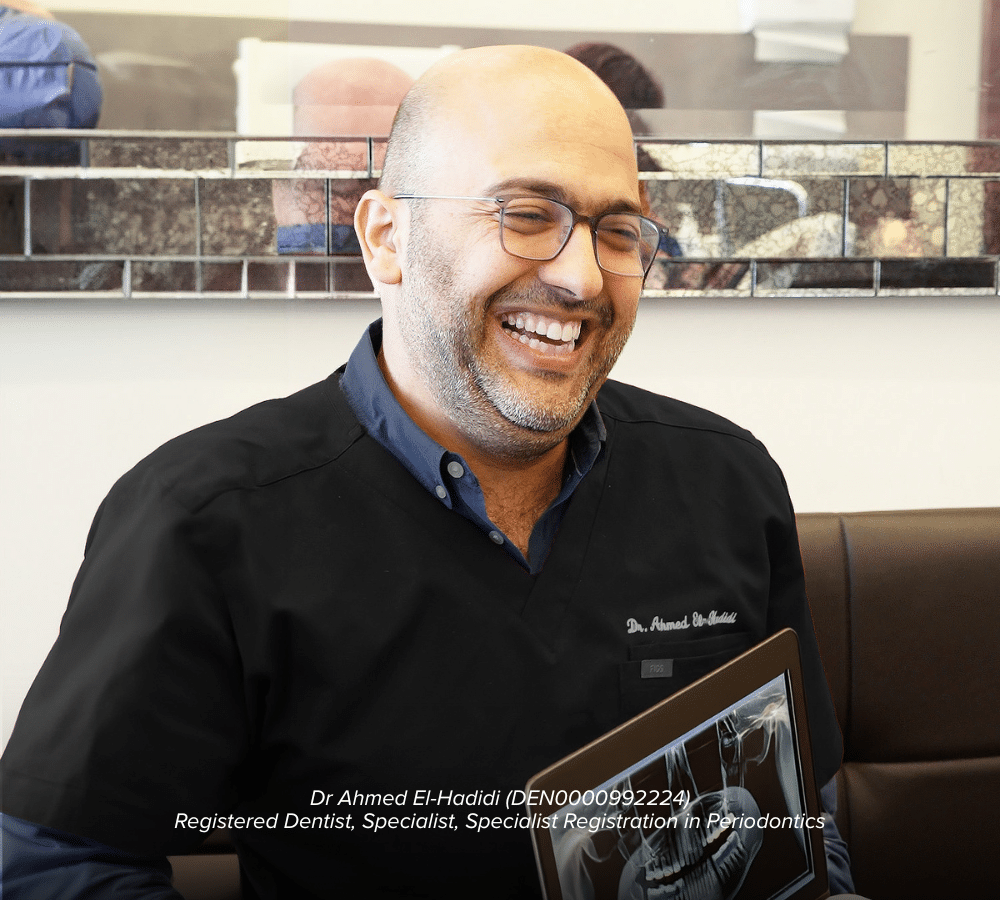
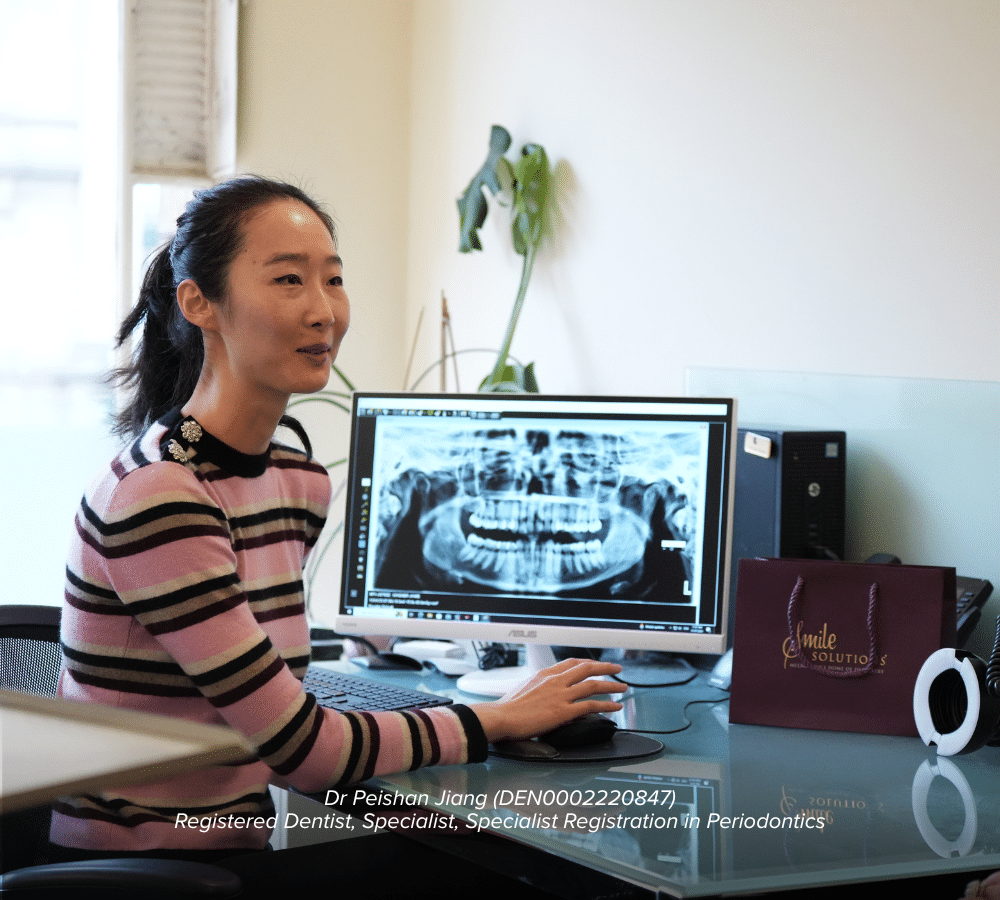
All periodontal treatment at we are carried out by Dental Board–registered specialist periodontists.
To use the title in Australia, a practitioner must hold a dental degree and then complete a further three or more years of full-time postgraduate training in periodontics, and hold specialist registration with the Dental Board of Australia. “Periodontist” is a protected title.
| Clinician | Role | Qualifications |
|---|---|---|
| Dr Ahmed El Hadidi | Specialist Periodontist | BDS, MRACDS (GDP), DCD (Perio) |
| Dr Peishan Jiang | Specialist Periodontist | BDSc (Griff), DClinDent (Griff) |
| Dr Simon Hinckfuss | Specialist Periodontist and Specialist Prosthodontist | BDSc, DCD (Pros), Cert.Perio MS (Minn) |
Dr Simon Hinckfuss holds dual specialist registration in both periodontics and prosthodontics — an unusual combination, and a useful one in implant cases where placement and restoration are planned together.
You can verify any clinician free on the AHPRA public register at ahpra.gov.au, or by calling 1300 419 495. See Dentists & Registered Specialists and Our Team.
Hygienist, dentist or periodontist?
| Focus | When | |
|---|---|---|
| Dental Hygienist | Professional cleans, gum health monitoring, prevention | At the interval your clinician advises — often three-monthly after periodontal treatment |
| General Dentist | General dental health, initial gum assessment | Routine check-ups |
| Specialist Periodontist | Advanced gum disease, implants, bone grafts, gum lifts | On recommendation, for complex cases |
No referral is required to see a periodontist here, though bringing recent radiographs and any previous periodontal charting saves time and repeat imaging.
Cost
Periodontal treatment is usually staged, and specialist fees are higher than general practice fees. Ask for the plan costed in stages, and for what the ongoing maintenance will cost each year — that continuing cost is part of the treatment, not an extra. Price Guide and Payment Plans.
On health funds: periodontal items generally attract a rebate, but more frequent maintenance visits can exhaust an annual limit faster than a standard six-monthly pattern, so it is worth asking how your limit applies across a year of three-monthly care before you start.
Questions worth asking
- What stage and grade is my periodontitis?
- Which teeth have the worst prognosis, and what is realistic for them?
- When is the re-assessment, and what numbers will we compare?
- Is surgery likely, or will the first phase probably be enough?
- How much of this is down to my home care, and what specifically should I change?
- What is my recall interval, and what would let me go back to six-monthly?
- If I am considering implants, does my gum history change that plan?
Related pages: Bleeding Gums, Dental Cleans & Hygienists, Bad Breath, Dental Implants, Bone Grafting, Gummy Smile, Specialist Prosthodontists, Specialist Care, Second Opinions & Corrective Dentistry.
Common questions
Does a referral to a periodontist mean I will need gum surgery?
No. Specialist assessment can lead to non-surgical treatment, changes to home care or a maintenance plan. The American Academy of Periodontology explains that surgery may be considered when non-surgical care does not achieve the required result. Ask what the first phase is intended to achieve and how the response will be assessed. A referral requests specialist judgement; it is not consent to an operation.
Am I unusual for having this? How common is periodontitis?
Common enough that the diagnosis says very little about you personally. Reviewing the epidemiology, a Diabetologia paper records that severe periodontitis — the form that threatens tooth retention — affects 10 to 15% of adults in most populations studied, and that moderate periodontitis is even more common, affecting 40 to 60% of adults. It describes the condition as “highly prevalent, but largely preventable”.
Two things are worth taking from that. The first is that moderate periodontal disease is closer to the norm than to the exception among adults, so a diagnosis is not evidence of neglect. The second is the reason it goes unnoticed: on those numbers a very large number of people have it, and the early and middle stages do not hurt. That is why the measured chart described above matters more than how your mouth feels.
I have diabetes. Does treating my gums actually help my blood sugar?
The measured effect is real but modest, and the honest version includes the disagreement between studies. Several meta-analyses have looked at HbA1c after periodontal treatment in people with diabetes, and they do not all agree on significance:
- Ten interventional studies, 456 patients combined: a weighted mean reduction in HbA1c of 0.66%, which failed to reach statistical significance.
- Nine studies, 485 patients (2008): a significant reduction of 0.46%.
- Five studies, 371 patients (2010): a significant weighted mean reduction of 0.40% over a follow-up of 3 to 9 months.
- A further meta-analysis of three studies: a significant reduction of 0.40% at 3 to 4 months after conventional periodontal therapy.
So the weight of evidence points to roughly a 0.4% HbA1c reduction, with the largest reported estimate the one that did not reach significance. The relationship also runs the other way: susceptibility to periodontitis is increased by approximately threefold in people with diabetes, and there is “a clear relationship between degree of hyperglycaemia and severity of periodontitis.”
One practical gap worth knowing about, noted by Diabetes Victoria: dental visits are not formally included in the Annual Cycle of Care for diabetes in Australia, which covers blood pressure, HbA1c, cholesterol, kidney function, podiatry and eye examinations. Nobody in that system is scheduled to ask about your gums, so you may have to raise it yourself — with both your dentist and whoever manages your diabetes. None of this is a claim that dental treatment treats diabetes; it is a reason for the two to be managed together.
Is gum disease linked to anything beyond my mouth?
Associations have been reported, and the strongest numbers come from long-term observational studies in people with type 2 diabetes — which is the population they apply to, and not adults generally. In those cohorts, after adjusting for age, sex, diabetes duration, BMI and smoking, the incidence of macroalbuminuria was 2.0, 2.1 and 2.6 times as high in people with moderate periodontitis, severe periodontitis, or no teeth respectively, compared with those with no or mild disease; the incidence of end-stage renal disease was 2.3, 3.5 and 4.9 times as high. In another cohort followed for a median of 11 years, age- and sex-adjusted death rates per 1,000 person-years were 3.7 with no or mild periodontitis, 19.6 with moderate and 28.4 with severe, and people with severe periodontitis had 3.2 times the risk (95% CI 1.1 to 9.3) of cardiorenal mortality after extensive adjustment.
Read those as associations, not as a mechanism you can treat your way out of. These are observational findings in a high-risk population; they do not show that periodontal treatment changes kidney or cardiac outcomes, and no study we hold demonstrates that. What they do support is taking a periodontal diagnosis seriously if you have diabetes, and telling each clinician what the other is managing.
My gums no longer bleed. Can I stop the maintenance visits?
Do not use the absence of bleeding alone to decide. The clinician needs to assess whether the condition is stable using your history and examination findings. Ongoing maintenance is commonly needed after periodontal treatment, as the AAP's guidance explains. Ask what your current findings show and what would justify changing the interval. If attending is difficult, discuss a workable plan rather than silently dropping out of care. And if you smoke, bleeding is a particularly poor guide — as noted above, smoking suppresses it while the disease continues.
Can my hygienist provide maintenance after the specialist treatment?
In many cases, yes, with an agreed handover and review plan. Ask who will provide each appointment, which measurements should be followed and what changes would trigger another specialist assessment. Make sure your usual dentist knows the diagnosis and treatment completed. Shared care works best when responsibilities are explicit; seeing several clinicians does not automatically mean that each has the latest findings or knows who is arranging the next review.
If I replace affected teeth with implants, does my gum-disease history stop mattering?
No. Your history remains relevant to implant planning and long-term maintenance. The AAP identifies previous periodontal disease as a risk factor for peri-implant disease. Implants need healthy surrounding tissues and ongoing assessment; replacing a tooth does not remove the need to manage the factors that contributed to disease. Ask the periodontist how your history affects the options, what needs stabilising before surgery and what follow-up would be required. Compare retaining treatable teeth with replacement rather than assuming implants are an escape from maintenance.
Practical details
| Address | Level 1, 220 Collins Street, Manchester Unity Building, Melbourne VIC 3000 |
| Phone | 13 13 96 |
| theteam@smilesolutions.com.au | |
| Monday – Friday | 8.00am – 6.00pm |
| Saturday | 8.30am – 1.30pm |
| Sunday | By appointment |
| Specialist training | Three or more years beyond the dental degree |
| Referral needed | No |
| Healthy pocket depth | 1–3 mm |
| Re-assessment | About 6–8 weeks after the first phase |
| Maintenance | Lifelong, often three- to four-monthly |
| Parking | Wilsons Parking, Flinders Lane (between Swanston and Russell) |
Periodontics is one of the thirteen recognised dental specialties in Australia, and specialist registration can be verified free on the AHPRA public register at ahpra.gov.au.
General information only — it is not a diagnosis, a treatment plan, a quote or a promise of any particular clinical outcome, and it does not replace advice from your treating practitioner. Periodontitis causes irreversible loss of bone; treatment aims to stabilise the disease rather than cure it, surgical procedures carry risks, and how well any individual responds varies considerably and depends on factors including smoking, general health and daily home care. Where links between gum disease and general health are described, those are associations reported in research rather than claims that dental treatment prevents any medical condition, and the figures quoted apply to the populations the studies examined. Fees and health fund rebates are indicative and subject to change; confirm at your consultation and with your fund.
Smile Solutions trades under ABN 28 193 514 103.
Images on This Page
-
https://www.facebook.com/tr?id=800557773428361&ev=PageView&noscript=1
(no alt text)
-
https://www.smilesolutions.com.au/wp-content/uploads/2025/10/calendar_month.svg
(no alt text)
-
https://www.smilesolutions.com.au/wp-content/themes/arcadian-wordpress-theme/assets/images/smile_solutions_logo_white.png
Smile Solutions Logo
-
https://www.smilesolutions.com.au/wp-content/themes/arcadian-wordpress-theme/assets/images/smile_solutions_logo_purple.png
Smile Solutions Logo
-
https://www.smilesolutions.com.au/wp-content/uploads/2025/11/Smile-Solutions-4.png
Smile Solutions - Melbourne CBD
-
https://www.smilesolutions.com.au/wp-content/uploads/2025/09/Periodontist-Smile-Solutions-Melbourne.png
Periodontist Smile Solutions Melbourne
-
https://www.smilesolutions.com.au/wp-content/uploads/2025/09/Periodontics-Smile-Solutions-Melbourne.png
Periodontics Smile Solutions Melbourne
-
https://www.smilesolutions.com.au/wp-content/uploads/2025/08/69a44c30c93ce196d539cc5520080df52a5f3f88-scaled.jpg
69a44c30c93ce196d539cc5520080df52a5f3f88 scaled
-
https://www.smilesolutions.com.au/wp-content/themes/arcadian-wordpress-theme/assets/images/family_owned_bussiness.png
Family Owned Business
-
https://www.smilesolutions.com.au/wp-content/themes/arcadian-wordpress-theme/assets/icons/icon--phone.svg
Smile Solutions Contact
-
https://www.facebook.com/tr? id=800557773428361&ev=PageView&noscript=1
(no alt text)
-
https://bat.bing.com/action/0?ti=25148060&tm=gtm002&Ver=2&mid=e564ccb4-9751-438a-b5bd-9e339e18a197&bo=1&sid=71bfa3b0ab2811f18741fd2d1cd7843e&vid=71bfccd0ab2811f1b4f1876289a21d53&vids=1&msclkid=N&pi=918639831&lg=en-US&sw=800&sh=600&sc=24&nwd=1&tl=Periodontists%20Melbourne%20-%20Smile%20Solutions&p=https%3A%2F%2Fwww.smilesolutions.com.au%2Fspecialist-care%2Fperiodontists%2F&r=&evt=pageLoad&sv=2&cdb=AQAQ&rn=741813
(no alt text)