Dental Implants at Smile Solutions
What does the implant service at Smile Solutions actually involve?
We offer a full range of dental implant solutions for permanent tooth replacement, from single-tooth replacement to complete upper and lower arch replacement.
All implant treatment is provided by board-registered specialist prosthodontists, periodontists, oral and maxillofacial surgeons, and dual medically qualified dental surgeons.
We are at Level 1, 220 Collins Street, Manchester Unity Building, Melbourne CBD. For the treatment in general, see Dental Implants.
What scale of treatment are you considering?
The word “implant” covers three quite different undertakings:
| One tooth | Several teeth | A full arch | |
|---|---|---|---|
| Typical approach | One fixture, one crown | Implants supporting a bridge — fewer implants than teeth | All-on-4 or a full-arch bridge |
| Surgery | Modest | Moderate | Significant; often sedation or hospital |
| Timeframe | Months | Months | Months, with a temporary throughout |
| Main alternative | Bridge or denture | Bridge or partial denture | Denture or overdenture |
| Where to read next | Conventional & Immediate Implants | Specialist Prosthodontists | Our All-on-4 Difference |
Most single-tooth cases are straightforward. Complexity comes from missing bone, from the aesthetics of a front tooth, or from the number of units involved.
The six-step procedure
1. Examination. A thorough assessment of your medical and dental health, bone density and the sinuses.
2. Site preparation. The area where the tooth is missing is prepared, and the surrounding gums treated to confirm they are healthy. Implants placed into unhealthy gum tissue fail.
3. Implant placement. The titanium screw is placed, and the area is generally allowed to heal for approximately two to three months.
4. Exposure and healing cap. The implant is surgically exposed and a healing cap placed.
5. Impressions. Taken and sent to the in-house laboratory, acting as the blueprint for your dental crown, which is created by hand.
6. Crown fitted. Approximately two weeks later, the healing cap is removed and replaced with your new crown.
Over time the implant fuses with the surrounding bone, functioning much like the root of a natural tooth.
Timeframes are typical rather than fixed. Healing varies between individuals, and cases needing grafting or a sinus lift take considerably longer. See Bone Grafting.
Your specialist discusses the procedure beforehand, and decides with you whether it takes place in the dental chair or in hospital. If you feel anxious, say so — it is taken into account when making that recommendation. See Dental Anxiety and Sleep Dentistry.
The consultation, and what to bring
The first appointment is assessment and discussion. What makes it productive:
- A list of your medications and supplements, including anything over the counter
- Your medical history, particularly diabetes, immune-suppressing treatment, previous radiotherapy to the head or neck, and any medication affecting bone
- Whether you smoke, answered honestly — it changes the risk assessment more than almost anything else
- Any recent x-rays from another practice
- When the tooth was lost, if it is already gone; the longer ago, the more likely bone has been lost
- What matters most to you — appearance, chewing, avoiding something removable, or cost
Planning is done from 3D imaging rather than by eye, and modern cases frequently use a printed surgical guide made by merging that scan with a digital impression, so the fixture goes exactly where the final tooth needs it. See Our Technology.
What the day of surgery is like
- Usually local anaesthetic, with sedation or general anaesthetic available where preferred or indicated.
- A single implant commonly takes under an hour. Larger cases take longer.
- You feel pressure rather than pain during placement; say something if that is not the case.
- Arrange a driver and a clear afternoon for anything beyond local anaesthetic.
- Stitches are often placed, usually dissolving over one to two weeks.
Afterwards: swelling peaks on days two and three; ice on the first day, head elevated at night, soft food, nothing chewed on that side, gentle salt-water rinses from day two, and no smoking. Call if bleeding will not stop, pain worsens after day three, swelling increases after day three, or you develop a fever. See Emergency Dentistry.
What can go wrong
Implant treatment is well established and generally very successful. It is surgery, and it has risks that should be set out before you consent:
- Failure to integrate, where the implant does not fuse with the bone and has to be removed
- Infection, at the time of surgery or later
- Peri-implantitis — inflammation and bone loss around an established implant, and the main long-term threat
- Nerve injury, with altered sensation in the lip or chin — uncommon, occasionally persistent
- Sinus complications with upper implants
- Restoration problems — screw loosening, chipping, or wear of the crown
Smoking and uncontrolled diabetes both raise the failure rate materially. So does untreated gum disease, which is why step 2 exists. See Bleeding Gums.
An implant is not maintenance-free. It cannot decay, but the bone around it can be lost, and that is driven by the same plaque control and review schedule as natural teeth.
Where an implant does fail, it is usually removed, the site allowed to heal or grafted, and a second attempt made some months later. Ask before you consent whether a replacement would be charged again — and get the answer in writing.
Keeping it, long term
- Clean around and under the crown daily — floss threaders, interdental brushes or a water flosser, sized by your hygienist
- Professional maintenance more often than six-monthly, commonly every three to six months, with instruments chosen not to scratch the implant surface. See Dental Cleans & Hygienists
- Tell any hygienist it is an implant, because the technique differs
- A nightguard if you grind — an implant has no ligament and cannot feel overload the way a natural tooth can. See TMD & Teeth Grinding
- Report bleeding, tenderness or a bad taste around it early
Ask for the implant system and component details in writing and keep them with your own papers. Parts are not interchangeable between manufacturers, and in fifteen years whoever treats you will need to identify them. See what are the different types of dental implants.
Ceramic teeth, not acrylic or plastic resin
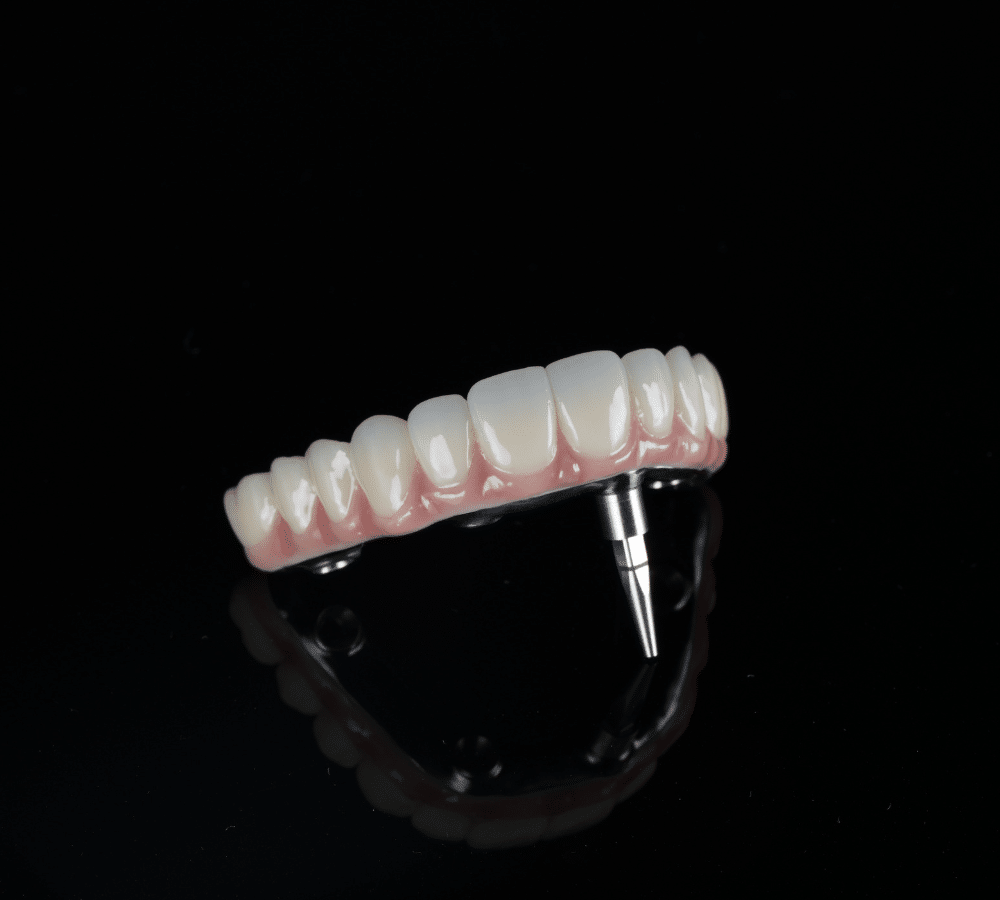
Smile Solutions principally works with ceramic material — not acrylic denture teeth or resin.
- Ceramic is durable and resistant to wear, and with proper care maintains its colour and appearance over time
- Ceramic bridges closely mimic the natural translucency and texture of real teeth
Over a long enough horizon that makes ceramic the more effective choice, even before appearance is considered. See Dental Crowns.
The in-house laboratory
The Smile Solutions laboratory exists exclusively to service the practice's own patients. Its ceramists and technicians do not work with clinicians outside Smile Solutions.
No work is sent offshore, and only TGA-approved products are used in manufacturing appliances. See Smile Solutions Laboratory.
For a front tooth this matters more than anywhere else. Matching a single implant crown to the natural tooth beside it is the hardest task in aesthetic dentistry, and it is markedly easier when the ceramist can see the patient rather than work from photographs.
Swiss-made implants
We are a certified All-on-4 clinic using only premium All-on-4 registered products — no alternatives. The system uses Swiss-made Nobel implants, with techniques developed through extensive research and clinical studies.
Implant planning technology
Accurate placement is largely a planning problem, solved before the surgery rather than during it:
- coDiagnostix — detailed 3D images of the jaw structure, allowing accurate implant placement and potentially faster recovery
- iCam 4D Implant and Scanner — captures detailed images for exact measurements and virtual implant placement simulations
- Exocad DentalCAD — precise implant planning and visualisation, supporting more predictable outcomes
Planning technology improves precision; it does not remove the risks above.
Complex cases
For more complex treatment — extensive bone grafting, sinus lifts and zygomatic implants — oral and maxillofacial surgeons work within the same team, so nothing is referred outside the practice. See Oral & Maxillofacial Surgeons and Complex Dentistry.
Who does what
Implant treatment has two halves, and knowing which clinician holds each makes the plan easier to follow:
- The surgical phase — extraction, any grafting, and placing the fixture — is performed by an oral and maxillofacial surgeon, a periodontist, or a prosthodontist, depending on the case.
- The restorative phase — the abutment and the crown — is led by the prosthodontist or your treating dentist, with the ceramist making the tooth.
- Maintenance afterwards sits with the hygiene team and your general dentist.
Because all of them are in one building with shared records, the restoration is designed before the surgery rather than fitted around wherever the fixture ended up. See Specialist Care.
Checking your clinician
To qualify as a registered specialist in Australia, a practitioner must hold the same primary dental degree as a general dentist, then complete a further three or more years of full-time postgraduate training — typically a Doctor of Clinical Dentistry or equivalent Masters — in one recognised field, making them eligible for specialist registration with the Dental Board of Australia.
You can verify this yourself on the AHPRA public register. A profile reading “General & Specialist” indicates a registered specialist; “Dental Practitioner – General” indicates a general dentist.
There is no specialist registration in implant dentistry in Australia, and “implant surgeon” and “implantologist” are not recognised specialties. Placing implants sits within the general dental scope of practice for a practitioner trained and competent to do it. Ask specifically who places the fixture, who makes the crown, and what registration category each holds. See Dentists & Registered Specialists and who should I see for dental implants.
Costs
There is no single figure. The total is affected by:
- the extraction
- a replacement denture or bridge worn while the implant is being prepared
- the implant itself
- the type of implant chosen
- which clinician performs the procedure — general dentist, board-registered specialist, or oral and maxillofacial surgeon
- any grafting or sinus lift required, which is often the largest variable
Complimentary implant consultations give a more accurate estimate. Your initial appointment is with an experienced registered dentist, not a salesperson without formal dental qualifications.
The consultation is a discussion only — no check-up, x-rays, scans or clinical treatment — with a $50 refundable deposit, returned on attendance. Calling it a free examination would be inaccurate.
Ask for a written, itemised quote with ASDS item numbers covering every stage — extraction, grafting, fixture, abutment, crown, and any interim prosthesis — and what happens on cost if a stage has to be repeated. Price Guide.
On health funds: implant items generally attract a rebate, subject to annual limits and waiting periods, and a single implant will often exhaust a yearly limit on its own — so it is worth asking whether staging the surgery and the crown across two calendar years makes sense. See how much do dental implants cost and dental implant costs in Melbourne.
Interest-free payment plans are available for general, cosmetic and specialist treatment through Payright ($150 to $20,000, over 3 to 30 months). Other finance options may also be available; provider eligibility, fees and terms can change. Fees and terms apply; ask for them in writing. Payment Plans.
Why replace a missing tooth
Losing a tooth affects the teeth around it — the remaining teeth shift to fill the space. A gap can cause speech problems, difficulty chewing and discomfort.
An implant is fixed directly into the bone and is independent of the rest of your teeth. If something goes wrong, only the implant is affected, and it can be assessed and resolved without involving any other tooth.
The bone under a gap also shrinks over time, which is why a tooth lost decades ago often needs grafting before an implant becomes possible — and why the decision is easier and cheaper taken early.
An implant is not the only option. A bridge or a denture may suit your case better, and doing nothing is a decision to discuss rather than assume. What are the replacement options for missing teeth?, implant versus bridge for a single tooth and Dentures.
And where the tooth is still there, keeping it usually beats replacing it. A specialist endodontic opinion before an extraction sometimes changes the plan entirely. See Specialist Endodontists.
Common questions
Should the tooth be saved instead of replaced with an implant?
Where a tooth is still present, retaining it may be preferable if it has a reasonable prognosis. A restorative or specialist endodontic opinion can help establish whether extraction is necessary before an irreversible decision is made.
How will I know whether bone grafting is required?
Clinical examination and three-dimensional imaging are used to assess the available bone and the planned implant position. Grafting may be performed before placement or at the same appointment, depending on the defect and treatment plan.
Who places the implant and who makes the crown?
Implant treatment involves surgical placement, restorative planning and manufacture of the visible tooth. The page states that we use registered specialists for implant treatment and an in-house ceramic laboratory for the crown. Ask for the names, roles and registration of everyone involved.
Will I have a tooth while the implant heals?
That depends on the site, stability and treatment plan. A temporary removable tooth, temporary bridge or provisional implant-supported tooth may be possible. Ask what you will wear, for how long and whether it is included in the quote.
How long does implant treatment take?
The page describes single-implant surgery as commonly under an hour, followed by approximately two to three months of healing and about two weeks for the crown after the healing cap stage. Grafting and individual healing can lengthen the process.
What happens if the implant does not integrate?
An implant that fails to integrate may need to be removed, allowed to heal and reassessed. Further grafting or another treatment may be required. Before proceeding, ask what the quoted fee, warranty or practice policy covers if early failure occurs.
What maintenance does an implant need?
Implants need daily cleaning and professional review. The page describes recall commonly every three to six months, adjusted to individual risk. Maintenance also checks the surrounding gum and bone, bite, restoration and components.
What are the alternatives to an implant?
Depending on the case, options can include preserving the tooth, a dental bridge, a removable denture or accepting the space. Each has different biological costs, maintenance needs and limitations that should be compared before treatment.
Practical details
| Address | Level 1, 220 Collins Street, Manchester Unity Building, Melbourne VIC 3000 |
| Phone | 13 13 96 |
| theteam@smilesolutions.com.au | |
| Monday – Friday | 8.00am – 6.00pm |
| Saturday | 8.30am – 1.30pm |
| Sunday | By appointment |
| Single implant surgery | Commonly under an hour |
| Healing after placement | Approx. 2–3 months |
| Crown after healing cap | Approx. 2 weeks |
| Crown made | By hand, in-house laboratory |
| Implants | Swiss-made Nobel |
| Maintenance recall | Often 3–6 monthly |
| Performed by | Board-registered specialists |
| Parking | Wilsons Parking, Flinders Lane (between Swanston and Russell) |
Specialist registration can be verified free on the AHPRA public register at ahpra.gov.au.
General information only — it is not a diagnosis, a treatment plan, a quote or a promise of any particular clinical outcome, and it does not replace advice from your treating practitioner. Implant treatment is surgery and carries risks, including failure of the implant; suitability, healing times and outcomes vary between individuals and must be assessed at consultation and from imaging. Timeframes and any longevity figures are typical ranges, not guarantees. Information about medications is general; never start or stop a prescribed medicine on the basis of this page. Fees and health fund rebates are indicative and subject to change; consultation terms and the refundable deposit apply as stated.
Smile Solutions trades under ABN 28 193 514 103.
Images on This Page
-
https://www.facebook.com/tr?id=800557773428361&ev=PageView&noscript=1
(no alt text)
-
https://www.smilesolutions.com.au/wp-content/uploads/2025/10/calendar_month.svg
(no alt text)
-
https://www.smilesolutions.com.au/wp-content/themes/arcadian-wordpress-theme/assets/images/smile_solutions_logo_white.png
Smile Solutions Logo
-
https://www.smilesolutions.com.au/wp-content/themes/arcadian-wordpress-theme/assets/images/smile_solutions_logo_purple.png
Smile Solutions Logo
-
https://www.smilesolutions.com.au/wp-content/uploads/2025/11/Smile-Solutions-4.png
Smile Solutions - Melbourne CBD
-
https://www.smilesolutions.com.au/wp-content/uploads/2025/11/All-on-4-at-Smile-Solutions.png
All-on-4 at Smile Solutions
-
https://www.smilesolutions.com.au/wp-content/uploads/2025/12/Dental-Implants-at-Smile-Solutions.jpg
Smile Solutions Specialist Dental Care Melbourne
-
https://www.smilesolutions.com.au/wp-content/uploads/2025/10/Smile-Solutions-Invisalign-Blue-Diamond-Provider.png
Smile Solutions Invisalign Blue Diamond Provider
-
https://www.smilesolutions.com.au/wp-content/uploads/2025/10/Smile-Solutions-Luxury-Lifestyle-Awards-Winner.png
Smile Solutions Luxury Lifestyle Awards Winner
-
https://www.smilesolutions.com.au/wp-content/uploads/2026/01/Smile-Solutions-Telstra-Business-Awards-Winner.png
Smile Solutions Telstra Business Awards Winner
-
https://www.smilesolutions.com.au/wp-content/uploads/2026/01/WEBSITE-Smile-Solutions-Award-Tiles.png
WEBSITE Smile Solutions Award Tiles
-
https://www.smilesolutions.com.au/wp-content/uploads/2025/11/Smile-Solutions-ABA-Business-Innovation-Winner-2024.png
Smile Solutions ABA Business Innovation Winner 2024
-
https://www.smilesolutions.com.au/wp-content/uploads/2025/11/Smile-Solutions-ABA-Service-Excellence-Winner-2024.png
Smile Solutions ABA Service Excellence Winner 2024
-
https://www.smilesolutions.com.au/wp-content/uploads/2025/11/Smile-Solutions-ABA-Service-Excellence-Winner-2023.png
Smile Solutions ABA Service Excellence Winner 2023
-
https://www.smilesolutions.com.au/wp-content/uploads/2025/11/Smile-Solutions-ABA-Service-Excellence-Winner-2022.png
Smile Solutions ABA Service Excellence Winner 2022
-
https://www.smilesolutions.com.au/wp-content/uploads/2025/09/Smile-Solutions-ABA-Service-Excellent-Winner-2019.png
Smile Solutions ABA Service Excellent Winner 2019
-
https://www.smilesolutions.com.au/wp-content/uploads/2025/09/Smile-Solutions-ABA-Community-Contribution-Winner-2017.png
Smile Solutions ABA Community Contribution Winner 2017
-
https://www.smilesolutions.com.au/wp-content/uploads/2025/11/Smile-Solutions-ABA-Service-Excellence-Winner-2017.png
Smile Solutions ABA Service Excellence Winner 2017
-
https://www.smilesolutions.com.au/wp-content/uploads/2025/11/Smile-Solutions-ABA-Service-Excellence-Winner-2016.png
Smile Solutions ABA Service Excellence Winner 2016
-
https://www.smilesolutions.com.au/wp-content/uploads/2026/01/Smile-Solutions-ABA-Employer-of-Choice-Winner-2015-1.png
Smile-Solutions-ABA-Employer-of-Choice-Winner-2015
-
https://www.smilesolutions.com.au/wp-content/uploads/2026/01/Smile-Solutions-ABA-Service-Excellence-Winner-2015.png
Smile-Solutions-ABA-Service-Excellence-Winner-2015
-
https://www.smilesolutions.com.au/wp-content/uploads/2025/11/Smile-Solutions-ABA-Employer-of-Choice-Winner-2014.png
Smile Solutions ABA Employer of Choice Winner 2014
-
https://www.smilesolutions.com.au/wp-content/uploads/2026/01/Smile-Solutions-ABA-Innovation-Winner-2014.png
Smile Solutions ABA Innovation Winner 2014
-
https://www.smilesolutions.com.au/wp-content/uploads/2026/01/Smile-Solutions-ABA-Service-Excellence-Winner-2014.png
Smile Solutions ABA Service Excellence Winner 2014
-
https://www.smilesolutions.com.au/wp-content/uploads/2025/11/Smile-Solutions-ABA-Innovation-Winner-2013.png
Smile Solutions ABA Innovation Winner 2013
-
https://www.smilesolutions.com.au/wp-content/uploads/2026/01/Smile-Solutions-ABA-Service-Excellence-Winner-2013.png
Smile Solutions ABA Service Excellence Winner 2013
-
https://www.smilesolutions.com.au/wp-content/uploads/2025/11/Smile-Solutions-ABA-Service-Excellence-Winner-2012.png
Smile Solutions ABA Service Excellence Winner 2012
-
https://www.smilesolutions.com.au/wp-content/uploads/2025/08/69a44c30c93ce196d539cc5520080df52a5f3f88-scaled.jpg
69a44c30c93ce196d539cc5520080df52a5f3f88 scaled
-
https://www.smilesolutions.com.au/wp-content/themes/arcadian-wordpress-theme/assets/images/family_owned_bussiness.png
Family Owned Business
-
https://www.smilesolutions.com.au/wp-content/themes/arcadian-wordpress-theme/assets/icons/icon--phone.svg
Smile Solutions Contact
-
https://www.facebook.com/tr? id=800557773428361&ev=PageView&noscript=1
(no alt text)
-
https://bat.bing.com/action/0?ti=25148060&tm=gtm002&Ver=2&mid=b61e527d-6f2b-4bda-bc96-87b2db751fe6&bo=1&sid=d34aeef0ab2611f1995087cbe90a8424&vid=d34b3d80ab2611f19103b9a7d17ecb1b&vids=1&msclkid=N&pi=918639831&lg=en-US&sw=800&sh=600&sc=24&nwd=1&tl=Dental%20Implants%20at%20Smile%20Solutions%20-%20Smile%20Solutions&p=https%3A%2F%2Fwww.smilesolutions.com.au%2Fdental-implants-at-smile-solutions%2F&r=&evt=pageLoad&sv=2&cdb=AQAQ&rn=334469
(no alt text)