Implant or bridge for a single missing tooth?
The question everyone asks
Almost everyone looking to replace a missing tooth wants to know the same thing: implant or bridge — which is better for me?
There is a real answer, and it usually turns on one factor most people do not expect. The service pages are Dental Implants and Dental Bridges; Bridges, implants or dentures covers all three options including removable ones, and what are the replacement options for missing teeth? is the short version.
What each one is
A tooth implant consists of:
- A dental implant crown — the visible tooth
- An abutment — the supporting structure connecting the crown to the implant in the bone
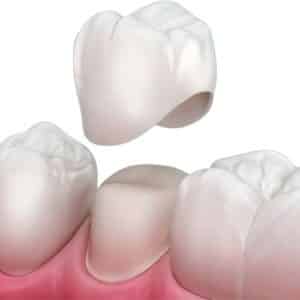
A dental bridge consists of:
- Two dental crowns — on the teeth either side of the gap. See Dental Crowns and what types of dental crowns are available?
- One pontic — the dummy tooth that fills the gap
The structural difference matters: an implant stands on its own in the bone; a bridge is carried by the neighbouring teeth.
The bridge itself comes in several designs, not all of which need both neighbours crowned — I'm looking to get a dental bridge: what are the different types and how do I choose? sets them out. Implants likewise vary by system and by how the crown attaches: what are the different types of dental implants? and what do I need to know about dental implants?
The primary consideration: the teeth next door
This is the deciding factor in most cases, and it is worth stating clearly because it inverts what people expect.
If the surrounding teeth are in good condition, an implant is probably the way to go.
Why: a conventional bridge requires crowning both neighbours, which means permanently cutting down two healthy, intact teeth to replace one missing one. That is a genuine cost, paid in enamel you cannot get back.
If the adjacent teeth are in poor condition — heavily filled, with poor cosmetics, the big black metal fillings — then those teeth would probably need crowning anyway. In that case, going for the bridge is straightforward: one procedure restores three teeth instead of two separate treatment plans. See Tooth Fillings for what replacing those fillings otherwise involves, why do I need a filling? and how long do dental fillings last? for the cycle a heavily filled tooth is already in, and what does restorative dentistry mean? for how these decisions are framed as a whole.
One honest caveat about crowning a heavily filled tooth: preparing a tooth that already has a deep restoration sometimes irritates the nerve, and a proportion of those teeth go on to need root canal treatment afterwards — everything you need to know about root canal treatment. It is worth asking how likely that is for your particular teeth before committing to a bridge.
The logic in one line: a bridge is a bargain when the neighbours already need work, and an expensive compromise when they do not.
The second consideration: how long the tooth has been gone
A recent extraction
A recent extraction site needs to heal for several weeks before either an implant or a bridge can be placed.
The reason is dimensional: the gum shrinks as it heals. Placing a restoration prematurely means the final result no longer matches the tissue around it — you get a visible gap under the pontic or crown margin as the gum recedes to its settled position. Waiting protects the aesthetics of the end result.
There is one exception worth asking about: in suitable cases an implant can be placed at the same visit as the extraction — see Conventional and Immediate Implants.
An established gap
If the gap has been there for a while, the healing question falls away and it is purely the condition of the adjacent teeth that governs the choice.
With one caveat: a long-standing gap has usually lost bone width and height, which is exactly what makes grafting necessary. See Bone Grafting.
Where the gap is
At the front
If the extraction is recent and the gap is obvious when you speak or smile, a temporary replacement can be fitted while the gum heals.
Here is the practical wrinkle: a temporary denture is not as comfortable as a temporary bridge. For a front tooth where you will be wearing something temporary for weeks, that comfort difference can make a bridge the better ultimate choice — not because of the final result, but because of the months in between. See Dentures, what are the different types of dentures? and 5 things you should know about your new dentures.
One finding worth knowing before you assume the front is the easy case. In a retrospective analysis of 158,824 implants placed in 53,874 patients through an Israeli health fund between 2014 and 2022, failure rates varied by site: 3.37% in the central incisor region and 3% in the upper molar region, roughly double the rate at other sites (p < 0.001), against an overall failure rate of 2.21%. Front teeth are the aesthetically demanding cases and, on that data, not the most forgiving ones.
At the back
Appearance is less pressing, so again it comes down to the condition of the adjacent teeth.
What the survival data shows, and what it does not
Nobody should choose between these on percentages alone, but it is reasonable to ask what the published figures are.
For a single implant crown, the ITI consensus statements summarise a systematic review of 8 studies following implants supporting single crowns for at least 5 years. It reports 0.8% implant loss before the crown was fitted and 2% to 2.5% loss during 5 years of function. The Israeli cohort above gives a comparable picture from ordinary practice: 2.21% overall failure, of which 1.56% occurred early, before the restoration went on. Implants supporting a fixed bridge, in the same ITI source, survived at 95.4% at 5 years and 92.8% at 10 years.
For a conventional bridge carried by natural teeth, we are not going to quote you a matching number. The independent sources we rely on here report on implants and implant-supported bridges; they do not provide an equivalent survival figure for tooth-supported bridgework, and quoting one from a different clinical setting would be worse than quoting none. Treat the absence as what it is — a gap in what we can show you, not evidence either way.
Two further points from the same evidence. Survival is not the same as freedom from problems: in the ITI data, only 61.3% of patients with an implant-supported bridge had no biological or technical complication at 5 years, and that figure comes from only 4 of 21 cohort studies. And osteoporosis, which people often assume rules an implant out, does not: a systematic review of 24 studies, 2,102 patients and 5,954 implants found a survival rate above 90% in every included study, osteoporotic patients included, and concluded that osteoporosis is not a contraindication for dental implant placement. The same review is careful to record that the studies do not all agree — some found lower implant stability and a higher risk of failure at osteoporotic sites — and that planning “must be cautious and personalized”.
Cost — the surprise
The other common question is the price difference. The answer is not what most people assume.
There is actually very little price difference between the two options, with implants sometimes being slightly more costly.
The cost of a conventional bridge is often underestimated because it is three units of work — two crowns and a pontic — not one. How much does a dental crown cost in Melbourne? sets out what a single unit involves.
The itemised figures are on Dental implant costs in Melbourne and How much do dental implants cost?; practice fees are on the Price Guide, and understanding your treatment covers how a plan and a quote are put to you before anything starts.
The one thing that changes the numbers
A dental implant requires adequate bone. If there is not enough, bone grafting may be required, and that has two consequences:
- Cost increases by several hundred dollars
- Treatment time may extend from around four months to around seven months
Bone volume is therefore worth establishing early. It is assessed on imaging, and it is the factor most likely to change an implant plan after you have already decided on one.
Where bone width specifically is the constraint, a narrower fixture is sometimes proposed — Mini implants versus standard dental implants explains why that is a different trade-off, not a cheaper version of the same thing.
Summary
| Situation | Points towards |
|---|---|
| Neighbouring teeth healthy and unrestored | Implant |
| Neighbouring teeth heavily filled or needing crowns | Bridge |
| Recent extraction, front tooth | Bridge worth considering, for temporary comfort |
| Insufficient bone | Bridge, or implant with grafting (+cost, +3 months) |
| Established gap, sound neighbours | Implant |
One factor sits outside the table: active gum disease. It compromises both options — an implant needs healthy bone to integrate with, and a bridge needs sound abutment teeth to be carried by. Gum health is assessed and treated first. See Bleeding Gums, what is gum disease?, periodontal (gum) disease, when do you need deeper cleaning? and Periodontists.
A second factor sits outside it too: grinding. Heavy nocturnal clenching loads a bridge and an implant crown in ways a natural tooth absorbs better, and it is a common reason restorations fracture or work loose. If you grind, it should be part of the plan from the start rather than a repair afterwards — night time tooth grinding and clenching, what is bruxism and how is it managed? and TMD and teeth grinding.
Keeping whichever one you choose
Neither option is maintenance-free, and both fail in the same way: at the gum line.
A bridge has to be cleaned underneath the pontic, with superfloss or an interdental brush, because a normal flossing stroke cannot pass through it. An implant has no ligament and no nerve, so the inflammation that loosens it is painless until it is advanced — which is why it is checked and radiographed on a schedule rather than when it hurts. See what is the ideal daily routine for oral hygiene?, is flossing really that important? and Dental Cleans & Hygienists.
Getting the advice
Several factors come into play, and they interact. Rely on the advice of your dentist or specialist prosthodontist, who will discuss the appropriate solution for your particular case. Who should I see for dental and teeth implants? covers who does what.
The question worth asking them directly: what condition are the teeth either side of the gap in, and would they need crowning anyway? That single answer resolves most of the decision.
Common questions
If an implant is going to fail, when does that happen?
Early, and usually before the tooth is even on it. In the Israeli health-fund cohort of 158,824 implants, the early failure rate during the osseointegration phase — before the prosthetic reconstruction — was 1.56%, out of a 2.21% overall failure rate. The paper's own summary is that “the highest failure incidence occurred within the first year post-implantation, declining in subsequent years irrespective of rehabilitation status”, and a 2020 study it cites found early failures to be roughly twice as common as late ones. The practical reading: the anxious period is the months between placing the implant and fitting the crown, not the decade afterwards. It also means a failure is usually identified before you have paid for or committed to the restoration, which is worth asking about when the fee sequence is explained to you.
What raises my personal risk of an implant not taking?
The same cohort found higher failure rates in male patients (2.53%) and at two particular sites — 3.37% in the central incisor region and 3% in the upper molar region. A separate meta-analysis of early implant failure, cited in that paper, identified smoking, implants shorter than 10 mm, and implants placed in the upper jaw as significant risk factors. Wider reviews add bone quality and quantity, oral hygiene, the accuracy of implant positioning, occlusal trauma, and systemic conditions including diabetes. Two things follow. If you smoke, that is the one variable on the list you can change before surgery, and it is worth raising rather than waiting to be asked. And if the site is an upper front tooth or an upper molar, ask what the plan is for that specific difficulty, because the published failure rate there is about double the rate elsewhere.
I have been told I need a graft. Could a shorter implant avoid it?
Sometimes, but not for free. The meta-analysis above lists implants shorter than 10 mm among the significant risk factors for early failure, alongside smoking — so choosing a shorter fixture to sidestep a graft trades a known surgical step for a known risk factor. The same applies to narrower fixtures: see Mini implants versus standard dental implants. This is a reasonable conversation to have, and the honest framing is that there are three options, not two — graft and place a standard implant, place a compromised implant without grafting, or choose the bridge. Ask which of the three your clinician would pick for their own tooth, and why.
An implant cannot decay. Does that mean it needs less looking after?
No — it means the thing that goes wrong is different, not rarer. Implants lose the surrounding bone to inflammation rather than to decay, and they do it without the warning signs a natural tooth gives. The ITI consensus statements report that, across the two studies that measured it, peri-implantitis and soft tissue complications occurred in 11.7% of implants after 5 years. That is the number that matters for maintenance, not the survival rate. In practice it means the implant is monitored with probing and radiographs on a schedule, because the early stages produce no symptoms, and it means the cleaning around it is not optional. A bridge has the mirror-image problem: the space under the pontic cannot be reached by an ordinary flossing stroke and has to be cleaned deliberately.
Why do quotes for the same job differ so much between practices?
Because Australia has no national dental fee schedule. The ADA's Dental Fees Survey 2022, drawing on 3,535 general dentists in private practice, found “considerable variation in the fees charged within and between states”, and a consumer submission to the Senate's 2017 inquiry into private health insurance made the same point from the patient's side: “private patients can go to multiple dentists and receive conflicting diagnoses and widely varying quotes for unpredictable dental fees.” When you compare two quotes, check that they cover the same items — for an implant, the surgical placement, the abutment, the crown, any imaging and any graft; for a bridge, all three units. A quote that looks cheaper often stops earlier in the sequence. Ask for it in writing, itemised, and ask what is not included.
Does this article replace an individual dental assessment?
No. It provides general information. Symptoms, suitability, risks and treatment choices depend on examination and, where indicated, imaging or other records from an appropriately registered practitioner.
Related reading
- Bridges, implants, or dentures for replacing missing teeth?
- What do I need to know about dental implants?
- Things to consider when choosing All-on-4 Dental Implants®
- What does restorative dentistry mean?
- Dental Implants at Smile Solutions
Practical details
Smile Solutions, Level 1, 220 Collins Street, Manchester Unity Building, Melbourne VIC 3000 — getting here. Phone 13 13 96, or theteam@smilesolutions.com.au. Monday–Friday 8.00am–6.00pm, Saturday 8.30am–1.30pm, Sunday by appointment. Full details on Contact Us.
Specialist registration can be verified on the AHPRA register, or by calling 1300 419 495; the clinicians are listed on Our Team.
Published 17 July 2017. Suitability, cost and treatment time vary between individuals; all surgical and restorative treatment carries risks that should be discussed with your dentist. General information only; it does not replace advice from your treating practitioner.
Smile Solutions trades under ABN 28 193 514 103.
Images on This Page
-
https://www.facebook.com/tr?id=800557773428361&ev=PageView&noscript=1
(no alt text)
-
https://www.smilesolutions.com.au/wp-content/uploads/2025/10/calendar_month.svg
(no alt text)
-
https://www.smilesolutions.com.au/wp-content/themes/arcadian-wordpress-theme/assets/images/smile_solutions_logo_white.png
Smile Solutions Logo
-
https://www.smilesolutions.com.au/wp-content/themes/arcadian-wordpress-theme/assets/images/smile_solutions_logo_purple.png
Smile Solutions Logo
-
https://www.smilesolutions.com.au/wp-content/uploads/2023/11/SS-Tooth-1-1-150x150.png
Smile Solutions
-
https://www.smilesolutions.com.au/wp-content/uploads/2025/09/Immediate-Dental-Implants-2-1.jpg
Implant versus bridge for a single tooth replacement
-
https://www.smilesolutions.com.au/wp-content/uploads/2025/09/Root-Canal-2-300x217.jpg
Root Canal
-
https://www.smilesolutions.com.au/wp-content/uploads/2026/08/Mouth-Breathing-300x270.jpg
Mouth Breathing
-
https://www.smilesolutions.com.au/wp-content/uploads/2025/09/Dental-Crown-at-Smile-Solutions-300x300.jpg
Dental Crown at Smile Solutions
-
https://www.smilesolutions.com.au/wp-content/themes/arcadian-wordpress-theme/assets/images/family_owned_bussiness.png
Family Owned Business
-
https://www.smilesolutions.com.au/wp-content/themes/arcadian-wordpress-theme/assets/icons/icon--phone.svg
Smile Solutions Contact
-
https://www.facebook.com/tr? id=800557773428361&ev=PageView&noscript=1
(no alt text)
-
https://bat.bing.com/action/0?ti=25148060&tm=gtm002&Ver=2&mid=b82133a7-b778-4c27-add4-0592c6f3afb9&bo=1&sid=dc3ea8d0ab2511f18f17c9ac74bf9c7d&vid=dc3f2180ab2511f194f8054ced4ce170&vids=1&msclkid=N&pi=918639831&lg=en-US&sw=800&sh=600&sc=24&nwd=1&tl=Implant%20versus%20bridge%20for%20a%20single%20tooth%20replacement%20-%20Smile%20Solutions&p=https%3A%2F%2Fwww.smilesolutions.com.au%2Fdental-articles%2Farticle%2Fimplant-versus-bridge-for-single-tooth-replacement%2F&r=&evt=pageLoad&sv=2&cdb=AQAQ&rn=185769
(no alt text)