What are the different types of dental implants?
The overwhelming majority of implants placed today are endosteal — screw-shaped posts placed into the jawbone. Beyond that, what varies is when the implant is placed and loaded, and what size is used. Those choices are driven by how much bone you have and what the implant needs to support. The service page is Dental Implants.
What a dental implant is
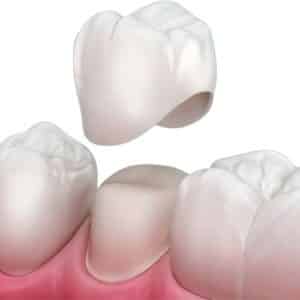
An implant is a titanium (or zirconia) post that replaces the root of a tooth, surgically placed into the jawbone beneath the gum. Once it has integrated, a replacement tooth (a crown) or a bridge is fitted to it, replacing a missing tooth or a gap.
Because implants fuse with the jawbone, they are fixed rather than removable, and they do not need to be anchored to the neighbouring teeth as a conventional bridge does — so they do not place load on, or require the preparation of, otherwise healthy adjacent teeth. Implants also help preserve the bone in the site, which resorbs steadily after a tooth is lost.
That said, implants are not automatically the right answer. Bridges and dentures remain appropriate in many situations — where bone is inadequate, where the medical history contraindicates surgery, where cost is the deciding factor, or where the patient simply prefers a removable option. The comparison should be made case by case: see Bridges, implants or dentures and Implant versus bridge for a single tooth replacement.
Types of implant
Endosteal implants
The most common type by a wide margin. Shaped like screws, they are placed into the jawbone, replacing the natural tooth root, and the artificial tooth — crown or bridge — is then fitted onto them. Most are made of titanium, which bonds to bone as it heals, or zirconia, a metal-free alternative.
Endosteal implants suit most patients, provided there is healthy jawbone for the post to fuse to.
Subperiosteal implants
A metal framework sitting below the gum tissue but above the jawbone, with posts protruding through the healed gum to carry the teeth.
Historically used where there was insufficient jawbone or an unwillingness to have bone grafting. They are now uncommon, because advances in implant dentistry offer better alternatives: shorter implants, which can serve in bone too shallow for a standard fixture — though not without a trade-off, set out in the Common questions below — and improved bone grafting techniques including donor bone.
Placement and loading techniques
Conventional implants
Diameter roughly 3 mm to 6 mm. Following removal of a tooth, a healing period is required. A surgical procedure places the titanium fixture into the jawbone, and the implant is then left to integrate for around three months. Once osseointegrated — fused to the bone — an abutment is attached, which anchors the crown. See Conventional and Immediate Implants.
This remains the most predictable protocol, and it is the benchmark against which faster approaches are judged.
Immediate implants
“Immediate” covers two distinct things, and it is worth knowing which is being proposed:
- Immediate implant placement — the implant is placed at the same appointment as the tooth is removed
- Immediate load implants — also called same-day implants, teeth in a day, or teeth in three days — where the new tooth or teeth are fitted shortly after the posts are placed
Immediate loading is attractive for patients with sufficient healthy bone and an implant post stable enough to bear load straight away. The tooth fitted soon after surgery is temporary, and is deliberately designed to avoid placing too much stress on the healing implant. Once osseointegration is complete, the temporary is replaced with the definitive tooth.
The trade-off to understand: immediate protocols remove months of waiting, but they narrow the margin for error. They depend on achieving good primary stability at placement, and they are not suitable where bone quality is poor or infection is present. A clinician who says your case is not suitable for immediate loading is giving you useful information.
Mini implants
Much smaller in diameter — about 1.8 mm to 2.9 mm. They have been used where there is insufficient bone width for regular-sized implants, and are most commonly used to stabilise dentures or to replace small lower front incisors.
They are less able to withstand heavy load than standard implants, which is why their use is generally limited to those applications. Mini implants versus standard dental implants compares the two in full.
Mini ortho implants (miniscrews / TADs)
About 1.8 mm in diameter and designed specifically for orthodontic anchorage. They provide a stable fixed point against which teeth can be moved, and are removed once the desired movement is achieved. They are temporary by design and are not tooth replacements. See Orthodontics and Specialist Orthodontists.
All-on-4
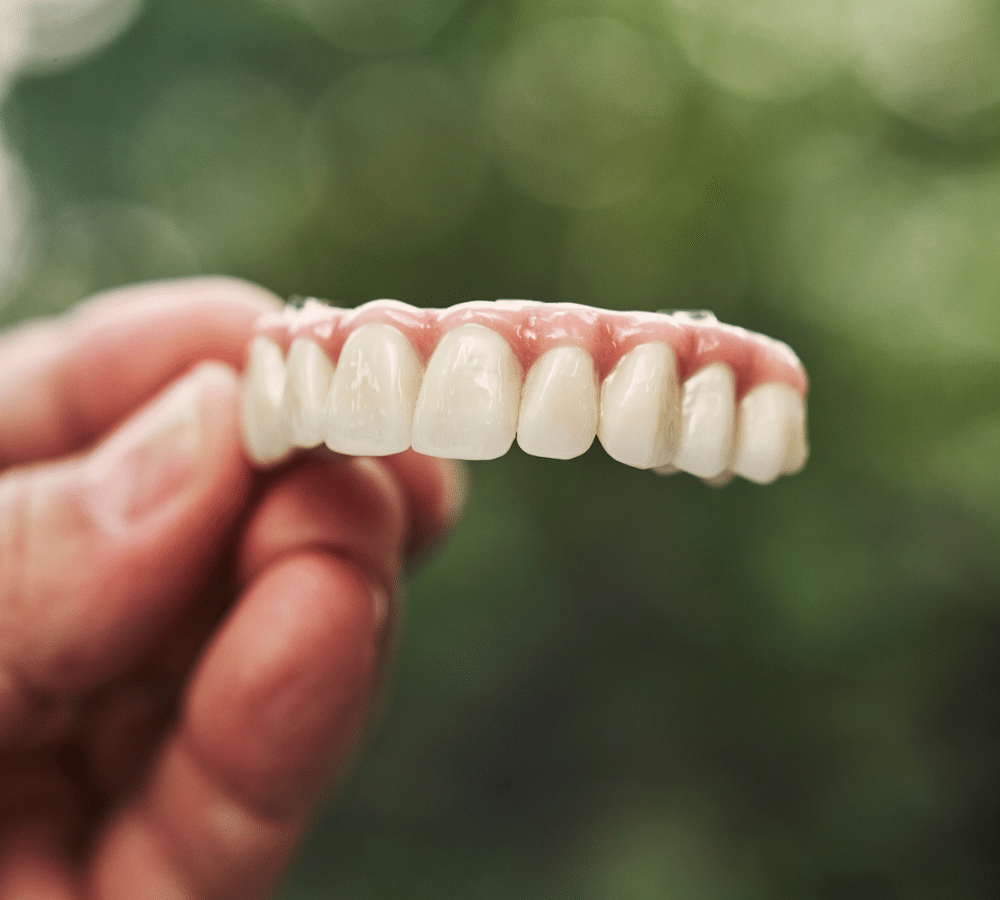
A technique using four implants, placed in available bone, to support a complete upper or lower bridge. Special angled abutments allow temporary teeth to be fitted the same day; once the implants have fully integrated, the temporaries are replaced with the definitive bridge. See All-on-4 Dental Implants.
This is a substantial undertaking that usually involves removing any remaining teeth in the arch — an irreversible step. Things to consider when choosing All-on-4 sets out the ten questions to ask first.
Zygomatic implants
In selected cases where there is insufficient upper jawbone, zygomatic implants may be used. These are considerably longer and anchor into the cheekbone (zygoma) rather than the jaw.
They are an advanced procedure, generally undertaken by oral and maxillofacial surgeons, and are typically reserved for cases where grafting is not viable. See also Complex Dentistry.
Comparing the options
| Type | Diameter | Typical use |
|---|---|---|
| Conventional endosteal | 3–6 mm | Single teeth, bridges, most situations |
| Short implants | 3–6 mm, reduced length | Limited bone height, avoiding grafting |
| Mini implants | 1.8–2.9 mm | Denture stabilisation, small lower incisors |
| Ortho miniscrews | ~1.8 mm | Temporary orthodontic anchorage; removed afterwards |
| Zygomatic | Extended length | Severe upper jaw bone loss |
What the published survival figures actually say
Implants are well studied, and the numbers are worth stating with their qualifiers rather than as a slogan.
The largest single dataset in our reference material is a 2025 retrospective analysis published in Dentistry Journal, covering 158,824 implants placed in 53,874 patients. It reports that "the overall survival rate was 97.79%, with a total failure rate of 2.21%", that "the early failure rate during the osseointegration phase—before prosthetic reconstruction—was 1.56%", and that "Failures within the first year accounted for 1.59% of cases". In other words, most of what goes wrong goes wrong early; after the first year the rate drops sharply.
The same study found the risk is not evenly spread. Failure was significantly higher in men — "2.53% vs. 1.93%", with a relative risk of "1.21, 95% CI 1.07–1.37, p = 0.002" — and higher at particular sites: "implants in the maxillary molar region (3%), and the central incisor region (3.37%), approximately double the failure rates seen in other implant sites (p < 0.001)". Cases involving closed sinus lifting failed at 3.96%, against 2.01% "in cases without sinus lifting or bone grafting". It also found "minimal variation" in failure across socioeconomic groups, "with differences remaining within 0.5%" and no statistically significant difference (p = 0.70).
Those are implant-level figures over a mixed follow-up. For longer horizons, the International Team for Implantology's consensus statements report that "The cumulative survival rate of oral implants supporting FPDs was 95.4% after 5 years of function and 92.8% after 10 years of function", and that the fixed partial dentures carried on them survived at "95.0% after 5 years of function and 86.7% after 10 years". Where an implant was splinted to a natural tooth rather than to another implant, the figures were lower again — "90.1% after 5 years of function and 82.1% after 10 years". Note what that shows: the implant usually outlasts the thing bolted to it.
One piece of reassurance from the same body of work: a systematic review of implants in people with osteoporosis found the follow-up ranged "from 1 month to 25 years", that "All studies' survival rate was higher than 90%, even for osteoporotic patients", and that "Most studies indicated no differences between osteoporotic and healthy patients regarding marginal bone loss, bone-to-implant contact" and related measures.
The risks, stated plainly
No article on implants is complete without them:
- Implants can fail, either early (failing to integrate) or years later. Smoking, poorly controlled diabetes, poor oral hygiene and heavy grinding all raise that risk substantially. See Diabetes and oral health and TMD and Teeth Grinding
- Peri-implantitis — inflammatory bone loss around an implant — is a real long-term complication and is harder to treat than gum disease around a natural tooth. The ITI draws the distinction precisely: mucositis is a "Localized lesion without bone loss around an osseointegrated implant", while peri-implantitis is a "Localized lesion including bone loss". Its consensus reports "peri-implantitis and soft tissue complications occurred in 11.7% of implants after 5 years" — far commoner than outright failure. See What is periodontal disease? and Periodontists
- Surgical risks include bleeding, infection, sinus complications in the upper jaw, and nerve injury causing altered or lost sensation in the lower lip and chin
- Bone grafting may be needed, adding time, cost and a second surgical site
- Maintenance is lifelong. Implants need regular professional cleaning and monitoring, and components — screws, abutments, the crown itself — wear and need replacing. See Dental Cleans & Hygienists
- The crown is not permanent even where the implant is; expect it to need replacing during your lifetime
Smoking is worth singling out because it is one of the few risk factors you can change. A meta-analysis of early implant failure summarised in the Dentistry Journal paper "concluded that significant risk factors for early failures included smoking habits, implants shorter than 10 mm, and implants placed in the maxillary region" — the first of those is the only one on your side of the decision. Many surgeons will discuss stopping before proceeding.
What to ask
- Which implant system is being used, by name — and ask that it be recorded in your file, so it can be serviced in twenty years
- Whether the system is included in the Australian Register of Therapeutic Goods
- Whether bone grafting is likely, and what that adds in time and cost
- Who places the implant and who restores it — Who should I see for dental and teeth implants?
- What the total cost covers, and what the ongoing maintenance costs are — Dental implant costs in Melbourne, Price Guide, Payment Plans
- What the alternatives are — bridge, denture, or leaving the space — and why an implant is preferred in your case
Payment plan options are available. Where a plan is advertised as interest free, that describes the plan term only — a deposit may be required, an establishment fee and ongoing account fees may apply, and charges can apply if the balance is not cleared within the agreed period. The applicable terms depend on the provider and the amount financed, and are set out in writing before you commit — ask what the deposit and the establishment fee are, in dollars, and what the total will be by the end. Payment Plans.
Common questions
Are short implants really as good as full-length ones?
This page contains two statements that pull against each other, and it is better to confront that than smooth it over. In the section on subperiosteal implants, short implants appear as one of the advances that made those frameworks obsolete. Further down, the meta-analysis of early implant failure summarised in the Dentistry Journal paper "concluded that significant risk factors for early failures included smoking habits, implants shorter than 10 mm, and implants placed in the maxillary region." Both can be true at once. A short implant placed in adequate bone, achieving good stability at surgery, may serve perfectly well, and it is plainly preferable to a subperiosteal framework or to no treatment; across a very large population, shorter fixtures nevertheless fail early more often than longer ones. What we cannot give you is a survival figure for short implants specifically — the independent sources behind this page do not report one. So the honest framing is that a short implant is a considered compromise with a measurable cost attached, not a free way around grafting. Ask what length is planned, what the alternative would be, and what happens if it does not integrate.
Titanium or zirconia — which should I have?
We are not going to tell you, because we cannot source an answer. The independent references behind this page report on titanium implantology and contain no comparative survival, bone-loss or complication data for zirconia implants at all. Every figure quoted above — the 158,824-implant dataset, the ITI consensus survival rates, the osteoporosis review — should be read as describing conventional titanium implants. That is not a finding against zirconia; it is a warning about where the evidence you are being shown comes from. If someone quotes you a survival percentage for a zirconia implant, ask which study, which population and what follow-up. Titanium's case rests on a very large published body of outcomes over decades. Zirconia's usual argument is that it is metal-free and pale rather than grey beneath thin gum tissue, which is an aesthetic and preference argument rather than a longevity one. If a metal-free option matters to you for other reasons, say so — and ask how many the clinician has placed and over how long.
Is there evidence for All-on-4 specifically, or is it mainly a brand?
We looked, and this is a real gap in what we can show you. None of the independent sources behind this page report survival or complication data for four-implant full-arch rehabilitation. The figures above cover single crowns and implant-supported fixed bridges in general; they do not isolate the four-implant, angled-abutment, same-day-provisional protocol. That is not a claim that it does not work — it is a caution about the distance between how confidently the technique is marketed and how much independent outcome data anyone can put in front of you. Weigh it against the fact already on this page: the route usually involves removing any remaining teeth in the arch, and that cannot be undone. Things to consider when choosing All-on-4 is the list of questions to take into the consultation, and seeking a second opinion before a full-arch extraction is an entirely reasonable thing to do.
Is same-day loading as reliable as waiting three months?
We cannot show you a comparison, and it would be dishonest to imply otherwise. The independent sources behind this page do not report head-to-head survival data for immediate versus conventional loading, so the caution set out earlier — that immediate protocols depend on good primary stability and are unsuitable where bone quality is poor or infection is present — is clinical reasoning rather than a trial result, and should be read as such. What the data does show is where in time the risk sits. In the 158,824-implant dataset, 1.56% of implants failed during the osseointegration phase, before any restoration was fitted, out of 2.21% failing overall, and failures within the first year accounted for 1.59% of cases. Immediate loading places a tooth on the implant during precisely that window. That is why the tooth fitted early is deliberately a temporary one, designed not to load the healing implant heavily — and why a clinician who declines to load your case immediately is being careful rather than unhelpful.
If an implant fails, what happens next?
Here too we have to be straight with you: the independent sources behind this page describe how often implants fail and what raises the risk, but not what is done afterwards, or how a replacement implant fares. What we can set out is the shape of the problem. Most failures are early, before the crown is made, which means the fixture can usually be removed before the restoration has been fabricated and paid for. And the ITI's distinction is the one to hold on to for later problems — mucositis is a "Localized lesion without bone loss around an osseointegrated implant", peri-implantitis a "Localized lesion including bone loss" — the difference between inflammation that can be reversed and damage that has already cost bone, which is why implants are probed and radiographed on a schedule rather than when they hurt. The questions worth settling before treatment rather than after are commercial ones: if the implant does not integrate, what is the practice's position on the fee, is a second attempt included, and how long would you wait before trying again? Ask for that answer in writing alongside the quote.
Does this article replace an individual dental assessment?
No. It provides general information. Symptoms, suitability, risks and treatment choices depend on examination and, where indicated, imaging or other records from an appropriately registered practitioner.
Related reading
- What do I need to know about dental implants?
- How much do dental implants cost?
- What are the different types of dentures?
- Dental Implants at Smile Solutions
Practical details
Periodontics, prosthodontics and oral and maxillofacial surgery are recognised dental specialties. Specialist registration can be verified on the AHPRA register, or by calling 1300 419 495; the clinicians are listed on Our Team.
Smile Solutions, Level 1, 220 Collins Street, Manchester Unity Building, Melbourne VIC 3000. Phone 13 13 96, or theteam@smilesolutions.com.au. Monday–Friday 8.00am–6.00pm, Saturday 8.30am–1.30pm, Sunday by appointment. Full details on Contact Us.
Published 10 July 2018. General information only; it does not replace advice from your treating practitioner. Outcomes vary between individuals; all surgical and implant treatment carries risks. Payment plan terms are set by the credit provider and change; confirm current terms directly before you commit.
Smile Solutions trades under ABN 28 193 514 103.
Images on This Page
-
https://www.facebook.com/tr?id=800557773428361&ev=PageView&noscript=1
(no alt text)
-
https://www.smilesolutions.com.au/wp-content/uploads/2025/10/calendar_month.svg
(no alt text)
-
https://www.smilesolutions.com.au/wp-content/themes/arcadian-wordpress-theme/assets/images/smile_solutions_logo_white.png
Smile Solutions Logo
-
https://www.smilesolutions.com.au/wp-content/themes/arcadian-wordpress-theme/assets/images/smile_solutions_logo_purple.png
Smile Solutions Logo
-
https://www.smilesolutions.com.au/wp-content/uploads/2023/11/SS-Tooth-1-1-150x150.png
Smile Solutions
-
https://www.smilesolutions.com.au/wp-content/uploads/2025/11/All-on-4-Dental-Implants-Smile-Solutions.png
All-on-4 Dental Implants Smile Solutions
-
https://www.smilesolutions.com.au/wp-content/uploads/2025/09/Root-Canal-2-300x217.jpg
Root Canal
-
https://www.smilesolutions.com.au/wp-content/uploads/2026/08/Mouth-Breathing-300x270.jpg
Mouth Breathing
-
https://www.smilesolutions.com.au/wp-content/uploads/2025/09/Dental-Crown-at-Smile-Solutions-300x300.jpg
Dental Crown at Smile Solutions
-
https://www.smilesolutions.com.au/wp-content/themes/arcadian-wordpress-theme/assets/images/family_owned_bussiness.png
Family Owned Business
-
https://www.smilesolutions.com.au/wp-content/themes/arcadian-wordpress-theme/assets/icons/icon--phone.svg
Smile Solutions Contact
-
https://www.facebook.com/tr? id=800557773428361&ev=PageView&noscript=1
(no alt text)