How much do dental implants cost?
Why missing teeth matter
Teeth are lost to decay, gum disease and trauma, among other causes. The consequences run further than appearance:
Function. People with missing teeth cannot eat normally, and may develop nutritional deficiencies through an inadequate diet.
Social. Loss of self-esteem, awkwardness in social situations — struggling to chew at catered functions, avoiding smiling.
Clinical. Missing teeth lead to significant bone loss, which can cause atrophy of the jawbone. That happens quietly and progressively, and it is what limits the options later.
That last point is the argument for not deferring the decision indefinitely. The bone that supports an implant is the bone that disappears while the gap is left, and bone grafting to rebuild it is an additional procedure with its own cost and healing time.
Why implants rather than the traditional options
Bridges — the main disadvantage is that they require preparation, or cutting, of often untouched teeth either side. Two healthy teeth are altered to replace one missing one.
Removable dentures — the recurring problems are instability, difficulty of retention, and jawbone loss.
Implants are now the preferred way to replace missing teeth.
That said, all three remain legitimate options, and which suits you depends on the bone, the neighbouring teeth, your medical history and the cost you can carry. Bridges, implants and dentures compared sets them side by side, and Dentures and Dental Bridges cover the alternatives in their own right.
What an implant is
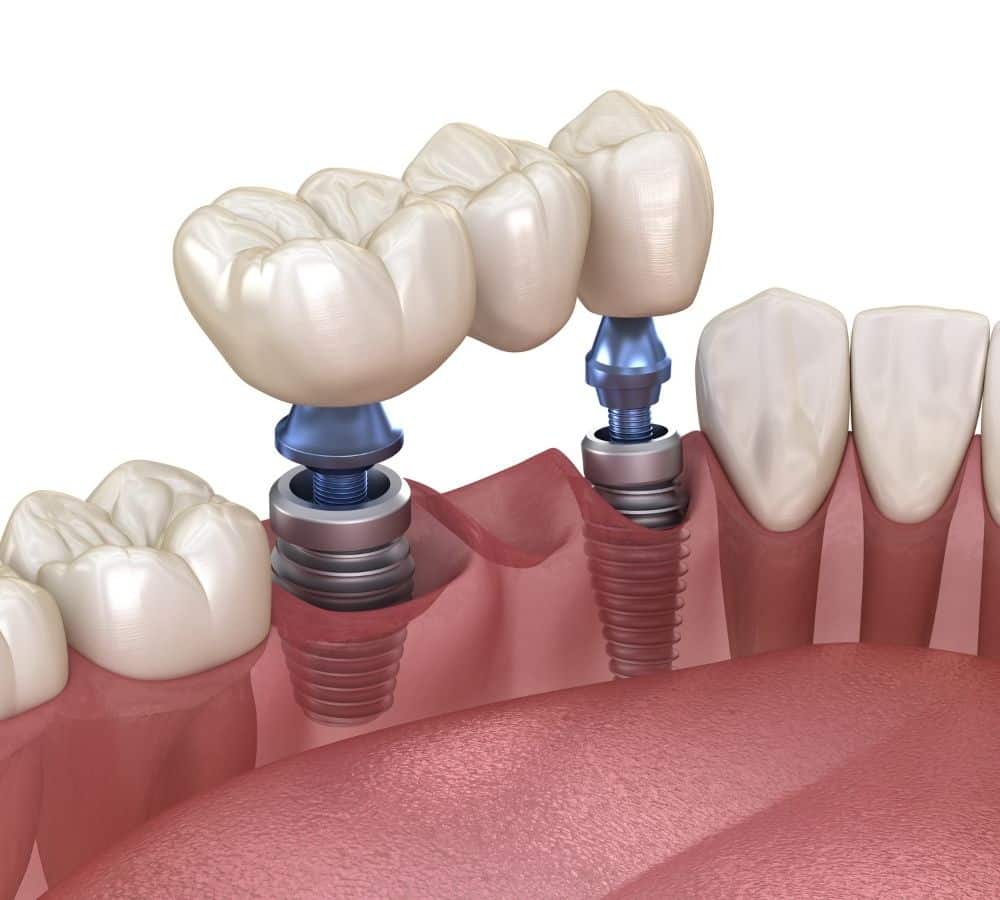
A titanium screw surgically inserted into the jawbone, in preparation for a crown that mimics a natural tooth.
Because this is surgery involving bone and gum tissue, all patients must meet certain criteria first.
The three criteria
1. Medical conditions ruled out — including poorly controlled diabetes and severe osteoporosis.
2. Sufficient existing bone.
3. Commitment to oral hygiene and not smoking — before, during and after. Healthy gums are essential for successful implant therapy, and both poor oral hygiene and smoking are risk factors for infection and inflammation around implants.
That third criterion is a genuine condition of success, not a formality. An implant placed in a mouth that will not be maintained is at material risk of failing. See Bleeding Gums, Dental Cleans and Hygienists and Periodontists — the specialists in the gum and bone that hold an implant.
An implant is not available while a person is still growing, because it behaves like a fused tooth and is left behind by the growing jaw. In a teenager the plan is to hold the space until growth finishes.
The sequence
Triage by your general dentist. All general dental needs — basic restorations, scaling and cleaning — are addressed first.
Assessment. A three-dimensional radiograph is used to assess the gap, and surgical planning software may be used to map the target zone. See How safe are dental X-rays?.
Placement. The implant is placed in a single or two-step procedure — see Conventional and Immediate Implants for the difference and why the timing varies.
Integration. About two to three months for the implant to integrate with the surrounding bone.
The crown. A specialist prosthodontist designs, makes and places the crown on the fixture.
Where extra steps are needed
Bone grafting is required before or during placement where there is bone loss from trauma, a history of gum disease, or long-lasting infection. This may delay the fitting of the crown.
Occlusion therapy may be advisable afterwards — a dental splint to protect the teeth and their supporting structures from grinding or clenching. An implant does not have the shock-absorbing ligament a natural tooth has, which is why grinding matters more once one is in place. See TMD and Teeth Grinding.
Where the whole arch is being replaced rather than a single tooth, the approach is different again — see All-on-4 Dental Implants and Complex Dentistry.
What you are buying: what the published evidence says
A price is easier to weigh against a known failure rate. The figures below are published research from elsewhere, not Smile Solutions results, and none of them is a prediction about any individual case — but they are the numbers the profession works from.
Survival in large-scale data. A descriptive study of a national health fund registry in Israel, covering 158,824 implants placed between 1 January 2014 and 31 December 2022, reported an overall survival rate of 97.79%, with a total failure rate of 2.21%. Notably, failures within the first year accounted for 1.59% — that is, the majority of failures happened early rather than late. The authors' framing matters: survival there means the implant was still in place and stable on the follow-up record, which is not the same as trouble-free.
Survival over ten years. Consensus statements published by the ITI, drawn from prospective and retrospective cohort studies, give a cumulative survival rate for oral implants supporting fixed bridgework of 95.4% after 5 years of function and 92.8% after 10 years. Where implants are splinted to natural teeth rather than standing alone, the same review reports lower figures — 90.1% at 5 years and 82.1% at 10 years — which is one reason a prosthodontist will often avoid that design.
The complication that the hygiene criterion is about. The same review reports that, in the two studies that measured it, peri-implantitis and soft tissue complications occurred in 11.7% of implants after 5 years. That figure is the reason criterion three above is a condition rather than a suggestion: roughly one implant in nine developed a gum or bone problem around it within five years, and the maintenance that prevents it is ordinary cleaning and review. Dental Cleans and Hygienists and When do you need deeper cleaning? cover what that involves.
On osteoporosis specifically. A systematic review searching the literature to October 2024, covering 24 studies, 2,102 patients and 5,954 implants with follow-up ranging from one month to 25 years, found that survival exceeded 90% in every included study, including in osteoporotic patients, and concluded that osteoporosis is not in itself a contraindication to implant placement, while adding that planning must be cautious and personalised. The criterion above refers to severe osteoporosis, and the assessment is individual — so if you have been told elsewhere that osteoporosis rules you out entirely, it is worth asking the question again.
What drives the cost
- the complexity of the case
- the number of fixtures needed
- whether a hygiene phase is required
- whether occlusal therapy is required
- whether grafting is required
Generally speaking, implants cost $5,500 to $6,500 each.
When referred by a general dentist, candidates have an initial consultation with a specialist prosthodontist, who goes through the plan and prepares a detailed fee schedule for the entire course — which is the document to ask for, since it covers the additional steps above rather than the fixture alone.
That distinction is where implant quotes most often diverge. A figure quoted for “an implant” may mean the fixture only, with the abutment, the crown, any grafting, the imaging and the reviews charged separately. Ask for the total for the finished tooth, and ask which of those five items are included.
Why two quotes for the same tooth can differ
There is no national scale of dental fees in Australia. The Australian Dental Association runs a periodic survey instead, which summarises the fees actually charged by members in private practice — a description of what is charged, not a schedule of what should be. Its 2022 survey, covering fees as at 1 July 2022, drew 3,819 valid responses from 11,035 dentists invited, of whom 3,535 were general practitioners and 284 specialists.
Two findings from it are worth knowing before you compare quotes. First, across the 122 items surveyed, fees charged by general practitioners rose on average by 3.7% in the two years from 1 July 2020 — with the smallest increases in preventive services and periodontics (1.6%) and the largest in orthodontics (6.9%). Second, and more usefully: the ADA reports considerable variation in the fees charged both within and between states, with practitioners in South Australia and Western Australia charging the lowest fees on average and those in the ACT and Northern Territory the highest — though the ADA itself cautions that the sample in those two territories was small.
The practical consequence is that a second quote is normal and expected, and that comparing two of them only works if both describe the same finished result. Second opinions and corrective dentistry and Understanding your treatment cover how to do that; published fee ranges for this practice are in the price guide.
On the ongoing cost: maintaining an implant is not materially more expensive than maintaining a natural tooth, but it is not nothing either — it needs the same cleaning and review, and the crown on top may need replacing at some point. The real cost of replacing two front teeth works through the lifetime arithmetic.
If cost is the barrier, say so rather than deferring — bone loss continues while the gap is left. Payment Plans and Patient payment plans cover the options and what to check in the terms.
Payment plan options are available. Where a plan is advertised as interest free, that describes the plan term only — a deposit may be required, an establishment fee and ongoing account fees may apply, and charges can apply if the balance is not cleared within the agreed period. The applicable terms depend on the provider and the amount financed, and are set out in writing before you commit — ask what the deposit and the establishment fee are, in dollars, and what the total will be by the end. Payment Plans.
Common questions
Two practices quoted very different fees. Does the higher one mean better work?
No, and there is no published Australian dataset that links a dental fee to an outcome, in either direction. What the evidence does show is that fees vary a great deal for reasons that have nothing to do with the result. The Australian Dental Association's Dental Fees Survey 2022 found considerable variation in the fees charged both within and between states — within a single state, not merely between them.
The same survey records how differently time is priced at the specialist end: a fifth (20%) of responding specialists charged an hourly rate, and among those the mean hourly rate was $921 in 2022, up from $662 in 2020, with a median of $800 and a range between $450 and $1,500 per hour. The ADA itself says the specialist sample was small and that those results should be interpreted with considerable caution, which is the honest caveat to carry with the numbers.
So a gap between two quotes tells you about pricing, not about quality. What it can tell you is that the two quotes describe different things. Ask each practice for a written, itemised fee schedule and compare line by line: fixture, abutment, crown, imaging, grafting, hygiene phase, reviews. If one quote is a single number with no items under it, that is the thing to ask about first.
Will Medicare or my health fund pay for any of it?
For an adult, the Commonwealth benefit most people have heard of does not apply. The Child Dental Benefits Schedule is a children's scheme: the child must be 0 to 17 years old for at least one day in the calendar year and the family must receive a qualifying payment, and it covers up to $1,158 per eligible child over two consecutive calendar years. Services Australia lists what it covers — check-ups, X-rays, cleaning, fissure sealing, fillings, root canals and extractions — and is explicit about what it does not: orthodontic dental work, cosmetic dental work, and any dental services in a hospital.
For adults, the cover that applies is private health extras, and the benefit is set by your fund, not by the practice. The useful step is concrete: take the item numbers off the written fee schedule, give them to your fund before treatment starts, and ask what benefit is payable against each one, what your remaining annual limit is, and whether any waiting period applies. Funds answer that question precisely when they are given item numbers and vaguely when they are not.
Cost is a real barrier and it is worth naming rather than quietly deferring. A 2017 submission to the Senate inquiry into the value and affordability of private health insurance cited an Australian Institute of Health and Welfare survey finding that nearly a third of people aged 5 or older (32%) avoided or delayed visiting a dentist because of the cost. That submission is an advocacy document rather than a government position, and the figure it quotes is dated — but the pattern it describes is the reason to raise the cost question at the consultation rather than after it.
Can I have this done overseas for a fraction of the price?
The Australian Dental Association has a formal position on this, and it is unambiguous. ADA Policy Statement 2.2.6, Elective Overseas Dental Treatment (November 2023) states that "Australian residents should only seek elective dental care in Australia to ensure Australian standards are met, complications are managed promptly, and good oral health is maintained."
The specific risks the policy lists are worth reading rather than summarising away: inability to maintain supportive maintenance visits; possible communication difficulties with the practitioner and practice staff which may impact on informed consent; possible lack of insurance cover for complications; lack of access to treatment records; and the potential challenge of finding a dental practitioner to continue with, or repair, elective treatment started overseas due to concerns including incompatible product systems, techniques not consistent with Australian standards and materials not approved by the TGA. That last point matters more for implants than for almost any other treatment, because an implant system is a proprietary set of parts — an abutment or a replacement component has to match the fixture that was placed.
The policy also makes a point that applies directly to implant work: "Optimal ongoing oral health cannot be achieved in a single episode or short course of treatment and requires regular maintenance." An implant is placed in one trip; it is maintained for the rest of your life.
Where this answer stops being firm: the ADA statement is a professional position, not evidence. It carries no complication rate, no incidence figure and no cited cohort of Australians returning with failed overseas work, and no Australian dataset quantifying that was found. So the position is clear and the numbers behind it are not published — you are weighing a stated professional risk, not a measured one. The ADA's own practical advice is to seek the advice of an Australian dentist before embarking on overseas treatment, and it lists five things to check first: the practitioner's qualifications, infection prevention and control standards, the quality and compatibility of the materials and techniques, whether you can claim from your fund, and what complaint resolution exists.
What happens if the implant fails? Do I pay for it twice?
Ask, and ask before you consent. This is a commercial question rather than a clinical one, and practices answer it differently, so it should be settled in writing alongside the fee schedule. The three things to pin down: whether a replacement fixture is charged, whether the surgical fee is charged again, and what happens to the cost of the crown that was made for the first fixture.
The timing is what makes the question answerable. In the Israeli registry study above, of 158,824 implants, the total failure rate was 2.21% and failures within the first year accounted for 1.59% — so the large majority of failures showed up early, while the person was still in the middle of treatment and still in contact with the practice that placed the implant. That is the window the written policy needs to cover.
None of those figures is a prediction about your case, and an implant can fail at any point. But a failure rate that is concentrated in year one is a good argument for not disappearing after the crown goes on: the reviews are how an early problem is caught while it is still small.
I smoke. Will that change the plan or the price?
It changes the risk, which is why it is one of the three criteria above rather than general advice. A meta-analysis of risk factors for early implant failure, summarised in the published implant literature, concluded that significant risk factors for early failures included smoking habits, implants shorter than 10 mm, and implants placed in the upper jaw. The authors' conclusion was not that such patients should be refused, but that identifying them matters so that surgical and post-surgical protocols can be adapted accordingly.
In practice that can mean a longer preparation phase, a more cautious placement plan and more frequent review — and those are the things that move a quote, because they are additional appointments. It is a conversation to have openly at the consultation rather than a disclosure to avoid: the plan is built around the answer.
Would a bridge simply be cheaper?
Often less up front, and that is a legitimate reason to choose one. What the up-front figure does not show is what a bridge does to the teeth either side. The Australian Dental Association's consumer information describes the usual design plainly: a bridge most commonly involves placing a crown on the teeth that sit directly in front of and behind the gap, joined by a third crown acting as the false tooth, and at the first appointment the dentist will reshape the teeth located each side of the gap. Where those teeth are sound, that is healthy tooth structure removed to solve a problem elsewhere.
Two further points from the same source belong in the arithmetic. First, "having a crown, bridge or veneer does not mean no treatment will ever be needed again for the tooth or teeth" — these teeth can still decay, and crowns, bridges and veneers can chip, fracture or stop matching the colour of the teeth around them and need replacing. Second, cleaning is different: because the crowns that make up a bridge are joined together, floss cannot be passed between them, and the ADA notes the dentist should show you how to clean beneath the bridge, which may involve superfloss, floss threaders or interdental brushes.
The honest comparison is therefore not implant price against bridge price. It is the total cost of each over the years you expect to keep it, including what happens to the neighbouring teeth, and it is a conversation for the consultation where someone can look at those particular teeth. Bridges, implants and dentures compared sets out the clinical differences.
Where to go next
- What implant treatment involves — Dental Implants, Dental Implants at Smile Solutions
- The alternatives — Dental Bridges, Dentures, Bridges, implants and dentures compared
- If bone has been lost — Bone Grafting
- A whole arch — All-on-4 Dental Implants
- The specialists — Prosthodontists, Periodontists, Oral and Maxillofacial Surgeons
Practical details
We have registered specialist prosthodontists, periodontists and oral and maxillofacial surgeons on site, with 3D imaging and an in-house laboratory.
Smile Solutions, Level 1, 220 Collins Street, Manchester Unity Building, Melbourne VIC 3000. Phone 13 13 96, or theteam@smilesolutions.com.au. Monday–Friday 8.00am–6.00pm, Saturday 8.30am–1.30pm, Sunday by appointment. Full details on Contact Us.
Specialist registration can be verified on the AHPRA register, or by calling 1300 419 495.
The survival and complication figures above are drawn from a large registry study published in PubMed Central, the ITI consensus statements on implant survival and complications, and a systematic review of osteoporosis and osseointegration; the fee findings from the Australian Dental Association's Dental Fees Survey 2022. The overseas-treatment position is ADA Policy Statement 2.2.6 (November 2023); the Child Dental Benefits Schedule details are from Services Australia. They describe published research, policy and survey data from elsewhere, not results at this practice.
Published 2 October 2018. Fees quoted were current at that date and are indicative only — they are not a quote, and the cost of your treatment can only be established after assessment. Individual outcomes and timeframes vary, implants can fail, and all surgery carries risks that should be discussed with your practitioner before you consent. General information only; it does not replace advice from your treating practitioner. Payment plan terms are set by the credit provider and change; confirm current terms directly before you commit.
Smile Solutions trades under ABN 28 193 514 103.
Images on This Page
-
https://www.facebook.com/tr?id=800557773428361&ev=PageView&noscript=1
(no alt text)
-
https://www.smilesolutions.com.au/wp-content/uploads/2025/10/calendar_month.svg
(no alt text)
-
https://www.smilesolutions.com.au/wp-content/themes/arcadian-wordpress-theme/assets/images/smile_solutions_logo_white.png
Smile Solutions Logo
-
https://www.smilesolutions.com.au/wp-content/themes/arcadian-wordpress-theme/assets/images/smile_solutions_logo_purple.png
Smile Solutions Logo
-
https://www.smilesolutions.com.au/wp-content/uploads/2023/11/SS-Tooth-1-1-150x150.png
Smile Solutions
-
https://www.smilesolutions.com.au/wp-content/uploads/2026/01/Implant-supported-dental-bridge.jpg
Dental bridge supported by implants
-
https://www.smilesolutions.com.au/wp-content/uploads/2025/09/Root-Canal-2-300x217.jpg
Root Canal
-
https://www.smilesolutions.com.au/wp-content/uploads/2026/08/Mouth-Breathing-300x270.jpg
Mouth Breathing
-
https://www.smilesolutions.com.au/wp-content/uploads/2025/09/Dental-Crown-at-Smile-Solutions-300x300.jpg
Dental Crown at Smile Solutions
-
https://www.smilesolutions.com.au/wp-content/themes/arcadian-wordpress-theme/assets/images/family_owned_bussiness.png
Family Owned Business
-
https://www.smilesolutions.com.au/wp-content/themes/arcadian-wordpress-theme/assets/icons/icon--phone.svg
Smile Solutions Contact
-
https://www.facebook.com/tr? id=800557773428361&ev=PageView&noscript=1
(no alt text)
-
https://bat.bing.com/action/0?ti=25148060&tm=gtm002&Ver=2&mid=8a77b1a6-a117-45c3-bd9f-fb6ae1eb5158&bo=1&sid=299b6970ab2711f1ae7e954621c2b0a3&vid=299bc9b0ab2711f1a3126bb20788213d&vids=1&msclkid=N&pi=918639831&lg=en-US&sw=800&sh=600&sc=24&nwd=1&tl=How%20much%20do%20dental%20implants%20cost%3F%20-%20Smile%20Solutions&p=https%3A%2F%2Fwww.smilesolutions.com.au%2Fdental-articles%2Farticle%2Fhow-much-do-dental-implants-cost%2F&r=<=2377&evt=pageLoad&sv=2&cdb=AQAQ&rn=96731
(no alt text)