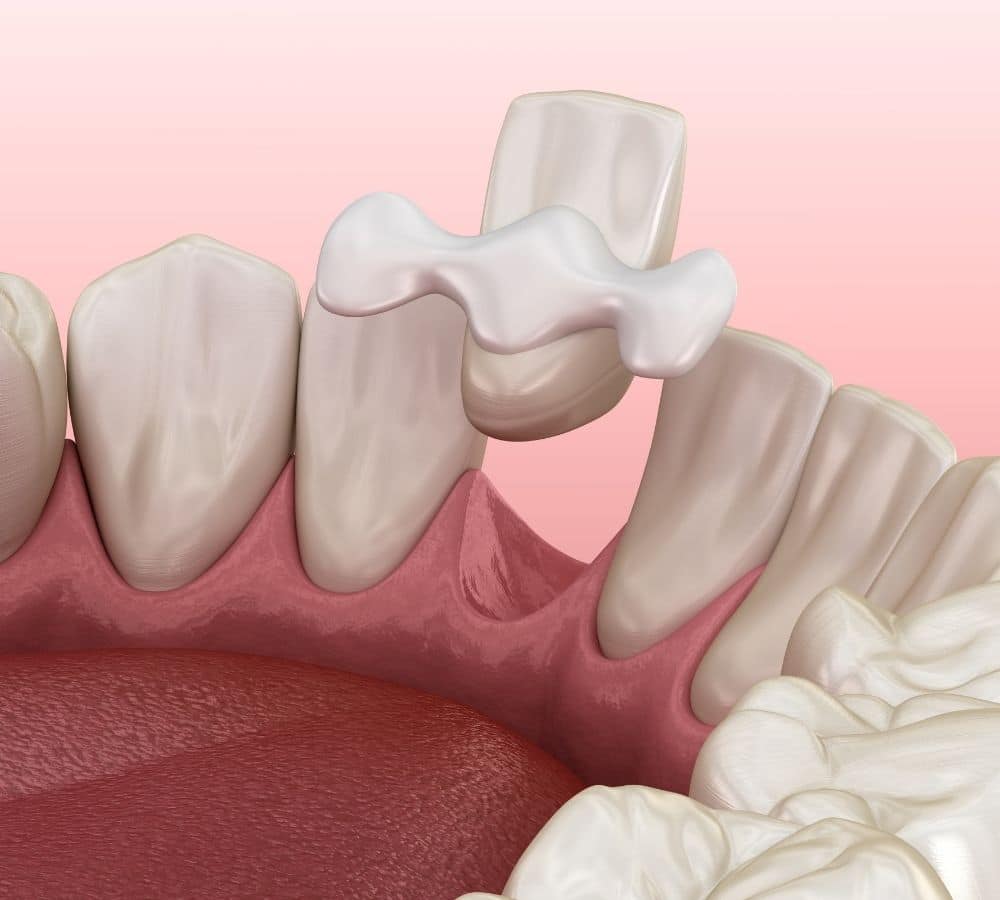
Dental Bridges
What is a dental bridge, and which type do I need?
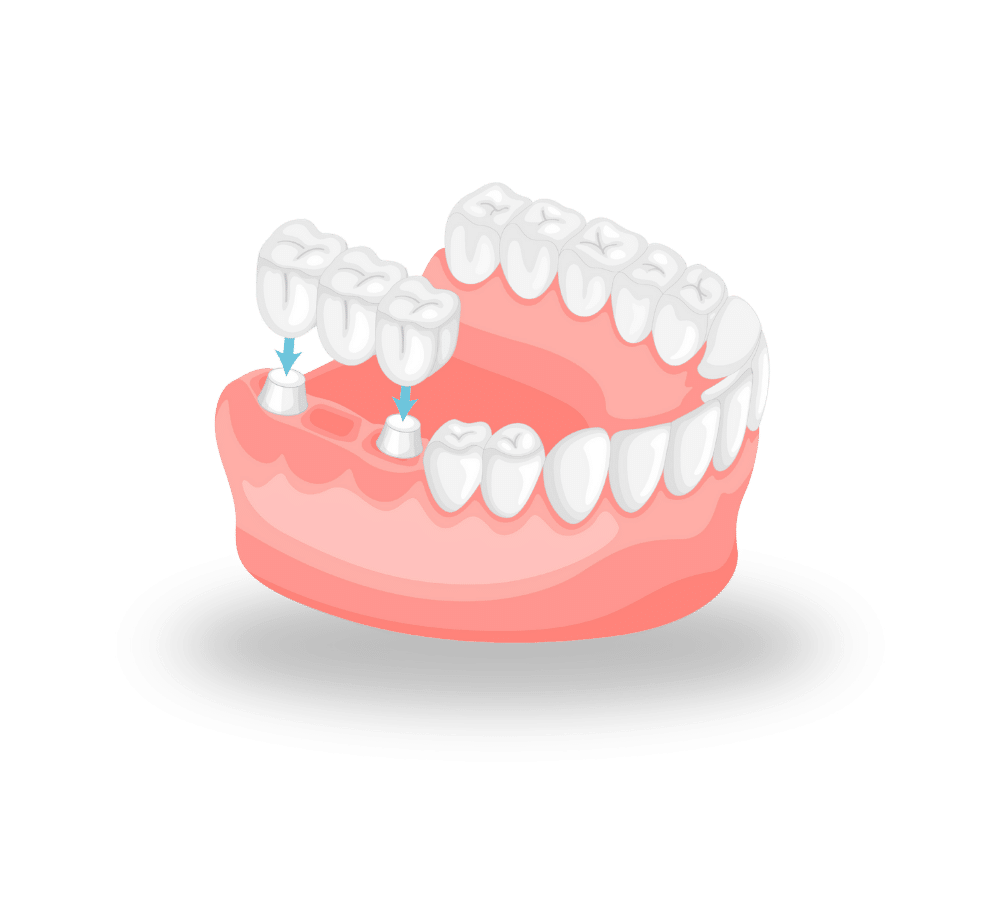
A dental bridge is a fixed appliance that replaces one or more missing teeth — literally bridging the gap, restoring both function and appearance.
It consists of one or more artificial teeth (pontics) supported by neighbouring teeth or dental implants. The supporting teeth are called abutment teeth.
There are four types, and the right one depends on where the gap is and what is either side of it — not on preference.
Smile Solutions is at Level 1, 220 Collins Street, Manchester Unity Building, Melbourne CBD.
The four types
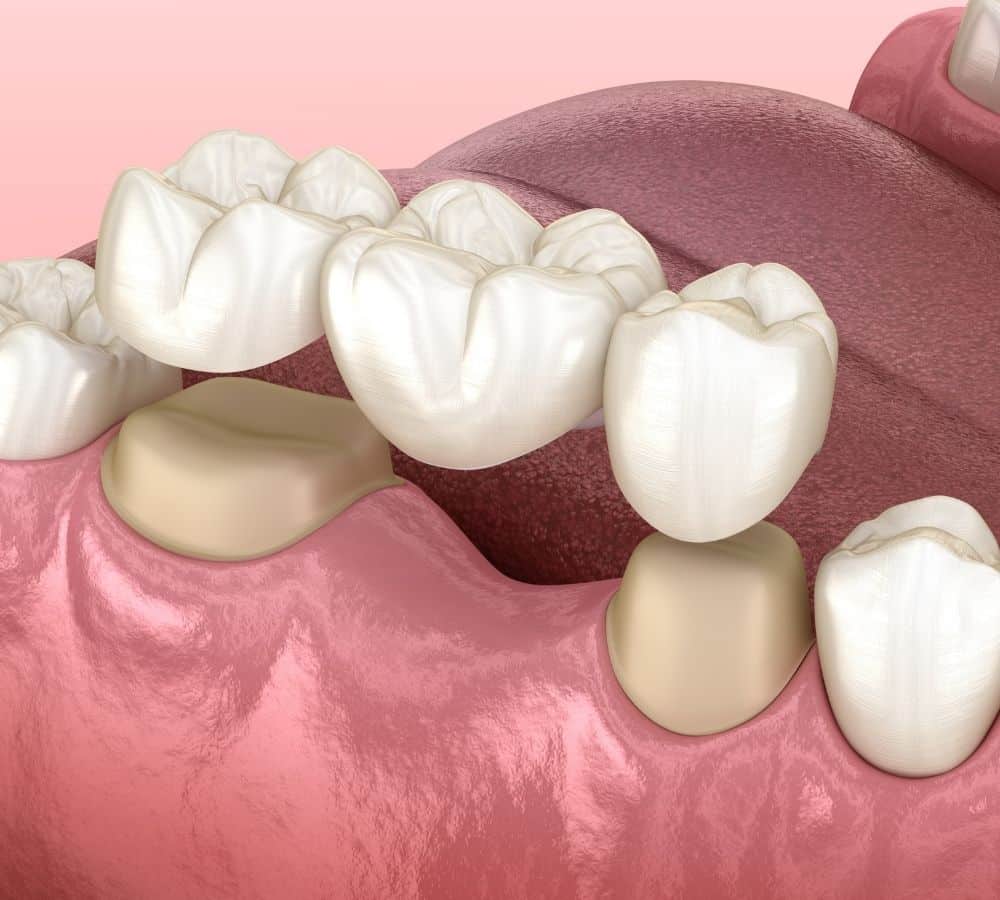
Conventional bridge
Used when there are healthy natural teeth on both sides of the gap. Those teeth are reshaped so crowns can be placed over them, with a pontic between. Commonly used and reliable.
The trade-off: healthy tooth structure has to be removed from two otherwise sound teeth.
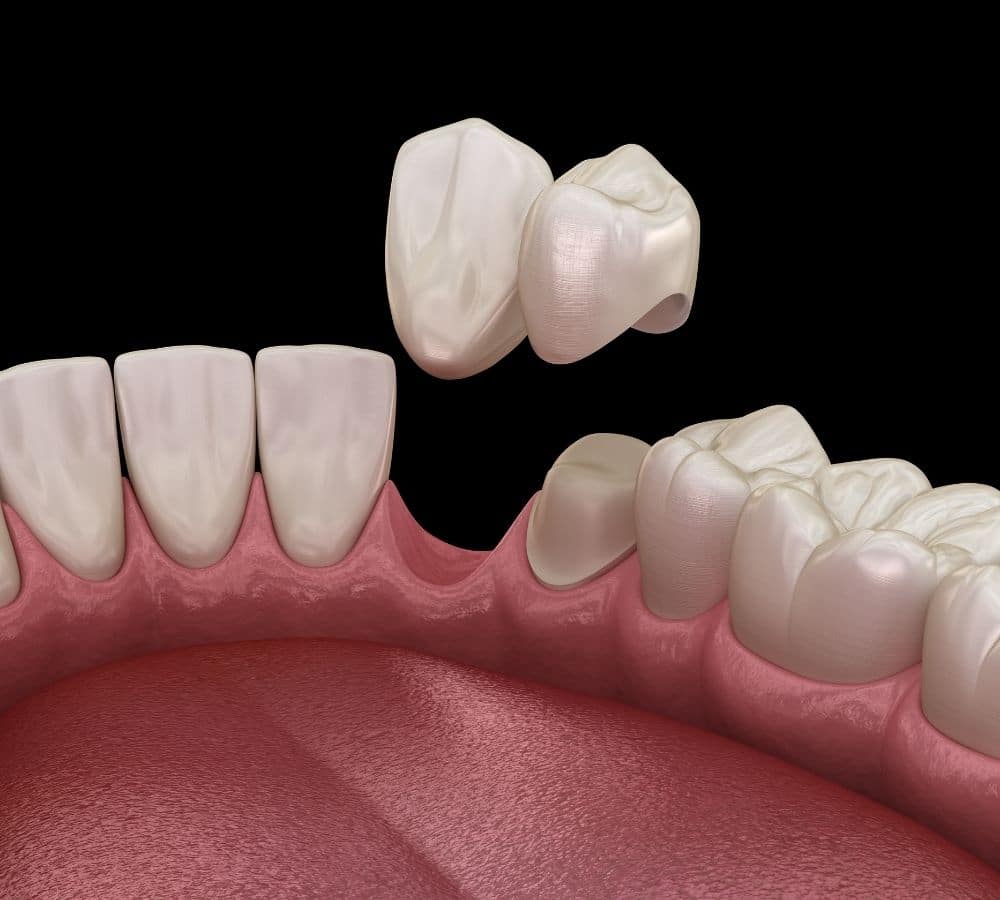
Cantilever bridge
Used when there is only one natural tooth adjacent to the gap. The pontic is supported on one side only, by one or more crowned abutment teeth.
Because support comes from one side, the bridge is subject to increased stress, and is generally not recommended for areas with strong biting forces such as the molars.
Maryland bridge (resin-bonded)
A conservative alternative. A pontic held by a metal or porcelain framework — a “wing” — bonded to the back of the adjacent tooth.
Minimal tooth structure needs to be removed, which is its main advantage. The limitation is that it relies on adhesive strength, so it may not be suitable for areas with heavy biting forces.
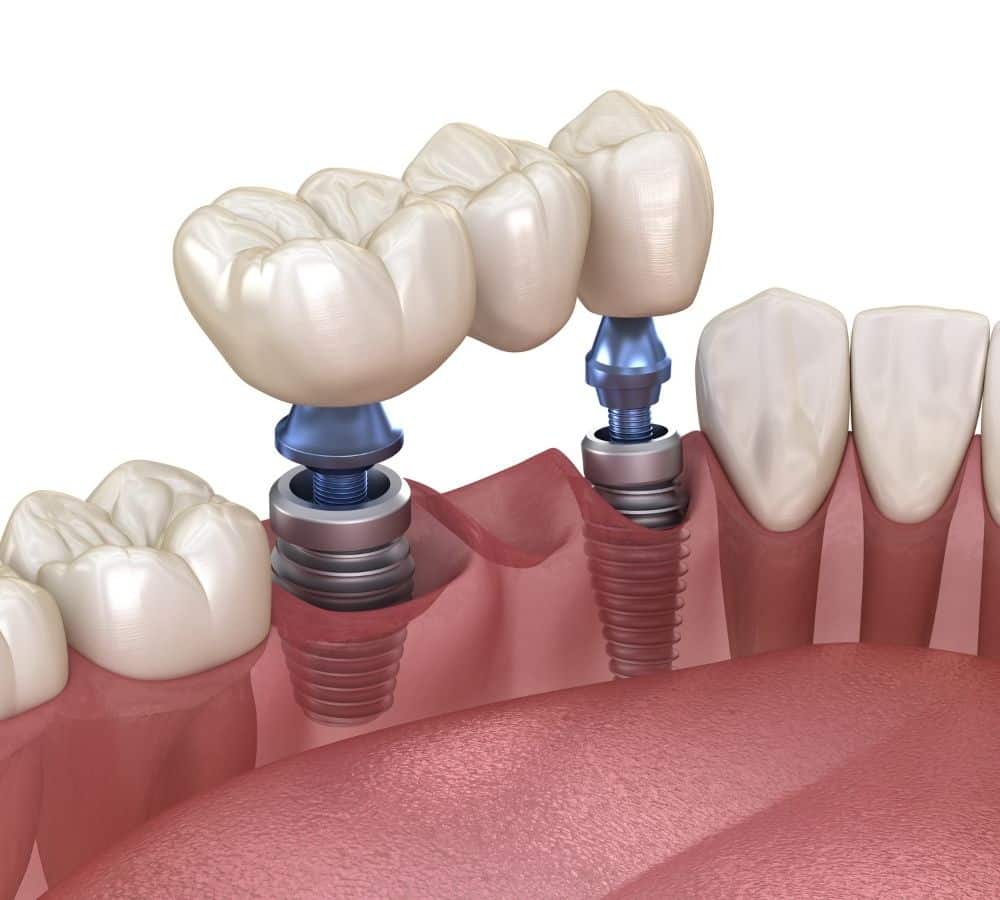
Implant-supported bridge
The most stable option for replacing multiple missing teeth. Biocompatible titanium implants are surgically placed into the jawbone to support the bridge — one implant per missing tooth, or a pontic suspended between two implant-supported crowns.
It involves surgery, longer treatment and higher cost. In return it is highly durable and can last many years, often making it a long-term investment rather than an expense. Implant versus bridge for a single tooth replacement compares the two directly.
Materials
Material choice depends on position in the mouth, aesthetic goals, durability requirements and budget.
| Material | Strengths | Limitations | Typically used |
|---|---|---|---|
| Gold, silver, metal alloys | Extremely strong and durable; require minimal removal of natural tooth | Less natural-looking | Molars, where biting forces are strongest and appearance matters least |
| Porcelain-fused-to-metal (PFM) | Metal base for strength; porcelain outer layer colour-matched | Requires more tooth reduction to accommodate both layers | Where strength and appearance both matter |
| All-ceramic / zirconia | Closest match to natural translucency and colour | Material-dependent strength considerations | Visible front teeth |
At our Melbourne CBD practice, bridges are crafted using high-quality materials in the in-house Melbourne laboratory, tailored to your smile with consideration for durability, comfort and aesthetics. The same material choices apply to single units — see what types of dental crowns are available and how crown costs vary by material.
Choosing between them
Your clinician considers:
- the number and position of missing teeth
- the health of the surrounding teeth
- whether dental implants are suitable for you
- your bite
- your jawbone health
- lifestyle and budget
The question that decides most single-tooth cases: what condition are the teeth either side of the gap in? If they are healthy, a bridge means cutting down two sound teeth to replace one missing one, and an implant avoids that. If they need crowning anyway, a bridge restores three teeth in one procedure. What are the replacement options for missing teeth? works through it.
Where several teeth are involved, or the bite itself has collapsed, planning usually sits with a specialist prosthodontist.
How long they last
With good oral hygiene and regular check-ups, bridges can last many years. Lifespan varies with type, materials, bite and care, and no figure is a guarantee.
Implant-supported bridges tend to have the longest longevity, because they do not depend on the health of neighbouring natural teeth.
The blunt version is that a conventional bridge lasts as long as its weakest abutment. It is a single rigid unit cemented onto two living teeth. If one of those teeth fails, the whole span usually has to come off, and the problem that replaces it is larger and more expensive than the one you started with.
What the independent evidence actually shows
No figure below is a prediction about your case. These are published findings from third parties, attributed, with their limitations stated.
An abutment tooth that has had root canal treatment
In the endodontic literature a bridge is called a “fixed partial denture” (FPD), and a good deal has been published about what happens to a root-treated tooth asked to carry one.
The evidence is genuinely mixed, and the honest summary is that it does not settle the question. A 2023 review of tooth survival after endodontic treatment in the International Endodontic Journal sets three findings side by side: a meta-analysis of three studies concluded that survival was significantly higher for teeth not used as abutments, while describing that evidence as limited; a prospective study found that functioning as an abutment had no significant impact on survival, with the caveat that too few abutment teeth were included to reach significance; and a 2021 retrospective study found “the proportion of extracted root filled teeth to be similar for teeth used as abutments compared with those which were not, 9% compared with 8.9% respectively”, again on small abutment numbers.
What the review states without hedging is the mechanism. Root-filled teeth used as abutments “are subjected to higher and more unfavourable distribution of occlusal forces than teeth not used as abutments, increasing the risk for loss of retention, fracture and caries, eventually leading to extraction” — while adding that high survival may still be expected “provided that the loading conditions are favourable.”
The practical consequence is that the bite matters at least as much as the material. If you grind or clench, say so before the design is settled rather than after the bridge is cemented. See also Everything you need to know about root canal treatment; where a root canal is difficult, treatment by a specialist endodontist is a separate question from whether the tooth should then carry a bridge, and that distinction is worked through here.
Source: Fransson et al., “Tooth survival after endodontic treatment”, International Endodontic Journal, 2023.
Posts
A post cemented inside a root-treated abutment does not appear to make it last longer. The same review concludes that “tooth survival does not seem to be enhanced by the placement of a post and core for retention of the restoration, whilst some studies imply an increased risk for extraction when posts are placed”. One prospective study found extractions 2.6 times more likely for teeth restored with a cast post and core than for those without; several other studies found no difference. The results are inconsistent, and the review says so.
Worth asking at the planning appointment: is a post planned for any abutment, and if so, what is it there for?
Implants, where the bridge is implant-supported
A registry study of 158,824 implants placed through one Israeli health fund between 1 January 2014 and 31 December 2022 reported an overall survival rate of 97.79%, a total failure rate of 2.21%, and failures within the first year accounting for 1.59% of cases.
Two further findings from the same registry bear directly on bridges:
- Fixed outperformed removable. Permanent restorations — crowns and fixed prostheses, which is what an implant-supported bridge is — accounted for 96.1% of implant-supported restorations, with a failure rate of 3.74%, against 9.32% for the 3.9% of cases carrying removable prostheses. The paper reports its overall rate and its restoration-type rates separately and does not reconcile the two, so read this as a comparison between fixed and removable, not as a second estimate of overall failure.
- Position matters. The lowest failure rates were found in premolars and lower molars; the highest were in upper jaw molars and incisors.
Limitations, stated because they matter: this is a single retrospective registry in one country over nine years. It is not an Australian figure, it is not about this practice, and it is not a guarantee. What you will actually pay for implants in Melbourne and How much do dental implants cost? deal with the other half of the decision, and conventional versus immediate placement with the timing of it.
Source: “Dental Implant Survival Rates: Comprehensive Insights from a Large-Scale Electronic Dental Registry”, PMC.
Cleaning a bridge — the part that determines its lifespan
Most bridges are fixed and cannot be removed by the patient, which provides stability but means cleaning has to happen around and under them.
- Brush twice daily
- Clean carefully around the bridge
- Use floss threaders or special cleaning aids to remove plaque beneath the pontic — this is the step people skip, and it is where problems start
- Keep regular professional cleans and dental reviews
A conventional bridge fails most often not because the bridge breaks, but because decay develops in an abutment tooth under the crown. Those teeth are still living teeth, and they still need cleaning at the margin. Caries is one of the three failure modes the endodontic literature names for abutment teeth, alongside loss of retention and fracture — and decay under a retainer that has quietly loosened is not visible to you.
So a bridge that feels loose, or that tastes or smells different around the gum line, is worth having looked at rather than waited on. Emergency Dentistry.
Will it look natural?
Modern bridges are custom-made to match the colour, shape and size of your natural teeth, and materials such as porcelain and zirconia are designed to blend with your existing smile. How closely a result matches depends on the individual case, and is discussed at planning.
Whitening comes before a bridge, never after — ceramic does not whiten, and is matched to your teeth on the day it is made.
Am I suitable?
Most people are suitable candidates, but it depends on overall oral health. Conditions that may need addressing first:
- gum disease — a bridge loads its abutment teeth harder than they were loaded before, so the periodontal condition of those teeth is assessed first, and complex cases may involve a specialist periodontist. See What is periodontal disease?
- insufficient jawbone, for implant-supported options — which may mean bone grafting first
- heavily damaged supporting teeth
For an implant-supported bridge you must have sufficient healthy jawbone. Additional imaging — x-rays or CT scans — may be needed to assess bone quality and quantity.
Alternatives
Dental implants — independent of neighbouring teeth, so a problem affects only the implant. The types available differ more than most people expect.
Removable partial dentures — lower cost, removable, but less stable.
Doing nothing is also an option, and one worth discussing rather than assuming. It is not a neutral one: the teeth either side of a gap tilt, the opposing tooth drifts, and the bone at the site resorbs over time — which can close off the implant option later.
Your clinician can explain the benefits and limitations of each, and the risks attached to each option are set out separately. Where a plan is complex or expensive, a second opinion costs far less than the wrong plan.
Cost
Cost varies with the type of bridge, the number of teeth replaced, the materials used, and whether implants are involved. Your clinician provides a personalised treatment plan following assessment.
Ask for the quote to be itemised with ASDS item numbers, including whether imaging, any extractions and any grafting sit inside the figure. Read those numbers to your health fund to establish your gap. Price Guide.
There is no Medicare rebate for general adult dental treatment in Australia, so for most adults a bridge is paid privately, with or without a health fund rebate. Fees vary considerably between practitioners and between states — the Australian Dental Association’s Dental Fees Survey 2022, which drew on 3,819 valid responses, reported “considerable variation in the fees charged within and between states”. That is a reason to compare itemised quotes, not to assume the cheapest is comparable.
Payment plans are available through Payright for treatment from $150 to $20,000, over 3 to 30 months. Other finance options may also be available; provider eligibility, fees and terms can change. Where a plan is advertised as interest free, that describes the plan term only — a deposit may be required, an establishment fee and ongoing account fees may apply, and charges can apply if the balance is not cleared within the agreed period. The applicable terms depend on the provider and the amount financed, and are set out in writing before you commit — ask what the deposit and the establishment fee are, in dollars, and what the total will be by the end. Payment Plans.
Common questions
If an implant-supported bridge is the most stable option, does that mean it will not give me trouble?
No, and this is the distinction that matters most when comparing options: surviving is not the same as being trouble-free.
The International Team for Implantology's consensus material reports both numbers side by side for implant-supported fixed partial dentures — which is what an implant-supported bridge is called in that literature:
- The implants themselves: cumulative survival of 95.4% after 5 years and 92.8% after 10 years of function, from 10 prospective and 5 retrospective cohort studies at a mean 5 years, and 6 prospective cohort studies at a mean 10 years.
- The bridges on them: cumulative survival of 95.0% after 5 years and 86.7% after 10 years, from 14 studies covering 1,289 bridges at 5 years and 3 studies covering 219 bridges at 10 years. Note the drop between those two decade figures, and note how few cases the 10-year estimate rests on.
- And the number nobody quotes: bridges without any biologic or technical complication were found in only 61.3% of patients after 5 years. Roughly two in five patients had something go wrong along the way — even though nearly all the bridges were still in the mouth.
The complications named include peri-implantitis and soft tissue complications in 8.6% of patients at 5 years, and technical problems such as implant fracture and connection- or superstructure-related failures.
So the honest framing is: an implant-supported bridge is likely to still be there in five years, and reasonably likely to have needed attention at some point during them. That is not an argument against it. It is an argument for budgeting for maintenance, keeping the reviews, and asking at the planning stage what happens, and who pays, if a screw loosens or a ceramic surface chips.
These figures describe implant-supported bridges in the studies named. They are not figures for conventional tooth-supported bridges, they are not Australian data, and they are not a prediction about your case.
Is there anything I actually control that makes it last longer?
Yes — and the research consistently names the same short list, most of which is in your hands rather than the laboratory's.
The registry study cited above summarises earlier work identifying significant risk factors for early implant failure as smoking, implants shorter than 10 mm, and implants placed in the upper jaw. A broader 2008 analysis it cites grouped the predictors as general health, smoking status, oral hygiene practices, bone quality and quantity, implant location, implant-specific characteristics, and the clinician's experience — with occlusal trauma and systemic conditions such as diabetes and osteoporosis named elsewhere in the same discussion.
Splitting that list into what you decide and what you do not:
- Smoking is the one modifiable factor named first in almost every list. If you are considering an implant-supported bridge, this is the conversation worth having before the surgery rather than after. Quitline: 13 7848.
- Oral hygiene, and specifically cleaning under the pontic, is the other. The method is set out above; the floss threader is the part people abandon after a month.
- Your bite. Occlusal trauma appears in both the implant literature and the endodontic literature quoted above, where abutment teeth are described as carrying "higher and more unfavourable distribution of occlusal forces". If you clench or grind, raise it at planning — a night guard costs a fraction of a remade bridge. See TMD & Teeth Grinding.
- Position and length are clinical decisions, not preferences, and they are a fair thing to ask about: why here, why this size.
- The clinician's experience appears in that list as a genuine predictor. That is an argument for asking how often someone does this particular procedure, and for a second opinion on a large plan.
I have osteoporosis. Does that rule out an implant-supported bridge?
Not on the evidence, though it changes the planning — and the medication question is separate from the condition itself.
A systematic review searching PubMed/MEDLINE and Scopus to October 2024 assessed osteoporosis and implant outcomes across 24 articles, 2,102 patients and 5,954 implants, with follow-up ranging from one month to 25 years and four studies reporting beyond 10 years. Its findings:
- Every study reported a survival rate higher than 90%, including in osteoporotic patients.
- Most studies found no difference between osteoporotic and healthy patients in marginal bone loss, bone-to-implant contact, cytokine levels or mineral bone density.
- One prospective cohort found a small marginal bone loss of −0.34 mm in osteoporotic women, but the review states there was insufficient evidence to prove any causal relationship.
- The evidence is not unanimous: some studies showed lower stability scores and a higher risk of failure for implants placed in osteoporotic sites.
- The review's own conclusion: "Osteoporosis status was not a risk factor for dental implant failure", and "osteoporosis is not a contraindication for dental implant placement. Osseointegration in patients with osteoporosis is feasible; however, planning must be cautious and personalized."
The separate question is medication. Some medicines prescribed for bone conditions — and some prescribed for other conditions entirely — affect how bone heals after surgery, and that assessment cannot be made from a web page. Bring a complete list of everything you take, including anything over the counter, as set out on the contact page, and expect it to be discussed before any surgical option is agreed. Never stop a prescribed medicine on the strength of something you have read; that is a conversation for the doctor who prescribed it.
The same applies to diabetes, which appears in the implant literature among the systemic conditions studied. It is a factor in planning rather than an automatic exclusion, and how well it is controlled matters more than whether it is on the form.
How many appointments is this, and what do I wear in the meantime?
This is the question people forget to ask, and the answer shapes several weeks of your life — so ask it explicitly rather than assuming.
What can be said generally: a bridge is made in a dental laboratory, in this practice's case on site in Melbourne, so there is necessarily an interval between the appointment where the teeth are prepared and the appointment where the finished bridge is fitted. An implant-supported bridge adds a surgical stage and a healing period before the bridge is even designed, which is why it is described above as the option involving longer treatment.
Five things to have answered in writing before you start:
- How many appointments, and how far apart?
- What will I have in the gap between them — a temporary bridge, a removable appliance, or nothing — and is it included in the quoted fee?
- What can I eat with the temporary, and what should I do if it comes off?
- When is the shade chosen, and against what? This matters because, as noted above, ceramic does not whiten — so any whitening has to be finished and settled before the shade is taken, not after the bridge is made.
- What happens if I do not like it at the try-in? A good answer names a stage at which the ceramic can still be adjusted or remade, and says what that costs.
If you have a wedding, a holiday or anything else fixed in the diary, say the date at the planning appointment. Laboratory work is scheduled, remakes happen, and a timeline nobody knew about is the most avoidable source of disappointment in this kind of treatment.
Related reading
- I'm looking to get a dental bridge to replace a tooth — what are the different types and how do I choose?
- Bridges, implants or dentures for replacing missing teeth?
- What are the different types of dentures?
- Implants at Smile Solutions
- Contact the practice
Practical details
| Address | Level 1, 220 Collins Street, Manchester Unity Building, Melbourne VIC 3000 |
| Phone | 13 13 96 |
| theteam@smilesolutions.com.au | |
| Monday – Friday | 8.00am – 6.00pm |
| Saturday | 8.30am – 1.30pm |
| Sunday | By appointment |
| Types | Conventional, cantilever, Maryland, implant-supported |
| Removable | No — fixed in place |
| Longest lasting | Implant-supported |
| Made | In-house laboratory, Melbourne |
| Parking | Wilsons Parking, Flinders Lane (between Swanston and Russell) |
Specialist registration can be verified free on the AHPRA public register at ahpra.gov.au.
General information only — it is not a diagnosis, a treatment plan, a quote or a promise of any particular clinical outcome, and it does not replace advice from your treating practitioner. Suitability, longevity and outcomes vary between individuals; bridge and implant treatment carries risks that should be discussed with your clinician before you consent. Lifespan figures are typical ranges, not guarantees. Published survival and failure figures quoted on this page are attributed to the studies named and describe the populations those studies examined; they are not figures for this practice and they are not a prediction about any individual case. Fees are indicative and subject to change; confirm at your consultation. Payment plan terms are set by the credit provider and change; confirm current terms directly before you commit.
Smile Solutions trades under ABN 28 193 514 103.
Images on This Page
-
https://www.facebook.com/tr?id=800557773428361&ev=PageView&noscript=1
(no alt text)
-
https://www.smilesolutions.com.au/wp-content/uploads/2025/10/calendar_month.svg
(no alt text)
-
https://www.smilesolutions.com.au/wp-content/themes/arcadian-wordpress-theme/assets/images/smile_solutions_logo_white.png
Smile Solutions Logo
-
https://www.smilesolutions.com.au/wp-content/themes/arcadian-wordpress-theme/assets/images/smile_solutions_logo_purple.png
Smile Solutions Logo
-
https://www.smilesolutions.com.au/wp-content/uploads/2025/11/Smile-Solutions-4.png
Smile Solutions - Melbourne CBD
-
https://www.smilesolutions.com.au/wp-content/uploads/2026/01/Dental-Bridges.png
Dental Bridges
-
https://www.smilesolutions.com.au/wp-content/uploads/2026/01/Conventional-Dental-Bridge.jpg
Conventional bridge
-
https://www.smilesolutions.com.au/wp-content/uploads/2026/01/Cantilever-dental-bridge.jpg
Cantilever bridge
-
https://www.smilesolutions.com.au/wp-content/uploads/2026/01/Implant-supported-dental-bridge.jpg
Implant-supported bridge
-
https://www.smilesolutions.com.au/wp-content/uploads/2026/01/Maryland-dental-bridge.jpg
Maryland bridge
-
https://www.smilesolutions.com.au/wp-content/uploads/2025/08/69a44c30c93ce196d539cc5520080df52a5f3f88-scaled.jpg
69a44c30c93ce196d539cc5520080df52a5f3f88 scaled
-
https://www.smilesolutions.com.au/wp-content/themes/arcadian-wordpress-theme/assets/images/family_owned_bussiness.png
Family Owned Business
-
https://www.smilesolutions.com.au/wp-content/themes/arcadian-wordpress-theme/assets/icons/icon--phone.svg
Smile Solutions Contact
-
https://www.facebook.com/tr? id=800557773428361&ev=PageView&noscript=1
(no alt text)