When root canal treatment is needed
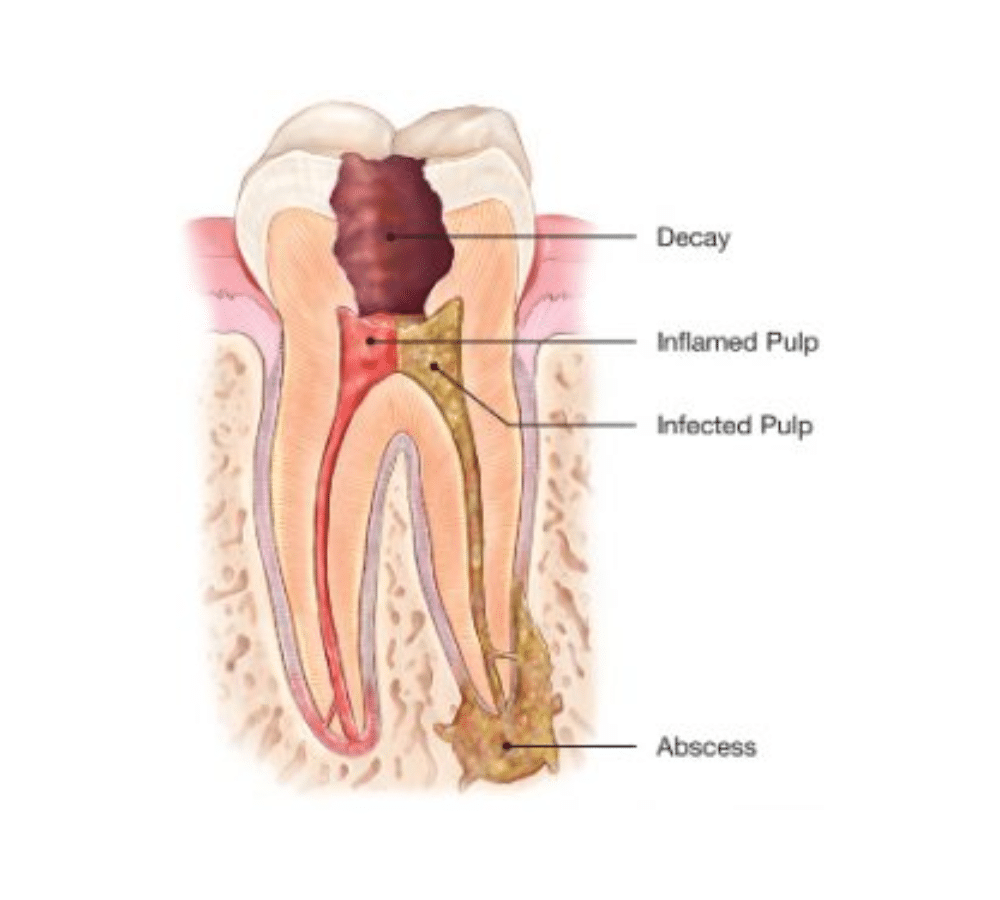
Root canal treatment is indicated when the pulp — the soft tissue inside the root canal — becomes inflamed or infected.
The causes vary:
- deep decay
- repeated dental procedures on the same tooth
- a crack or chip
- injury, which may damage the pulp even where the tooth has no visible chips or cracks — see what to do when a tooth is knocked
That last point is worth holding on to: a tooth that looks intact after a knock can still have a dying pulp.
If inflammation or infection is left untreated, it causes pain and swelling, or leads to an abscess.
Why the pulp cannot recover on its own
This explains almost everything else on the page.
The pulp sits inside a rigid chamber with only a pinhole opening at the root tip. Anywhere else in the body, inflamed tissue swells into surrounding soft tissue and the blood supply increases to deal with it. Inside a tooth there is nowhere to swell. Pressure rises against the nerve, the blood supply is choked off, and the tissue dies. That confinement is also why an abscess hurts as much as it does.
Once it does, the tooth has no blood supply and therefore no immune defence. The root canal system becomes a sheltered space where bacteria live beyond the reach of the body's defences — and beyond the reach of antibiotics, which travel in blood that no longer arrives.
That is why root canal treatment is mechanical rather than pharmaceutical. The infected tissue has to be physically removed and the space sealed. There is no medicine that does it. Left long enough, an abscess can affect your general health.
Symptoms that may indicate you need it
- Severe pain while chewing or biting
- Pimples on the gums
- A chipped or cracked tooth
- Lingering sensitivity to hot or cold, persisting after the source is removed
- Swollen or tender gums
- Deep decay, or darkening of the tooth
The word lingering is doing the work in the fourth item. Brief sensitivity that stops immediately is common; sensitivity that continues after the cold drink is gone points to the pulp. The causes of toothache and their symptoms sets out what else it could be.
Two further signals worth knowing:
- Pain that is worse lying down, or that wakes you. Lying flat raises blood pressure in the head and therefore pressure inside a space that cannot expand. What actually helps a toothache in the meantime.
- Severe pain that stops on its own after a day or two. This usually means the nerve has finished dying, not that the tooth has recovered. The problem has moved silently to the next stage. A tooth that hurt badly and then went quiet still needs to be examined — see Tooth Pain and Toothaches.
And sometimes there are no symptoms at all — a dead pulp is often found on a routine radiograph, with an area of infection at the root tip that the patient has never felt.
What the treatment involves
An endodontist:
- Removes the inflamed or infected pulp
- Carefully cleans and shapes the inside of the root canal
- Fills and seals the space
You then return to your dentist for a crown or other restoration to protect the tooth and restore full function. Who and what is involved covers the sequence in more detail.
After restoration, the tooth continues to function like any other tooth.
What the appointment is actually like
- Local anaesthetic first. A badly infected tooth can be harder to numb, because infected tissue is acidic and local anaesthetics work less well in acid. More anaesthetic, or a different technique, is sometimes needed. This is expected, not a sign that anything has gone wrong — tell your clinician if you are still feeling anything. On the injection itself, see how a comfortable injection is given.
- A rubber dam is placed — a sheet isolating the tooth. It keeps the tooth dry and stops irrigating solutions and small instruments entering the mouth. It is a standard of care for root canal treatment, and while it feels odd it makes the procedure more comfortable, not less.
- Access, cleaning and shaping. Fine instruments and disinfecting solutions clean the canal system. Radiographs are taken during the procedure to confirm length, and a microscope is used to see what the naked eye cannot.
- One visit or two. Simple cases are often completed in one. Where there is significant infection, a medicated dressing may be left in for a few weeks first. Neither is better in general — it depends on the tooth.
- Time. Allow an hour to ninety minutes, sometimes longer for molars, which may have three or four canals.
- Afterwards, expect the tooth to be tender to bite on for a few days as the surrounding tissue settles. Simple analgesia usually covers it.
If the length of the appointment is the obstacle rather than the procedure, see Dental Anxiety and Sleep Dentistry.
Why a crown afterwards, on back teeth
This is the part most often skipped, and skipping it is the commonest reason a successfully treated tooth is later lost.
A root-treated back tooth is structurally weakened — by whatever destroyed the pulp in the first place, and by the access cavity cut to reach it. It is significantly more likely to fracture, and a vertical root fracture is usually unrestorable: the tooth comes out.
A crown or onlay binds the tooth together and protects it. Dental Crowns, the types available, and what the materials cost in Melbourne.
Front teeth are a different case — they take less force and often need only a well-sealed filling. Ask which applies to yours.
Do not delay the final restoration. A temporary filling left for months leaks, bacteria re-enter the canal system, and the treatment is undone — and if a temporary filling comes out, that is a reason to ring, not to wait.
Will it hurt?
With modern technology and anaesthetics, most people find it comparable to having a cavity filled.
The framing that helps here: the pain from a severe toothache is caused by the damaged tissue inside the tooth — and root canal treatment is what removes that tissue and resolves it. The procedure ends the pain; it is not the source of it.
Endodontists are also experts in pain management, and most cases can be treated comfortably. Individual experience varies, and a small number of people have a difficult time — usually where infection was advanced or anaesthesia was hard to achieve. Say so rather than enduring it; there are options.
The reputation the procedure has is largely historical. It comes from a time before rotary instrumentation, magnification and modern anaesthesia, when the treatment was slow and often incomplete.
What can go wrong
Worth hearing in advance, because none of it means the treatment was poor:
- A flare-up — increased pain and swelling in the days after treatment, needing review
- A missed canal. Root anatomy is variable, and some canals are very narrow or unusually placed. This is one of the main reasons cases go to an endodontist, who works under a microscope — see Endodontist vs dentist for root canal.
- An instrument separating in the canal, which may be left in place or bypassed
- Perforation of the canal wall
- Persistent infection requiring re-treatment or surgery
- Root fracture, particularly in teeth not protected with a crown
- Discolouration of a root-treated front tooth over time, which can be managed with internal bleaching or a restoration — see whitening around a crowned front tooth
How long does a treated tooth last?
Most endodontically treated teeth last as long as other natural teeth.
In a few cases the tooth does not heal, or pain continues. Occasionally a tooth becomes painful or diseased months or even years after apparently successful treatment.
When that happens, redoing the root canal treatment, or considering periapical surgery, can often save the tooth. Failure is not usually the end of the road.
Success figures published anywhere are population averages from studies, not predictions for your tooth. What determines the outcome: how much sound tooth remains, whether the anatomy is straightforward, whether infection was present at the start, how well the canal is sealed, and — critically — whether the final restoration is placed promptly and properly.
The myth that circulates
Worth addressing directly, because it appears regularly online and frightens people out of keeping their teeth.
The claim that root canal treatment causes cancer or chronic systemic disease originates in “focal infection theory”, a set of ideas from the early twentieth century that led to the widespread removal of healthy teeth and tonsils. The research it rested on was uncontrolled and has not held up. The theory was abandoned by mainstream medicine decades ago, and the position of dental and endodontic professional bodies is that there is no valid evidence linking root canal treatment to systemic disease.
Extracting a treatable tooth on that basis is not a neutral choice. It costs a tooth, and it commits you to replacing it or living with the gap. Holistic Dentistry
Why saving the natural tooth matters
Saving your natural teeth, where possible, is always the best option. Nothing artificial replaces the look or function of a natural tooth.
Endodontic treatment has a high success rate, and many treated teeth can last a lifetime.
By contrast, replacing an extracted tooth with a bridge or implant requires more time in treatment, and may lead to further complications and procedures involving neighbouring teeth and supporting tissue — a bridge means preparing the teeth either side; an implant means surgery and, often, grafting. Implant versus bridge for a single tooth compares the two directly.
So the comparison is not "root canal versus nothing". It is root canal versus a longer, more involved sequence that also affects teeth which are currently healthy — see also bridges, implants or dentures.
When extraction is the right answer
Not every tooth should be saved, and a good clinician will say so. Extraction may be the better option where:
- Too little sound tooth remains to restore predictably
- There is a vertical root fracture
- Advanced gum disease has already destroyed the supporting bone
- The tooth cannot be adequately cleaned or sealed because of its anatomy
- Re-treatment has already failed more than once
- Cost or circumstances make a long course of treatment unrealistic — a fair consideration, and one worth stating plainly rather than leaving unsaid
Ask what the prognosis actually is, in plain terms, before deciding.
Common questions
My dentist gave me antibiotics and the pain went away. Do I still need the root canal?
Yes. Antibiotics travel in blood, so they reach the inflamed tissue in the bone around the tooth — which is the part that settles when the pain eases. They cannot reach inside the canal system, because the blood supply that would carry them there is exactly what has been destroyed. The RACGP's guidance on odontogenic infection puts it without hedging: “Antibiotic treatment without dental treatment to remove the cause always fails.” Antibiotics have a real place in controlling a spreading infection, and drainage comes before them in any case — but neither is a treatment for the tooth, and a quiet tooth is not a healed one.
How long can the final crown or filling safely wait?
Weeks rather than months. The 2025 British Dental Journal review of endodontic predictability reports that a systematic review comparing the coronal restoration against the quality of the root filling “concluded that coronal seal was as important as the quality of the endodontic treatment in terms of treatment success”, and that there is “evidence of an increased failure rate of endodontic treatment with temporary restorations.” The same review cites a 2016 retrospective study in which back teeth crowned more than four months after treatment “were extracted at three times the rate of those that received a crown within four months of endodontic treatment.” If the delay is about cost or scheduling rather than the tooth, say so while the treatment is being planned — the order and staging of the work can sometimes be arranged differently.
What do the survival figures look like with time points attached?
Two useful sources, measuring different things. A 2023 retrospective study followed 312 patients and 598 root-treated teeth in a single private practice, all on at least annual recall, and reported cumulative tooth survival of “97%, 81%, 76% and 68% after 10, 20, 30 and 37 years”, with endodontic success at “93%, 85%, 81% and 81%” across the same intervals. Whole-population figures sit lower, because they count everybody rather than people who keep their check-ups: a 2023 review in the International Endodontic Journal puts five-year survival of root-filled teeth at 91% in the Swedish population and 93% in Taiwan. Neither set predicts one tooth. More useful than the headline number is why root-filled teeth are eventually lost — that review found the main reasons to be “caries, cracks and fractures, leading to a non-restorable condition” rather than failure of the root filling, and the practice cohort found the strongest predictors of extraction to be deep periodontal pockets (greater than 6 mm), an area of infection visible at the root tip before treatment, and the absence of occlusal protection — no night guard in someone who grinds. Keep the gum healthy, treat it before the lesion grows, protect it if you clench or grind.
Why has my tooth been given a poorer outlook than someone else's?
Because prognosis is tooth by tooth, and most of what drives it is on the radiograph rather than in how the tooth feels. The 2025 British Dental Journal review sets out the main factors. An area of infection at the root tip counts against the tooth, and its size matters — the review quotes a 2011 prospective study finding that “the odds of success of treatment were found to decrease by 14% for every 1 mm increase in diameter of the preoperative lesion.” A sinus, meaning a discharging point on the gum, is linked to both poorer healing and poorer survival. A crack, confirmed or inferred, counts against survival, and so does a narrow isolated deep pocket, which can be the sign of one. Being the last tooth in the arch, or having lost contact with a neighbouring tooth, also counts. Age and sex do not. Diabetes may have a negative effect on healing at the root tip, though the review notes that the small number of studies means the finding “must be interpreted with caution.”
What drives the cost, and why do quotes differ so much between practices?
There is no national dental fee schedule in Australia, and that is the root of it. A consumer submission to the Senate's 2017 inquiry into private health insurance made exactly this complaint: “private patients can go to multiple dentists and receive conflicting diagnoses and widely varying quotes for unpredictable dental fees.” The ADA's Dental Fees Survey 2022, drawing on 3,535 general dentists in private practice, likewise found “considerable variation in the fees charged within and between states.” For root canal treatment the specific drivers are how many canals the tooth has — a front tooth usually one, a molar three or four — whether this is a first treatment or a re-treatment, whether one visit or two are needed, and whether a general dentist or an endodontist carries it out. The largest single item is often not the canal treatment at all but the crown or onlay afterwards, which is charged separately. Ask for the whole sequence in writing rather than the first appointment alone, and ask what happens to the estimate if the tooth turns out not to be restorable once the decay has been cleared away.
My root canal was years ago and the tooth feels fine, but a new radiograph shows a shadow at the root tip. What happens now?
This is found far more often than it is felt. The International Endodontic Journal review notes that symptoms from root-filled teeth are infrequent — “perhaps, one out of 10 individuals with root filled teeth have symptoms” — and that at review “it may come as a surprise to the patient to be informed that their asymptomatic root filled tooth has radiological signs of disease.” It does not mean the tooth has to come out. The realistic options are re-treating the canal, periapical surgery, or monitoring, and which is sensible turns on how much sound tooth is left, whether the existing root filling and any post can be removed safely, and what the restoration on top is doing. If monitoring is proposed, ask what specifically is being watched, at what interval, and what finding would change the plan.
Does this article replace an individual dental assessment?
No. It provides general information. Symptoms, suitability, risks and treatment choices depend on examination and, where indicated, imaging or other records from an appropriately registered practitioner.
Related reading
Root Canal Therapy · Specialist Endodontists · Chipped or Cracked Teeth · Specialist Prosthodontists · Emergency Dentistry · Understanding your treatment
Practical details
Written by Dr Aovana Timmerman, Smile Solutions. Adapted in part from patient information published by the American Association of Endodontists.
We have registered specialist endodontists on site, working alongside general dentists and prosthodontists so the crown can be planned in the same practice. “Specialist endodontist” is a protected title in Australia, held only by practitioners on the Dental Board's specialist register; registration can be verified free on the AHPRA public register at ahpra.gov.au.
Smile Solutions, Level 1, 220 Collins Street, Manchester Unity Building, Melbourne VIC 3000. Phone 13 13 96, or theteam@smilesolutions.com.au. Monday–Friday 8.00am–6.00pm, Saturday 8.30am–1.30pm, Sunday by appointment. See Contact Us.
Published 14 January 2021.
General information only — it is not a diagnosis, a treatment plan, a quote or a promise of any particular clinical outcome, and it does not replace advice from your treating practitioner. Individual outcomes vary and no success rate or lifespan can be guaranteed. Root canal treatment carries risks, including flare-up, missed canals, instrument separation, perforation, persistent infection requiring re-treatment or surgery, root fracture and discolouration; extraction and its alternatives carry their own risks. Nothing here is medical or medication advice — take analgesia only as directed. Whether a tooth can be saved can only be determined after examination and radiographs. Fees are indicative and subject to change; confirm at your consultation.
Smile Solutions trades under ABN 28 193 514 103.
Images on This Page
-
https://www.facebook.com/tr?id=800557773428361&ev=PageView&noscript=1
(no alt text)
-
https://www.smilesolutions.com.au/wp-content/uploads/2025/10/calendar_month.svg
(no alt text)
-
https://www.smilesolutions.com.au/wp-content/themes/arcadian-wordpress-theme/assets/images/smile_solutions_logo_white.png
Smile Solutions Logo
-
https://www.smilesolutions.com.au/wp-content/themes/arcadian-wordpress-theme/assets/images/smile_solutions_logo_purple.png
Smile Solutions Logo
-
https://www.smilesolutions.com.au/wp-content/uploads/2017/07/Aovanna-150x150.jpg
Dr Aovana Timmerman
-
https://www.smilesolutions.com.au/wp-content/uploads/2025/09/Root-Canal-Treatment-Smile-Solutions.png
Tooth anatomy with decay and infection
-
https://www.smilesolutions.com.au/wp-content/uploads/2025/09/Root-Canal-2-300x217.jpg
Root Canal
-
https://www.smilesolutions.com.au/wp-content/uploads/2023/11/SS-Tooth-1-1-150x150.png
Smile Solutions
-
https://www.smilesolutions.com.au/wp-content/uploads/2025/09/Wisdom-Teeth-Smile-Solutions-300x300.png
Smile Solutions Dentist Melbourne
-
https://www.smilesolutions.com.au/wp-content/uploads/2025/11/Kia-150x150.jpg
Dr Kia Pajouhesh
-
https://www.smilesolutions.com.au/wp-content/uploads/2026/08/Mouth-Breathing-300x270.jpg
Mouth Breathing
-
https://www.smilesolutions.com.au/wp-content/themes/arcadian-wordpress-theme/assets/images/family_owned_bussiness.png
Family Owned Business
-
https://www.smilesolutions.com.au/wp-content/themes/arcadian-wordpress-theme/assets/icons/icon--phone.svg
Smile Solutions Contact
-
https://www.facebook.com/tr? id=800557773428361&ev=PageView&noscript=1
(no alt text)