Can a dental abscess affect your general health?
Yes.
Although the manifestation is localised, the implications for general health range from significant to serious. An abscess is a bacterial infection, and infections do not respect the boundary between a tooth and the rest of you.
Read this part first
Go to a hospital emergency department now, or call 000, if there is:
- Difficulty breathing or swallowing, or drooling because you cannot swallow
- Swelling that is spreading — under the jaw, into the neck, or closing an eye
- A stiff neck with a dental infection
- Fever with facial swelling, or feeling generally very unwell
- Inability to open the mouth
Dental infections can spread into the tissue spaces of the face and neck, and that is dangerous. People still die of them. That is not a scare line: the Royal Australian College of General Practitioners published a peer-reviewed review in 2020 under the title Dental abscess: a potential cause of death and morbidity, drawing on more than 1,000 cases of severe odontogenic infection managed at the Royal Adelaide Hospital between 2002 and 2019.
Two of the checks a clinician makes are ones you can make yourself while deciding whether to go in. Can you open your mouth more than 2 cm between the teeth? Can you speak in full sentences? Restricted opening and a change in speech or in the ability to control saliva are all on that review's airway-risk checklist, along with noisy breathing and the tongue sitting raised against the palate. Its instruction for anyone with those signs is specific: keep sitting upright — do not lie flat, because lying down increases the risk of obstruction.
Most general hospital emergency departments cannot treat the tooth — they manage the airway, the infection and the pain, and refer the tooth on. That is exactly what you need them for.
What is a dental abscess?
A collection of pus that forms in your teeth or gums as a result of a bacterial infection. What is a tooth abscess, and how is it treated? covers the treatment in detail.
There are two main kinds, and the distinction changes the treatment:
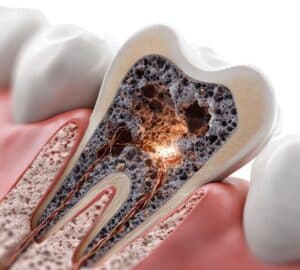
- A periapical abscess starts inside the tooth. Bacteria reach the pulp through deep decay, a crack or trauma; the pulp dies, and infection exits at the root tip into the surrounding bone. Treated by root canal treatment or extraction. See Tooth Fillings and Chipped and Cracked Teeth
- A periodontal abscess starts in the gum, in a deep pocket beside a tooth whose pulp may be perfectly healthy. Treated by draining and cleaning the pocket — root canal treatment would achieve nothing. See Bleeding Gums and What is periodontal disease?
They can feel identical. Telling them apart needs an examination and usually a radiograph, which is why self-diagnosis does not work here.
The main symptom
A severe, throbbing toothache or pain at the site of the abscess. It typically comes on suddenly, then gets gradually worse over a few hours or a few days. Why are dental abscesses so painful? explains the mechanism.
Other symptoms:
- Tenderness of the tooth and surrounding area
- Sensitivity to very hot or cold food and drinks
- An unpleasant taste in the mouth — see Bad Breath
- Difficulty opening your mouth
- Difficulty swallowing
- Disturbed sleep, and a general feeling of being unwell
- In some cases, localised facial swelling or tender, swollen lymph nodes in the neck
The last three on that list are the ones that indicate the infection is no longer confined to the tooth.
A pimple-like spot on the gum that discharges and eases the pain is a sinus tract — the infection has found a route out. It is not resolution. The infection is ongoing and the tooth still needs treating.
What health problems can it cause?
Complications are rare — but serious when they occur.
Osteomyelitis. The infection may spread to nearby bone. Symptoms include fever, nausea, and severe pain in the affected bone. The important detail: the infection spreads through your blood, so it is possible for it to affect any bone in your body — not only the jaw.
Airway compromise. Extreme cases can result in difficulty breathing and swallowing, and require urgent hospitalisation. In the Royal Adelaide series, 64% of patients admitted with a spreading dental infection were assessed as being at high risk of airway obstruction; the remaining 36% had superficial infections. Length of stay tracked the same divide — about 1.9 days on average for the low-risk group against 5.1 days for the high-risk group.
Spread into the facial tissue spaces, including under the tongue and floor of mouth, which is the mechanism behind the most dangerous presentations. The review names the submandibular space, under the jaw, as "the most dangerous space" — it is in direct contact with the pharyngeal spaces, runs down the neck to the mediastinum, and connects across to the opposite side. Irritation of the muscle there is what produces the restricted jaw opening.
Sepsis, where the body's response to infection becomes systemic and life-threatening.
Rarely, spread to the sinuses, the eye, or intracranially. The route is specific to the upper front teeth and premolars: infection there can travel by the infraorbital veins to the ocular veins and on to the cavernous sinus, and the review notes that spread "is facilitated as these veins have no valves".
For scale: the Australian Institute of Health and Welfare recorded about 88,600 potentially preventable hospital admissions for dental conditions in 2023–24, a rate of roughly 3 per 1,000 people, up from a low of 2.6 per 1,000 in 2019–20. That count covers every dental condition AIHW regards as avoidable with timely non-hospital care, not infections alone.
Who is at greater risk
Worth knowing, because the threshold for seeking help should be lower:
- Diabetes, particularly if poorly controlled — see Diabetes and oral health
- A weakened immune system — from illness, chemotherapy, or immunosuppressive medication
- Heart valve disease, prosthetic valves or a history of infective endocarditis. Tell your dentist; antibiotic prophylaxis is indicated for some procedures in some of these patients, and that is a specific medical decision
- Antiresorptive medication for osteoporosis or cancer — bisphosphonates and denosumab — because extraction carries a risk of medication-related osteonecrosis of the jaw. Disclose this even if you took it years ago. See Oral & Maxillofacial Surgeons
- Head and neck radiotherapy, past or planned
- Smoking, which impairs healing
The RACGP review reports the same pattern from the hospital end: immunocompromise, including poorly controlled diabetes, made management harder and stays longer, and older patients with heart and lung disease coped least well with surgery and intensive care.
Treatment
Antibiotics — for short-term relief only. This is the point most often misunderstood. Antibiotics settle the infection; they do not remove its cause. The abscess will return.
Bacteria in an abscess sit in a space with no blood supply, which is why an antibiotic circulating in the bloodstream cannot reliably reach and clear them. Removing the source — by drainage, root canal treatment or extraction — is the treatment. The antibiotic, where used at all, is an adjunct.
This is not a house opinion. The RACGP review puts it in one sentence: "Antibiotic treatment without dental treatment to remove the cause always fails." And: "If treated with antibiotics alone, the infection will not resolve and will become progressively worse."
The research position is, if anything, starker. A 2024 Cochrane review searched for trials testing antibiotics against placebo without any procedure, for symptomatic apical periodontitis or acute apical abscess in adults, and found none at all — there is no randomised evidence that antibiotics alone resolve these conditions. What the three eligible trials (134 participants in total) did test was whether adding antibiotics to the procedure helps. A single pre-operative dose left median pain at 3.0 in both groups at 24 hours and 0 in both groups at 72 hours and seven days — low-certainty evidence. For a seven-day course afterwards, every outcome was rated very low certainty, with pain differences straddling zero at every time point.
Then, definitive treatment:
- Root canal treatment — removing the infected pulp and sealing the tooth, keeping it. See Root canal treatment: who and what is involved? and, for complex cases, Endodontists
- Extraction — removing the tooth. The gap then needs managing: Bridges, implants or dentures
- For a periodontal abscess — drainage and debridement of the pocket, followed by treatment of the underlying gum disease. See Periodontists and Dental Cleans & Hygienists
A root-filled back tooth usually then needs cuspal coverage — an onlay or crown — and that cost belongs in the original conversation, because a root canal left under a temporary filling is a treatment likely to fail. Fees are on the Price Guide, with Payment Plans for spreading them.
Payment plan options are available. Where a plan is advertised as interest free, that describes the plan term only — a deposit may be required, an establishment fee and ongoing account fees may apply, and charges can apply if the balance is not cleared within the agreed period. The applicable terms depend on the provider and the amount financed, and are set out in writing before you commit — ask what the deposit and the establishment fee are, in dollars, and what the total will be by the end. Payment Plans.
Antimicrobial resistance is a real reason this matters. Repeated courses of antibiotics for a problem that needs a procedure contribute to resistance and delay the actual treatment. Cochrane's own closing advice to the profession is that "antibiotic use is recognised as a major contributor to antimicrobial resistance" and that dental professionals "should be judicious in their use of these agents".
What to do while you wait
- Paracetamol and ibuprofen together, at recommended doses, are generally more effective for dental pain than either alone. Check with a pharmacist, and do not exceed the labelled dose or take ibuprofen if you have been advised against it.
- Cold pack on the outside of the face.
- Sleep propped up. Lying flat increases pulpal pressure and worsens the pain.
- Warm salt-water rinses.
What not to do:
- Do not put aspirin against the gum — it causes a chemical burn.
- Do not apply heat to a facial swelling.
- Do not try to drain it yourself.
- Do not use leftover antibiotics. A partial course achieves nothing and contributes to resistance.
What not to do overall
Do not wait for it to settle. An abscess only gets better with treatment. Left untreated it becomes more painful, and the risk of the complications above increases.
A temporary easing of pain can be misleading — it sometimes means the pulp has died, not that the infection has resolved. The RACGP review is explicit about this sequence: decay reaching the pulp produces poorly localised pain, and then, "when pulp necrosis finally occurs, there is no pain" — until a periapical abscess develops and severe, well-localised pain returns. Its observation about what comes before is worth sitting with: by the time an abscess arrives, "all patients have had intermittent episodes of pain as a warning that something is wrong."
If you feel pain in your mouth and think you have a dental abscess, book to see your dentist as soon as possible. Contact Us.
Related pages: Emergency Dentistry, Root Canal Therapy, Tooth Pain and Toothaches, Specialist Endodontists, General Dentistry.
Common questions
Am I going to lose the tooth?
Not necessarily, and the decision usually turns on how much sound tooth is left, not on how bad the infection looks today. A tooth with a healthy root and enough structure to rebuild is a candidate for root canal treatment; one that is split below the gum, or has lost most of its crown, often is not.
When root canal treatment is possible, the long-run numbers are reasonable. A cohort study of 598 root-canal-treated teeth in 312 patients followed for a mean of 21 years reported overall success of 87.8% at tooth level (95% CI 84 to 90%) and 80.8% at patient level (95% CI 75 to 86%), with survival of 85.5% of teeth (95% CI 81 to 88%). Its cumulative success figures were 93% at 10 years, 85% at 20 years and 81% at 30 years.
Two things to hold alongside those numbers. They describe a group of teeth in one study, not a prediction about yours — a tooth with a crack or very little remaining structure sits at the difficult end. And the figures assume the tooth was properly restored afterwards: for a back tooth that means cuspal coverage rather than a temporary filling left in place, which is why that cost belongs in the first conversation rather than the fourth.
Ask directly: “What is the prognosis for this particular tooth, and what would make you change that assessment?”
It is Saturday night and I am not on the emergency list above. Can it wait until Monday?
If none of the red flags at the top of this page is present, waiting a day or two is often reasonable — but the decision should be made again every few hours rather than once, because the thing that changes is the speed.
What should trigger a new decision: swelling that is visibly bigger than it was three hours ago, swelling that moves toward the eye or down under the jaw, fever developing, difficulty swallowing or opening the mouth, or feeling unwell in yourself rather than just sore in the tooth. Spreading infection progresses on a timescale of hours, not weeks, which is why the checklist at the top is written as a now-decision.
While you wait, follow the measures above — pain relief at labelled doses, a cold pack outside the face, propped up to sleep, salt-water rinses. Do not use heat on a swelling, and do not raid the medicine cabinet for old antibiotics.
And when you do get seen, expect triage first: the priority at an emergency appointment is to relieve the pressure and the pain — by draining the infection, opening the tooth or removing it — with definitive treatment arranged afterwards. A first appointment that ends with a plan rather than a finished tooth is the normal outcome, not a failure.
What is this going to cost me?
The cost is driven less by the abscess than by what the tooth needs afterwards, which is why a single figure does not exist.
The realistic drivers: the emergency visit itself, which is usually examination, a radiograph and immediate relief; which treatment the tooth needs — extraction is a shorter piece of work than root canal treatment, which is priced by how many canals the tooth has (front teeth and molars differ considerably), and whether it is done by a general dentist or a registered specialist endodontist; the restoration afterwards, which for a back tooth is normally a crown or onlay rather than a filling; and, if the tooth comes out, whether and how the gap is replaced later.
What to ask before agreeing: an itemised written plan with item numbers, what your health fund pays on each, what the total to a finished tooth is rather than the cost of today's visit, and — if money is the constraint — which parts are urgent and which can safely be staged. That last question has a real answer and it is worth asking out loud.
Published fees are in the price guide and understanding your treatment covers how a plan should be set out. Note also that the extraction is rarely the cheap option once the gap has to be managed — see bridges, implants or dentures.
Once it is treated, can it come back?
It can, and the honest answer depends on which kind of abscess it was.
After root canal treatment, the figures above are the best guide: success was not 100%, it was 87.8% at tooth level in that cohort, and the cumulative curve declines slowly over decades. A tooth that becomes tender again, or develops a pimple on the gum, should be reviewed rather than watched — retreatment or a surgical approach is often possible, and the sooner it is assessed the more options remain.
After a periodontal abscess, recurrence is about the gum disease underneath it. Draining the pocket relieves the episode; it does not treat the periodontitis that made the pocket. Without ongoing periodontal treatment and maintenance at the interval your clinician sets, the same site can flare again.
Two general points. Make the review appointment — the commonest reason a problem is caught late is that the patient felt better and did not return. And if new infections keep occurring in different teeth, that is a different conversation: it points at decay risk, gum disease or a medical factor such as poorly controlled diabetes or a dry mouth, and treating one tooth at a time will never get ahead of it.
Does a mouth infection really affect the rest of my body, or is that overstated?
Both things are true, and the distinction is worth drawing carefully because this area attracts a lot of overclaiming.
The acute risk is not overstated. A spreading dental infection is a genuine medical emergency, for the anatomical reasons set out above, and that is documented in the Australian hospital literature cited on this page.
The chronic-disease claims need more care. The best-established of them is the relationship between gum disease and diabetes, where a peer-reviewed review describes “a two-way relationship” — diabetes increasing the risk of periodontitis, and “periodontal inflammation negatively affecting glycaemic control” — while noting that the underlying mechanisms “are not completely understood”. That is a real and clinically useful finding, and it is a reason to tell your dentist you have diabetes and your doctor about your gums.
What it is not is a licence for the broader claims that circulate about oral bacteria and every chronic disease. Association is not the same as cause, most of the evidence is observational, and a page that promises your general health will improve if you treat your gums is going beyond what has been shown. Health problems linked to poor oral hygiene sets out where the line currently sits.
The practical version: treat the infection because it is an infection, and tell each of your clinicians what the other is dealing with.
Practical details
Smile Solutions holds emergency appointment slots each day and has registered specialist endodontists on site for root canal treatment, and oral and maxillofacial surgeons for surgical extraction. The clinicians are listed on Our Team.
For difficulty breathing or swallowing, or rapidly spreading facial swelling, call 000 or attend a hospital emergency department.
Smile Solutions, Level 1, 220 Collins Street, Manchester Unity Building, Melbourne VIC 3000. Phone 13 13 96, or theteam@smilesolutions.com.au. Monday–Friday 8.00am–6.00pm, Saturday 8.30am–1.30pm, Sunday by appointment.
Every practitioner's registration and any specialist entry can be verified free on the AHPRA public register at ahpra.gov.au.
Published 23 April 2018. General information only — it is not a diagnosis or a treatment plan and does not replace assessment. No medication should be started or stopped on the basis of this page. For medical advice, Nurse-on-Call in Victoria is 1300 60 60 24. Payment plan terms are set by the credit provider and change; confirm current terms directly before you commit.
Smile Solutions trades under ABN 28 193 514 103.
Images on This Page
-
https://www.facebook.com/tr?id=800557773428361&ev=PageView&noscript=1
(no alt text)
-
https://www.smilesolutions.com.au/wp-content/uploads/2025/10/calendar_month.svg
(no alt text)
-
https://www.smilesolutions.com.au/wp-content/themes/arcadian-wordpress-theme/assets/images/smile_solutions_logo_white.png
Smile Solutions Logo
-
https://www.smilesolutions.com.au/wp-content/themes/arcadian-wordpress-theme/assets/images/smile_solutions_logo_purple.png
Smile Solutions Logo
-
https://www.smilesolutions.com.au/wp-content/uploads/2023/11/SS-Tooth-1-1-150x150.png
Smile Solutions
-
https://www.smilesolutions.com.au/wp-content/uploads/2018/04/Dental-abscess.jpg
Can a dental abscess affect your general health?
-
https://www.smilesolutions.com.au/wp-content/uploads/2022/04/Tooth-Decay-300x270.jpg
Tooth Decay
-
https://www.smilesolutions.com.au/wp-content/uploads/2017/12/Dental-pain-300x270.jpg
Dental pain
-
https://www.smilesolutions.com.au/wp-content/uploads/2022/04/Dental-Emergency-300x270.jpg
What is considered a dental emergency?
-
https://www.smilesolutions.com.au/wp-content/themes/arcadian-wordpress-theme/assets/images/family_owned_bussiness.png
Family Owned Business
-
https://www.smilesolutions.com.au/wp-content/themes/arcadian-wordpress-theme/assets/icons/icon--phone.svg
Smile Solutions Contact
-
https://www.facebook.com/tr? id=800557773428361&ev=PageView&noscript=1
(no alt text)