Oral & Maxillofacial Surgeons
What is an oral and maxillofacial surgeon?
Oral and maxillofacial surgery is a highly specialised field covering the diagnosis, surgical treatment and management of diseases, injuries and defects affecting the mouth, gums, teeth and jaws — both function and appearance.
The distinguishing feature is the training. These surgeons hold degrees in both Dentistry and Medicine, combining dental, medical and surgical expertise. They are the clinicians who operate where dentistry meets surgery.
Smile Solutions is at Level 1, 220 Collins Street, Manchester Unity Building, Melbourne CBD.
The training path
Among the longest in healthcare:
- 15 to 17 years of continuous study
- degrees in both Dentistry and Medicine
- a further four years of specialist training in oral and maxillofacial surgery
- some also hold a Masters degree, such as in Paediatric Maxillofacial Surgery or Surgical Anatomy
Smile Solutions' surgeons are registered specialists with the Dental Board of Australia and Fellows of the Royal Australasian College of Dental Surgeons (FRACDS (OMS)).
“Oral and maxillofacial surgeon” is a protected title in Australia. Note that “oral surgery” is a separate recognised specialty — an oral surgeon holds a dental qualification but not a medical degree, and works within a narrower scope. Both are legitimate; they are not the same registration. See Dentists & Registered Specialists.
Why the medical degree matters practically: a significant share of this work involves patients with serious medical conditions, operating in hospital, managing anaesthesia and interacting with other medical teams. The dual qualification is what allows the surgeon to hold both halves of that picture at once.
What they treat
Impacted wisdom teeth
Wisdom teeth that do not fully emerge from the gum line can cause infection and damage to nearby teeth.
For more complicated impactions — particularly where the tooth sits close to the nerve or the sinus — removal by an oral and maxillofacial surgeon is generally the safer route, because depth of experience is what minimises the risks. Nerve injury in the lower jaw is uncommon but consequential, and it is the reason position matters more than difficulty. Wisdom Teeth sets out the risks of that operation in full.
TMJ surgery
The temporomandibular joint enables the jaw to open, close and move sideways and forwards. TMJ disorder can cause limited movement, jaw pain, difficulty chewing and locking.
There are several treatment options, and surgery is generally considered the last resort — after splint therapy, osteopathy and conservative management have been tried. TMD & Teeth Grinding.
Orthognathic (jaw) surgery
Repositioning one or both jaws, usually recommended where significant jaw growth imbalance has produced a considerable malocclusion.
Orthodontics can realign the teeth, but surgery is needed to realign the jaw. Surgery aims to improve chewing, speaking and breathing by moving teeth and jaws into more balanced, functional positions.
This is major surgery and a long commitment: orthodontics usually runs for six to eighteen months before the operation and continues afterwards, the operation itself involves a hospital admission and a general anaesthetic, and recovery includes weeks of swelling and a restricted diet. Altered sensation in the lip and chin is common immediately afterwards and is occasionally permanent. Your surgeon will set out the risks that apply to your case. Jaw Surgery.
In selected patients with obstructive sleep apnoea, advancing both jaws enlarges the airway and is a recognised surgical treatment — a decision made jointly with a sleep physician on the basis of a sleep study, not a dental one. See Snoring & Sleep Apnoea.
Bone grafting
When a tooth is removed, the jawbone beneath begins to recede, often producing facial changes such as sunken lips or cheeks. Bone can be rebuilt through grafting.
An oral and maxillofacial surgeon can perform the surgical placement of the titanium implant screw, as well as any extractions needed beforehand. Bone Grafting for Implants and Dental Implants.
Where bone loss is extensive, the surgical options widen — sinus lifts, block grafts and, in selected cases, longer implants anchored in the cheekbone. These are the cases where a surgeon's involvement changes what is possible at all, rather than simply who holds the instrument. See All-on-4 Dental Implants.
Cancer surgery and facial trauma
Oral and maxillofacial surgeons diagnose and treat oral cancers and tumours. Following surgery, reconstruction may be needed to restore function and appearance — skin, muscle, bone and other tissue can be moved from elsewhere in the body to the affected areas.
If you have a mouth ulcer, lump, or red or white patch that has not healed within two weeks, have it looked at. Most such findings are not cancer, and the ones that are do far better when found early.
Facial trauma can move the jaw out of alignment and cause serious health and dental problems. Surgeons reconstruct facial form and function afterwards, often realigning bone and holding it with small plates and screws.
Because patients who sustain facial injuries frequently have other medical problems, your surgeon coordinates with other medical professionals involved in your care. Acute facial trauma is a hospital emergency — call 000 or attend an emergency department rather than a dental practice. For dental injuries that are urgent but not emergencies, see Emergency Dentistry and Chipped & Cracked Teeth.
Cysts and tumours of the jaw and face
Oral cysts and tumours are fairly common in the mouth and jaw regions and are not usually cancerous. Left untreated they can cause irritation, infection or damage to surrounding bone and teeth, so removal is often still necessary.
Depending on size and type, removal may be under local anaesthetic or require more extensive surgery. A specimen is usually sent for pathology — that is routine, not a sign of concern.
What a biopsy involves
Since this is the procedure people find most worrying, it is worth describing plainly.
A biopsy removes a small sample of tissue — or sometimes the whole lesion — usually under local anaesthetic, in an appointment lasting well under an hour. A stitch or two may be placed, and the area is sore for a few days.
The sample goes to an oral pathologist, and results typically take around a week to ten days. Sending tissue for pathology is standard practice for anything removed, including entirely benign lumps, and it is not an indication that anyone suspects cancer.
On mouth cancer generally: the main risk factors are smoking and other tobacco use, alcohol — particularly the two together — sun exposure for the lower lip, and HPV infection, with risk rising with age. It can also occur in people with none of those. Look once a month in good light at the tongue, including its sides and underside, the floor of the mouth, the cheeks, gums and palate, and have anything that has not healed in two weeks examined. Dental check-ups include this screening, which is one of the quieter arguments for keeping them up.
Before surgery: what your surgeon needs to know
The medical history is not a formality here, and a few items change the plan materially.
- Blood thinners. Do not stop them on your own account. For most dental surgery they are continued, because the risk of stopping usually outweighs the bleeding risk — but that is a decision made between your surgeon and whoever prescribes them.
- Medications affecting bone. Some treatments for osteoporosis and for cancer alter how jawbone heals, and they carry a small risk of a complication known as osteonecrosis of the jaw after extractions or implant surgery. It is uncommon, it is manageable when anticipated, and the essential thing is that your surgeon knows before operating. If you are about to start such a medication, a dental assessment beforehand is worth arranging — again, never stop the medication yourself.
- Diabetes, immune-suppressing treatment, radiotherapy to the head or neck, and heart valve or joint replacement history, each of which changes healing, infection risk or the need for antibiotic cover.
- Smoking, which impairs healing and raises the risk of dry socket and implant failure.
- Every medication and supplement, including over-the-counter ones.
Bring the list rather than reciting it, and bring any recent imaging.
Where surgery happens
Procedures can be performed under local anaesthetic in the dental chair, or under general anaesthetic in a private hospital, depending on complexity and your medical history. Sedation options are set out at Sleep Dentistry, and if the prospect itself is the obstacle, see Dental Anxiety.
Worth knowing: only registered specialists and dual-qualified medical surgeons are authorised to operate in hospitals. General dentists cannot.
Surgery under general anaesthesia carries its own risks, assessed by an anaesthetist before the day, and fasting and post-operative instructions must be followed exactly.
Practical preparation: arrange a driver and someone to stay with you for sedation or general anaesthetic, keep the day clear, stock soft food and ice packs beforehand, and confirm what time your fasting starts. An operation is cancelled for a cup of coffee, and that is not the surgeon being difficult — it is an aspiration risk.
Imaging, and why 3D is sometimes needed
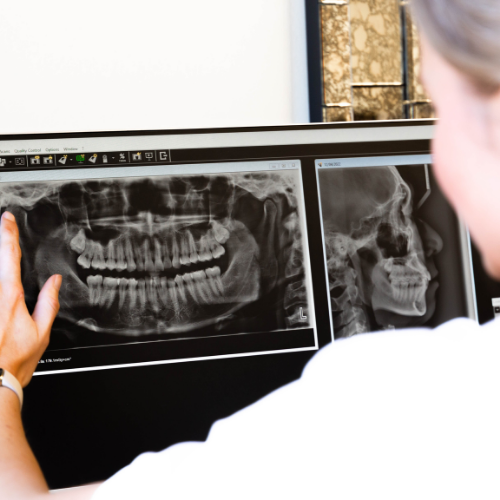
Most oral surgery is planned from an ordinary radiograph. A 3D scan is taken when the flat image raises a specific question — how close a wisdom tooth root sits to the nerve canal, how much bone is available for an implant, where the sinus floor sits, or the extent of a cyst.
It is not routine, and if one is recommended it is reasonable to ask what the plain film showed that prompted it. See Our Technology.
Recovery, in general terms
Every procedure differs, and your surgeon's written instructions govern — but the shape is usually the same:
- Swelling and stiffness peak on days two and three, then improve. That is expected, not a complication.
- Ice for the first day, warm salt-water rinses from the second, head elevated when sleeping.
- No smoking, no vigorous rinsing and no straws in the first days — all three dislodge the clot.
- Soft food, and enough fluid; dehydration is what makes most first weeks worse than they need to be.
- Call if bleeding will not stop, pain worsens after day three rather than improving, swelling increases after day three, or you develop a fever.
- Difficulty breathing or swallowing is an emergency — call 000.
Your surgeons
| Surgeon | Role | Qualifications |
|---|---|---|
| A/Prof. Patrishia Bordbar | Specialist Oral & Cranio-Maxillofacial Surgeon | B.D.Sc. (Melb.), M.B.B.S (Hons.) (Melb.), PGDip.Surg.Anat (Melb.), M.D.Sc (O.M.S.) (Melb.), F.R.A.C.D.S (O.M.S.), F.R.C.S (Ed.) |
| Dr Ricky Kumar | Specialist Oral & Maxillofacial Surgeon | BHB (Auck), MBChB (Auck), BDS (Otago), FRACDS (OMS) |
You can verify any clinician free on the AHPRA public register at ahpra.gov.au, or by calling 1300 419 495. See Our Team.
Costs and rebates
If you have private health insurance with hospital cover, Medicare rebates may apply to certain aspects of the procedure — parts of oral and maxillofacial surgery are classified as medical rather than dental, which changes what is claimable.
Expect separate accounts from the surgeon, the anaesthetist, the hospital and any pathology, and ask for all of them in writing before you book. What Medicare and your fund each contribute depends on the item numbers and your policy. Price Guide and Payment Plans.
Two points that catch people out: hospital cover generally carries a waiting period, often twelve months for this kind of surgery, so the fund conversation belongs early rather than near the date; and a Medicare item number does not mean the treatment is free — it sets a schedule fee, and the gap between that and the actual fee is yours. Ask for the informed financial consent paperwork, which is the document that sets all of this out.
Working with the rest of the team
Because the surgeons practise alongside the orthodontists, prosthodontists, periodontists and endodontists, surgical and restorative phases are planned together — which matters most in orthognathic cases, where orthodontics runs for six to 18 months before surgery and continues afterwards. See Specialist Care and Complex Dentistry.
Common questions
Do I need a referral to see an oral and maxillofacial surgeon?
The page states that no referral is required. A referral from a dentist, GP or specialist can still help by providing the clinical question, medical history and existing imaging.
How is an oral and maxillofacial surgeon different from a general dentist?
Oral and maxillofacial surgeons have dental and medical training followed by specialist surgical training. They manage more complex conditions of the teeth, jaws, face and related structures, including difficult extractions, jaw surgery, trauma, pathology and grafting.
Why might three-dimensional imaging be needed?
Three-dimensional imaging can show the relationship between teeth, nerves, sinuses, bone and pathology when ordinary radiographs do not provide enough detail. It should be used when the additional information is expected to affect diagnosis or surgical planning.
Will surgery use local anaesthetic, sedation or general anaesthesia?
That depends on the procedure, complexity, medical history, anxiety and treatment setting. Ask why the proposed option is appropriate, who administers it, what preparation and escort are required and what risks apply.
What should I expect during recovery?
Recovery varies with the operation. The page notes that swelling commonly peaks around days two to three. Your surgeon should provide procedure-specific instructions, warning signs and an expected return-to-work or activity range.
Is removed tissue always sent for pathology?
Not every procedure produces a specimen, but tissue removed because its nature is uncertain may be sent for examination. Ask whether pathology is planned, how results will be communicated and what follow-up could be required. The page gives a usual result range of about seven to ten days.
What nerve risks should I ask about?
Procedures near sensory nerves can cause temporary or, less commonly, permanent altered sensation. Ask the surgeon to show the relationship on imaging and explain the estimated risk, possible alternatives and what follow-up occurs if sensation changes.
How do I obtain the complete cost?
Request a written estimate covering the surgeon, anaesthetist, hospital or facility, imaging, pathology and follow-up. Medicare and private insurance may apply differently to each component, so confirm item numbers and likely gaps before booking.
Related reading
Practical details
| Address | Level 1, 220 Collins Street, Manchester Unity Building, Melbourne VIC 3000 |
| Phone | 13 13 96 |
| theteam@smilesolutions.com.au | |
| Monday – Friday | 8.00am – 6.00pm |
| Saturday | 8.30am – 1.30pm |
| Sunday | By appointment |
| Training | 15–17 years; Dentistry and Medicine, plus 4 years specialist |
| Registration | Dental Board of Australia; RACDS (FRACDS (OMS)) |
| Referral needed | No |
| Swelling peaks | Days two to three |
| Biopsy results | Usually about 7–10 days |
| Anything unhealed at 2 weeks | Have it examined |
| Parking | Wilsons Parking, Flinders Lane (between Swanston and Russell) |
Oral and maxillofacial surgery is one of the thirteen recognised dental specialties in Australia, and specialist registration can be verified free on the AHPRA public register at ahpra.gov.au.
General information only — it is not a diagnosis, a treatment plan, a quote or a promise of any particular clinical outcome, and it does not replace advice from your treating practitioner. Every procedure described here is surgery and carries risks — including bleeding, infection, altered sensation and the risks of anaesthesia — which your surgeon will discuss with you before you consent. Suitability, recovery and outcomes vary between individuals and can only be assessed after examination and imaging. Information about medications is general; never start or stop a prescribed medicine on the basis of this page — that is a decision for the prescriber. Your surgeon's and anaesthetist's instructions take precedence over this page. Fees, Medicare and health fund rebates are indicative and subject to change; confirm before booking.
Smile Solutions trades under ABN 28 193 514 103.
Images on This Page
-
https://www.facebook.com/tr?id=800557773428361&ev=PageView&noscript=1
(no alt text)
-
https://www.smilesolutions.com.au/wp-content/uploads/2025/10/calendar_month.svg
(no alt text)
-
https://www.smilesolutions.com.au/wp-content/themes/arcadian-wordpress-theme/assets/images/smile_solutions_logo_white.png
Smile Solutions Logo
-
https://www.smilesolutions.com.au/wp-content/themes/arcadian-wordpress-theme/assets/images/smile_solutions_logo_purple.png
Smile Solutions Logo
-
https://www.smilesolutions.com.au/wp-content/uploads/2025/11/Smile-Solutions-4.png
Smile Solutions - Melbourne CBD
-
https://www.smilesolutions.com.au/wp-content/uploads/2025/09/Wisdom-Teeth-Smile-Solutions.png
Smile Solutions Dentist Melbourne
-
https://www.smilesolutions.com.au/wp-content/uploads/2025/08/69a44c30c93ce196d539cc5520080df52a5f3f88-scaled.jpg
69a44c30c93ce196d539cc5520080df52a5f3f88 scaled
-
https://www.smilesolutions.com.au/wp-content/themes/arcadian-wordpress-theme/assets/images/family_owned_bussiness.png
Family Owned Business
-
https://www.smilesolutions.com.au/wp-content/themes/arcadian-wordpress-theme/assets/icons/icon--phone.svg
Smile Solutions Contact
-
https://www.facebook.com/tr? id=800557773428361&ev=PageView&noscript=1
(no alt text)