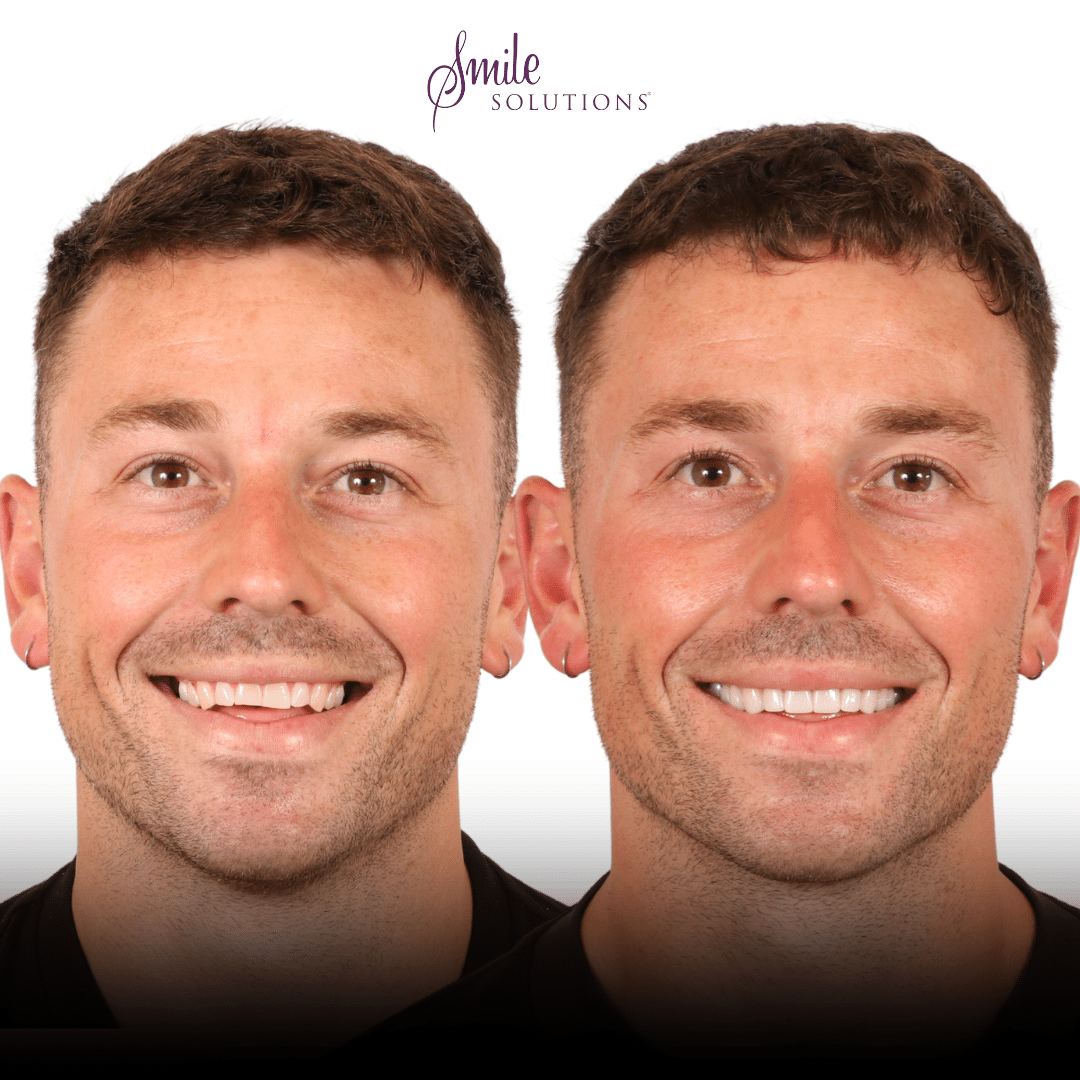
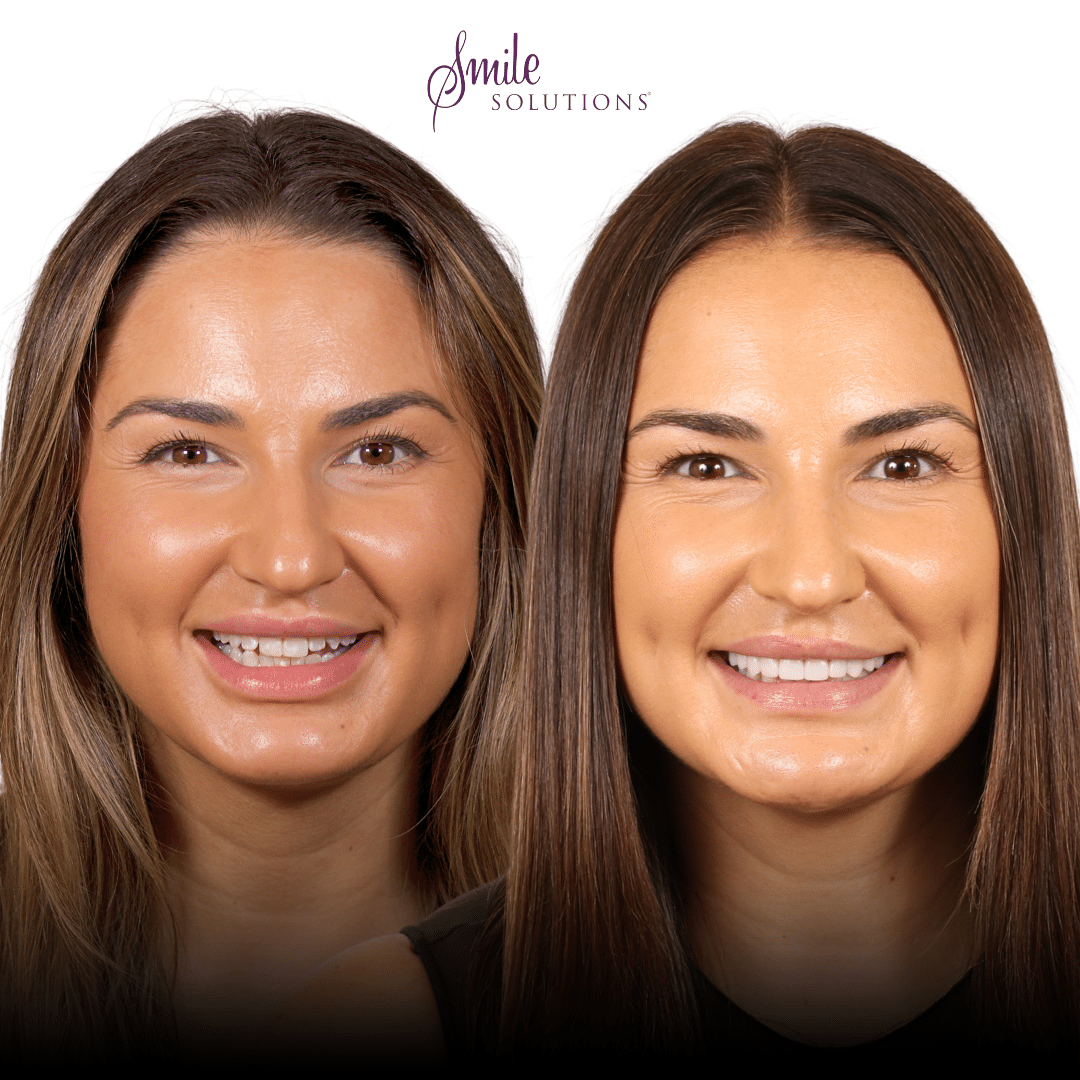
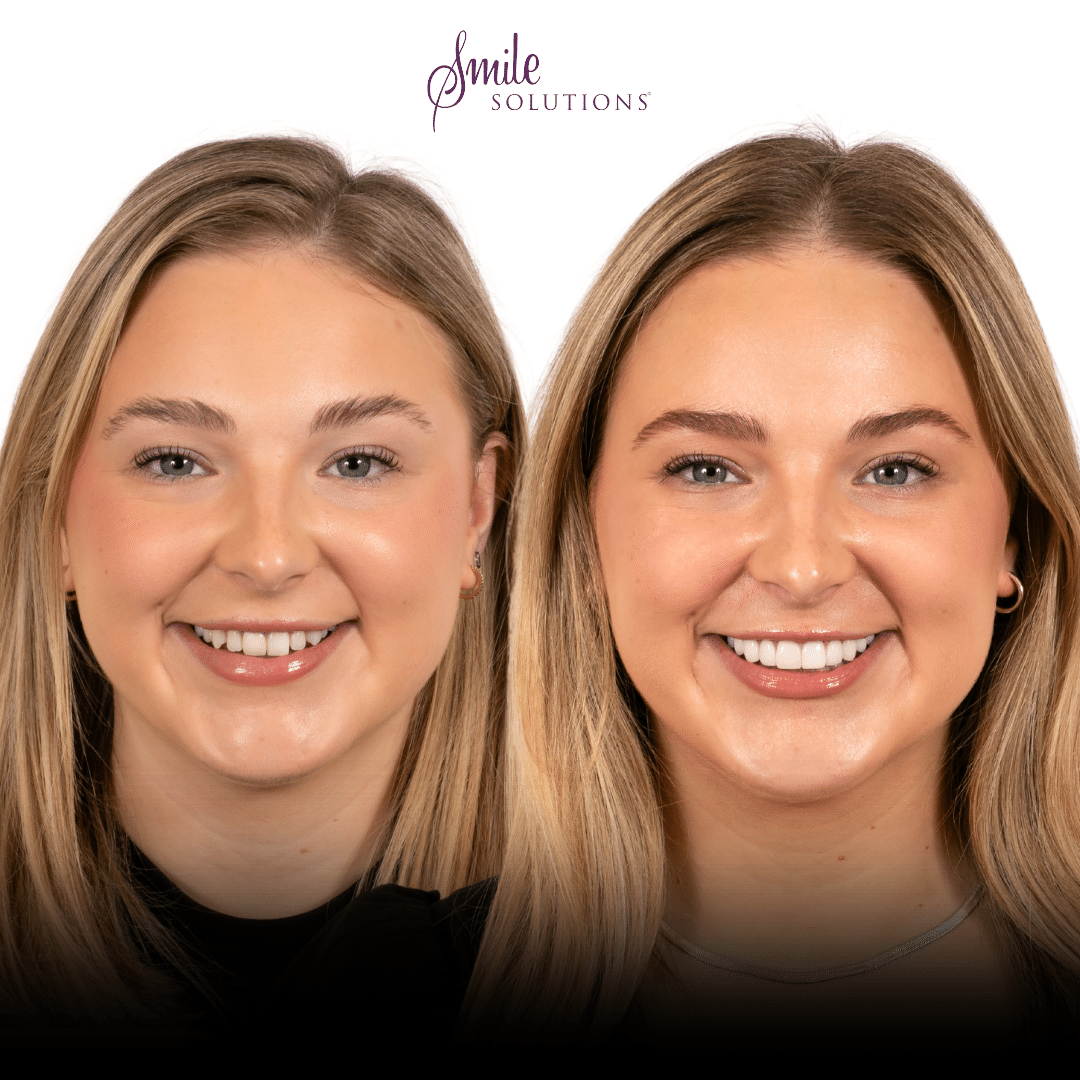
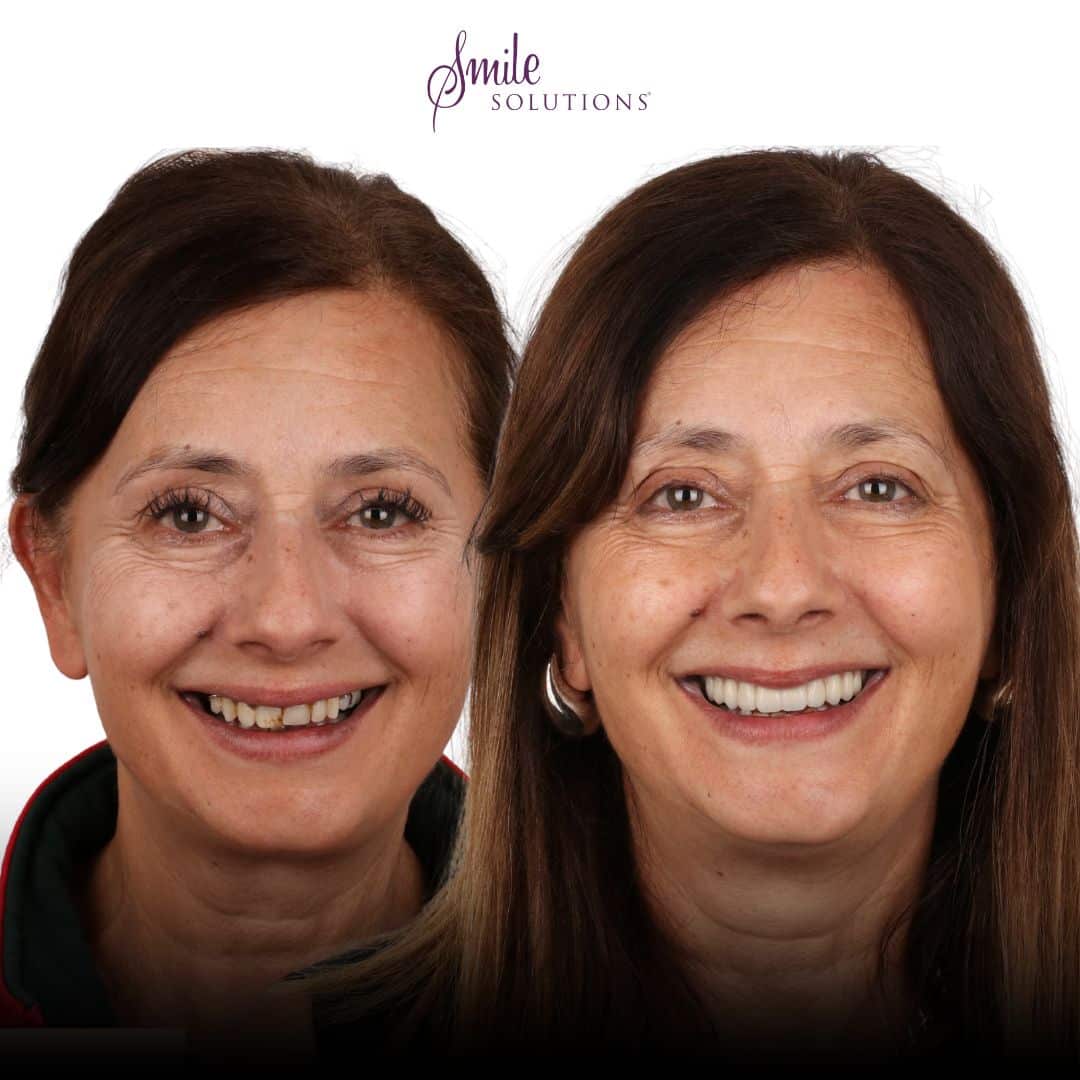
All-on-4® Dental Implants
What is All-on-4, and who is it for?
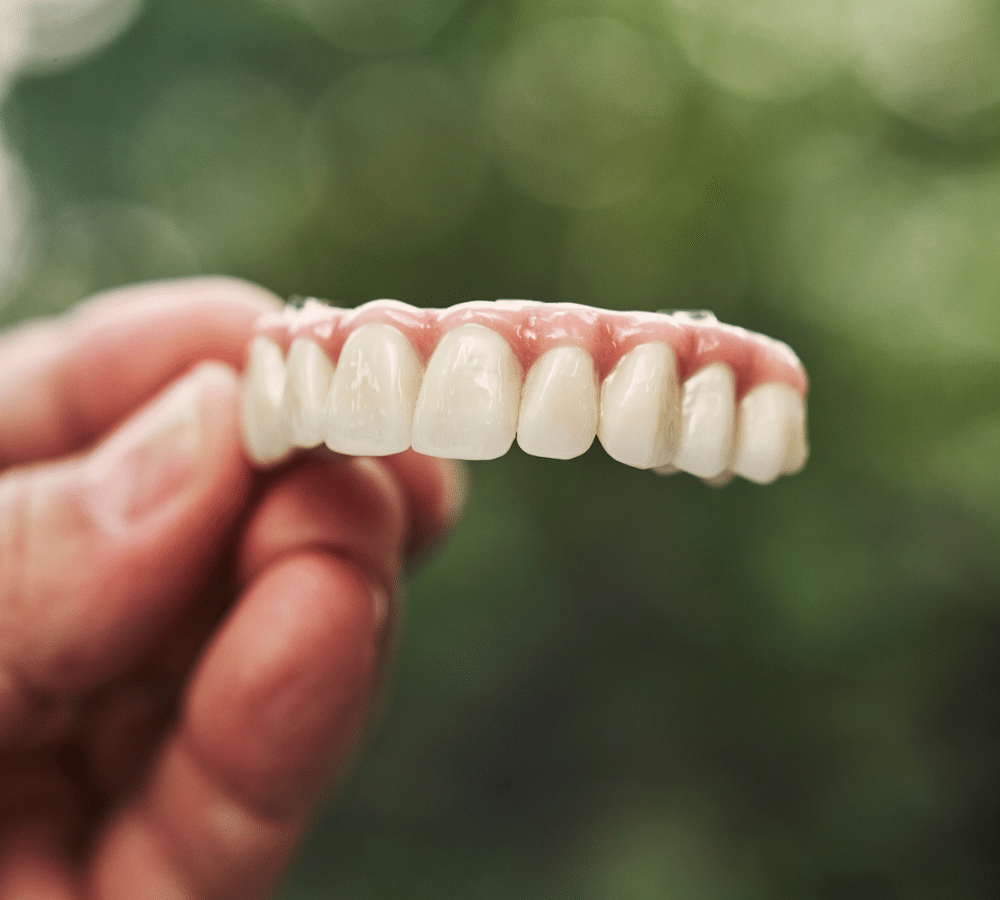
All-on-4 permanently attaches a full set of artificial teeth to one or both jawbones during a surgical procedure. It replaces most or all of the remaining teeth in an arch with a fixed prosthesis.
The defining feature, and the reason people choose it over dentures: the prosthesis does not cover the palate — the roof of the mouth. Traditional full dentures do, and that single difference improves comfort, taste sensation and speech clarity.
Smile Solutions is at Level 1, 220 Collins Street, Manchester Unity Building, Melbourne CBD.
Why four implants, and why they are angled
This is the part that explains the technique, and it is rarely set out.
The back of the upper jaw sits beneath the sinus; the back of the lower jaw carries the nerve supplying the lip and chin. Both limit how much bone is available at the rear, and bone at the back of the jaw is also the first to be lost after teeth are gone. Historically that meant grafting before implants could be placed.
All-on-4 works around it. Two implants are placed vertically at the front, where bone is usually most plentiful, and two are angled backwards at the rear so they engage solid bone in front of the sinus or the nerve while their heads emerge further back in the arch. Angling them achieves two things at once: it avoids the anatomy that would otherwise require grafting, and it spreads the support further along the jaw, which is what allows a full arch of teeth to sit on four fixtures.
It is not always four. Six is common where bone allows or the bite demands it, and the number is a clinical decision made from a 3D scan rather than a brand name. Ask how many implants your plan uses and why. Where bone is genuinely insufficient, grafting or a sinus lift may still be needed — see Bone Grafting.
Who it suits
All-on-4 may be appropriate if you:
- have difficulty chewing food
- have ill-fitting dentures
- have broken teeth, or teeth that cannot be saved
- are anxious about your smile
It is a full-arch solution rather than a single-tooth one. If you are replacing one or two teeth, conventional or immediate implants are the relevant options — see Conventional & Immediate Implants and Dental Implants.
Who it suits less well: anyone with untreated gum disease or active infection until that is stabilised; heavy smokers, in whom implant failure rates are higher; people with poorly controlled diabetes or conditions that impair healing; anyone taking medications affecting bone metabolism, which must be disclosed; and heavy grinders, who need the force managed as part of the plan. None of these is automatically disqualifying — each changes the risk discussion and sometimes the plan.
Two of those points can be put more precisely, because they have been measured. On smoking, a 2025 analysis of 158,824 implants placed across the Maccabi Dent clinics in Israel between 2014 and 2022 summarises a meta-analysis of early implant failure whose significant risk factors were smoking habits, implants shorter than 10 mm, and implants placed in the maxillary region — the upper jaw. On bone density, a systematic review searching PubMed/MEDLINE and Scopus to October 2024 across 24 studies, 2,102 patients and 5,954 implants concluded that “Osteoporosis is not a contraindication for dental implant placement”, while adding that “planning must be cautious and personalized”. More detail on both is in the questions below.
How it works
1. Implants placed. Small titanium screws are placed into the jaw.
2. Integration. These fuse with the jawbone, creating a stable artificial tooth root.
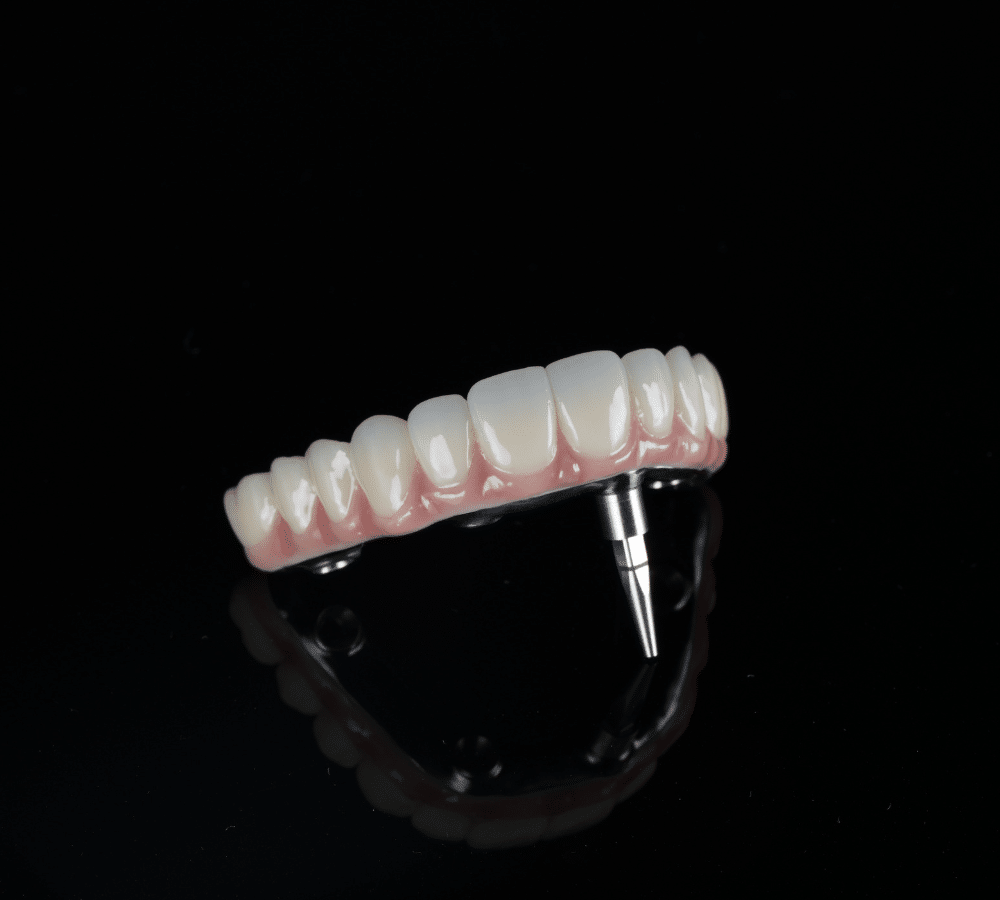
3. Prosthesis attached. Your new set of porcelain teeth is permanently screwed to those roots.
The prosthesis is fixed: you do not remove it at night or for daily cleaning. A clinician can remove a screw-retained bridge when needed for assessment, maintenance or repair.
“Fused” is literal. Bone grows directly onto the titanium surface over the following months — osseointegration — so the implant becomes continuous with the jaw rather than being held by anything like a screw thread in wood. That process cannot be rushed, and it is the reason for the wait described below.
One consequence worth knowing: an implant has no periodontal ligament. A natural tooth is suspended in a ligament that cushions load and carries sensation; an implant has neither. So implants transmit force more directly, and you feel less through them — which is why the bite is adjusted so carefully and why a nightguard is often part of the plan.
The timeline
| Stage | Timing |
|---|---|
| Surgery and implant placement | Day one |
| Temporary bridge fitted | 1–2 days |
| Healing of bone and gums | 3–6 months |
| Permanent bridge fitted | After 3–6 months |
The wait between temporary and permanent is deliberate. Allowing the bone and gums to recover properly after surgery, before the permanent bridge is fabricated, is what makes the final fit accurate — tissue changes shape as it heals, and a permanent bridge made too early fits the healing mouth rather than the healed one.
What the surgical day involves
The scale of it surprises people, so it is worth stating.
If teeth remain, they are removed on the same day. The bone is then contoured to a level, even ridge — an essential step, because the prosthesis needs a predictable foundation and the junction between bridge and gum has to be hidden. The implants are placed, and the temporary bridge is fitted within a day or two.
It is performed under local anaesthetic, sedation or general anaesthetic depending on the case and the setting. Appointments run to several hours. See Sleep Dentistry for the sedation options.
Arrange a driver and a few days clear afterwards, and expect swelling and bruising to peak around days two and three, as with any oral surgery.
The rule that matters most: the soft diet
If you take one instruction from this page, take this one.
The temporary bridge is not there to chew hard food on. The implants are integrating during those months, and excessive load in that window is the most common preventable cause of early implant failure. Your surgeon will specify the period — commonly six to eight weeks or longer on a genuinely soft diet, then a gradual return.
That means soft, cut-up food, and no crusty bread, steak, nuts, apples or anything requiring a forceful bite. It is the single hardest part of the whole treatment for most patients, largely because the new teeth look finished and it is difficult to believe they are not. Plan the food the way you would for any operation.
Speech takes adjusting too. Most people adapt within a few weeks, and reading aloud genuinely speeds it up. Some air escape on certain sounds is normal early on and is often addressed at the permanent stage.
What the teeth are made of
Smile Solutions principally works with ceramic materials for the permanent fixed bridge — not acrylic denture teeth or printed plastic resin teeth.
The practical differences:
- Durability. Ceramic is resistant to wear, and with proper care can have a longer lifespan.
- Staining. Ceramic is highly resistant to staining and holds its colour.
- Appearance. Ceramic closely mimics the natural translucency, texture and shape of real teeth. Printed resin and acrylic typically have a flat, uniform colour across all teeth with no natural variation, and come in prefabricated “stock” shapes that do not match your natural contours.
We offer ceramic zirconia with a reinforced titanium bar for the same price as printed resin or denture acrylic, with treatment by a board-registered specialist.
The titanium bar substructure
Every case at Smile Solutions includes a titanium bar substructure, rather than a bridge that is more prone to fracture.
The bar serves as a strong foundation supporting the prosthetic teeth, and it distributes chewing forces evenly across the implants, which preserves the underlying bone structure. Uneven force distribution is what causes both prosthesis fracture and long-term bone loss.
The implants themselves
We are a certified All-on-4 clinic using only premium All-on-4 registered products.
The system uses Swiss-made Nobel implants, with techniques developed through extensive research and clinical studies.
Why the brand matters practically, beyond quality: implant components are not interchangeable between manufacturers. If a screw or an abutment needs replacing in fifteen years, a clinician has to be able to identify and source the exact parts — which is far easier with a major, long-established system than with an obscure or discontinued one. Ask for the implant system and the reference details to be recorded in writing, and keep them with your own papers. See what are the different types of dental implants.
How it compares with the alternatives
All-on-4 is one of four ways to deal with a failing or absent arch, and the honest comparison runs in several directions:
| Conventional full denture | Implant-retained overdenture | All-on-4 fixed bridge | Individual implants | |
|---|---|---|---|---|
| Implants needed | None | Usually 2–4 | 4–6 per arch | One per tooth, or bridges |
| Removable | Yes | Yes, clips in and out | No — fixed | No |
| Covers the palate | Yes, upper | Usually reduced | No | No |
| Chewing | Most limited | Much improved | Close to fixed teeth | Closest to natural |
| Cleaning | Out, brushed | Out, brushed | Under the bridge, in place | Like natural teeth |
| Upfront cost | Lowest | Moderate | High | Highest |
| Surgery | None | Moderate | Significant | Varies |
| Reversible | Yes | Implants are permanent | No | Implants are permanent |
The overdenture is the option most often left out of the conversation, and for some people it is the better answer: fewer implants, lower cost, easier cleaning, and it can be taken out at night. Its drawback is that it still moves slightly and still has to be removed. See Dentures and bridges, implants or dentures.
Where teeth can still be saved, saving them usually beats replacing them. A full-arch plan is a large, irreversible step, and it is entirely reasonable to ask which of your remaining teeth could be kept and what that alternative would look like.
Living with it: maintenance is real
Fixed teeth are not maintenance-free teeth, and anyone who suggests otherwise is selling rather than explaining.
- Cleaning happens underneath the bridge, not by taking it out. That means a water flosser, superfloss or specific brushes threaded beneath the prosthesis, daily. The junction between bridge and gum is where trouble starts.
- Professional maintenance is more frequent, commonly every three to six months, with instruments chosen not to damage the implant surfaces. See Dental Cleans & Hygienists.
- The clinician assesses whether the bridge needs to be removed for inspection, cleaning or repair. Removal is a clinical decision rather than an automatic step at every visit.
- Screws can loosen and are re-tightened; this is routine rather than a failure.
- A nightguard is often recommended, particularly for grinders.
Peri-implantitis — inflammation and bone loss around an implant — is the main long-term threat, and it behaves differently from gum disease around natural teeth: it can progress with few symptoms and is harder to treat once established. The ITI Academy consensus statements on implant survival and complications draw the distinction precisely: mucositis is a “localized lesion without bone loss around an osseointegrated implant”, while peri-implantitis is a “localized lesion including bone loss”. The same statements recommend systematic and continuous monitoring rather than treatment after the fact, and note that evidence for antimicrobial treatment of peri-implant disease “is limited”. Good daily cleaning and keeping the recall appointments is genuinely what protects the investment. See Bleeding Gums.
Risks and limitations
This is major surgery with a permanent result, and the recognised risks belong in the conversation before you consent:
- Implant failure, early (before integration) or late (after loading). Individual implants can sometimes be replaced; occasionally the plan changes. In the 2025 Maccabi Dent analysis of 158,824 implants, the overall failure rate was 2.21 per cent, of which 1.56 per cent failed during the osseointegration phase before any prosthesis was fitted.
- Infection, bleeding, swelling and bruising, as with any oral surgery.
- Altered sensation in the lip or chin where lower implants sit near the nerve — usually temporary, occasionally permanent.
- Sinus complications with upper implants.
- Peri-implantitis and bone loss over the years. The ITI Academy consensus statements record peri-implantitis and soft-tissue complications in 8.6 per cent of patients five years after implant-supported fixed bridges, on the basis of 8 cohort studies.
- Fracture or chipping of the prosthesis, and screw loosening. The same consensus reports veneer or framework fracture in 14.0 per cent of cases and screw loosening or fracture in 7.3 per cent at five years, with implant fracture itself at 0.4 per cent at five years and 1.8 per cent at ten.
- Speech changes and air escape, usually adapting but sometimes persisting.
- Food trapping beneath the bridge, which is managed by design and cleaning.
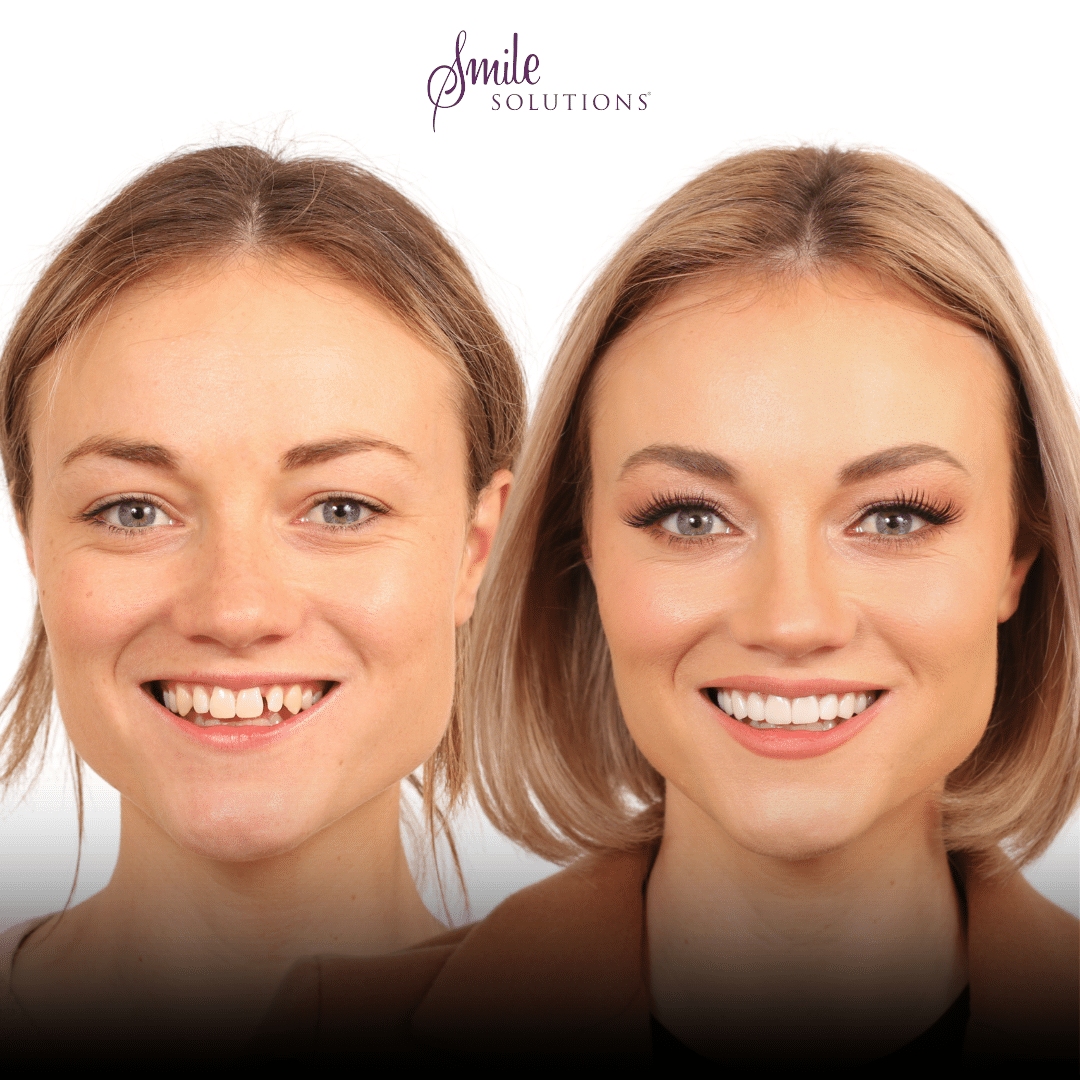
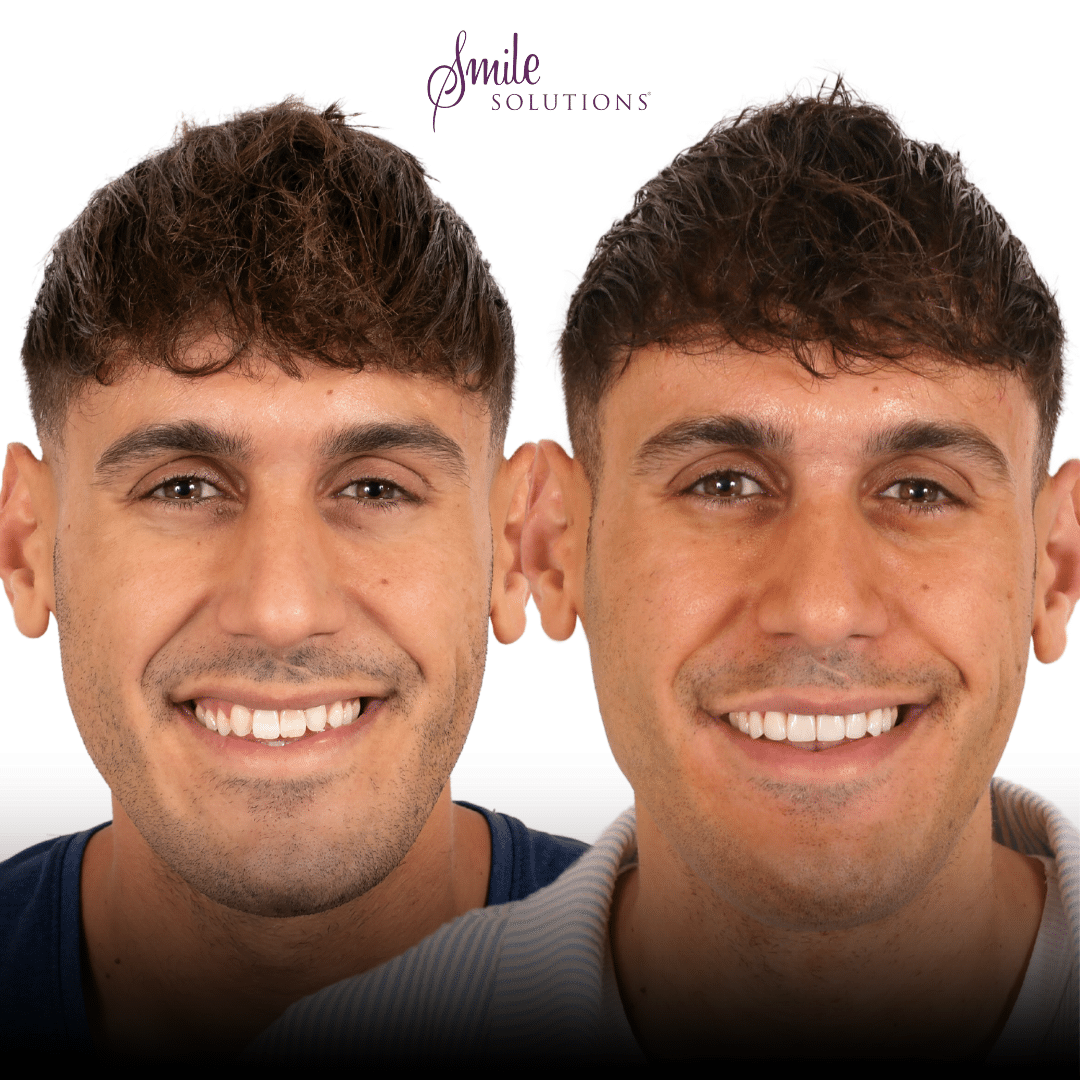
- Changes to lip support and facial appearance, which can be for better or worse and should be previewed with the temporary.
- The remaining teeth are gone permanently. That is the part that cannot be reversed.
Nothing here is guaranteed, and how any individual heals varies. Figures from other countries, other implant systems and other populations describe those groups, not your case.
Where the procedure happens
All-on-4 can be performed under local anaesthetic in the dental chair, or in a private hospital.
If you have private health insurance with hospital cover, treatment can be performed in hospital, and certain aspects of the procedure are covered by Medicare, giving access to relevant Medicare rebates.
Hospital is generally the better option for:
- patients with private health insurance and hospital cover
- older patients
- dental phobic patients
- those with pre-existing or co-existing medical conditions
- procedures involving bone grafting, sinus lifts or other complex surgery
One point worth knowing: general dentists cannot perform these procedures in a hospital. Only registered specialists and dual-qualified medical surgeons are authorised to do so.
Who performs it
All-on-4 treatment is performed by board-registered specialist prosthodontists, periodontists, oral and maxillofacial surgeons, and dual medically qualified dental surgeons — not by a general dentist working across multiple fields. See Specialist Prosthodontists, Specialist Periodontists and Oral & Maxillofacial Surgeons.
For complex cases requiring extensive bone grafting, open sinus lifts or zygomatic implants, oral and maxillofacial surgeons work within the same team — no referral to an external surgeon.
You can verify any clinician's specialist status on the AHPRA public register — see Dentists & Registered Specialists and who should I see for dental implants.
Costs and support
Your initial complimentary consultation is with an experienced registered dentist, not a salesperson without formal dental qualifications. The consultation is a discussion only — no check-up, x-rays, scans or clinical treatment — with a $50 refundable deposit.
A dedicated treatment coordinator handles appointment scheduling and payment arrangements, acting as a single point of contact before, during and after the procedure.
What a complete quote should itemise: the planning scans, extractions, bone contouring and any grafting, the implants themselves, the temporary bridge, the permanent bridge, the anaesthetic and any hospital fee, a nightguard where indicated, and the review appointments. Ask separately what long-term maintenance costs — recall visits, unscrewing and cleaning the bridge, and eventual repair or replacement — because that is the figure most often omitted.
On rebates: dental extras, hospital cover and Medicare can each apply to different parts of the treatment, which is unusual and worth untangling in writing with item numbers before you commit. See Price Guide, Payment Plans and dental implant costs in Melbourne.
Interest-free payment plans are available through Payright for treatment from $150 to $20,000, over 3 to 30 months. Other finance options may also be available; provider eligibility, fees and terms can change. Fees and terms apply; ask for them in writing.
Common questions
Does All-on-4 mean every remaining tooth has to be removed?
A fixed full-arch replacement is planned for an arch where the teeth are already missing or where removal of the remaining teeth is proposed. That does not establish that removal is the best option for you. Ask for the prognosis of the remaining teeth and a comparison with a plan that retains suitable teeth. Clarify which arch is being treated; treatment of one arch does not automatically require treatment of the other. Extraction is irreversible, so resolve those questions before consenting.
One point from the published record is worth raising here. The ITI Academy consensus statements report that bridges supported by a combination of implants and natural teeth performed less well than bridges on implants alone — implant survival of 90.1 per cent at five years and 82.1 per cent at ten, against 95.4 per cent and 92.8 per cent for implant-only bridges. That is an argument about how a mixed-support bridge is designed, not an argument for removing sound teeth, and the consensus does not make the latter claim.
How many implants will I actually get, and why that number?
Four is the minimum the technique is designed around; six is common where bone allows or the bite demands it. The number comes from your 3D scan, and two findings in the literature are worth asking about directly.
First, position matters. In the 2025 Maccabi Dent analysis of 158,824 implants placed in 54,210 patients, implants in the upper jaw failed at roughly twice the rate of those in the lower jaw; the maxillary molar region ran at 3 per cent and the central incisor region at 3.37 per cent, against an overall failure rate of 2.21 per cent across the whole cohort. Second, length matters: the meta-analysis of early failure that the same paper summarises found implants shorter than 10 mm to be a significant risk factor. So ask which jaw, how long the implants are, and whether an extra fixture is proposed to spread the load.
What that study did not find was any meaningful penalty for placing several implants in one session: the failure rate for multiple implants was 0.18 per cent higher than for single implants, a difference that was not statistically significant.
High survival rates are quoted everywhere. What is the honest picture?
Survival and freedom from trouble are two different measurements, and the gap between them is the part that is usually left out.
On survival, the numbers are genuinely good. The Maccabi Dent analysis recorded overall survival of 97.79 per cent across 158,824 implants, and the ITI Academy consensus statements put cumulative survival of implants supporting fixed bridges at 95.4 per cent after five years of function and 92.8 per cent after ten, with the bridges themselves at 95.0 per cent and 86.7 per cent.
On complications, the same ITI document is blunt: “biologic and technical complications occurred in about half the cases after 5 years of function”, and bridges free of any biologic or technical complication were found in only 61.3 per cent of patients at five years. Failures also cluster early — 1.59 per cent of the Israeli cohort failed within the first year, with the rate declining afterwards.
Both sources state their own limits, and those matter. The ITI statements draw on cohort studies of implant types and components some of which are no longer manufactured, and note that data on the absence of complications came from only 4 of 21 studies. The Israeli data is retrospective and from a single clinical database, which its authors identify as a limitation. So read these as the shape of the risk, not as your odds.
I have osteoporosis, or I have been told my bone is thin. Am I ruled out?
Not on the basis of osteoporosis alone. A systematic review searching PubMed/MEDLINE and Scopus to October 2024 pooled 24 studies — 2,102 patients, 5,954 implants, follow-up from one month to 25 years, with four studies running past ten years — and concluded that “Osteoporosis is not a contraindication for dental implant placement”, adding that “planning must be cautious and personalized”. Survival was above 90 per cent in every study included, osteoporotic patients as well.
The review is not uniformly reassuring, and it should not be quoted as though it were. Most of the included studies found no difference in marginal bone loss or bone-to-implant contact between osteoporotic and healthy patients; one prospective cohort found a small marginal bone loss of 0.34 mm in osteoporotic women, with the review noting there was insufficient evidence of a causal relationship; and some studies did report lower implant stability scores and a higher risk of failure.
Three separate things get run together in this conversation and should be kept apart: osteoporosis as a diagnosis, the amount and quality of bone at the actual implant site — which is what the 3D scan measures, not a bone-density scan — and any medicine you take that acts on bone. Disclose all three, and never start or stop a prescribed medicine on the basis of a web page; that decision belongs to the prescriber.
Would an implant-retained overdenture suit me better?
It might, and the comparison table above sets out the trade-offs. Two measured findings belong in that conversation, and neither favours the removable route on durability.
The ITI Academy consensus statements report 2.5 per cent implant loss before overdentures were fitted and nearly 6 per cent loss during five years of function, against 0.8 per cent early loss and 2 to 2.5 per cent over five years of function for implants carrying single crowns. The Maccabi Dent analysis found implants supporting removable restorations failed at 9.32 per cent against 3.74 per cent for fixed crowns and bridges — although removable cases made up only 3.9 per cent of that cohort.
Neither dataset compared the two choices in the same patient, and people offered an overdenture often have less bone to start with, so the figures describe the groups rather than your decision. What they do establish is that removable is not automatically the lower-risk option, and that is worth hearing before choosing on cost or convenience alone. On cost, ask for both plans quoted in writing; no independent source publishes Australian fees for either.
If the bridge is fixed, why might the dentist remove it?
Fixed means you do not remove it for daily cleaning or at night. A screw-retained bridge can be removed by a clinician when needed for assessment, maintenance or repair. That does not mean it must be removed at every review, nor that it is a removable denture. Ask how your bridge will be checked, when removal may be necessary and whether that work is included in the maintenance fee.
What if I cannot clean underneath the bridge easily?
Raise this during planning and during the provisional stage, rather than waiting until the final bridge is fitted. Ask the team to demonstrate access with suitable cleaning aids and let you practise. Tell them about limited dexterity, vision or support at home. The design and maintenance plan need to work for your circumstances. Discuss alternatives, including an implant-retained removable overdenture, if keeping a fixed bridge clean would be difficult.
It is worth knowing what the review appointment is actually looking for. The ITI Academy consensus recommends bleeding on probing and peri-implant probing depth as the main monitoring parameters, probed at a deliberately light force of 0.2 to 0.25 newtons, and states that probing depths around conventionally placed implants “generally range between 2 and 4 mm under healthy conditions”, with increases above your own recorded baseline treated as a sign of disease. It also finds that implant mobility indicates osseointegration has already been lost rather than warning of trouble ahead, and that no evidence-based recommendation can be made on how much firm, keratinised gum an implant needs.
Is the temporary bridge a chance to change the final smile?
It is an important opportunity to report concerns about tooth shape, appearance, speech and comfort. Ask which features can still be changed, how your feedback will be recorded, and what must be agreed before the definitive bridge is made. A temporary bridge also has healing and loading restrictions, so it is not a trial of unrestricted eating. Follow the treating team's instructions and report problems rather than assuming the final bridge will automatically resolve them.
If an implant fails, who pays for putting it right?
Ask before you consent, and ask for the answer in writing. There is no standard arrangement, and three separate things get confused: the manufacturer's warranty on the component, which covers a part and not the surgery to place it; the practice's own policy on redoing clinical work; and your health fund's position on claiming the same item number twice inside one benefit period.
The measured failure rates above are low but not zero, and they cluster early — 1.56 per cent of the Israeli cohort failed before any prosthesis was fitted at all. So ask three specific things: what happens if an implant fails before the permanent bridge is made, what happens if one fails years afterwards, and whether a revision that needs grafting would fall outside the current quote.
Related pages: Dental Implants, Conventional & Immediate Implants, Bone Grafting, Dentures, Our Difference — Implants, Dental Implants at Smile Solutions, Specialist Prosthodontists, Specialist Care, things to consider when choosing All-on-4.
Practical details
| Address | Level 1, 220 Collins Street, Manchester Unity Building, Melbourne VIC 3000 |
| Phone | 13 13 96 |
| theteam@smilesolutions.com.au | |
| Monday – Friday | 8.00am – 6.00pm |
| Saturday | 8.30am – 1.30pm |
| Sunday | By appointment |
| Temporary bridge | 1–2 days |
| Soft diet | Commonly 6–8 weeks or longer |
| Permanent bridge | 3–6 months |
| Implant system | Swiss-made Nobel; certified All-on-4 clinic |
| Prosthesis material | Ceramic zirconia with titanium bar |
| Covers palate | No |
| Removable | No |
| Maintenance recall | Commonly every 3–6 months |
| Parking | Wilsons Parking, Flinders Lane (between Swanston and Russell) |
General information only — it is not a diagnosis, a treatment plan, a quote or a promise of any particular clinical outcome, and it does not replace advice from your treating practitioner. All-on-4 is major surgery carrying the risks set out above, and removing the remaining teeth is irreversible. Whether it is appropriate, how many implants are required and how you will heal can only be established from examination and 3D imaging, and vary between individuals. Timelines here are typical patterns rather than predictions for your case, and your surgeon's instructions take precedence over this page. Fees, Medicare and health fund rebates are indicative and subject to change; confirm before booking.
Smile Solutions trades under ABN 28 193 514 103.
Images on This Page
-
https://www.facebook.com/tr?id=800557773428361&ev=PageView&noscript=1
(no alt text)
-
https://www.smilesolutions.com.au/wp-content/uploads/2025/10/calendar_month.svg
(no alt text)
-
https://www.smilesolutions.com.au/wp-content/themes/arcadian-wordpress-theme/assets/images/smile_solutions_logo_white.png
Smile Solutions Logo
-
https://www.smilesolutions.com.au/wp-content/themes/arcadian-wordpress-theme/assets/images/smile_solutions_logo_purple.png
Smile Solutions Logo
-
https://www.smilesolutions.com.au/wp-content/uploads/2025/11/Smile-Solutions-4.png
Smile Solutions 4
-
https://www.smilesolutions.com.au/wp-content/uploads/2025/11/All-on-4-Dental-Implants-Smile-Solutions.png
All on 4 Dental Implants Smile Solutions
-
https://www.smilesolutions.com.au/wp-content/uploads/2025/11/All-on-4-at-Smile-Solutions.png
All on 4 at Smile Solutions
-
https://www.smilesolutions.com.au/wp-content/uploads/2026/01/Ryan3.png
Ryan3
-
https://www.smilesolutions.com.au/wp-content/uploads/2026/01/Ryan7.png
Ryan7
-
https://www.smilesolutions.com.au/wp-content/uploads/2026/01/Ryan6.png
Ryan6
-
https://www.smilesolutions.com.au/wp-content/uploads/2026/01/Casey1.png
Casey1
-
https://www.smilesolutions.com.au/wp-content/uploads/2025/11/23.png
23
-
https://www.smilesolutions.com.au/wp-content/uploads/2026/03/Smile-I.jpg
Smile I
-
https://www.smilesolutions.com.au/wp-content/uploads/2026/03/Smile-I-1.jpg
Smile I 1
-
https://www.smilesolutions.com.au/wp-content/uploads/2026/01/Ryan10.png
Ryan10
-
https://www.smilesolutions.com.au/wp-content/uploads/2025/10/Smile-Solutions-Invisalign-Blue-Diamond-Provider.png
Smile Solutions Invisalign Blue Diamond Provider
-
https://www.smilesolutions.com.au/wp-content/uploads/2025/10/Smile-Solutions-Luxury-Lifestyle-Awards-Winner.png
Smile Solutions Luxury Lifestyle Awards Winner
-
https://www.smilesolutions.com.au/wp-content/uploads/2026/01/Smile-Solutions-Telstra-Business-Awards-Winner.png
Smile Solutions Telstra Business Awards Winner
-
https://www.smilesolutions.com.au/wp-content/uploads/2026/01/WEBSITE-Smile-Solutions-Award-Tiles.png
WEBSITE Smile Solutions Award Tiles
-
https://www.smilesolutions.com.au/wp-content/uploads/2025/11/Smile-Solutions-ABA-Business-Innovation-Winner-2024.png
Smile Solutions ABA Business Innovation Winner 2024
-
https://www.smilesolutions.com.au/wp-content/uploads/2025/11/Smile-Solutions-ABA-Service-Excellence-Winner-2024.png
Smile Solutions ABA Service Excellence Winner 2024
-
https://www.smilesolutions.com.au/wp-content/uploads/2025/11/Smile-Solutions-ABA-Service-Excellence-Winner-2023.png
Smile Solutions ABA Service Excellence Winner 2023
-
https://www.smilesolutions.com.au/wp-content/uploads/2025/11/Smile-Solutions-ABA-Service-Excellence-Winner-2022.png
Smile Solutions ABA Service Excellence Winner 2022
-
https://www.smilesolutions.com.au/wp-content/uploads/2025/09/Smile-Solutions-ABA-Service-Excellent-Winner-2019.png
Smile Solutions ABA Service Excellent Winner 2019
-
https://www.smilesolutions.com.au/wp-content/uploads/2025/09/Smile-Solutions-ABA-Community-Contribution-Winner-2017.png
Smile Solutions ABA Community Contribution Winner 2017
-
https://www.smilesolutions.com.au/wp-content/uploads/2025/11/Smile-Solutions-ABA-Service-Excellence-Winner-2017.png
Smile Solutions ABA Service Excellence Winner 2017
-
https://www.smilesolutions.com.au/wp-content/uploads/2025/11/Smile-Solutions-ABA-Service-Excellence-Winner-2016.png
Smile Solutions ABA Service Excellence Winner 2016
-
https://www.smilesolutions.com.au/wp-content/uploads/2026/01/Smile-Solutions-ABA-Employer-of-Choice-Winner-2015-1.png
Smile-Solutions-ABA-Employer-of-Choice-Winner-2015
-
https://www.smilesolutions.com.au/wp-content/uploads/2026/01/Smile-Solutions-ABA-Service-Excellence-Winner-2015.png
Smile-Solutions-ABA-Service-Excellence-Winner-2015
-
https://www.smilesolutions.com.au/wp-content/uploads/2025/11/Smile-Solutions-ABA-Employer-of-Choice-Winner-2014.png
Smile Solutions ABA Employer of Choice Winner 2014
-
https://www.smilesolutions.com.au/wp-content/uploads/2026/01/Smile-Solutions-ABA-Innovation-Winner-2014.png
Smile Solutions ABA Innovation Winner 2014
-
https://www.smilesolutions.com.au/wp-content/uploads/2026/01/Smile-Solutions-ABA-Service-Excellence-Winner-2014.png
Smile Solutions ABA Service Excellence Winner 2014
-
https://www.smilesolutions.com.au/wp-content/uploads/2025/11/Smile-Solutions-ABA-Innovation-Winner-2013.png
Smile Solutions ABA Innovation Winner 2013
-
https://www.smilesolutions.com.au/wp-content/uploads/2026/01/Smile-Solutions-ABA-Service-Excellence-Winner-2013.png
Smile Solutions ABA Service Excellence Winner 2013
-
https://www.smilesolutions.com.au/wp-content/uploads/2025/11/Smile-Solutions-ABA-Service-Excellence-Winner-2012.png
Smile Solutions ABA Service Excellence Winner 2012
-
https://www.smilesolutions.com.au/wp-content/uploads/2025/08/69a44c30c93ce196d539cc5520080df52a5f3f88-scaled.jpg
69a44c30c93ce196d539cc5520080df52a5f3f88 scaled
-
https://www.smilesolutions.com.au/wp-content/themes/arcadian-wordpress-theme/assets/images/family_owned_bussiness.png
Family Owned Business
-
https://www.smilesolutions.com.au/wp-content/themes/arcadian-wordpress-theme/assets/icons/icon--phone.svg
Smile Solutions Contact