What makes Smile Solutions Different?
What should I actually compare between All-on-4 providers?
All-on-4 is sold by many clinics at widely different prices, and the differences that matter are mostly invisible in an advertisement. This page sets out what we do differently — and, more usefully, what to ask any provider you are considering.
We are at Level 1, 220 Collins Street, Manchester Unity Building, Melbourne CBD. For the treatment itself, see All-on-4 Dental Implants.
1. Who performs the treatment
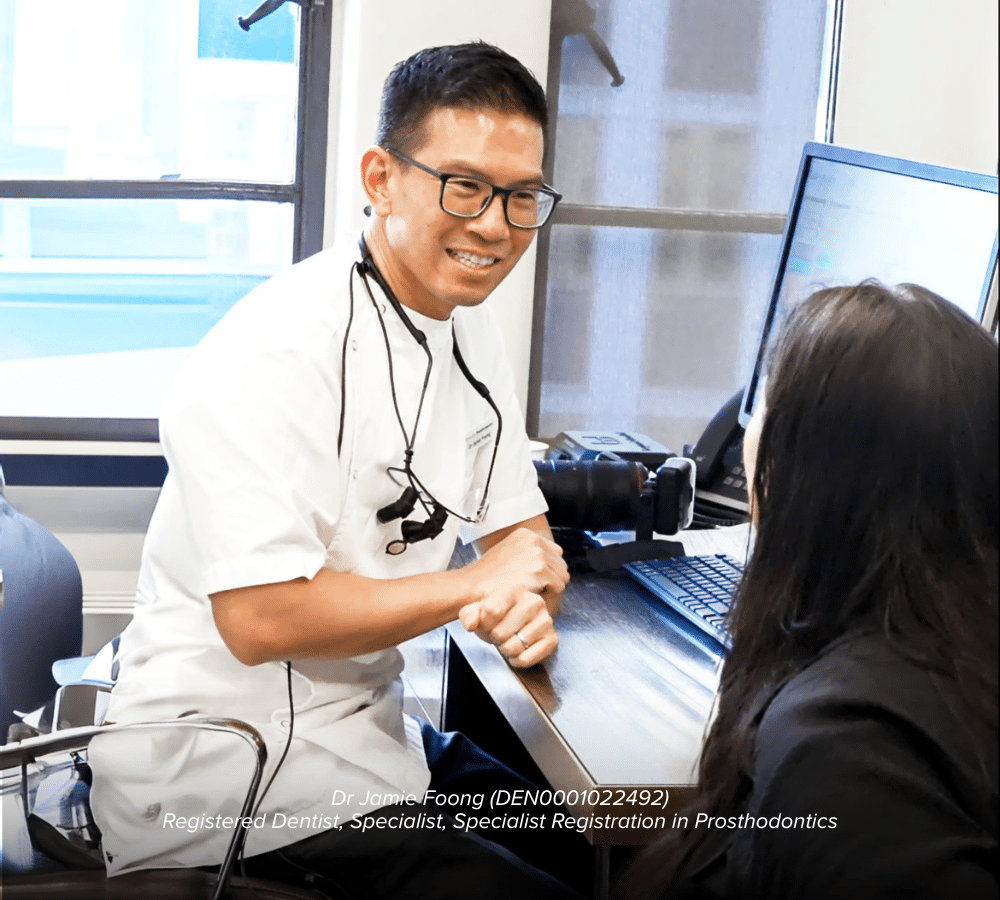
At our Melbourne CBD practice, All-on-4 is performed by board-registered specialist prosthodontists, periodontists, oral and maxillofacial surgeons, and dual medically qualified dental surgeons — not a general dentist providing care across multiple fields.
To qualify as a registered specialist in Australia, a practitioner must hold the same primary dental degree as a general dentist, then complete a further three or more years of full-time postgraduate training — typically a Doctor of Clinical Dentistry or equivalent Masters — in one recognised speciality, making them eligible for specialist registration with the Dental Board of Australia.
Check any clinician on the AHPRA public register — a profile reading "General & Specialist" indicates a registered specialist. See Dentists & Registered Specialists, Specialist Prosthodontists, Specialist Periodontists and Oral & Maxillofacial Surgeons.
There is no AHPRA speciality called “implant dentistry”. Where a clinic describes someone as an “implant specialist”, the registration behind it is one of the recognised thirteen — and which one is worth knowing. See who should I see for dental implants.
2. PF1 versus PF3 — the question almost nobody asks
This is the most technical item here and arguably the most important.
In All-on-4 dentistry, "PF" stands for prosthetic framework.
- PF1 bridges have little to no pink material and closely follow the natural bone contours.
- PF3 bridges rely on larger volumes of pink acrylic or ceramic to compensate for significant bone loss or aggressive surgical reduction.
The distinction matters because PF3 often exists to hide bone that was removed unnecessarily. Smile Solutions aims for PF1 wherever possible, which means preserving bone rather than removing it.
Achieving PF1 demands skill across the whole team:
- the implant surgeon must be conservative
- the prosthodontist must design with precision
- the ceramist must craft with minimal need for camouflage
The result is a more natural fit, better soft tissue support, and preserved bone — which matters enormously if future treatment is ever needed. Bone that has been reduced to make a prosthesis fit cannot be put back. See Bone Grafting.
To be fair about it: some patients have already lost so much bone that a PF3 design is the honest and correct answer, and pink material is then restoring what is genuinely missing rather than hiding something. The question is not “which is better” but “which does my anatomy require, and how much bone is being removed to get there?”
3. Ceramic teeth, not acrylic or printed resin
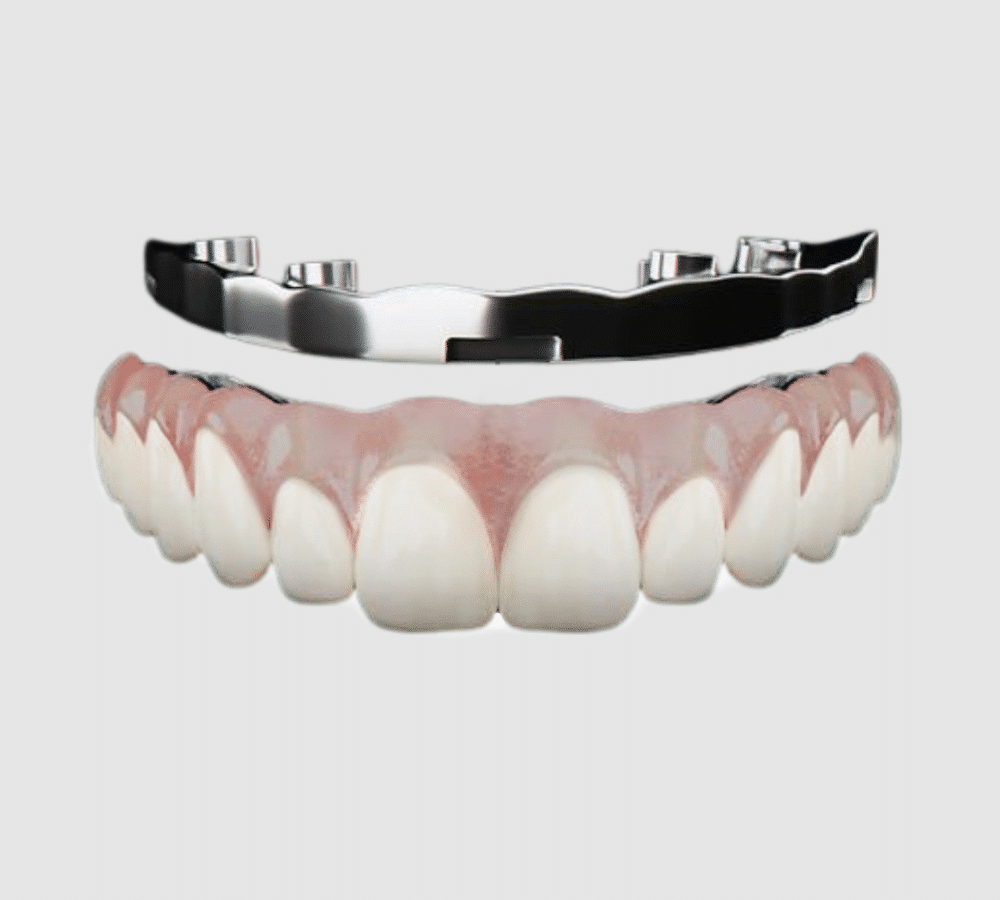
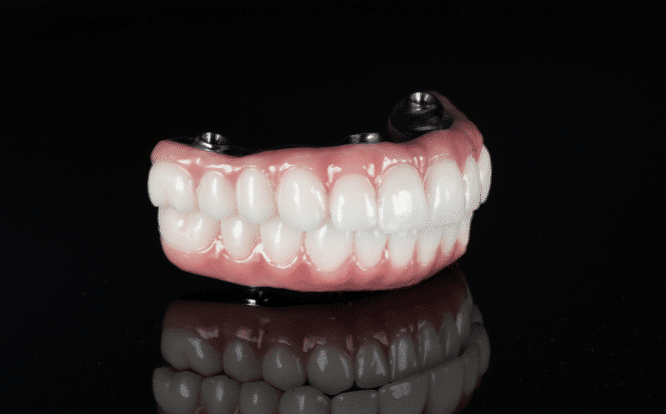
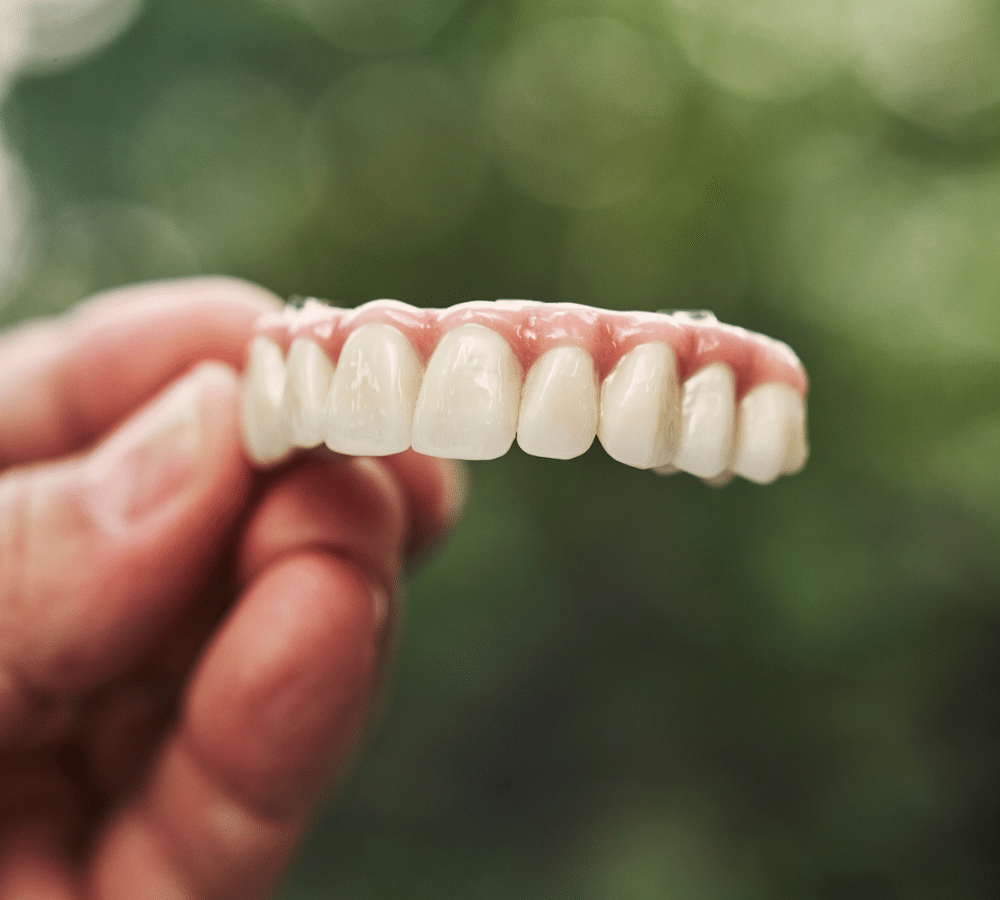
We offer ceramic zirconia with a reinforced titanium bar for the same price as printed resin or denture acrylic — with a board-registered specialist.
Why the material matters:
| Ceramic | Printed resin / acrylic | |
|---|---|---|
| Durability | Resistant to wear; longer lifespan with proper care | Wears faster |
| Staining | Highly resistant; holds colour | Stains more readily |
| Colour | Natural translucency and variation | Flat, uniform colour across all teeth |
| Shape | Matches your natural contours | Prefabricated "stock" shapes |
| Long-term cost | More cost-effective over time | Replacement sooner |
4. A titanium bar substructure in every case
Every Smile Solutions case includes a titanium bar substructure, rather than a bridge more prone to fracture.
The bar securely supports the prosthetic teeth and distributes chewing forces evenly across the implants, preserving the underlying bone structure. Uneven force distribution is what leads to both prosthesis fracture and long-term bone loss.
5. Swiss-made implants, no cost-cutting alternatives
We are a certified All-on-4 clinic using only premium All-on-4 registered products — no alternatives.
The system uses Swiss-made Nobel implants, with techniques developed through extensive research and clinical studies.
Why the system matters beyond quality: implant components are not interchangeable between manufacturers. If a screw or abutment needs replacing in fifteen years, whoever is treating you then has to identify and source those exact parts — straightforward with a major, long-established system, and sometimes impossible with an obscure or discontinued one. Ask for the implant system and reference details in writing, and keep them yourself. See what are the different types of dental implants.
6. Timing: temporary in 1–2 days, permanent in 3–6 months
A temporary bridge is fitted within 1 to 2 days. The permanent bridge follows after 3 to 6 months.
That wait is deliberate, not a delay: allowing bone and gums to recover properly after surgery, before the permanent bridge is fabricated, is what makes the final fit accurate.
This is also the single most important thing to pin down in any quote. Some advertised full-arch prices cover the surgery and the temporary bridge only, with the permanent bridge a substantial separate cost months later. Ask explicitly: does this price include the final bridge, and in what material? See Conventional & Immediate Implants for how integration timing works.
7. Hospital treatment, and who is allowed to provide it
If you have private health insurance with hospital cover, treatment can be performed in a private hospital rather than under local anaesthetic in a dental chair. Certain aspects of the procedure are also covered by Medicare, giving access to relevant rebates.
Hospital is the better setting for:
- patients with private health insurance and hospital cover
- older patients
- dental phobic patients — see Sleep Dentistry and Dental Anxiety
- those with pre-existing or co-existing medical conditions
- procedures involving bone grafting, sinus lifts or other complex surgery
General dentists cannot perform these procedures in a hospital. Only registered specialists and dual-qualified medical surgeons are authorised to do so — which means a provider without specialists cannot offer you the hospital option at all.
8. Complex cases handled in-house
Oral and maxillofacial surgeons work within the team for complex treatment such as extensive bone grafting, open sinus lifts and zygomatic implants — no referrals to an external surgeon, and no gap between the surgical plan and the restorative one. See Complex Dentistry.
9. The in-house laboratory
The Smile Solutions laboratory exists exclusively to service the practice's own patients. Its ceramists and technicians do not work with clinicians outside Smile Solutions.
No work is sent offshore, and only TGA-approved products are used in manufacturing appliances. See Smile Solutions Laboratory.
10. Technology
- iCam 4D Implant and Scanner — captures detailed images for precise measurements and virtual implant placement simulations
- coDiagnostix — detailed 3D images of jaw structure for accurate implant placement
- Exocad DentalCAD — precise implant planning and visualisation for more predictable outcomes
See Our Technology.
11. Who you meet first
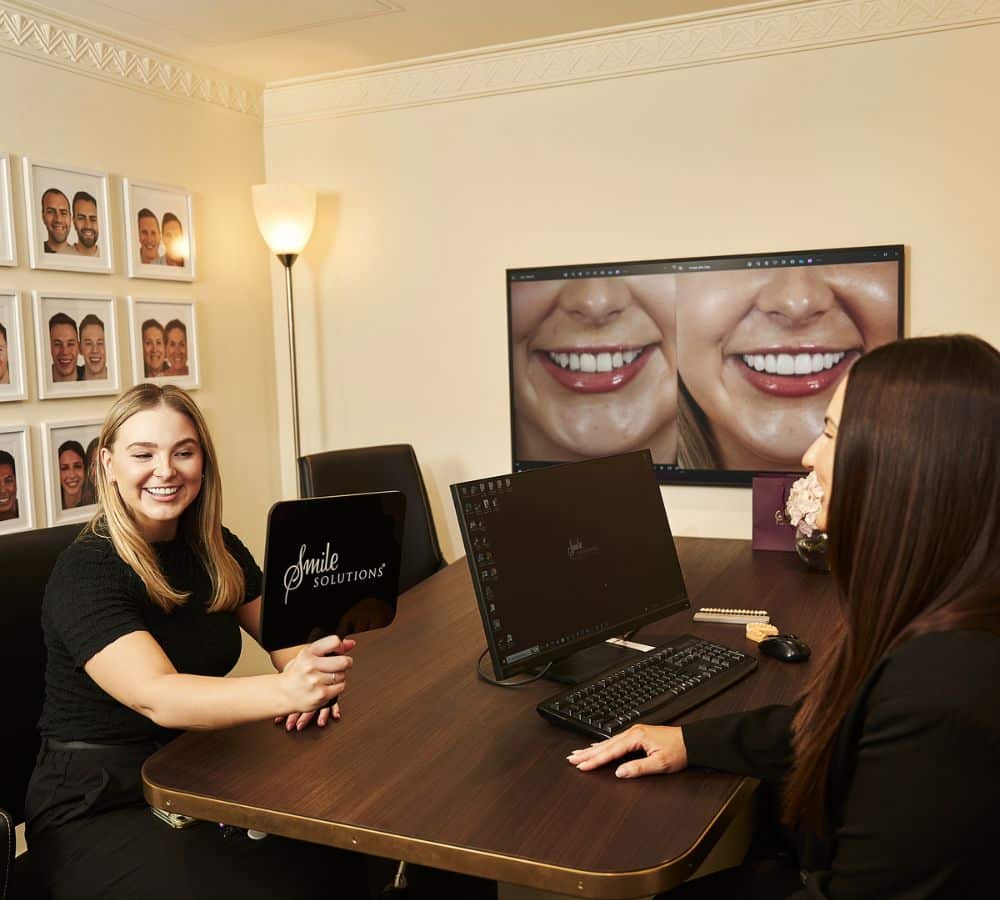
Your initial complimentary appointment is with an experienced registered dentist, not a salesperson without any formal qualification in dentistry.
This is worth checking elsewhere too. Many high-value implant consultations are conducted by non-clinical sales staff.
The consultation is a discussion only — no check-up, x-rays, scans or clinical treatment — with a $50 refundable deposit.
12. A dedicated treatment coordinator
One person handles appointment scheduling and payment arrangements, and acts as your single point of contact before, during and after the procedure.
13. One team in one location
All treatment happens in one place — no franchise locations. Peer review and case analysis by multiple practitioners are a standard step in treatment planning.
We have been operating since 1993, and have received multiple Australian Business Awards for Service Excellence, the Telstra Award for Best Business in Victoria, and a runner-up placing for Best Business in Australia.
What a full-arch quote should itemise
Price comparisons fail because two quotes rarely cover the same things. A complete quote sets out each of these separately:
| Item | Why it varies |
|---|---|
| Consultation and 3D imaging | Sometimes bundled, sometimes charged |
| Extractions | Number of teeth, and difficulty |
| Bone contouring, grafting or sinus lift | Frequently excluded from headline prices |
| The implants themselves | Number — four, six, or more — and which system |
| Anaesthetic | Local, sedation or general; the anaesthetist bills separately |
| Hospital fee | Where applicable |
| The temporary bridge | Nearly always included |
| The permanent bridge | Often not included — confirm |
| Material of the final bridge | Ceramic, or printed resin/acrylic |
| Framework | Titanium bar, or none |
| Review appointments | Usually several in the first year |
| A nightguard | Commonly recommended, rarely quoted |
| Ongoing maintenance | Recalls, unscrewing and cleaning the bridge |
| What happens if an implant fails | Whether a revision is charged again |
Ask for the total for both arches if both are being treated, and for the figure to be stated as an informed financial consent document rather than a headline. See Price Guide, Payment Plans and dental implant costs in Melbourne.
Signs worth slowing down for
None of these proves anything is wrong. All of them are reasons to ask another question:
- A discount that expires if you do not decide today. Full-arch treatment is irreversible; no sound clinical plan needs a deadline.
- A consultation conducted by a salesperson rather than a clinician.
- A plan produced without a 3D scan.
- “Teeth in a day” offered before anyone has looked at your bone. Whether immediate loading is safe depends on stability measured at surgery.
- No clear answer about who is operating, or about their registration.
- The implant system not named.
- The laboratory not named, or work sent offshore.
- The price covering only the temporary bridge.
- No written answer about failure and revision costs.
- Pressure not to seek a second opinion.
A practice confident in its plan will answer all of these in writing without hesitation. See Second Opinions & Corrective Dentistry.
On having it done overseas
Full-arch implant treatment abroad is marketed heavily on price, and the arithmetic looks compelling until the aftercare is counted.
What tends not to be included: the review appointments over the following months, adjustments as the tissue settles, the permanent bridge if the temporary was fitted before you flew home, and anyone locally who will take responsibility if something fails. Components from an unfamiliar system can be difficult to source in Australia, and there is no Australian regulator to complain to.
If you are considering it, at minimum establish who will review you here, what that costs, whether the implant system's parts are available locally, and what happens if a fixture fails in year two. Those answers are worth having before the flights are booked, not afterwards.
What maintenance actually commits you to
Fixed teeth are not maintenance-free teeth, and the long-term cost belongs in any comparison:
- Cleaning under the bridge daily, with a water flosser or specific brushes
- Professional recalls more often than six-monthly, commonly every three to six months. See Dental Cleans & Hygienists
- The bridge unscrewed periodically so everything beneath it can be cleaned and inspected
- Screws re-tightened as routine, not as failure
- Peri-implantitis — inflammation and bone loss around implants — as the main long-term threat, and the reason recalls are not optional. See Bleeding Gums
Ask what that costs annually. It is the figure most often missing from a full-arch comparison, and over a decade it is not trivial.
Common questions
What should I compare between full-arch implant providers?
Compare the diagnosis, clinician registrations, proposed bone removal, implant system, temporary and final prostheses, materials, laboratory, treatment setting, inclusions, failure policy and long-term maintenance rather than the headline price alone.
What do PF1 and PF3 mean?
They describe different full-arch prosthesis designs. A PF1 aims to replace teeth with minimal artificial gum, while a PF3 also replaces missing gum and often requires different space and cleaning considerations. Ask which design is planned and why.
Is the permanent bridge included in the quote?
Do not assume it is. Ask the quote to distinguish extractions, grafting, implants, temporary bridge, permanent bridge, anaesthesia, hospital fees, imaging and reviews. The final material and timing should be stated.
Why does the implant system matter?
A well-documented system with identifiable components can make long-term servicing easier. Ask for the brand and component details to be recorded for you, because repairs or treatment may occur elsewhere years later.
Does every full-arch bridge need a titanium bar?
The page describes a titanium-bar substructure as the practice's approach. Whether a particular design and material are appropriate depends on space, bite, implant positions and the planned prosthesis. Ask how the structure will be serviced or repaired.
Can the treatment be performed in hospital?
Hospital treatment may be considered for selected patients or procedures after assessment. Ask who performs the surgery and anaesthesia, where it occurs and whether medical history or complexity makes hospital care advisable.
What happens if an implant fails?
Failure can require removal, healing, grafting, another implant or redesign of the prosthesis. Obtain the practice's written policy on early and later failure, including which clinical and laboratory costs are covered.
What long-term maintenance will I need?
Full-arch implant teeth require daily cleaning, professional review and periodic maintenance of the prosthesis and components. Ask for the expected recall interval, how the bridge is cleaned or removed when needed and the likely annual cost.
Practical details
| Address | Level 1, 220 Collins Street, Manchester Unity Building, Melbourne VIC 3000 |
| Phone | 13 13 96 |
| theteam@smilesolutions.com.au | |
| Monday – Friday | 8.00am – 6.00pm |
| Saturday | 8.30am – 1.30pm |
| Sunday | By appointment |
| Framework aim | PF1 wherever possible |
| Prosthesis | Ceramic zirconia, reinforced titanium bar |
| Implants | Swiss-made Nobel |
| Temporary bridge | 1–2 days |
| Permanent bridge | 3–6 months |
| Laboratory | In-house, Melbourne; TGA-approved materials only |
| Consultation with | A registered dentist, not a salesperson |
| Parking | Wilsons Parking, Flinders Lane (between Swanston and Russell) |
Specialist registration can be verified free on the AHPRA public register at ahpra.gov.au.
General information only — it is not a diagnosis, a treatment plan, a quote or a promise of any particular clinical outcome, and it does not replace advice from your treating practitioner. Full-arch implant treatment is major surgery, removing remaining teeth is irreversible, and which framework, materials and approach are appropriate can only be determined from examination and 3D imaging. Results, recovery times and potential risks vary for each individual. The comparison points on this page describe what differs between approaches and what to ask; they are not a claim that any provider achieves a superior clinical outcome in an individual case. Seek independent advice from a qualified, AHPRA-registered practitioner before proceeding, and you are entitled to a second opinion before consenting to irreversible treatment. Fees, Medicare and health fund rebates are indicative and subject to change; confirm before booking.
Smile Solutions trades under ABN 28 193 514 103.
Images on This Page
-
https://www.facebook.com/tr?id=800557773428361&ev=PageView&noscript=1
(no alt text)
-
https://www.smilesolutions.com.au/wp-content/uploads/2025/10/calendar_month.svg
(no alt text)
-
https://www.smilesolutions.com.au/wp-content/themes/arcadian-wordpress-theme/assets/images/smile_solutions_logo_white.png
Smile Solutions Logo
-
https://www.smilesolutions.com.au/wp-content/themes/arcadian-wordpress-theme/assets/images/smile_solutions_logo_purple.png
Smile Solutions Logo
-
https://www.smilesolutions.com.au/wp-content/uploads/2025/11/Smile-Solutions-4.png
Smile Solutions - Melbourne CBD
-
https://www.smilesolutions.com.au/wp-content/uploads/2025/11/Board-registered-specialists.png
Smile Solutions Dentist Melbourne Specialist Prosthodontist
-
https://www.smilesolutions.com.au/wp-content/uploads/2025/08/all-on-4-titanium-bar.png
all on 4 titanium bar
-
https://www.smilesolutions.com.au/wp-content/uploads/2025/08/all-on-4-handcrafted-ceramic.png
all on 4 handcrafted ceramic
-
https://www.smilesolutions.com.au/wp-content/uploads/2025/09/All-on-4-at-Smile-Solutions.png
Dental prosthesis with natural appearance
-
https://www.smilesolutions.com.au/wp-content/uploads/2026/01/Cosmetic-Consult.jpg
Consultation at a cosmetic clinic.
-
https://www.smilesolutions.com.au/wp-content/uploads/2025/11/All-on-4-Dental-Implants-Smile-Solutions.png
All-on-4 Dental Implants Smile Solutions
-
https://www.smilesolutions.com.au/wp-content/uploads/2025/12/Dental-Implants-at-Smile-Solutions.jpg
Smile Solutions Specialist Dental Care Melbourne
-
https://www.smilesolutions.com.au/wp-content/uploads/2025/08/69a44c30c93ce196d539cc5520080df52a5f3f88-scaled.jpg
69a44c30c93ce196d539cc5520080df52a5f3f88 scaled
-
https://www.smilesolutions.com.au/wp-content/themes/arcadian-wordpress-theme/assets/images/family_owned_bussiness.png
Family Owned Business
-
https://www.smilesolutions.com.au/wp-content/themes/arcadian-wordpress-theme/assets/icons/icon--phone.svg
Smile Solutions Contact
-
https://www.facebook.com/tr? id=800557773428361&ev=PageView&noscript=1
(no alt text)