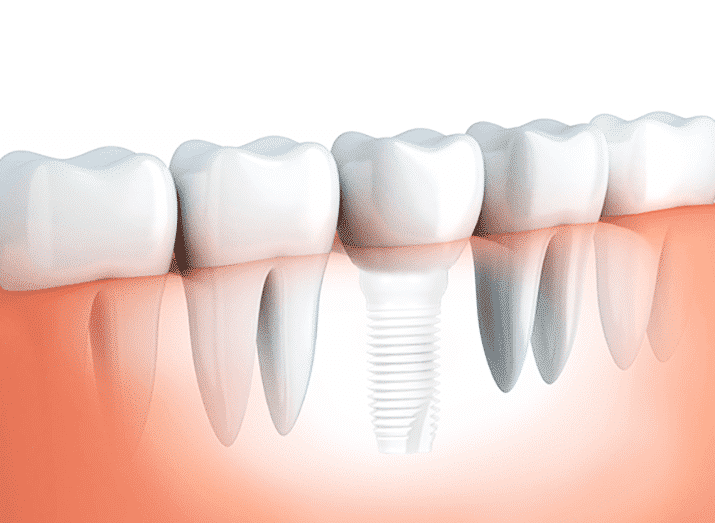
Conventional & Immediate Implants
Conventional or immediate implants — what's the difference?
The difference is timing, and it changes both the treatment experience and who is eligible.
Conventional implants take a staged approach: the implant is placed first, then left to integrate with the bone for three to six months before the crown is fitted.
Immediate placement means placing the implant on the day the tooth is extracted. Whether a temporary tooth can also be attached promptly is a separate decision; the final crown may be fitted after healing.
Smile Solutions is at Level 1, 220 Collins Street, Manchester Unity Building, Melbourne CBD.
Two decisions, not one
Worth separating before anything else, because the words are used loosely and the distinction changes what you are agreeing to.
- Immediate placement means the implant goes in on the day the tooth comes out, rather than months later.
- Immediate loading means a tooth is attached to that implant straight away, rather than waiting for it to integrate.
They are separate decisions. It is entirely common to place an implant immediately and still leave it unloaded for months, with a temporary tooth that rests on the gum instead. “Same-day implant” in most advertising means both at once, and that combination has the narrowest list of suitable patients.
Ask which of the two is being proposed for you, and whether the temporary tooth will touch the implant or not.
Why integration takes months
An implant is not a screw held by thread, like a screw in wood. Bone grows directly onto the titanium surface over the following months — osseointegration — and once that has happened the implant is continuous with the jaw.
That gives two different kinds of stability, and the distinction is the key to the whole page:
- Primary stability is mechanical, on the day — how tightly the fixture is gripped by the bone it was screwed into.
- Secondary stability is biological — the bone that grows onto the surface over the months afterwards.
Primary stability dips as the initial grip remodels, before secondary stability takes over. That dip, some weeks in, is the vulnerable window. It is why load in the early phase matters, and why immediate loading is only offered where the implant achieves high primary stability on the day — which the surgeon can measure at placement.
Which one suits you
| Conventional | Immediate | |
|---|---|---|
| Timeline | Healing before the definitive restoration; timing varies | Placement on extraction day; restoration timing assessed separately |
| Suitable for | Most patients seeking a long-term solution | Patients with good bone density and no infection |
| Temporary tooth | Options may be available during healing | Depends on whether immediate restoration is suitable |
| Best for | Long-term reliability across a wide range of cases | Broken or soon-to-be-removed teeth |
| Success rate | Very high | High, in appropriate cases |
Conventional implants are suitable for most patients and offer a very high success rate, with a reliable, durable restoration that blends with your own teeth.
Immediate implants require good bone density and no infection at the site — though bone grafting may make the procedure possible where those conditions are not initially met. Potential advantages include fewer stages and a temporary tooth during healing where suitable; a shorter total treatment time and avoiding a visible gap are not guaranteed. See Bone Grafting.
Which applies to you is settled at consultation, after examination. Neither approach is universally better; the staged route is often chosen precisely because it is more forgiving where bone quality or infection is uncertain.
What tends to rule immediate placement out: active infection at the site, a broken outer wall of the socket, insufficient bone beyond the socket to grip, heavy smoking, poorly controlled diabetes, and a front tooth with a thin, high-visibility gum margin where the aesthetic risk is greatest.
What happens to the socket after an extraction
This explains why timing matters at all.
The thin inner lining of a tooth socket exists because the tooth is there. Once the tooth is removed, that layer is lost, and the ridge narrows and shortens — most of the change happening in the first few months, and more on the cheek side than the tongue side.
Three consequences follow:
- Waiting a year or two after an extraction often means less bone than there was, and grafting to rebuild it.
- Placing an implant into the fresh socket does not prevent that remodelling by itself, which is a common misconception; grafting around the implant is frequently done at the same time to compensate.
- Where an implant is not going in immediately, socket preservation — grafting the socket at the time of extraction — is often the cheaper decision in the long run, because rebuilding lost bone later costs more than keeping it.
If a tooth is coming out and an implant is even a possibility later, ask about this before the extraction, not afterwards.
The three components of an implant
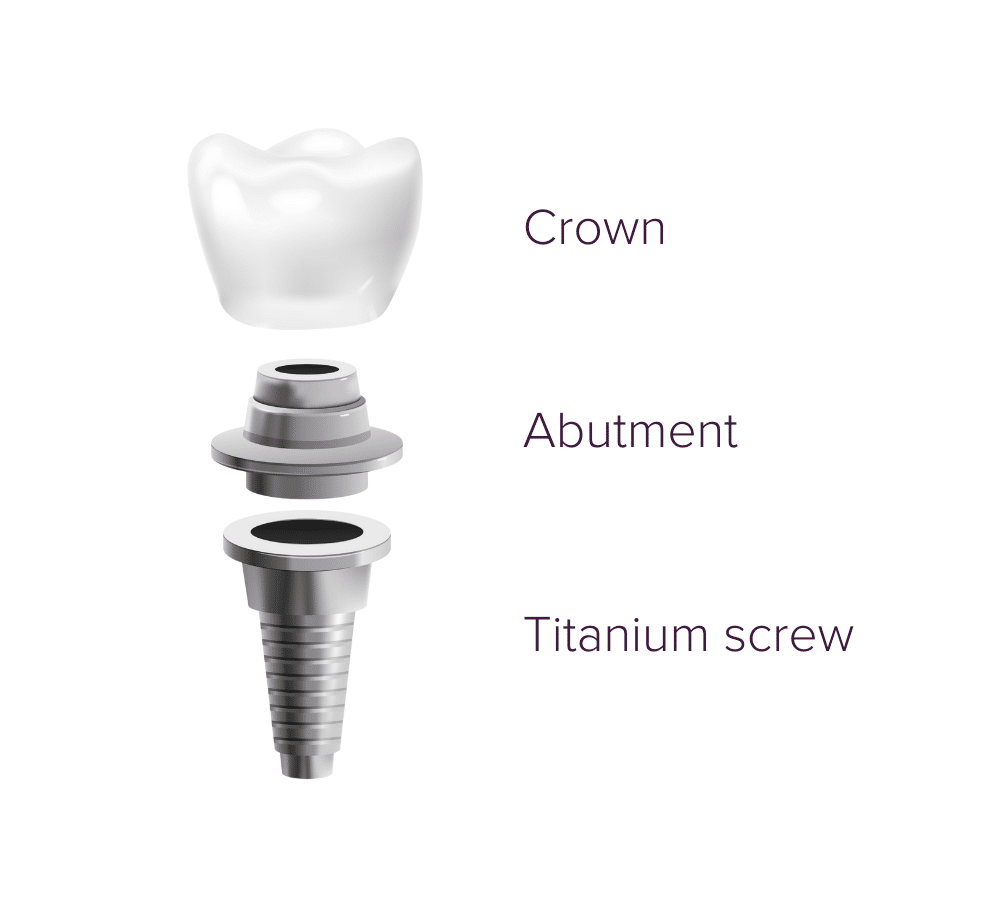
Every implant, conventional or immediate, has the same three parts:
1. Titanium screw (fixture). Placed into the jawbone, this acts as the artificial tooth root and provides a stable foundation for everything above it.
2. Abutment. A metal connector attached to the fixture. It sits above the gumline and supports the final crown.
3. Crown. Secured on top of the abutment, completing the restoration. Made from all-ceramic materials, or porcelain fused to precious metal. See Dental Crowns.
Understanding the three parts is useful later: if something needs attention years afterwards, it is usually the crown or abutment rather than the fixture in the bone.
Components are not interchangeable between manufacturers. If a screw or abutment needs replacing in fifteen years, whoever treats you has to identify and source the exact parts — far easier with a major, long-established system. Ask for the implant system and reference details in writing, and keep them with your own papers. See what are the different types of dental implants and mini implants vs standard implants.
The assessment beforehand
Implants are planned from imaging, not from looking. Expect:
- A 3D scan (CBCT), showing bone height, width and quality, and mapping the nerve in the lower jaw and the sinus floor in the upper. See Our Technology
- A digital scan of the teeth, so the final tooth position is known before the fixture is placed
- Assessment of the gum — its thickness, and how high your lip rises when you smile, which together determine the aesthetic risk at a front tooth
- The bite, including whether you grind. See TMD & Teeth Grinding
- Gum health, because active periodontal disease is treated first. See Bleeding Gums
- Medical history, particularly smoking, diabetes control, immune-suppressing treatment and any medication affecting bone — which must be disclosed and never stopped on your own account
Modern planning frequently produces a printed surgical guide, made by merging the 3D scan with the digital impression, which positions the implant exactly where the final tooth needs it. The restoration is designed first and the surgery follows the design — not the other way round.
The process
Step 1 — Tooth removal. Any damaged tooth is removed, leaving a space ready for the implant.
Step 2 — Implant placement. The fixture is placed into the jawbone.
- Conventional: the implant integrates with the bone over three to six months to form a stable foundation.
- Immediate placement: the implant is placed on extraction day. A temporary replacement tooth may be attached if the separate criteria for immediate restoration are met.
Step 3 — Abutment attachment. Once the implant has healed, the abutment is attached to provide a secure connection for the crown. For immediate implants, a temporary abutment may be placed on the same day.
Step 4 — Crown placement. A custom crown is fitted to replicate a natural tooth. For immediate implants, the temporary or final crown may be placed the same day or after healing.
Surgery is usually done under local anaesthetic, and sedation is available where preferred — see Sleep Dentistry. The crown is made in the practice's own laboratory; see Smile Solutions Laboratory.
What you wear while it heals
With the staged approach there is a period without a tooth, and the options are worth knowing because they are rarely offered unprompted:
- Nothing, where the gap is not visible and you are content with that
- A removable single-tooth denture, the cheapest option, taken out at night
- A clear retainer with a tooth built into it, comfortable and discreet, but not for eating
- A temporary bonded tooth, attached to the neighbouring teeth — the most stable of the three and the most expensive
None of these should press on the healing implant, which is the main thing your clinician is designing around. Ask what the temporary will be, what it costs, and whether it is included in the quote — it is a frequent omission.
After the surgery
- Swelling and discomfort peak on days two and three, then settle. Ice on the first day, head elevated at night.
- Do not smoke. It is the single most modifiable risk factor for early failure.
- No vigorous rinsing or spitting for the first day; gentle warm salt-water rinses from the second.
- Soft food, and nothing chewed on the implant side.
- Keep the rest of your mouth clean normally; your clinician will say when and how to clean around the site.
- Call if bleeding will not stop, pain worsens after day three, swelling increases after day three, or you develop a fever. See Emergency Dentistry.
- A temporary that feels like it is touching first should be checked rather than tolerated.
How long they last
With proper home care and regular professional cleanings, both conventional and immediate implants can last 10 to 15 years. Like crowns, bridges or fillings, they may eventually need replacing.
Those figures are typical ranges observed in practice, not a warranty period. Some implants last considerably longer; some fail early.
Keep six-monthly check-ups. The implant itself cannot decay, but the gum and bone supporting it can still be lost to disease — which is the usual reason an implant fails years after placement.
Maintaining an implant
An implant needs more attention than a natural tooth, not less, because the tissue around it has no periodontal ligament and a poorer blood supply.
- Clean around and under the crown daily — floss threaders, interdental brushes or a water flosser, whichever your hygienist sizes for you
- Professional maintenance more often, commonly three- to six-monthly, using instruments chosen not to damage the implant surface. See Dental Cleans & Hygienists
- Tell any hygienist that it is an implant, because the technique differs
- A nightguard if you grind, since an implant cannot feel overload the way a natural tooth can
- Report bleeding, tenderness or a bad taste around it early; peri-implant disease is far easier to arrest than to reverse
What can go wrong
Implant surgery is surgery, and the same-day route in particular is less forgiving of an imperfect site. The recognised risks include:
- Failure to integrate. The fixture does not fuse with the bone and has to be removed. More likely in smokers, in poorly controlled diabetes, and where bone quality is marginal — which is precisely why immediate placement is not offered to everyone.
- Peri-implantitis. Inflammatory loss of the bone around an established implant, usually years later. It is the leading cause of late implant loss and is driven by plaque control and smoking.
- Nerve injury. Where a fixture is placed near the inferior alveolar nerve in the lower jaw, altered sensation in the lip or chin can occur. Usually temporary; occasionally not.
- Sinus complications in the upper jaw, including perforation of the sinus membrane.
- Mechanical problems — a loosened or fractured abutment screw, or a chipped crown. Usually repairable without disturbing the fixture.
- An aesthetic result that does not match expectations, particularly at the gum margin of a front tooth.
Ask your clinician which of these apply to your case, what the plan is if the implant does not integrate, and whether a replacement would be charged again. Get the answer before you consent, not after.
Where an implant does fail, it is usually removed, the site is allowed to heal or is grafted, and a second attempt is made some months later. That is a setback rather than the end of the option, and it is worth asking how often the clinician sees it.
Is an implant the right answer at all?
Not always, and the alternatives deserve a fair hearing:
- Keeping the tooth. A root-treated and crowned tooth retains your own root, ligament and bone, and costs less. A specialist opinion before extraction sometimes changes the plan. See Specialist Endodontists.
- A bridge, which needs no surgery and is quicker, at the cost of permanently preparing the teeth either side.
- A removable denture, the least invasive and least expensive.
- Leaving the gap, which is occasionally reasonable for a back tooth — though the teeth around it tend to drift over the years.
See implant versus bridge for a single tooth, bridges, implants or dentures and Dentures. For full-arch replacement, see All-on-4 Dental Implants.
Who performs it
Smile Solutions' registered specialists and general dentists work as one team in a single location.
Implant treatment is performed by board-registered specialist prosthodontists, periodontists, oral and maxillofacial surgeons, and dual medically qualified dental surgeons — not by a general dentist working across multiple fields.
One point worth knowing: there is no AHPRA specialty called “implant dentistry”. Implants are placed by specialists in the fields above, and lawfully by general dentists with appropriate training. When any practice describes a clinician as an “implant specialist”, the specialty being referred to is one of the recognised thirteen — you can check which on the AHPRA public register. See Dentists & Registered Specialists and who should I see for dental implants.
Because the surgical and restorative clinicians are in the same building, the surgical placement and the final crown are planned together rather than handed between practices. See Specialist Care.
Costs
The total depends on the extraction, any temporary replacement worn during healing, the implant itself, the type chosen, and which clinician performs the procedure.
What a complete quote should itemise: the consultation and 3D scan, the extraction, any socket graft or bone graft, the surgical guide, the fixture, the healing and final abutments, the temporary tooth, the final crown, and the review appointments. A figure quoted as “the implant” frequently means the fixture alone, which is roughly half the job.
On rebates: implant items generally attract a health fund rebate, subject to annual limits and waiting periods, and a single implant will often exhaust a yearly limit on its own — so ask whether staging the surgery and the crown across two calendar years makes sense. See Price Guide, how much do dental implants cost and dental implant costs in Melbourne.
Complimentary implant consultations are available for an accurate estimate — with an experienced registered dentist, not a salesperson. The consultation is a discussion only, and is secured with a $50 deposit, refunded when you attend. Confirm the current terms, including what happens if you cancel or do not attend, when you book on 13 13 96.
Interest-free payment plans are available through Payright for treatment from $150 to $20,000, over 3 to 30 months. Other finance options may also be available; provider eligibility, fees and terms can change. Approval, fees and terms are set by the finance provider, not by Smile Solutions. Payment Plans.
Common questions
Can the tooth be saved instead?
Ask this first, and ideally ask someone whose recommendation does not depend on the answer — an endodontic opinion before an extraction does sometimes change the plan.
Root canal treatment is not a poor second option. A published cohort of endodontically treated teeth reported overall success of 87.8% at the tooth level (95% CI 84 to 90%) and 80.8% at the patient level (95% CI 75 to 86%). Keeping your own root keeps the periodontal ligament, the bone it maintains and the sensation that comes with it — none of which an implant reproduces.
Two honest caveats about any comparison you are shown. First, the two literatures do not measure the same thing: a British Dental Journal review notes that tooth survival became the headline endodontic outcome measure precisely when “comparisons to implants were made”, so a side-by-side percentage that does not state which measure it uses is not a comparison at all. Second, endodontic outcome studies are heterogeneous, which the same review identifies as “one of the main criticisms” of that literature — the numbers are real but the confidence they invite is sometimes overstated.
What usually decides it is structural rather than statistical: how much sound tooth remains above the gum, whether a crack extends below the bone level, and whether the tooth can be restored in a way that will survive years of chewing. Ask for the answer in those terms. See Specialist Endodontists.
Immediate placement, immediate loading, or both — and why?
Ask for the answer as two separate sentences, because they are two separate decisions and the second carries most of the risk.
The international consensus literature treats them separately too — the ITI consensus programme carries distinct statements on placement of implants in extraction sockets, on loading protocols, and on aesthetic outcomes following immediate and early placement in the anterior maxilla. If the evidence is organised that way, a plan described to you as one thing called “same-day implants” is under-described.
Why the caution is not theoretical: a large-scale registry analysis of 158,824 implants placed in one Israeli health fund reported overall survival of 97.79% with a total failure rate of 2.21% — and failures within the first year accounted for 1.59% of cases. In other words failure is uncommon, and when it happens it is usually early, in exactly the window that loading decisions affect. The same paper notes a meta-analysis finding that significant risk factors for early failure included smoking habits, implants shorter than 10 mm, and implants placed in the maxillary region. If any of those apply to you, ask how they change the loading plan.
Then ask the fallback question: if the stability measured on the day is not what was hoped for, what happens instead, what will you wear, and how will any extra cost be authorised?
Is grafting needed, now or at the extraction?
These are two different questions with two different answers, and the cheaper one is usually the earlier one.
At the extraction, the question is whether to graft the socket to limit the ridge narrowing that follows tooth loss. At placement, the question is whether to graft around the fixture to compensate for bone that has already gone. A third possibility is a separate staged graft that has to heal before an implant can be placed at all — which adds months and a second surgical fee.
So ask, in order: is a socket graft proposed at the extraction; is a graft proposed at placement; would a staged graft be needed first; who performs each; what each costs; and what the plan is if a graft does not take as expected. Ask also what graft material is proposed and where it comes from, because that is a reasonable thing to know and to consent to specifically. See Bone Grafting.
The general rule worth carrying into that conversation is the one above: rebuilding bone later costs more than not losing it, so this conversation belongs before the tooth comes out rather than after.
Which implant system, and will the details be recorded for me?
Ask for the manufacturer, the system name, the diameter and length, and the catalogue or reference numbers — in writing, for you to keep, not only in the practice’s file.
The reason is not paranoia. Reviewing five- and ten-year outcome data on implant-supported restorations, the ITI consensus observes that “the implant types and components reported in the literature have been modified, and some of them are no longer available”. If that is true of the systems used in published research, it will be true of yours in fifteen years, and whoever repairs it then needs the part numbers.
The parts that need repair are usually not the fixture. In the ITI consensus review of implant-supported fixed partial dentures, implant fracture ran at 0.4% after five years and 1.8% after ten, while connection-related complications — screw loosening or fracture — ran at 7.3% at five years, and among cemented restorations loss of retention occurred in 2.9% within five years and 16.2% within ten. Those are fixable events, and they are fixable faster when the system is identified.
While you are asking: what length and diameter are planned, and why. The registry analysis above lists implants shorter than 10 mm among the significant risk factors for early failure, so it is a fair question rather than an awkward one.
What will I wear while it heals, and is that in the quote?
Ask both halves, because the second is one of the most common omissions in an implant quote.
The options are set out above — nothing, a removable single-tooth denture, a clear retainer with a tooth built into it, or a temporary bonded to the neighbouring teeth. They differ in cost by a wide margin and in comfort even more. What they must have in common is that none of them presses on the healing implant, which is why this is a clinical decision rather than a preference.
So the questions are: which one is suitable for my site, is it removable, when can I wear it, what can I eat with it, how do I clean it, and is it inside the quoted figure or an extra line. Get the last one in writing. If the surgeon and the clinician making the final crown are different people, ask which of them is responsible for the temporary between now and then, and how to reach that person out of hours.
What happens if it does not integrate — who pays for the second attempt?
Two questions, and you want both answered before you consent rather than afterwards.
Clinically, a fixture that does not fuse is removed, the site is allowed to heal or is grafted, and a second attempt is usually made some months later. That is a setback rather than the end of the option. The scale is reassuring without being a guarantee: in the 158,824-implant registry analysis above, overall survival was 97.79% with a total failure rate of 2.21%, most of it inside the first year.
It is also worth noting what those numbers are and are not. They are survival at stated time points in defined cohorts — the ITI consensus, for example, reports cumulative implant survival of 95.4% at five years and 92.8% at ten years for implants supporting fixed partial dentures. They are not a lifespan in years for your implant, and no authority publishes one. The “10 to 15 years” range given above is an expectation drawn from practice, not a warranty.
Financially, nothing in any guideline covers who pays, and practices differ. Ask specifically whether a replacement fixture, a second surgery, any graft required the second time, and a new crown would be charged again, and ask for the answer in writing. Ask too how often the clinician sees a failure in cases like yours — a clinician who tracks their own outcomes will be able to tell you.
What does maintaining it cost each year?
Ask for a figure and an interval, not a description — how many visits a year, which item numbers, and what each one costs.
The reason maintenance is not optional is that the tissue around an implant has no periodontal ligament and a poorer blood supply than gum around a tooth, so inflammation there behaves differently. The ITI consensus review of implant-supported fixed partial dentures found peri-implantitis and soft-tissue complications in 8.6% of patients after five years, across eight cohort studies — which is a figure for that restoration type and follow-up period, not for every implant ever placed, and should be quoted that way. The same consensus is blunt about what prevents it: patients “should be instructed and motivated to regularly perform an adequate level of plaque control around both teeth and implants”.
One thing you are entitled to question is imaging. The consensus states that “justification for repeated exposure to radiation during maintenance care should not be based on predetermined protocols” and that the indication for a radiograph “should be made following individual clinical assessment”. So “we x-ray every implant annually” is not, on its own, a reason. Ask what the x-ray is looking for and what it would change. See How safe are dental x-rays?
On the money: no independent source we can find publishes an annual maintenance cost for a dental implant in Australia, and there is no national dental fee schedule to benchmark one against. That makes this a question only your own practice can answer, so ask for the item numbers and their fees rather than a general reassurance. See Price Guide and Dental Cleans & Hygienists.
Does an immediate implant mean I leave with the final tooth?
No. Immediate placement describes when the implant is placed relative to extraction; it does not establish when the final crown will be fitted. A same-day tooth may be provisional, and attaching a restoration promptly is a separate decision from placing the implant. Ask which stages your plan includes on surgery day, whether the tooth is temporary, and when the final restoration is expected. ITI guidance distinguishes restoration and loading schedules.
What happens if the surgeon cannot follow the same-day plan?
Agree on a fallback plan before surgery. The site's condition and stability achieved during placement may change what is appropriate; ITI's selection guidance emphasises assessment of both patient and site. Ask what the alternative would involve, what you would wear during healing, and how any additional treatment or cost would be authorised. A proposed same-day approach should not be treated as an unconditional promise.
Will choosing a staged implant leave a visible gap for months?
Not necessarily. Depending on the site and treatment plan, a temporary replacement may be possible while healing takes place. Ask what option is suitable, whether it is removable, when it can be worn and how it must be cared for. Confirm that its design protects the healing area and that its cost is included in the written estimate. Choosing a staged approach does not automatically mean choosing to go without a visible tooth.
Who should I contact if the temporary tooth feels wrong?
Contact the treating team and explain what has changed, such as looseness, rubbing or the tooth meeting first when you bite. Ask for advice before trying to adjust it yourself. Before surgery, obtain the daytime and out-of-hours contact arrangements and clarify who manages the temporary restoration if the surgeon and restoring clinician are different people. Keep the written postoperative instructions with those details so you know whom to contact during healing.
Related pages: Dental Implants, Bone Grafting, All-on-4 Dental Implants, Dentures, Our Difference — Implants, Dental Implants at Smile Solutions, Specialist Prosthodontists, Dental Crowns, Price Guide.
Practical details
| Address | Level 1, 220 Collins Street, Manchester Unity Building, Melbourne VIC 3000 |
| Phone | 13 13 96 |
| theteam@smilesolutions.com.au | |
| Monday – Friday | 8.00am – 6.00pm |
| Saturday | 8.30am – 1.30pm |
| Sunday | By appointment |
| Conventional timeline | 3–6 months integration |
| Immediate placement | Extraction day; restoration timing assessed separately |
| Placement vs loading | Two separate decisions |
| Planning | 3D scan, often with a surgical guide |
| Typical lifespan | 10–15 years |
| Components | Titanium fixture, abutment, crown |
| Maintenance recall | Often 3–6 monthly |
| Performed by | Board-registered specialists |
| Parking | Wilsons Parking, Flinders Lane (between Swanston and Russell) |
Specialist registration can be verified free on the AHPRA public register at ahpra.gov.au.
General information only — it is not a diagnosis, a treatment plan, a quote or a promise of any particular clinical outcome, and it does not replace advice from your treating practitioner. Implant placement is a surgical procedure carrying the risks set out above. Suitability, healing times and outcomes vary between individuals, and whether immediate placement is possible can only be decided after examination and imaging. Lifespan figures are typical ranges, not guarantees. Information about medications is general; never start or stop a prescribed medicine on the basis of this page. Fees and health fund rebates are indicative and subject to change; confirm at your consultation and with your fund.
Smile Solutions trades under ABN 28 193 514 103.
Images on This Page
-
https://www.facebook.com/tr?id=800557773428361&ev=PageView&noscript=1
(no alt text)
-
https://www.smilesolutions.com.au/wp-content/uploads/2025/10/calendar_month.svg
(no alt text)
-
https://www.smilesolutions.com.au/wp-content/themes/arcadian-wordpress-theme/assets/images/smile_solutions_logo_white.png
Smile Solutions Logo
-
https://www.smilesolutions.com.au/wp-content/themes/arcadian-wordpress-theme/assets/images/smile_solutions_logo_purple.png
Smile Solutions Logo
-
https://www.smilesolutions.com.au/wp-content/uploads/2025/11/Smile-Solutions-4.png
Smile Solutions - Melbourne CBD
-
https://www.smilesolutions.com.au/wp-content/uploads/2025/09/Conventional-Dental-Implants.png
Conventional Dental Implants
-
https://www.smilesolutions.com.au/wp-content/uploads/2025/09/Immediate-Dental-Implants-2-1.jpg
Immediate Dental Implants
-
https://www.smilesolutions.com.au/wp-content/uploads/2025/09/WEBSITE-Images-5.png
WEBSITE Images 5
-
https://www.smilesolutions.com.au/wp-content/uploads/2025/08/69a44c30c93ce196d539cc5520080df52a5f3f88-scaled.jpg
69a44c30c93ce196d539cc5520080df52a5f3f88 scaled
-
https://www.smilesolutions.com.au/wp-content/themes/arcadian-wordpress-theme/assets/images/family_owned_bussiness.png
Family Owned Business
-
https://www.smilesolutions.com.au/wp-content/themes/arcadian-wordpress-theme/assets/icons/icon--phone.svg
Smile Solutions Contact
-
https://www.facebook.com/tr? id=800557773428361&ev=PageView&noscript=1
(no alt text)