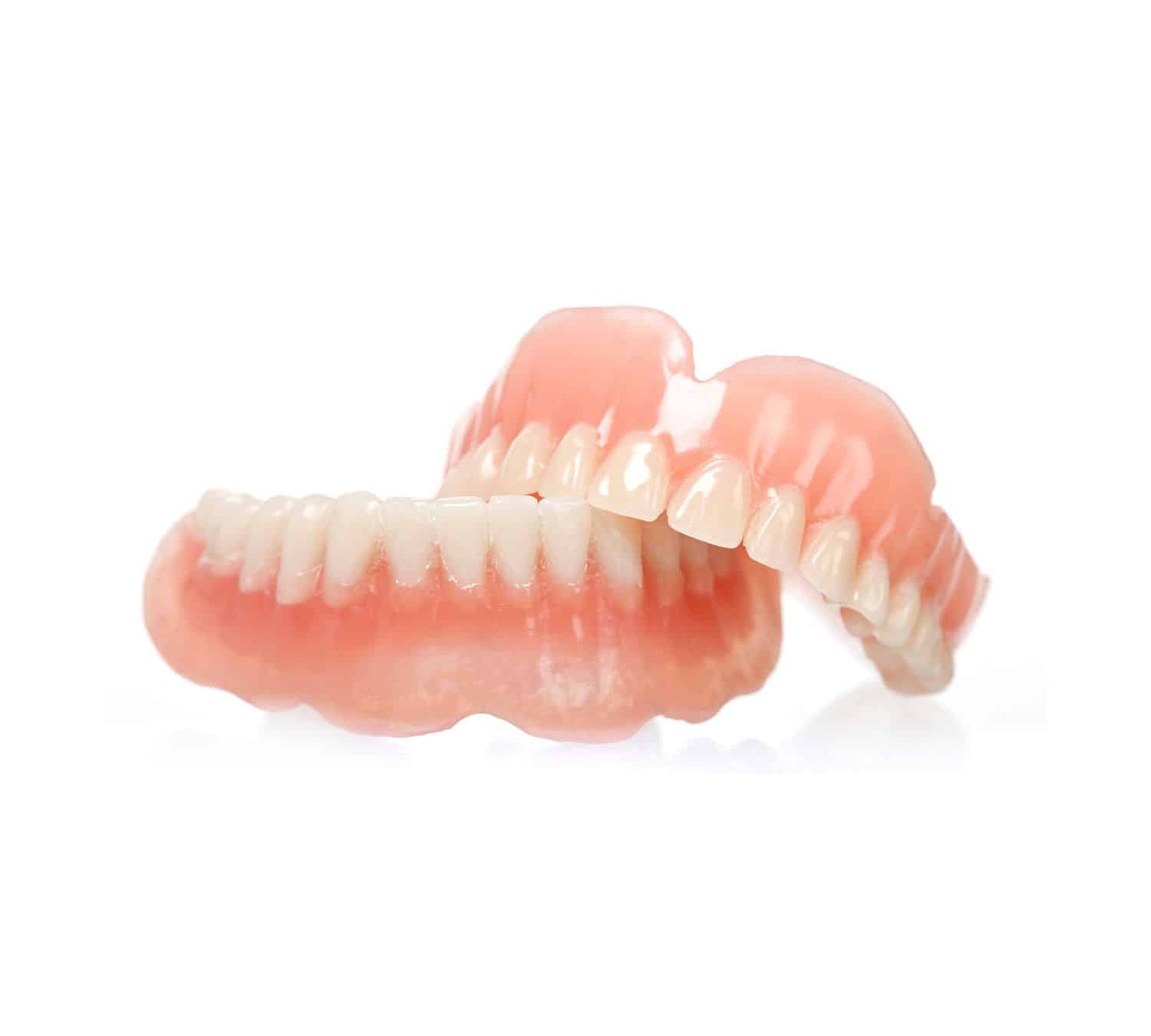
Dentures
What are dentures, and are they still the right choice?
A denture is a removable prosthetic device that replaces missing teeth and the associated gum loss. Dentures are also called false teeth or plates.
They come in two forms:
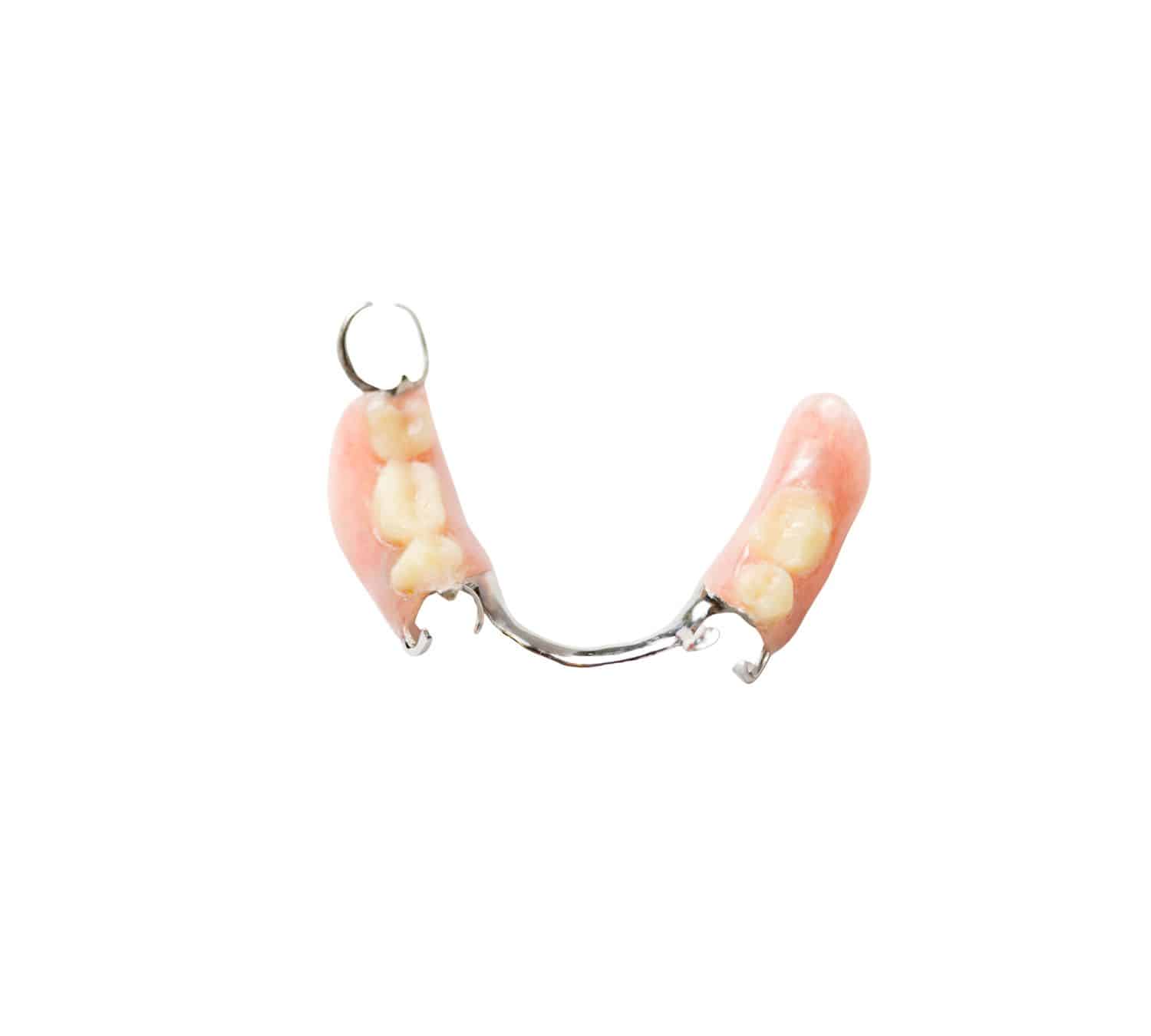
- Partial dentures — replacing one or more teeth, where natural teeth remain
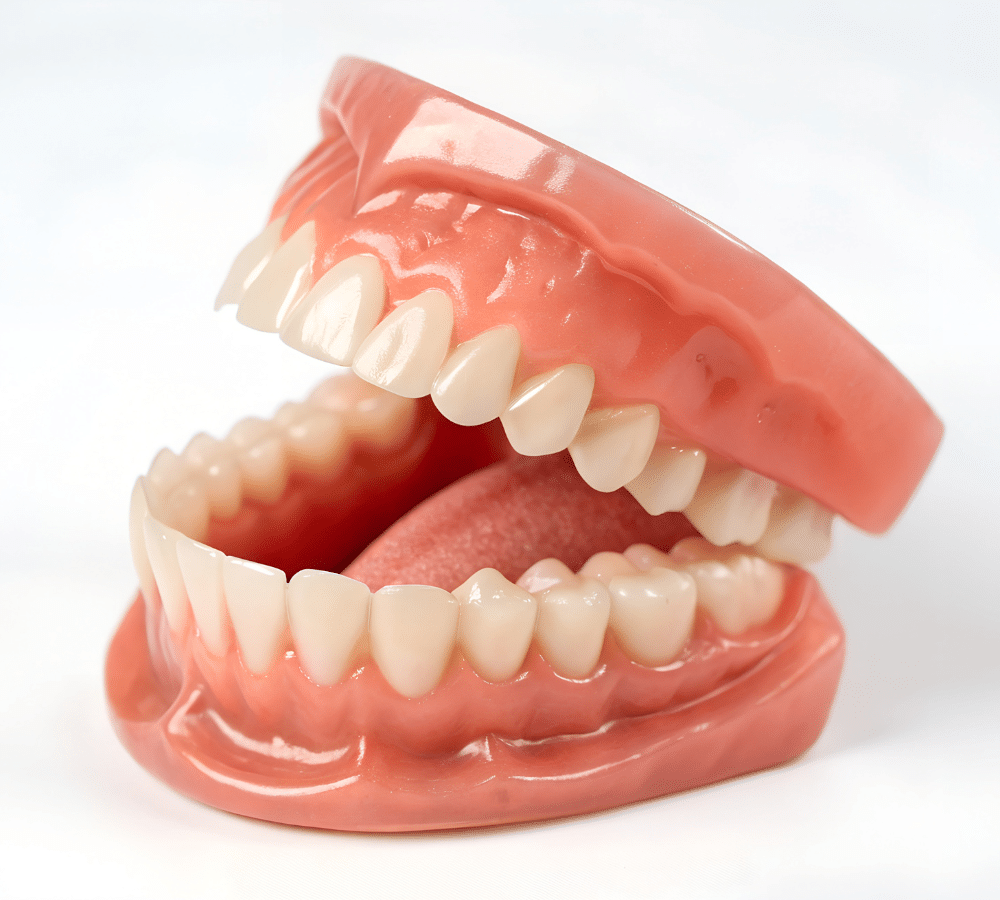
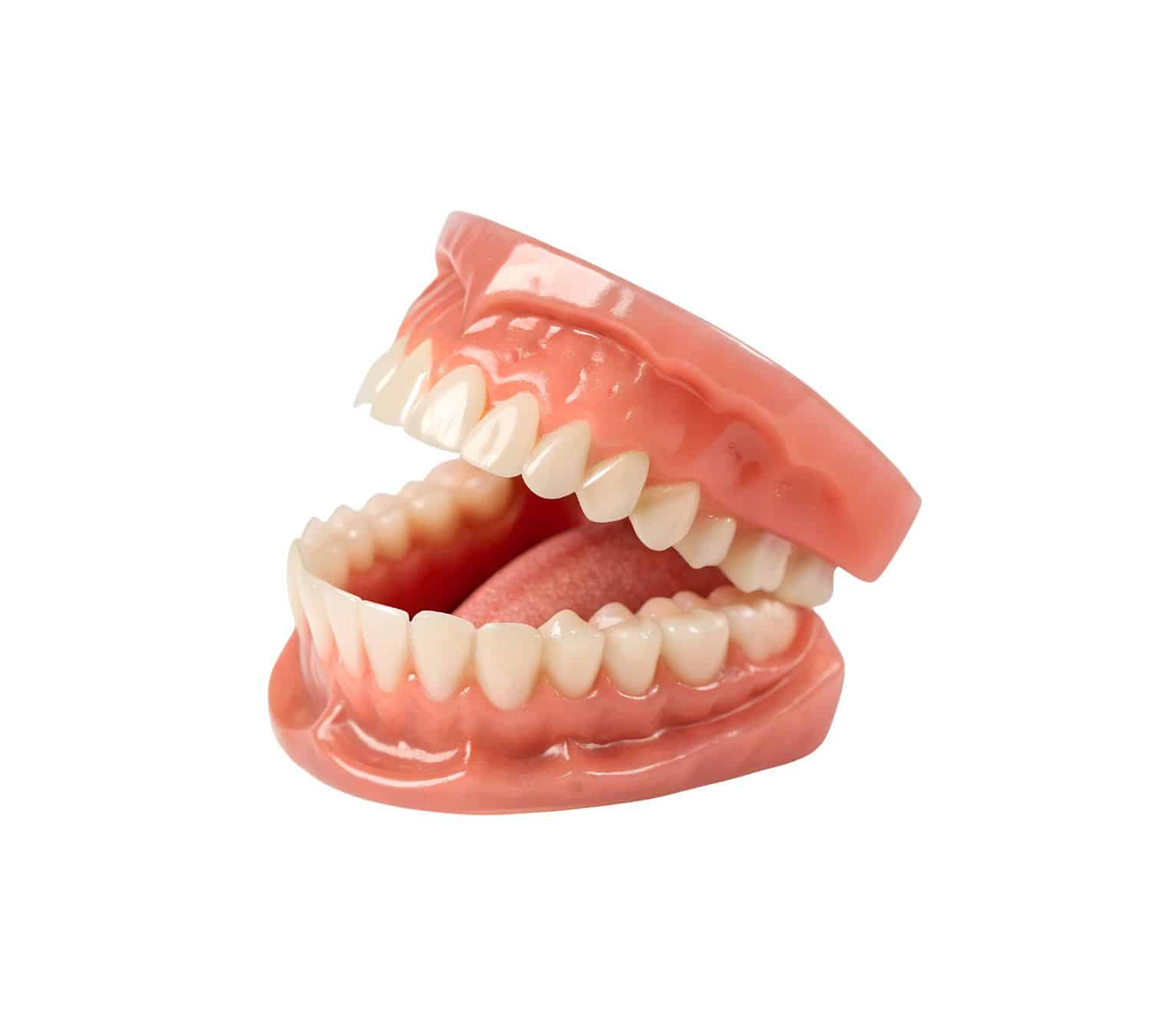
- Full dentures — replacing all the teeth in one jaw, or both
They remain a legitimate option, but they are no longer the only one. Dental implants are a permanent, long-term alternative, in use since the mid-1960s, and they look, feel and function like your own teeth.
Your clinician advises which suits you based on the health of your existing teeth and jaw, your budget and your preference.
Smile Solutions is at Level 1, 220 Collins Street, Manchester Unity Building, Melbourne CBD.
A note on the evidence behind this page
Worth saying at the outset, because it changes how you should read the numbers here.
There is very little independent published evidence on conventional dentures. We hold a curated library of third-party sources — the Dental Board of Australia, the Australian Dental Association, healthdirect, NHMRC, Cochrane reviews, the ITI Academy and peer-reviewed journals — and searched it specifically for complete-denture adaptation, relining intervals, acrylic care and how long a denture lasts. It contains nothing on any of them. Everything that looks at first like denture research turns out to be about a partial denture used as an abutment in an implant or root-canal study, which is a different question entirely.
So the timeframes on this page — six to twelve months to the first reline, a remake somewhere around five to ten years — are the practice's clinical experience, offered as ranges, not figures any authority publishes. We would rather tell you that than dress them up.
The one area where real data does exist is implant-retained overdentures, because those are studied as implant treatment. Those figures are given in their own section below, attributed, and they are about the implants rather than the denture clipped to them. Where this page gives a number, it says which of the two kinds it is.
The types, in more detail
Full (complete) dentures replace every tooth in an arch. The upper is usually well retained, because the palate provides suction; the lower is considerably harder, for reasons covered below.
Partial dentures fill gaps while natural teeth remain, and come in two main constructions:
| Acrylic partial | Cobalt-chrome (metal frame) partial | |
|---|---|---|
| Bulk | Thicker, covers more palate or gum | Thinner, covers far less |
| Strength | Breaks more readily | Strong; rarely fractures |
| How it is supported | Mostly by the gum | Rests on the teeth as well as the gum |
| Effect on the ridge | More pressure on gum and bone | Less, because teeth take some load |
| Cost | Lower | Higher |
| Usual role | Temporary, transitional, or budget-conscious | The long-term partial denture of choice |
That “how it is supported” row is the one that matters clinically. A denture resting only on gum presses on the ridge every time you chew, and the ridge responds by shrinking. A metal-framed denture that seats on the remaining teeth spreads that load and is kinder to the bone underneath.
Flexible nylon partials are also available and are comfortable and unbreakable in normal use, though they are harder to adjust and reline, and they rest almost entirely on the gum.
Immediate dentures are made in advance and fitted on the same day the teeth come out, so you are never without teeth — covered below.
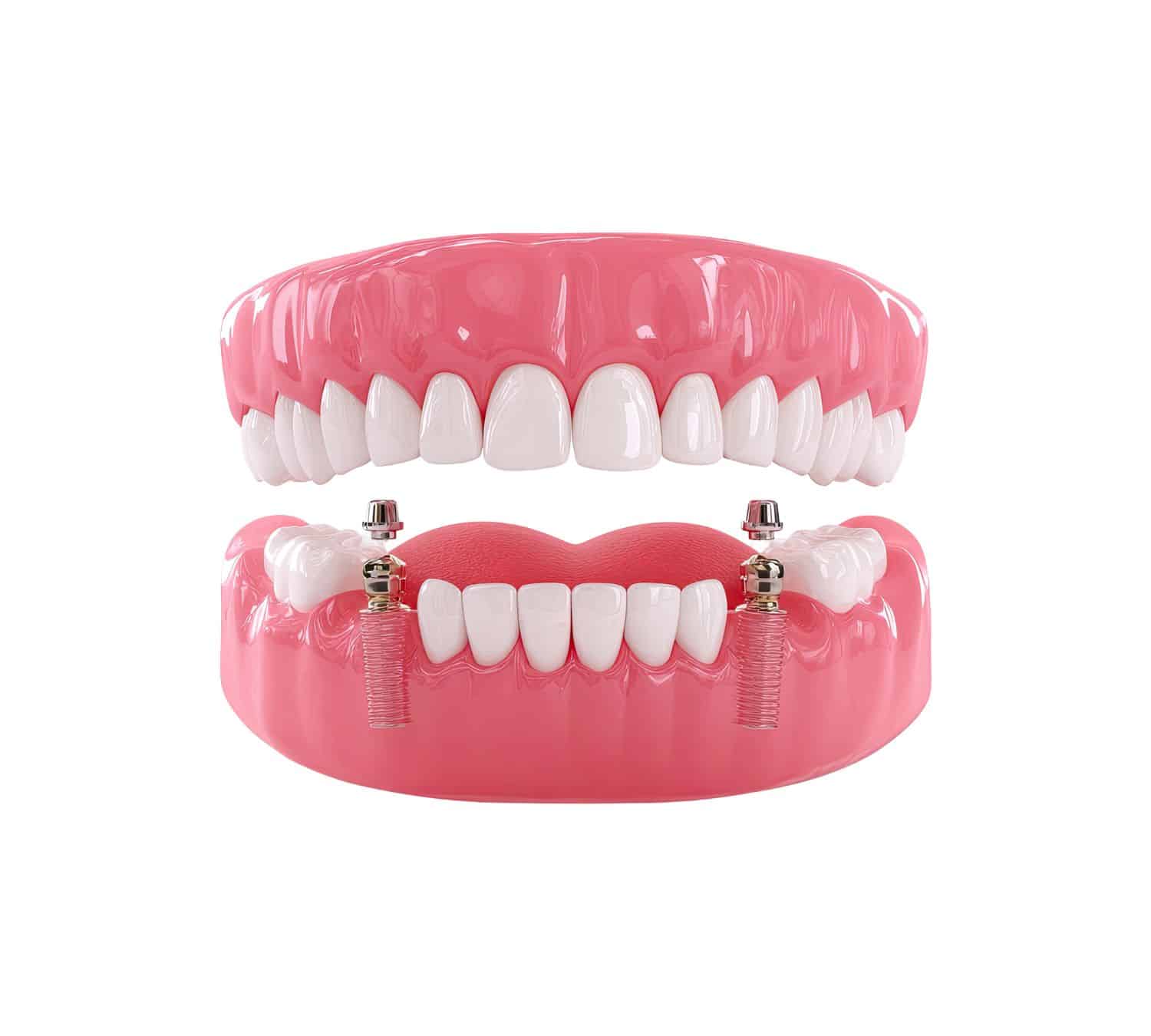
Implant-retained overdentures clip onto implants, and are the middle ground between a conventional denture and fixed teeth.
See the different types of dentures.
Dentures compared with the alternatives
| Dentures | Implants | All-on-4 | |
|---|---|---|---|
| Fixed or removable | Removable | Fixed | Fixed |
| Covers the palate | Full upper dentures do | No | No |
| Surgery required | No | Yes | Yes |
| Upfront cost | Lowest | Higher | Higher |
| Bone preservation | Does not prevent bone loss | Helps preserve bone | Helps preserve bone |
| Adjustment over time | Needs relining as the jaw changes | Minimal | Minimal |
| Best for | Immediate, lower-cost replacement | One or several teeth | A full arch |
The palate point is worth understanding if you are choosing between a full upper denture and All-on-4. A full upper denture covers the roof of the mouth, which affects taste sensation and speech clarity. A fixed All-on-4 prosthesis does not. See All-on-4 Dental Implants, Dental Implants and bridges, implants or dentures.
The option in the middle: implant-retained overdentures
This is the choice most often left out of the conversation, and for many people it is the right one.
Two implants in the lower jaw can transform a lower denture. The denture clips onto them, so it stops lifting and rocking, and chewing improves substantially — while the denture itself still comes out for cleaning.
Where it sits between the alternatives:
- Far less surgery and far less cost than a fixed full-arch bridge
- Easier to clean than anything fixed, because it comes out
- Still removable, which some people prefer and others do not
- The clips wear and are replaced periodically — a routine, inexpensive maintenance item to budget for
What the published data says, and what it is about. The ITI Academy consensus statements on implant survival and complications draw on a systematic review of implant loss over at least five years. For implants placed to carry an overdenture, it reported 2.5% implant loss before the overdenture was fitted, and nearly 6% implant loss during 5 years of function. For comparison, implants carrying a single crown in the same review lost 0.8% before the crown was fitted and 2% to 2.5% over 5 years of function.
Read those figures for what they measure. They describe how often an implant is lost, not how long the denture clipped to it lasts, and the overdenture figure is the higher of the two. That is a reason to ask about maintenance and about what happens if one implant is lost, not a reason against the treatment.
If a lower denture is the problem, ask about this specifically before considering either a remake or a full fixed bridge. See Conventional & Immediate Implants.
What dentures cannot do
One limitation applies to every removable denture and is often not explained:
When teeth are removed, the jawbone beneath begins to recede, and a denture sitting on top of the gum does not stop that. Over time the jaw changes shape, which is why a denture that fitted well when made will eventually loosen. This is also why long-term denture wearers can develop the sunken lip and cheek appearance associated with tooth loss.
Implants, by contrast, are anchored in the bone, and that loading helps preserve it. See Bone Grafting, which explains why a long-standing denture wearer sometimes needs bone rebuilt before implants become possible.
None of this makes dentures the wrong choice — they are the right choice for many people — but it is worth knowing what to expect over ten or twenty years, not just at fitting.
How a denture is made
Usually four or five appointments over several weeks:
- First impressions, taking a broad record of the ridges.
- Second, accurate impressions in a tray made to fit you, which is what produces a close seal.
- Bite registration — recording how your jaws meet, and how much tooth should show at rest and when you smile. Where all the teeth are gone, this appointment decides the height of your face, so it is not a formality.
- The wax try-in. The teeth are set in wax, and you see and approve the shape, colour, position and fullness of the lip before anything is finished.
- Fitting, then a review a few days later to relieve any sore spots.
The try-in is your decision point. Changes made in wax are easy; changes after the denture is processed mean remaking it. Look in daylight, bring someone whose opinion you trust, speak with it in, and say so if the teeth look too even, too white or too long. “I am not sure” is a complete answer at that stage.
Dentures for Smile Solutions patients are made in the practice's own laboratory — see Smile Solutions Laboratory.
Immediate dentures
An immediate denture is made beforehand and inserted on the day the teeth are extracted, so you do not go without teeth.
The trade-off is fit. The gum and bone change shape fastest in the first few months after extractions, so an immediate denture loosens quickly and will need relining — sometimes more than once — with a definitive denture or a permanent reline usually around six to twelve months later. That interval is the practice's own guidance; no independent source in our library sets one.
Practical points for the first weeks: leave it in for the first 24 hours unless told otherwise, since it acts as a dressing and limits swelling; expect sore spots and go back to have them relieved rather than enduring them; and expect the appearance to be assessed again once everything has settled. See caring for immediate dentures and five things to know about new dentures.
Adjusting to new dentures
Expect an adjustment period. In the first weeks it is normal to experience:
- increased saliva production
- a sense that the denture is bulky
- difficulty with certain sounds when speaking — reading aloud helps the tongue adapt faster
- difficulty eating — start with soft foods cut small, chew on both sides at once to keep the denture stable, and reintroduce harder foods gradually
- sore spots where the denture presses
How long this takes varies considerably between people, and some patients never find a lower full denture comfortable — the lower jaw gives a denture much less to hold onto than the upper. If that is your experience, raise it; implant-retained options exist that stabilise a lower denture without replacing it entirely.
Sore spots are normal and adjustable. Do not try to adjust the denture yourself — return to the practice so it can be relieved properly. Home adjustments usually make the fit worse permanently.
See your clinician promptly if a sore spot does not settle within a week or two, or if an ulcer under a denture has not healed in that time. A non-healing ulcer needs to be looked at rather than tolerated — and an ulcer sitting under a denture is exactly the kind that gets explained away as rubbing for months.
On eating specifically, a few techniques make more difference than practice alone: take smaller pieces, bite with the side teeth rather than the front ones (biting into an apple with the front teeth tips a denture out), chew on both sides at once, and reintroduce sticky and hard foods last. Most people find eating largely normal again within a few weeks, though a full lower denture is the exception for some.
Daily care
- Clean dentures daily, over a folded towel or a basin of water so they are not damaged if dropped
- Use a denture brush and a denture cleaner — not regular toothpaste, which is abrasive enough to scratch the acrylic and create places for stain and bacteria
- Clean your mouth too, including the gums, tongue and palate, and any remaining natural teeth
- Remove dentures overnight unless your clinician advises otherwise, giving the tissues a rest
- Store them in water or a denture solution — acrylic distorts if it dries out
- Never use hot water, which warps the fit
- Do not use bleach on a metal-framed denture, which can tarnish it; ask which cleaner suits yours
A note on adhesives: they can help a well-fitting denture feel more secure, but they are not a fix for a denture that has stopped fitting. Relying on adhesive to hold a loose denture masks the bone loss underneath and delays the reline that is actually needed.
Why overnight removal matters more than it sounds. The palate under a denture worn continuously can become red, sore and inflamed — a yeast overgrowth that is one of the most common problems denture wearers develop, and one that responds to proper cleaning and leaving the denture out at night. Redness under an upper denture that does not settle should be examined, not treated with more adhesive. See Dental Cleans & Hygienists.
One thing this page deliberately does not do is name a treatment for that. If the tissue needs treating as well as cleaning, that is a prescribing decision for your clinician after looking at it — not something to read off a web page or buy over a counter.
If it breaks
- Do not glue it. Household adhesives are toxic, they do not hold, and they contaminate the fracture surfaces so a proper repair becomes far harder or impossible. This is the single most expensive mistake denture wearers make.
- Keep every piece, including small fragments.
- Do not wear a cracked denture, which can cut the gum and will break further.
- Call the practice — repairs are available, including as an emergency service, and many are done quickly. See Emergency Dentistry and my denture is broken — can it be fixed on the spot.
A denture that breaks repeatedly is usually telling you something — commonly that the fit has deteriorated and it is flexing, or that the bite is uneven. Repairing it without addressing that means it breaks again.
If you travel or depend on your denture for work, ask about a spare. A second denture made from the same records is far cheaper than an emergency interstate.
Ongoing appointments
Denture wearers still need dental appointments — more so, not less.
- Relining or remaking as the jaw changes shape
- Repairs if a denture cracks or a tooth comes loose; the practice provides denture repairs, including as an emergency service
- Oral examination, since the soft tissues, gums and any remaining teeth still need checking. Oral cancer screening is part of a routine examination and does not depend on having natural teeth
That last point is the one people most often assume does not apply to them. Writing in the Royal Australian College of General Practitioners' own publication, the authors of its oral cancer training module record that oral cancer has a relatively low five-year survival rate, at around 50%, mostly due to diagnostic delays — so the soft-tissue examination is doing real work even in a mouth with no teeth left to check.
A denture that has become loose is not simply an inconvenience. It causes sore spots, accelerates bone loss under the pressure points, and makes eating harder.
The vocabulary is worth knowing, because the three are priced very differently: a reline adds new material to the fitting surface so it seats against the changed ridge; a rebase replaces the whole base while keeping the teeth; a remake starts again. Relines are commonly needed every few years, and a denture is often remade somewhere around five to ten years — ranges rather than rules, and, as set out at the top of this page, the practice's experience rather than a published figure. Budgeting for that from the start is the realistic way to compare a denture's cost against an implant's.
Partial dentures and the teeth around them
If you have a partial denture, the natural teeth it clasps onto carry extra load and collect more plaque.
Clean those teeth particularly carefully, especially around the clasps and where the denture meets the gum, and keep six-monthly hygienist appointments. Losing an abutment tooth usually means the partial denture needs remaking. See Bleeding Gums.
Have the denture out when you brush, and clean both it and the teeth separately. A partial worn over unbrushed teeth is a decay trap, and the teeth it clips to are the ones you can least afford to lose.
Costs
Cost varies with the type of denture, the number of teeth replaced and the materials used. Your clinician provides a treatment plan after assessment.
When you compare quotes, check what is included beyond the denture itself — any extractions, the number of fitting appointments, and whether early adjustments and the first reline are covered. Those items are where quotes most often differ. Price Guide.
Payment plans are available through Payright for treatment from $150 to $20,000, over 3 to 30 months. Other finance options may also be available; provider eligibility, fees and terms can change. Where a plan is advertised as interest free, that describes the plan term only — a deposit may be required, an establishment fee and ongoing account fees may apply, and charges can apply if the balance is not cleared within the agreed period. The applicable terms depend on the provider and the amount financed, and are set out in writing before you commit — ask what the deposit and the establishment fee are, in dollars, and what the total will be by the end. Payment Plans.
We are a Bupa Members First Platinum provider. Annual limits and policy restrictions apply. See Bupa Platinum Dental Provider.
Dentures generally attract a health fund rebate, and eligible patients may also access public dental services in Victoria, which include dentures through community dental agencies and the Royal Dental Hospital of Melbourne. Waiting lists apply, and it is a genuine option worth knowing about.
Common questions
Should I choose an acrylic denture or a metal framework?
Acrylic is generally easier to modify and is often used for immediate or transitional dentures. A metal framework can be thinner and more rigid, but requires suitable supporting teeth and more planning. The design should protect the remaining teeth and gums.
Would implants improve a loose lower denture?
They can. An implant-retained overdenture can improve retention and stability, particularly for a lower denture, while remaining removable for cleaning. Suitability, surgery, component maintenance and cost need separate assessment. The ITI Academy figures above are the published evidence on that option, and they are about implant loss rather than denture comfort.
Will I see the teeth before the denture is finished?
For a conventional denture, a wax try-in usually lets you review appearance, tooth position and bite before processing. An immediate denture is made before teeth are removed, so the same preview may be more limited.
When does an immediate denture need relining?
The page gives a common range of six to twelve months because the gums and bone change after extraction. Temporary adjustments or an earlier reline may also be needed while healing occurs. No independent source we can find sets an interval, so ask your clinician what they are watching for and why, rather than treating any number as a schedule.
Are early adjustments normal?
Yes. New dentures commonly create sore areas as the mouth adapts. Arrange an adjustment rather than trying to grind or bend the denture yourself. Ask whether early reviews and adjustments are included in the fee.
Should I sleep in my dentures?
Dentures are generally removed for sleep unless your clinician gives a specific short-term instruction, such as immediately after extraction. Removing them allows the supporting tissues to rest and gives you an opportunity to clean the denture and mouth.
How should I clean a denture?
Clean it over a basin of water or a folded towel, using a denture brush and an appropriate cleaner. Clean the gums, tongue and any remaining teeth separately. Avoid hot water, household bleach and abrasive products unless specifically advised.
How long does a denture last?
The page describes remaking as common every five to ten years, with relines potentially needed sooner. Tooth wear, breakage, changes in the mouth and the condition of supporting teeth determine when repair, reline or replacement is appropriate.
The honest version of this answer is that nobody publishes a figure. Our library of independent sources contains no complete-denture survival data at all — the range above is clinical experience, and the variables that move it are your bite, how much ridge you started with, whether you grind, and how the bone changes. Ask instead what your clinician expects in your mouth and what would trigger a reline rather than a remake.
Practical details
| Address | Level 1, 220 Collins Street, Manchester Unity Building, Melbourne VIC 3000 |
| Phone | 13 13 96 |
| theteam@smilesolutions.com.au | |
| Monday – Friday | 8.00am – 6.00pm |
| Saturday | 8.30am – 1.30pm |
| Sunday | By appointment |
| Types | Partial and full; acrylic, metal frame, implant-retained |
| Appointments to make one | Usually four or five |
| Your decision point | The wax try-in |
| Immediate denture reline | Commonly 6–12 months (practice guidance, not a published figure) |
| Remake | Commonly every 5–10 years (practice guidance, not a published figure) |
| Overdenture implant loss | 2.5% before fitting; ~6% over 5 years (ITI Academy) |
| If it breaks | Keep the pieces; never glue it |
| Made | In-house laboratory, Melbourne |
| Repairs | Available, including emergency |
| Parking | Wilsons Parking, Flinders Lane (between Swanston and Russell) |
Prosthodontics is one of the 13 dental specialties recognised in Australia by the Dental Board of Australia and approved by the Australian Health Workforce Ministerial Council. A registered specialist holds a dental degree, a further postgraduate qualification in the field, and a minimum of two years general dental practice; specialist registration can be verified free on the AHPRA public register at ahpra.gov.au. Specialist Prosthodontists.
General information only — it is not a diagnosis, a treatment plan, a quote or a promise of any particular clinical outcome, and it does not replace advice from your treating practitioner. Comfort, fit and how long a denture lasts before relining vary considerably between individuals, and the comparison table above describes general characteristics rather than what will be true in your case. Timeframes for conventional dentures given here are the practice's clinical experience, not figures published by any independent authority; the implant-retained overdenture figures are attributed to the ITI Academy and measure implant loss. Fees, rebates and public eligibility are indicative and subject to change; confirm at your consultation and with your fund. Payment plan terms are set by the credit provider and change; confirm current terms directly before you commit.
Smile Solutions trades under ABN 28 193 514 103.
Images on This Page
-
https://www.facebook.com/tr?id=800557773428361&ev=PageView&noscript=1
(no alt text)
-
https://www.smilesolutions.com.au/wp-content/uploads/2025/10/calendar_month.svg
(no alt text)
-
https://www.smilesolutions.com.au/wp-content/themes/arcadian-wordpress-theme/assets/images/smile_solutions_logo_white.png
Smile Solutions Logo
-
https://www.smilesolutions.com.au/wp-content/themes/arcadian-wordpress-theme/assets/images/smile_solutions_logo_purple.png
Smile Solutions Logo
-
https://www.smilesolutions.com.au/wp-content/uploads/2025/11/Smile-Solutions-4.png
Smile Solutions - Melbourne CBD
-
https://www.smilesolutions.com.au/wp-content/uploads/2025/09/Dentures-Smile-Solutions.png
Dentures Smile Solutions
-
https://www.smilesolutions.com.au/wp-content/uploads/2025/09/partial-denture.jpg
Partial Denture
-
https://www.smilesolutions.com.au/wp-content/uploads/2025/09/Dentures.jpg
Full Denture
-
https://www.smilesolutions.com.au/wp-content/uploads/2025/09/overdenture.jpg
Over-Denture
-
https://www.smilesolutions.com.au/wp-content/uploads/2025/09/immediate-denture.jpg
Immediate Denture
-
https://www.smilesolutions.com.au/wp-content/uploads/2025/12/Dental-Implants-at-Smile-Solutions.jpg
Smile Solutions Specialist Dental Care Melbourne
-
https://www.smilesolutions.com.au/wp-content/uploads/2025/08/69a44c30c93ce196d539cc5520080df52a5f3f88-scaled.jpg
69a44c30c93ce196d539cc5520080df52a5f3f88 scaled
-
https://www.smilesolutions.com.au/wp-content/themes/arcadian-wordpress-theme/assets/images/family_owned_bussiness.png
Family Owned Business
-
https://www.smilesolutions.com.au/wp-content/themes/arcadian-wordpress-theme/assets/icons/icon--phone.svg
Smile Solutions Contact
-
https://www.facebook.com/tr? id=800557773428361&ev=PageView&noscript=1
(no alt text)
-
https://bat.bing.com/action/0?ti=25148060&tm=gtm002&Ver=2&mid=23abf6e0-a30e-42df-a2b7-c017698955ec&bo=1&sid=aba7a760ab2511f1bbd7bf75cdd18d93&vid=aba7e920ab2511f1a8fd574647e9f8dc&vids=1&msclkid=N&pi=918639831&lg=en-US&sw=800&sh=600&sc=24&nwd=1&tl=Dentures%20-%20Smile%20Solutions&p=https%3A%2F%2Fwww.smilesolutions.com.au%2Fdenture%2F&r=<=2147&evt=pageLoad&sv=2&cdb=AQAQ&rn=582015
(no alt text)