Caring for yourself and your immediate dentures
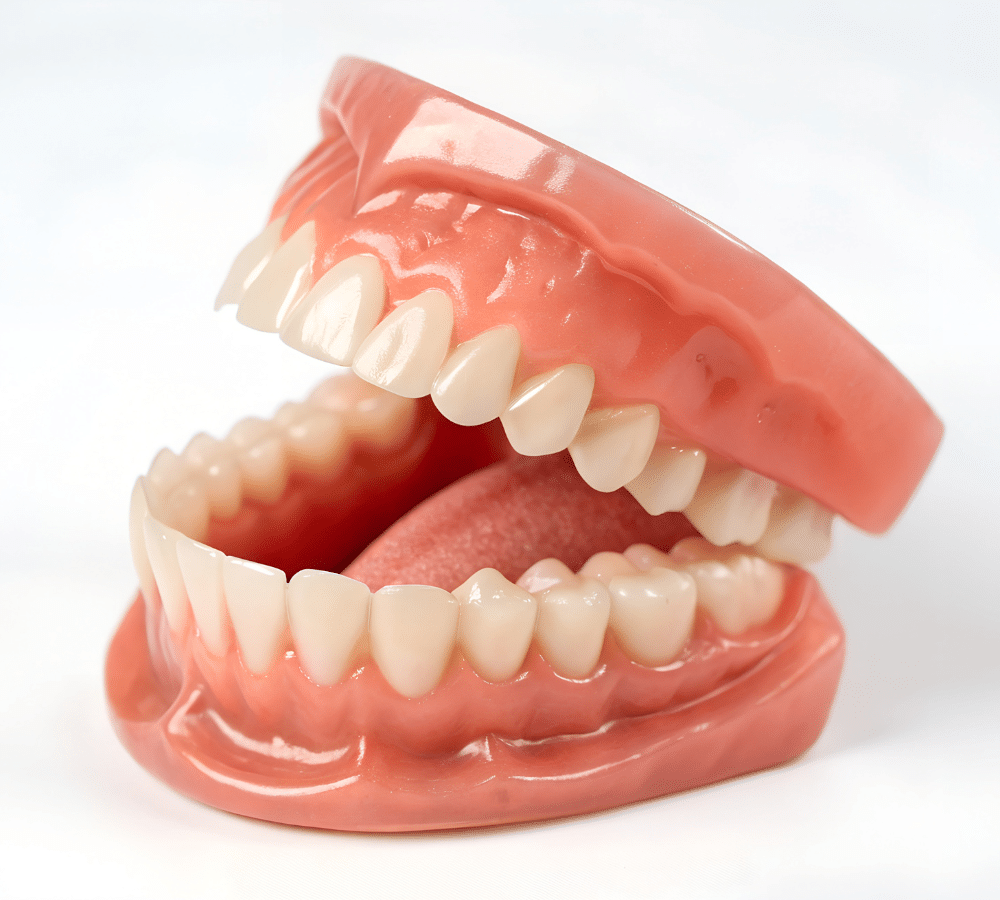
An immediate denture is a complete or partial denture inserted on the same day, immediately following the removal of natural teeth.
The first days matter more than the weeks that follow. Here is what to do, in order. Five things to know about your new dentures covers the longer settling-in period once these first days are behind you.
First day and overnight
Leave the denture in.
This is the instruction people most often disregard, and the consequence is real: if you take it out, you may have trouble re-seating it — and that difficulty can continue for some days. The tissues swell as soon as the denture is removed.
The denture is also acting as a dressing, holding pressure over the sockets and helping control bleeding.
Continue with any medication prescribed by the surgeon.
Also on day one:
- Bite firmly on gauze if there is oozing, for 20 minutes at a time without checking in between
- Do not rinse, spit forcefully, or use a straw for the first 24 hours — all three dislodge clots
- Do not smoke. It is the largest controllable risk factor for dry socket and it impairs healing generally. The Australian Dental Association's consumer site gives the same instruction and the reason behind it: "do not smoke for as long as possible after getting a tooth removed to decrease your risk of developing a dry socket", because "smoking can cause sores inside the mouth to heal slowly" as a result of decreased blood flow to the gums. The same applies to vaping — and the ADA is blunt about that too: "vaping is not recommended as a replacement for tobacco smoking. Or as a way to quit tobacco smoking." See the effects of vaping on your oral health and are e-cigarettes bad for your teeth?
- No alcohol, and no strenuous activity
- Cold pack on the outside of the face, 20 minutes on and 20 off, for the first day
- Sleep propped up on an extra pillow
- Soft, cool food, and keep fluids up
Some oozing on the first day is normal. A small amount of blood mixed with saliva looks like a great deal more than it is. Recovering from wisdom teeth surgery describes the same post-extraction pattern in more detail.
Next morning
- Remove the denture and rinse your mouth gently
- Do not interfere with the blood clots in the tooth sockets. Those clots are the foundation of healing — disturbing them risks a painful dry socket
- Rinse the denture and remove all debris, using a denture brush by preference, or a soft toothbrush
- Replace the denture carefully and without further delay
That last point is the same principle as day one — the longer it is out, the harder it becomes to put back.
Warm salt-water rinses — gently, from the second day — help keep the area clean.
What dry socket actually is, since it is the complication these instructions exist to prevent: Cochrane defines it as a socket "not filled by a blood clot", with "severe pain and bad odour". One thing worth knowing if it happens to you — NSW Health's Emergency Care Institute notes that "dry sockets are not a bacterial infection, thus antibiotics are not usually required in the absence of pus or swelling". It is managed by dressing the socket, not by a prescription.
Subsequent days
Food: gradually experiment with firmer food when you are ready. There is no schedule to keep to — let comfort set the pace. Chew on both sides, and take smaller pieces than you are used to.
For the first week, leave the denture in overnight.
Once swelling has resolved — usually by 7–10 days — you may leave the denture out overnight. For the long term this is healthier for your gums and more hygienic, so it is the habit to settle into rather than a temporary allowance. Healthdirect Australia's standing advice for anyone wearing dentures is the same three points: make sure "they fit well", "you clean them regularly", and "you take them out before you go to sleep" — the last because bacteria on an unclean denture are a common and avoidable cause of bad breath.
Speech takes practice. Reading aloud for ten minutes a day genuinely helps, and most people adapt within a few weeks.
Sore spots are adjusted, not endured. Do not attempt to file or trim the denture yourself. Wear it for a few hours before an adjustment appointment — the sore area needs to be visible for the practitioner to find it. A sore spot that has not settled after two weeks should be examined rather than tolerated; see the causes of mouth ulcers and their usual treatments.
Cleaning and storage
Obtain an effervescent denture cleansing powder from a pharmacy or supermarket and follow the manufacturer's directions. Steradent is a well-known and trusted product.
Keep the denture moist when it is not in your mouth. The acrylic material needs to stay hydrated — for comfort, longevity and hygiene. A denture allowed to dry out can warp, and a warped denture no longer fits.
Also:
- Brush it daily with a denture brush and mild soap. Not with toothpaste — it is abrasive and scratches acrylic, and scratches hold stain and bacteria
- Clean over a basin of water or a folded towel. Dentures break when dropped on a hard surface — my denture is broken, what should I do? sets out what happens next, and why superglue makes it worse
- Never use boiling water, bleach or household cleaners. Boiling water distorts acrylic permanently
- Clean your gums, tongue and palate with a soft brush each morning, and any remaining natural teeth as normal — the ideal daily routine for oral hygiene and which toothbrushes do dentists recommend?
- Label it. Dentures lost in hospital and aged care are a genuine and miserable problem
What to expect as you heal
The gum shape will change as you heal. This leads to:
- loss of the close fit of the denture
- sometimes speech difficulties
This is expected, not a sign that anything has gone wrong. The denture can be relined to accommodate the healing changes.
An immediate denture is fitted before healing is complete, which is exactly what makes it possible to leave the surgery with teeth — and exactly why a reline, or a replacement denture, is usually planned for a few months later.
Understand this cost from the start. The reline or replacement is part of the treatment, not a failure of it, and it should be in the original written quote. Published fees are in the price guide; understanding your treatment covers how plans are set out here.
And the change does not stop. Bone continues to resorb slowly and indefinitely after teeth are lost, so dentures need periodic relining for as long as they are worn. A denture that fitted ten years ago does not fit now, even though it looks unchanged.
When to contact the practice
Contact the practice if you have significant bleeding, increasing rather than decreasing pain, or a denture that has become too loose or too sore to wear. Contact us, or see emergency dentistry out of hours.
Also:
- Pain that increases from about day three, often radiating to the ear — the classic timing for dry socket
- A bad taste or smell, or discharge from a socket — see what is a tooth abscess?
- A raised temperature — can a dental abscess affect your general health?
- Numbness that has not resolved after the anaesthetic should have worn off
- The denture rocking or falling during speech or eating
NSW Health's emergency guidance flags fever with a suspected dental abscess, and facial cellulitis or swelling, as the two findings that should prompt a dentist to be consulted — useful if you end up in an emergency department rather than a dental chair.
Go to a hospital emergency department, or call 000, if there is spreading facial swelling, difficulty swallowing or breathing, or bleeding that will not stop with firm pressure.
Longer term
- Keep attending for examinations even with no natural teeth. The examination includes screening for oral cancer, and that risk rises with age. This is the most important reason and the one most often missed. How a dentist can help with early detection of oral cancer, the signs and risk factors, and the causes, symptoms and treatment of mouth cancer
- Denture stomatitis — a red, inflamed palate under an upper denture — is common, usually fungal, and treatable. Leaving the denture out overnight is the main preventive measure. A dry mouth makes it more likely; see why does my mouth always feel dry? and the causes of dry mouth
- Have the fit checked at every visit — dental cleans and hygienists
- Ask about the alternatives when the time comes for a definitive solution — a new conventional denture, an implant-retained denture, or implants. Each has a different cost, maintenance requirement and lifespan. Bridges, implants or dentures compares them; what are the different types of dentures covers the designs; All-on-4 dental implants and things to consider when choosing All-on-4 cover the fixed option, and how much do dental implants cost? is specific about the money
One note on the evidence for all of the above. The aftercare sequence on this page is standard clinical practice rather than a set of findings from published trials, and it is presented as that. The independent literature on complete and immediate dentures — adaptation, relining, acrylic care, how long one lasts — is genuinely thin, and we have not padded this page with figures borrowed from studies of implants or partial prostheses, which are different things. The quotations above are the points where a named authority does speak directly to what you have been asked to do.
Common questions
Should I be using denture adhesive?
Not as the first answer to a loose immediate denture, and it is worth understanding why.
An immediate denture is designed to stop fitting. It was made to the shape of a jaw that still had teeth in it, and the gum underneath it is remodelling from the day it goes in — which is the whole reason a reline or a replacement is planned a few months later. Adhesive masks that change; it does not slow it. A denture held in place with progressively more adhesive is one that has stopped being assessed, and the sore spots and uneven loading underneath it continue regardless.
So the sequence that works is: loose or sore denture → adjustment or reline appointment → adhesive only if your practitioner suggests it, usually for a specific reason such as a flat lower ridge where retention is genuinely limited by anatomy.
Three practical points if adhesive is in use:
- Less is more. Excess adhesive squeezes out and can hold the denture slightly off its proper seat, which is the opposite of what you want.
- Clean it off completely each day — both from the denture and from the gum. Residue plus warmth plus an unclean surface is the setting in which denture stomatitis develops, and as noted above the main preventive measure is leaving the denture out overnight.
- Adhesive is not a repair. If the denture has cracked or a tooth has come off it, nothing bought from a chemist fixes it — see my denture is broken, can it be fixed on the spot?, which also explains why superglue makes the eventual repair harder.
This is standard clinical practice rather than a finding from a trial, and — as the note above says — the independent literature on complete-denture adaptation is thin. Your own practitioner's instruction takes precedence over anything here.
What happens once the healing is finished, and is an implant-retained denture worth considering?
You reach a decision point rather than an endpoint. The usual options are a reline of the existing denture, a new conventional denture made to the healed shape, or a denture retained by implants — and the honest comparison is about cost, surgery and maintenance rather than about one being straightforwardly better.
On implants there is real independent evidence, and it is worth reading precisely, because it is about the implants rather than about dentures.
- A registry study of 158,824 implants placed through one Israeli health fund between 2014 and 2022 reported an overall survival rate of 97.79%, a total failure rate of 2.21%, with failures in the first year accounting for 1.59% of cases.
- The same registry separates restoration types, and the result is the one most relevant here: permanent restorations — crowns and fixed prostheses — made up 96.1% of implant-supported restorations, with a failure rate of 3.74%, against 9.32% for the 3.9% of cases carrying removable prostheses. In other words, in that dataset implants carrying removable work failed more often than implants carrying fixed work. The paper reports its overall and restoration-type rates separately without reconciling them, so read this as a comparison between fixed and removable, not as a second estimate of overall risk.
- Position matters: the lowest failure rates were in premolars and lower molars, the highest in upper jaw molars and incisors.
That is a single retrospective registry in one country over nine years. It is not Australian data, it is not about this practice, and it is not a prediction about you.
On the medical side, two things come up constantly and neither is an automatic exclusion. A systematic review covering 24 articles, 2,102 patients and 5,954 implants concluded that "osteoporosis status was not a risk factor for dental implant failure" and that "osteoporosis is not a contraindication for dental implant placement", while adding that "planning must be cautious and personalized" — and the separate question of medication for bone conditions is one for your treating doctors, with a complete list of everything you take brought to the consultation. Smoking appears in the same literature among the risk factors for early implant failure, alongside implants shorter than 10 mm and placement in the upper jaw.
The practical questions to ask at that appointment: how many implants, fixed or removable, what the maintenance schedule and its cost look like over ten years, and what happens if one implant fails. Bridges, implants or dentures, what are the different types of dentures and how much do dental implants cost?
I am not getting on with it at all. Is that normal, and what can be done?
It is common in the first weeks, and it is not something to simply endure quietly until the next scheduled visit.
Separate three things, because they have different answers:
- A sore spot is an adjustment. As above, wear the denture for a few hours beforehand so the area is visible, and do not trim it yourself.
- Looseness is usually fit, and fit is changing by design at this stage — which points at a reline rather than at adhesive.
- "I cannot eat, and I cannot make the sounds" is adaptation, and it takes longer than anyone wants. Reading aloud helps speech. Small pieces, chewing on both sides at once and starting with softer food help eating. Most people improve steadily over weeks.
What is not normal: pain that is increasing rather than settling, a raised temperature, a bad taste or discharge, numbness that has not resolved, or a denture that rocks so much it cannot be worn — all of which are on the contact list above and should be acted on rather than waited out.
If it is still wrong after a course of adjustments, say so plainly and ask what the plan is: a reline, a remake to the healed shape, or referral for a different design. Complex cases are the province of a registered specialist prosthodontist, and asking for that opinion is reasonable rather than awkward — second opinions and corrective dentistry exists for the same reason.
One last thing worth saying, because people rarely raise it: losing teeth is not only a mechanical event. If the change to your face, your speech or your confidence is weighing on you, that is a legitimate thing to mention at the appointment. It often changes what is offered.
Related pages: Dentures, Specialist Prosthodontists, Dental Implants, Emergency Dentistry, Oral and Maxillofacial Surgeons, What does restorative dentistry mean?
Practical details
Smile Solutions, Level 1, 220 Collins Street, Manchester Unity Building, Melbourne VIC 3000 — getting here. Phone 13 13 96, or theteam@smilesolutions.com.au. Monday–Friday 8.00am–6.00pm, Saturday 8.30am–1.30pm, Sunday by appointment. Dentures are made and repaired in the on-site laboratory; the clinical team is listed by name.
Every practitioner's registration can be verified free on the AHPRA public register at ahpra.gov.au.
Published 19 September 2016. General information only; it does not replace advice from your treating practitioner or the instructions given by your surgeon — where the two differ, follow your surgeon. Healing varies between individuals. Published implant survival and failure figures quoted on this page are attributed to the studies named and describe the populations those studies examined; they are not figures for this practice and they are not a prediction about any individual case.
Smile Solutions trades under ABN 28 193 514 103.
Images on This Page
-
https://www.facebook.com/tr?id=800557773428361&ev=PageView&noscript=1
(no alt text)
-
https://www.smilesolutions.com.au/wp-content/uploads/2025/10/calendar_month.svg
(no alt text)
-
https://www.smilesolutions.com.au/wp-content/themes/arcadian-wordpress-theme/assets/images/smile_solutions_logo_white.png
Smile Solutions Logo
-
https://www.smilesolutions.com.au/wp-content/themes/arcadian-wordpress-theme/assets/images/smile_solutions_logo_purple.png
Smile Solutions Logo
-
https://www.smilesolutions.com.au/wp-content/uploads/2023/11/SS-Tooth-1-1-150x150.png
Smile Solutions
-
https://www.smilesolutions.com.au/wp-content/uploads/2025/09/Dentures-Smile-Solutions.png
Realistic model of human dentures
-
https://www.smilesolutions.com.au/wp-content/uploads/2025/09/Root-Canal-2-300x217.jpg
Root Canal
-
https://www.smilesolutions.com.au/wp-content/uploads/2026/08/Mouth-Breathing-300x270.jpg
Mouth Breathing
-
https://www.smilesolutions.com.au/wp-content/uploads/2025/09/Dental-Crown-at-Smile-Solutions-300x300.jpg
Dental Crown at Smile Solutions
-
https://www.smilesolutions.com.au/wp-content/themes/arcadian-wordpress-theme/assets/images/family_owned_bussiness.png
Family Owned Business
-
https://www.smilesolutions.com.au/wp-content/themes/arcadian-wordpress-theme/assets/icons/icon--phone.svg
Smile Solutions Contact
-
https://www.facebook.com/tr? id=800557773428361&ev=PageView&noscript=1
(no alt text)
-
https://bat.bing.com/action/0?ti=25148060&tm=gtm002&Ver=2&mid=185a142a-5be5-438a-a718-54f2f101fd60&bo=1&sid=b3e3c9d0ab2711f18a03294fffd204ab&vid=b3e432b0ab2711f19cfd35e299e3d968&vids=1&msclkid=N&pi=918639831&lg=en-US&sw=800&sh=600&sc=24&nwd=1&tl=Caring%20for%20yourself%20and%20your%20immediate%20dentures%20-%20Smile%20Solutions&p=https%3A%2F%2Fwww.smilesolutions.com.au%2Fdental-articles%2Farticle%2Fcaring-immediate-dentures%2F&r=&evt=pageLoad&sv=2&cdb=AQAQ&rn=602998
(no alt text)