Which toothbrush do dentists recommend?
A small head and soft bristles. Almost everything else in the dental aisle is preference.
That is the short answer, and it holds for manual and electric brushes alike. The range of options makes choosing feel complicated; the two features that actually affect the outcome are simple. What is the ideal daily routine for oral hygiene? puts the brush in the context of the whole routine.
The four things to consider
1. Size
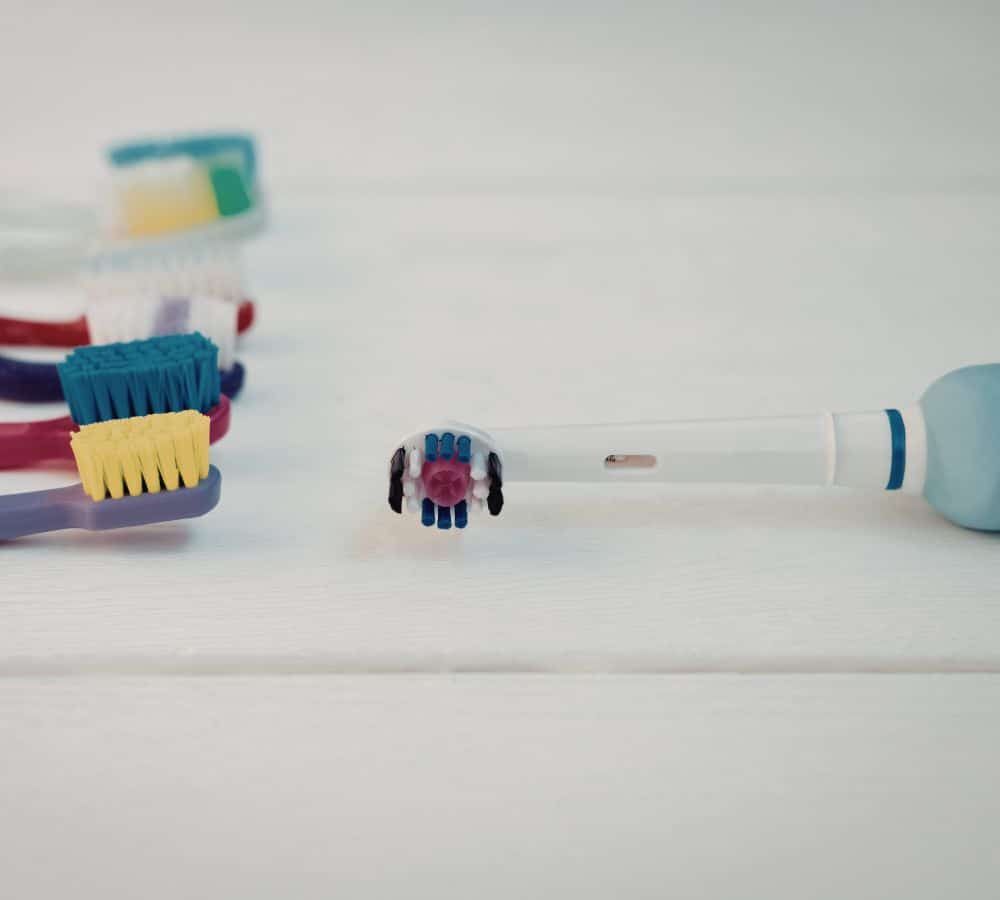
The brush must be easy to manoeuvre so it can clean all the tooth surfaces, right into the back corners of the mouth. A small head achieves this.
The trade-off with a manual brush: a small head takes longer to clean the whole mouth. One workable approach is a medium-sized brush for most teeth, with a small children's brush kept for difficult spots — wisdom teeth, the inside of the lower front teeth, and the back surfaces of the last molars.
2. Bristles
Three options: soft, medium and hard.
Bristles were once all hard, and people scrubbed. We now know this erodes tooth structure and traumatises the gums, causing recession. Dentists therefore recommend against hard bristles, and a soft-bristle brush is preferable — particularly if you are heavy-handed. Over-brushing covers that damage in detail, and how dental erosion is addressed explains why brushing after acid makes it considerably worse.
The soft-bristle advice is not this practice's house preference. Diabetes Australia puts it in its own oral health guidance as “Brush your teeth twice-a-day using a soft toothbrush with a pea-size amount of fluoride-containing toothpaste”, and ADA NSW gives the same instruction for children from the first tooth: teeth “should be cleaned twice a day with a soft toothbrush”. Two independent bodies, writing for two different audiences, specify the same bristle.
The point worth internalising: plaque is soft. Removing it takes contact and coverage, not force. Pressing harder does not clean better; it just wears the tooth and pushes the gum away. And gum recession does not grow back — which is why this is the single most consequential item on the list. Exposed root is also what produces sensitivity.
If your gums bleed, that is usually a sign the gumline is being missed rather than scrubbed too hard — see bleeding gums and what is gum disease?
3. Tongue cleaner
Removing debris from the tongue contributes to oral hygiene, and many people find it makes the mouth feel fresher. The soft or medium bristles of your brush are usually adequate. If you notice a thick film building up, look for a brush with a dedicated tongue cleaner on the back of the head, or use a separate tongue scraper — should I use a tongue scraper? and do I need to use a tongue scraper?
Most of the bacteria associated with oral malodour are found on the back of the tongue. Whether cleaning it actually treats bad breath is far less settled than the tongue-scraper aisle suggests, and the Common questions section below sets out what the evidence says. Persistent bad breath is worth investigating rather than scraping at — what causes bad breath and how can I fix it? and bad breath cover the rest.
4. Wear indicator
With regular use, a toothbrush lasts around three months. Some have a dyed layer in the bristles that fades to remind you when to replace it. If your brand does not, replace it when the seasons change — a memorable enough rule that people actually follow it.
Also replace it after any illness, and as soon as the bristles splay. Splayed bristles no longer sit against the gumline properly, which is exactly where they need to be. Caring for your toothbrush covers storage and hygiene between replacements, and can you catch dental decay from someone else's toothbrush? answers the question that follows.
Manual versus electric
Research shows that with correct technique and adequate brushing time, a manual toothbrush can be as effective as a powered one. That is worth knowing before spending money — an electric brush is not a requirement for a healthy mouth.
The Australian Dental Association takes the same even-handed line where the case for a powered brush would be strongest — cleaning around braces, where food traps against the brackets. Its advice there is simply that “Both manual and electric toothbrushes can be used”. It does not tell people wearing fixed appliances to buy a powered brush.
Where powered brushes help:
- Hard-to-reach areas are usually cleaned more efficiently
- Built-in timers solve the most common problem, which is brushing for well under the two minutes people believe they are doing — see how often should I brush my teeth?
- Pressure sensors on many models stop or warn when you brush too hard — genuinely useful for anyone prone to scrubbing
- Limited dexterity — arthritis, injury, or a child still developing coordination — makes a powered brush considerably easier. Oral health care for children with special needs covers the cases where an electric brush is either much easier or intolerable; both happen, and both are worth trying
The honest summary: an electric brush mostly compensates for technique and timing. If yours are already good, the additional benefit is modest.
How to hold it, which matters more than which one you bought
The ADA sets out the technique in enough detail to copy:
- Hold the brush at a 45-degree angle to the gums, with the bristles split evenly over the teeth and the gums
- Move it gently in small circular or back-and-forward motions — the word doing the work there is gently
- Cover every surface. The outside faces are the ones everybody does; the inside faces and the chewing surfaces are the ones that get skipped
- Spit out the excess toothpaste, but do not rinse your mouth with water. The ADA's stated reason: this “allows the fluoride paste to sit on the teeth for longer, increasing protection”. See the benefits of fluoride
If you wear braces, the ADA adds two things: brushing after every meal is recommended, because food gets caught around the brackets; and the brush should be turned to clean the top of the brackets and then turned again for the bottom of them. What are the hygiene benefits of Invisalign? covers the removable alternative.
No toothbrush reaches between the teeth
This is the limitation of every brush on the shelf, at every price. The surfaces between the teeth are roughly a third of each tooth, and they are where a great deal of adult decay and gum disease begins.
Both Diabetes Australia and the ADA give the same instruction: clean between your teeth daily, using floss or interdental brushes. Diabetes Australia describes the latter usefully for anyone who has not seen one — they “look similar to a toothpick but have bristles at the end to clean away food and bacteria when placed in the spaces between the teeth” — and suggests asking your dentist whether they would suit you. For braces, floss threaders or interdental brushes do what string floss struggles to.
The ADA's own survey data suggests this is where the gap is: 76% of children never floss themselves, nor have their parents do it, with many respondents believing it was not worthwhile while baby teeth were still in place. Is flossing really that important? takes that argument apart.
Toothbrushes for children
Choosing the right brush for a child matters, because it influences their lifetime oral hygiene habits. Kids teeth cleaning tips and how to encourage your child to brush their teeth cover the daily battle.
- A child-size brush — many brands include age guidelines
- Soft bristles
- Something attractive or fun — a favourite character works
- Involve your child in choosing it, which helps make a daily task something to enjoy rather than avoid
The ADA's timings are worth having in front of you:
- Start a toothbrush at around 6 months, or when the first tooth arrives. Before that, a clean damp washcloth over the gums does the job. You do the brushing, but let your child have a turn as well
- Toothpaste from 18 months. Babies do not need it before then
- Two minutes is the target for children and adults alike. The ADA notes babies and toddlers with only a few teeth do not need that long, provided every surface is reached, and that a song or a timer app helps as more teeth arrive
- Keep helping. ADA NSW advises parents assist with brushing until age eight — manual dexterity develops later than most parents expect, and a child who can brush enthusiastically is not the same as a child who can brush effectively
Protecting your child from dental disease and when should a child first visit the dentist? set out the rest of the picture.
The things that matter more than the brush
- Two minutes, twice a day. Time it once; most people manage 30 to 40 seconds. The ADA's survey found 68% of children brush twice a day and 21% only once — so the frequency gap is real, and it is not confined to children
- Angle the bristles into the gumline — that is where plaque collects and gum disease starts
- Spit, don't rinse after brushing, so the fluoride stays where it is needed. Which paste matters too: selecting a toothpaste: fluoride or non-fluoride and choosing the right toothpaste
- Clean between the teeth daily, with floss or interdental brushes
A soft small-headed brush used well beats an expensive brush used badly, every time.
None of it replaces the appointment: once plaque hardens into calculus no brush removes it. Dental cleans and hygienists, and what to expect at a hygienist visit.
Common questions
Will cleaning my tongue fix bad breath?
This is the claim on the shelf that the evidence supports least, and it is worth reading the numbers rather than the packaging.
Cochrane's 2019 review of interventions for managing halitosis (CD012213) — which absorbed its own earlier reviews of tongue scraping and of mouthrinses — included 44 trials and 1,809 participants, and found that only 3 of the 44 were at low risk of bias. Its authors concluded that they found ‘low- to very low-certainty evidence' on effectiveness and were ‘unable to draw any conclusions regarding the superiority of any intervention or concentration'. On tongue cleaning specifically, the comparison against no tongue cleaning rested on 2 trials and 46 participants (mean difference −0.20, 95% CI −0.34 to −0.07), rated very low certainty; against mouthwash it was a single trial of 44 participants with a confidence interval crossing zero.
The ADA's consumer material makes the same point, and then contradicts itself — which is worth surfacing rather than resolving. It states that ‘a review of the scientific evidence in 2019 found no evidence that cleaning your tongue, using several different methods including mouthwash or chewing gum, were effective for managing the cause of halitosis', and adds that ‘bad breath can actually be caused by other areas of the body including the lungs and the nose'. Elsewhere on the same page a key-message bullet says ‘cleaning your tongue can help to reduce bad breath', and its own page description is more careful again — cleaning ‘can reduce the bacterial load on the tongue, but the impact of this reduction has not been proven yet'. We have followed the cautious version.
So: clean your tongue if you like how it feels, gently. The ADA's technique is to ‘be very gentle because the tongue surface is delicate and sensitive', starting ‘gently at the back of the tongue, pulling or brushing forward'. What you should not do is treat a scraper as the treatment for persistent bad breath, or let it delay finding the cause. Bad breath is common enough to take seriously — one 2018 review in Clinical Oral Investigations puts prevalence at 31.8% (95% CI 24.6–39.0%) — and the causes run well past the tongue.
Is an electric toothbrush worth the money?
It depends entirely on what you are buying it to fix. As this page says above, a manual brush used with correct technique for an adequate time does the job, and the ADA's own position even in the hardest case — cleaning around fixed braces — is simply that ‘both manual and electric toothbrushes can be used'. We could not find an Australian authority in our reference material that recommends a powered brush over a manual one for the general population.
What a powered brush reliably buys you is not scrubbing power. It is feedback. A timer removes the guesswork from two minutes, which is the thing most people actually get wrong; a pressure sensor tells you the one thing you cannot feel, which is that you are pressing too hard. Both of those correct the errors that cause recession and missed gum lines.
Where it is closer to genuinely necessary is limited hand function — arthritis, tremor, injury, or a child whose coordination has not caught up with their enthusiasm.
What it does not buy is reach between the teeth, which no brush at any price achieves, or a shorter brushing time. If you are choosing between a more expensive powered brush and a cheaper one plus interdental brushes, the second combination addresses more of the surfaces.
Should I be using a mouthwash as well?
Most people do not need one, and four independent sources decline to treat it as essential. Healthdirect, the government-funded consumer service, says plainly: ‘most people don't need to use mouthwash. Speak with your dental practitioner about the risks and benefits of using mouthwash regularly.' The ADA's policy lists mouthrinse among ‘proven aids to oral hygiene' but keeps it off its short list of main strategies — which are brushing twice a day for two minutes, age-appropriate fluoride toothpaste, cleaning between the teeth once a day, and regular professional care. Australian Prescriber calls it ‘an adjunct to, not a substitute for, regular brushing and flossing'. And Cochrane's review of chlorhexidine tested it only ‘as an adjunct to mechanical oral hygiene procedures'.
None of that says mouthwash is useless — the ADA's own word is ‘proven'. It says it is an addition to physical cleaning, never a replacement for it, because rinsing does not remove a biofilm that is stuck to the tooth.
If you do use one, the timing matters more than the brand. Using a non-fluoride rinse straight after brushing washes away the fluoride you have just applied; use it at a different time of day instead. See the truth and myths about mouthwashes
Charcoal, bamboo, whitening, ‘ionic' — do any of the specialty brushes do more?
We are not able to tell you, and it is more useful to say that than to guess. We looked for a statement from an Australian regulator, the ADA or a government health service assessing charcoal-infused bristles, bamboo handles, ionic brushes or brushes sold as whitening, and there is nothing in the reference material we hold, in either direction. That is an absence of evidence, not evidence that they are worthless.
What can be said is what the professional guidance does specify, repeatedly and across sources: a soft brush and a small head. If a specialty brush is soft and small-headed, it is unlikely to do harm; if it is stiff, or sold on the promise of scrubbing something off, be sceptical, because everything on this page about pressure and recession still applies.
One related caution that is sourced. A review in Frontiers in Dental Medicine notes that whitening toothpastes ‘usually present a combination of abrasives', and that inadequate use of over-the-counter whitening products ‘might also cause teeth sensitivity and gingival irritation'. A product marketed on removing stain is generally marketed on abrasion.
I have dentures, implants or a bridge. Does that change the brush?
Partly, and the ADA's own list gives the first clue. Its set of proven aids to oral hygiene opens with ‘toothbrush or denture brush' — naming them as two different products rather than one. A denture brush is stiffer and shaped for an appliance, and it is not what you would use on gums and natural teeth.
Around implants and under a bridge, the problem is access rather than bristle choice. No toothbrush reaches beneath the span of a bridge or fully around an implant's contour, so the interdental brush, the floss threader or the superfloss is doing the work that matters, and the brush is only finishing the job. Ask specifically which size interdental brush fits your gaps — they are sized, and the wrong one either will not go in or will not touch the sides.
On denture care itself we have to be honest about a gap. We could not locate independent Australian guidance in our reference material on cleaning solutions, overnight storage, relining or how long a denture should last, so this page does not offer figures on any of those. Your dentist or prosthetist is the source for that, and it is a reasonable thing to ask at a review rather than to work out from a supermarket shelf.
Related reading
- Three oral hygiene tips you need to know
- Should I brush my teeth before or after breakfast?
- How to make a wise choice among the many toothpastes on the market
- Preventing dental decay
- Can you reverse tooth decay?
- What do dental hygienists do?
- Health problems linked to poor oral hygiene
Practical details
Specialist registration can be verified on the AHPRA register, or by calling 1300 419 495. The clinical team is listed by name, with registered specialists identified as such.
Smile Solutions, Level 1, 220 Collins Street, Manchester Unity Building, Melbourne VIC 3000 — getting here. Phone 13 13 96, contact us, or theteam@smilesolutions.com.au. Monday–Friday 8.00am–6.00pm, Saturday 8.30am–1.30pm, Sunday by appointment.
Published 1 September 2013. General information only; it does not replace advice from your treating practitioner. Statements and figures attributed to the Australian Dental Association, ADA NSW, Diabetes Australia, healthdirect, Australian Prescriber and Cochrane are those publishers' own.
Smile Solutions trades under ABN 28 193 514 103.
Images on This Page
-
https://www.facebook.com/tr?id=800557773428361&ev=PageView&noscript=1
(no alt text)
-
https://www.smilesolutions.com.au/wp-content/uploads/2025/10/calendar_month.svg
(no alt text)
-
https://www.smilesolutions.com.au/wp-content/themes/arcadian-wordpress-theme/assets/images/smile_solutions_logo_white.png
Smile Solutions Logo
-
https://www.smilesolutions.com.au/wp-content/themes/arcadian-wordpress-theme/assets/images/smile_solutions_logo_purple.png
Smile Solutions Logo
-
https://www.smilesolutions.com.au/wp-content/uploads/2023/11/SS-Tooth-1-1-150x150.png
Smile Solutions
-
https://www.smilesolutions.com.au/wp-content/uploads/2013/09/Toothbrushes.jpg
How to choose a toothbrush
-
https://www.smilesolutions.com.au/wp-content/uploads/2025/09/Root-Canal-2-300x217.jpg
Root Canal
-
https://www.smilesolutions.com.au/wp-content/uploads/2026/08/Mouth-Breathing-300x270.jpg
Mouth Breathing
-
https://www.smilesolutions.com.au/wp-content/uploads/2025/09/Dental-Crown-at-Smile-Solutions-300x300.jpg
Dental Crown at Smile Solutions
-
https://www.smilesolutions.com.au/wp-content/themes/arcadian-wordpress-theme/assets/images/family_owned_bussiness.png
Family Owned Business
-
https://www.smilesolutions.com.au/wp-content/themes/arcadian-wordpress-theme/assets/icons/icon--phone.svg
Smile Solutions Contact
-
https://www.facebook.com/tr? id=800557773428361&ev=PageView&noscript=1
(no alt text)
-
https://bat.bing.com/action/0?ti=25148060&tm=gtm002&Ver=2&mid=8f7f6a16-32dd-4bc6-9f0d-91d7a016e4c7&bo=1&sid=e83bd650ab2711f1aee3e93fe259ea89&vid=e83c0bf0ab2711f1a72a3b30b7880113&vids=1&msclkid=N&pi=918639831&lg=en-US&sw=800&sh=600&sc=24&nwd=1&tl=Which%20toothbrushes%20do%20dentists%20recommend%3F%20-%20Smile%20Solutions&p=https%3A%2F%2Fwww.smilesolutions.com.au%2Fdental-articles%2Farticle%2Fwhich-toothbrushes-do-dentists-recommend%2F&r=<=2071&evt=pageLoad&sv=2&cdb=AQAQ&rn=837678
(no alt text)