How often should I brush my teeth?
Twice a day
The toothbrush is the first line of defence against gum disease.
People vary widely in practice — some brush after every meal, others manage once a day.
The answer dentists give is consistent: twice a day.
And it is not just consistent, it is written down. The Australian Dental Association's Policy Statement 2.2.3 on Oral Hygiene (amended October 2025) sets out what it calls the main oral hygiene strategies, verbatim:
“brushing for two minutes twice a day; using an age-appropriate fluoride toothpaste; clean between teeth once a day using floss or interdental brushes; and visit a dental professional for regular check-ups and professional cleaning.”
Four items. Everything else on this page is detail hanging off that sentence — and it is worth noticing what is not in it, which comes up under mouthwash below.
Why twice, and not more
The number comes from how plaque behaves, not from convention.
Plaque is a bacterial biofilm that begins reforming within hours of removal. Left undisturbed, it matures over roughly a day or two into a community that causes gum inflammation — the first stage of periodontal disease — and after a few days it starts mineralising into calculus, which no toothbrush will shift and which may need deeper cleaning to remove.
Disturbing it twice a day keeps it permanently immature. That is the whole mechanism. Brushing once a day lets it mature every night; brushing five times a day disturbs an already-immature film and adds wear for no further benefit.
The ADA's reason for caring at all is in the same policy: “tooth decay (dental caries) and gum disease (periodontal disease) are two of the most common” conditions it addresses — these are not rare outcomes being guarded against.
There is a second reason, which is fluoride. Brushing is also how you apply it, and its protective effect depends on frequency of application rather than force. Two applications a day is where the evidence settles — and it is why the ADA's wording is “twice a day with an age-appropriate fluoride toothpaste” rather than simply “twice a day”. If you are weighing up a non-fluoride paste, the trade-off is set out here.
On strength, there is a number worth checking on the tube. The World Health Organization identifies a lack of plaque removal by toothbrushing with fluoride toothpaste containing 1,000–1,500 ppm as one of the three conditions that lead to decay, alongside a continued high intake of free sugars and inadequate fluoride exposure generally. Some children's and “natural” pastes sit well below that range.
And on how much difference fluoride makes at population scale: the National Health and Medical Research Council's 2016 review found that water fluoridation reduces tooth decay by 26 to 44% in children and adolescents, and by about 27% in adults. That is water rather than toothpaste, and a population effect rather than yours — but it is the clearest published measure of what fluoride is doing.
More is not better. Over-brushing wears enamel and causes gum recession, both irreversible. What over-brushing is
The two-by-two rule
Brush twice a day, for two minutes, after breakfast and before bed.
The first two of those are the ADA's own wording — “brushing for two minutes twice a day”. The timing is the practical part, and it is ours.
When you brush matters as much as how often.
The before-bed brush is the one to protect if you are ever going to skip one. Saliva flow drops substantially during sleep, which removes the mouth's main defence for seven or eight hours. Whatever is on your teeth when you fall asleep stays there, working, all night.
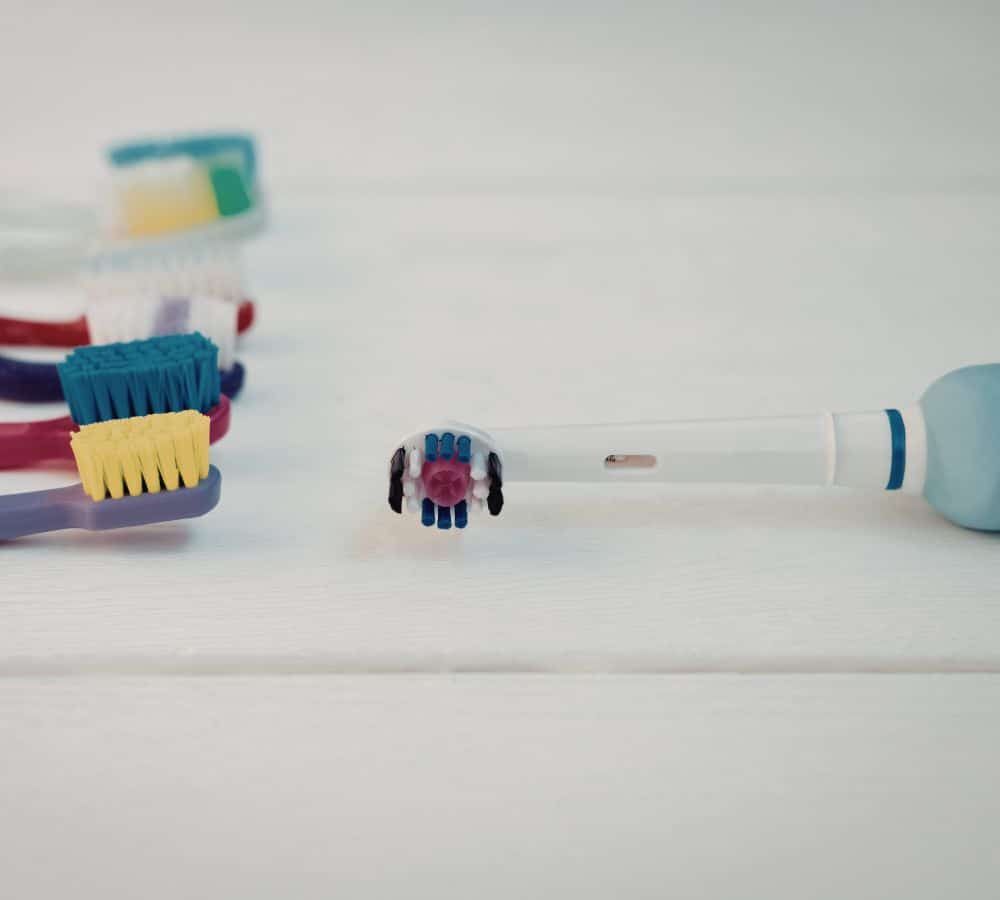
Two minutes is longer than it feels. Most people brush for around 45 seconds while believing they brushed for two. A timer, or an electric brush with one built in, resolves that gap immediately — on which brush to buy, see which toothbrushes dentists recommend.
Where the two minutes should go
Duration only helps if the time is spread evenly. Most people over-brush the outer surfaces of the front teeth — the ones they can see — and under-brush everything else.
Divide the mouth into four quadrants and give each 30 seconds, covering three surfaces in each: outer, inner, and biting. The inner surfaces of the lower front teeth and the outer surfaces of the upper back teeth are the two areas most commonly missed — the first because the brush is awkward there, the second because it is out of sight.
Aim the bristles at about 45 degrees into the gumline, where plaque actually starts, rather than scrubbing across the middle of the tooth.
Use light pressure. Around 150 to 200 grams — the brush held like a pen, not gripped like a hammer. Plaque is soft and does not need force; gums are not, and force damages them. How much pressure should I apply when brushing my teeth?
Those last three are practice technique rather than published standards — no authority we hold specifies an angle, a pressure in grams or a per-quadrant split. They are how the four-item list above gets carried out, and your hygienist's advice for your mouth takes precedence over any of them.
Three details that change the result
- Spit, do not rinse. Rinsing with water after brushing washes away the fluoride you have just applied. Spit out the excess and leave the rest.
- Do not rinse with mouthwash straight after brushing either — most rinses dilute the toothpaste fluoride off the teeth. Use one at a different time of day, if you use one at all; the truth and myths about mouthwashes covers what they can and cannot do.
- Replace the brush every three months, or sooner if the bristles splay. A splayed brush before three months means you are pressing too hard, and worn bristles clean less well. How to care for your toothbrush covers the rest.
The exception: do not brush after anything acidic
This is the most important qualification, and it works against instinct.
Acidic foods and drinks weaken tooth enamel. Brushing too soon afterwards damages the enamel in that softened state. Repeated often enough, that is dental erosion, and it is not reversible.
Wait at least an hour after:
- Fruit juice
- Soft drink — the sugar-free versions are just as acidic
- Sports drinks
- Alcohol, wine included
- Foods containing citric acid — oranges, grapefruit, lemons
- Vinegar and pickled foods, kombucha, flavoured mineral water
- Vomiting or reflux — stomach acid is far stronger than anything in the list above
Fruit juice is worth singling out, because it is widely treated as the healthy option. In the World Health Organization's definition, free sugars include those naturally present in honey, syrups and fruit juices, not only sugar added from a packet — so juice counts twice over, for its acid and for its sugar.
The mechanism: acid softens the outer layer of enamel temporarily. Saliva remineralises it over roughly 30 to 60 minutes. Brushing during that window physically removes the softened layer — and unlike plaque, it does not come back. How acidic food affects your teeth and what acid wear looks like go into the detail.
If you want to do something immediately, rinse with plain water. That dilutes the acid without abrading anything. Sugar-free chewing gum also helps, by stimulating the saliva that does the repairing — and it is one of the five items the ADA lists in the same policy as a proven aid to oral hygiene. See does chewing sugar-free gum really help prevent cavities?
This is also the argument for the two-by-two timing: after breakfast, ideally with an hour's gap if breakfast included juice or fruit.
If an hour's gap is impractical, brush before breakfast instead. It is a perfectly good option: it puts fluoride on the teeth ahead of the meal, and it removes the plaque that would otherwise metabolise breakfast into acid. Brushing your teeth: before or after breakfast?
Flossing
Floss once a day — ideally in the evening, after brushing.
Once is genuinely enough, and again this is the ADA's own figure: “clean between teeth once a day using floss or interdental brushes.” Unlike brushing, the argument here is not about frequency — it is about whether it happens at all. Roughly a third of every tooth surface lies between the teeth, where no brush reaches, and that is where most gum disease and a large share of adult decay begins. (That fraction is a figure long used in dentistry that we have not been able to trace to a published source, so treat it as an illustration of scale rather than a measurement.)
How many people actually do it is the more sobering number. An ADA survey of 25,000 Australian adults found that 76% of children never floss themselves, nor have their parents do it — many respondents thought it not worthwhile while baby teeth are in place. The ADA's position is that once a child has two or more baby teeth side by side, parents should floss daily.
The technique
Go gently, and follow this sequence:
- Start with a generous length of floss, winding most of it around each middle finger and leaving an inch or two to work with.
- Hold it tightly between your thumbs and index fingers, and slide it gently up and down between your teeth. Do not use a back-and-forth sawing motion — that is what makes gums bleed.
- Gently curve the floss around the base of each tooth, going beneath the gumline.
- Use a clean section of floss as you move from tooth to tooth.
- Rinse your mouth with water afterwards.
The two steps most people miss
Curving around the base of each tooth, beneath the gumline. Floss snapped straight down and pulled out again cleans almost nothing. The plaque that causes gum disease sits just under the gum margin, on the side of the tooth — which requires the C-shape.
Using a clean section each time. Reusing the same few centimetres moves bacteria from one contact point to the next.
If your gums bleed when you floss, that generally means they are inflamed, not damaged — and gentle, consistent daily flossing is what makes the bleeding stop. Bleeding that persists beyond a couple of weeks of proper technique is worth having looked at. See Bleeding Gums and Is flossing really that important?.
If you will not floss
Worth saying, because a great many people will not, and the honest advice is not to keep repeating the instruction.
Interdental brushes are an equal option, not a downgrade. The ADA's own wording puts them alongside floss — “using floss or interdental brushes” — and lists “interdental aids including floss & interdental brushes” together among its proven aids. Where the gaps are large enough to take them, many adults, particularly anyone with gum disease or recession, find them easier and clean better with them. A water flosser is a reasonable option for people with bridges, implants, braces or limited dexterity; if you wear clear aligners, cleaning before they go back in matters more than usual.
The best interdental method is the one you will actually use every day. Ask a hygienist to size the brushes for you; the wrong size does little.
What brushing does not do
Four honest limits:
- It does not remove calculus. Once plaque has mineralised, only instruments in a hygienist's hands will shift it — which is what a professional clean is for, and why the fourth item on the ADA's list is a professional one.
- It does not clean between the teeth. No brush, manual or electric, reaches those surfaces.
- It does not compensate for constant snacking. Frequency of sugar exposure drives decay, and no amount of brushing outruns grazing all day. The WHO recommends limiting free sugars to less than 10% of total energy intake, and ideally less than 5% — see also the stages of dental decay.
- It is not what a mouthwash replaces, or is replaced by. See below.
When to be seen
- Gums that bleed regularly when brushing or flossing, or bleeding that persists after two weeks of good technique
- Persistent bad breath despite brushing, flossing and cleaning the tongue — though see the question on that below, because the evidence is not what most people expect
- Sensitivity to cold or sweet that is new or getting worse
- Teeth that look longer, or a notch you can feel at the gumline
- A toothbrush that splays within weeks
- Any ulcer, lump, or white or red patch lasting more than two weeks — see oral cancer: signs and risk factors
- Facial swelling, or fever with dental pain — a medical emergency; present to an emergency department or call 000. For everything short of that, see Emergency Dentistry
Common questions
Is mouthwash part of a routine, or a replacement for one?
An addition, and the Australian Dental Association is precise about this in a way most packaging is not.
In Policy Statement 2.2.3, mouthrinse does not appear among the four main oral hygiene strategies — brushing twice daily for two minutes, fluoride toothpaste, cleaning between the teeth once a day, and regular professional care. It does appear in a separate list of “proven aids to oral hygiene”, alongside a toothbrush, fluoridated toothpaste, interdental aids and sugar-free chewing gum.
So the ADA's position is not that mouthwash is useless — it explicitly calls the category proven. It is that mouthwash is adjunctive rather than essential: something that can help on top of the four things that do the work, and not a substitute for any of them. The company it keeps on that list, next to chewing gum, is the clearest guide to how much weight to give it.
One practical point stands regardless: do not use it immediately after brushing, because most rinses wash the toothpaste fluoride off the teeth before it has acted.
Will cleaning my tongue fix bad breath?
Probably not, and this is the answer most people find surprising.
The Australian Dental Association's own consumer guidance states that “a review of the scientific evidence in 2019 found no evidence that cleaning your tongue, using several different methods including mouthwash or chewing gum, were effective for managing the cause of halitosis.” A Cochrane review of tongue scraping reached a similar place: the measured effect of mechanical tongue cleaning on breath odour was small (mean difference −0.20, 95% CI −0.34 to −0.07) and rested on 2 trials with 46 participants between them, which the reviewers rated very low certainty.
Worth noting that the ADA page itself reads somewhat two ways — it reports the absence of evidence and then gives instructions for doing it anyway. We are not going to resolve that for them. What both it and Cochrane agree on is that there is no good evidence tongue cleaning treats the cause of halitosis.
So: if you like how it feels, do it gently — the ADA warns that “you need to be very gentle because the tongue surface is delicate and sensitive”. But if bad breath is the actual problem, it needs a diagnosis rather than a gadget. See Bad Breath.
Is an electric brush better than a manual one?
The ADA's list does not distinguish between them — it names “toothbrush or denture brush” among its proven aids, without specifying a type, and its instruction is about two minutes twice a day rather than about the motor.
Where an electric brush genuinely helps is with the two things people get wrong: it times the two minutes for you, and many models warn you when you press too hard. If a manual brush and a timer get you to the same place, that is the same place. See which toothbrushes dentists recommend.
If I can only do one thing properly, which is it?
Brushing twice a day with a fluoride toothpaste, and of the two, the brush before bed — for the reason above, that saliva flow drops during sleep and whatever is on the teeth stays there working all night.
But be clear about the trade: the ADA lists four strategies, not one, and brushing cannot do what interdental cleaning does. Roughly a third of each tooth's surface is between the teeth, and a toothbrush has never reached it. Skipping interdental cleaning is not brushing less thoroughly — it is leaving a category of surface untouched altogether.
My gums bleed when I brush. Should I stop?
No — that is usually the opposite of what is needed. Bleeding generally means the gum is inflamed, not injured, and it is consistent gentle cleaning that settles it. Gums that bleed are gums with plaque at the margin.
What should change is the technique, not the frequency: light pressure, bristles angled into the gumline, no sawing with floss. If bleeding is still there after two weeks of doing it properly, that is the point to have it looked at rather than persist. The ADA names gum disease as one of the two most common conditions it is addressing, and the early stage is the reversible one. See Bleeding Gums.
Does it matter what the fluoride number on the toothpaste is?
It does, and almost nobody looks. The World Health Organization names toothbrushing with fluoride toothpaste containing 1,000–1,500 ppm as one of the protections whose absence allows decay to develop. The ADA's wording is “an age-appropriate fluoride toothpaste” — which is the important qualifier for children, where a lower concentration is deliberate and the amount used matters too.
The practical check: look for the ppm figure on the tube, and if you cannot find one at all, ask your dentist or hygienist whether the paste is doing anything. See the benefits of fluoride and choosing between fluoride and non-fluoride toothpaste.
Related reading
What is the ideal daily routine for oral hygiene? · 3 oral hygiene tips you need to know · Caring for your teeth: 8 steps to dental health · The importance of dental hygiene — a window onto your overall health · Dental Cleans and Hygienists · General Dentistry
Practical details
Smile Solutions, Level 1, 220 Collins Street, Manchester Unity Building, Melbourne VIC 3000. Phone 13 13 96, or theteam@smilesolutions.com.au. Monday–Friday 8.00am–6.00pm, Saturday 8.30am–1.30pm, Sunday by appointment. See Contact Us.
Registration for any practitioner can be verified free on the AHPRA public register at ahpra.gov.au.
Published 1 December 2015. Sourced against Australian Dental Association Policy Statement 2.2.3 — Oral Hygiene (document version October 2025), World Health Organization guidance on sugars and dental caries, the NHMRC 2016 review of water fluoridation, and the ADA and Cochrane positions on tongue cleaning.
General information only — it is not a diagnosis, a treatment plan or a promise of any particular clinical outcome, and it does not replace advice from your treating practitioner. Timings, pressures, brush angles and intervals given here are general guidance, and where they are not attributed to a named body they are practice technique rather than published standards. What is right for you depends on your gum health, dexterity, restorations and decay risk — your practitioner's advice takes precedence. Persistent bleeding, pain or bad breath should be examined rather than managed at home.
Smile Solutions trades under ABN 28 193 514 103.
Images on This Page
-
https://www.facebook.com/tr?id=800557773428361&ev=PageView&noscript=1
(no alt text)
-
https://www.smilesolutions.com.au/wp-content/uploads/2025/10/calendar_month.svg
(no alt text)
-
https://www.smilesolutions.com.au/wp-content/themes/arcadian-wordpress-theme/assets/images/smile_solutions_logo_white.png
Smile Solutions Logo
-
https://www.smilesolutions.com.au/wp-content/themes/arcadian-wordpress-theme/assets/images/smile_solutions_logo_purple.png
Smile Solutions Logo
-
https://www.smilesolutions.com.au/wp-content/uploads/2023/11/SS-Tooth-1-1-150x150.png
Smile Solutions
-
https://www.smilesolutions.com.au/wp-content/uploads/2013/09/Toothbrushes.jpg
How to choose a toothbrush
-
https://www.smilesolutions.com.au/wp-content/uploads/2025/09/Root-Canal-2-300x217.jpg
Root Canal
-
https://www.smilesolutions.com.au/wp-content/uploads/2026/08/Mouth-Breathing-300x270.jpg
Mouth Breathing
-
https://www.smilesolutions.com.au/wp-content/uploads/2025/09/Dental-Crown-at-Smile-Solutions-300x300.jpg
Dental Crown at Smile Solutions
-
https://www.smilesolutions.com.au/wp-content/themes/arcadian-wordpress-theme/assets/images/family_owned_bussiness.png
Family Owned Business
-
https://www.smilesolutions.com.au/wp-content/themes/arcadian-wordpress-theme/assets/icons/icon--phone.svg
Smile Solutions Contact
-
https://www.facebook.com/tr? id=800557773428361&ev=PageView&noscript=1
(no alt text)