How to care for your toothbrush
Everyone knows oral hygiene matters. Far fewer people think about the condition of the tool doing the work — and the condition of your toothbrush makes a real difference to how effectively you can clean your teeth. What is the ideal daily routine for oral hygiene? is the routine this tool serves, and which toothbrushes do dentists recommend? covers choosing one.
Most of what follows is simple. A few widely repeated pieces of toothbrush advice are also out of date, and this page corrects them rather than repeating them — in the same spirit as dental myths exposed.
Replace it regularly
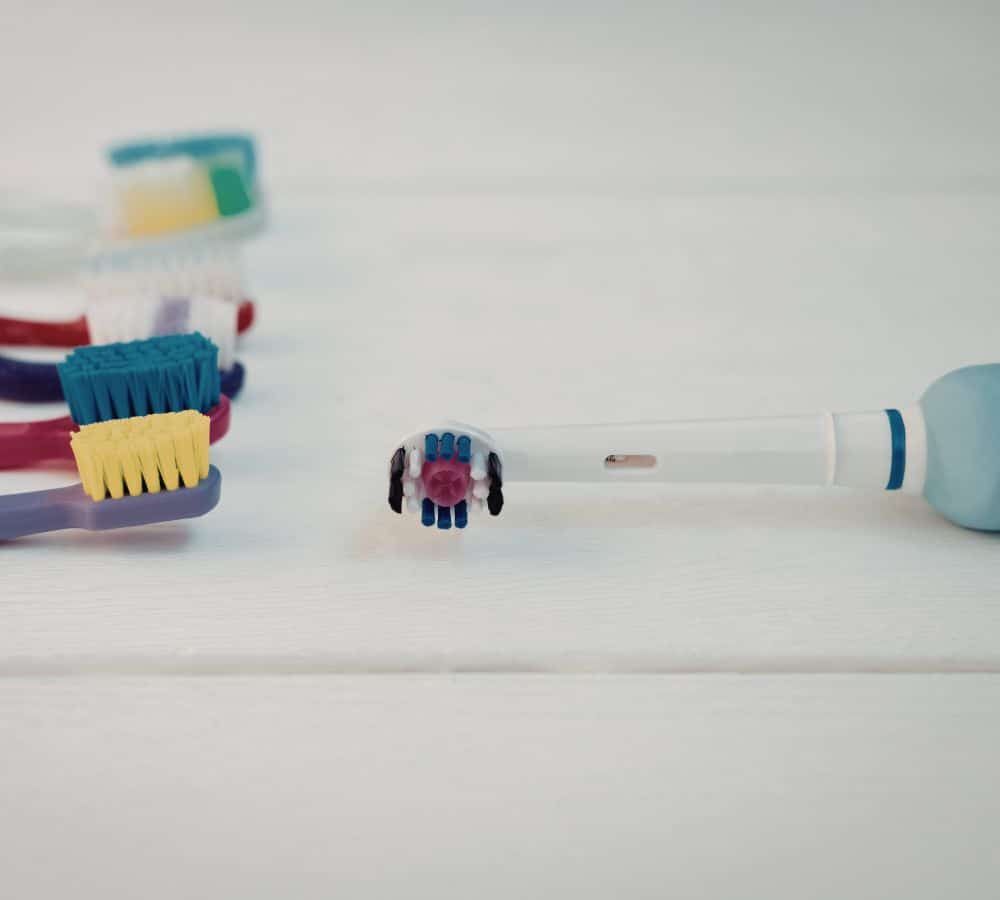
Replace your brush — or your electric brush head — every three to four months, or sooner if the bristles look worn or spread apart.
A toothbrush wears out through normal use and stops cleaning each tooth effectively. Splayed bristles are the clearest sign: once they spread, you may not actually be reaching every tooth surface, no matter how carefully you brush.
If your brush is splaying well before three months, that is information. It usually means you are pressing too hard — which does not clean better, and which wears enamel at the gum line and drives gum recession. Both are permanent. An electric brush with a pressure sensor is the easiest fix. Over brushing: what can it do to my teeth? and how much pressure should I apply when brushing my teeth?
After illness
The traditional advice is to replace the brush after flu, a cold sore or another contagious illness.
Here is the honest version: there is little evidence that your own toothbrush re-infects you with an illness you have already had and recovered from, because you develop an immune response to it. Replacing it is cheap and harmless, so do it if it makes you more comfortable — but it is not a medical necessity, and it is not the reason people get sick twice.
What does matter: if someone in the house has an active infection, keep the brushes physically separated so they are not touching, and do not let them share a cup where bristles contact one another.
Don't share — including in ways you may not have considered
Don't share a toothbrush, even with a partner. It transfers blood and bacteria directly, and it is a genuinely bad idea. Can I catch dental decay by using someone else's toothbrush? takes that question on directly.
The less obvious one: when squeezing toothpaste onto the brush, don't press the tube opening against the bristles. That transfers bacteria from your brush to the tube, and from the tube to every other brush in the household. Hold the tube clear and let the paste drop.
Household bacteria transfer matters most for children. Decay-causing bacteria pass from carer to infant through shared spoons, dummies cleaned in an adult's mouth, and shared brushes. An adult with untreated decay is a risk factor for a child's. Protecting your child from dental disease, children's dentistry and when should a child first visit the dentist?
Clean it, and let it dry
- Rinse the brush thoroughly after every use, under running water, until no paste remains
- Don't let toothpaste build up in the bristles — residue traps debris and keeps the brush damp
- Store it upright, in the open air, and let it dry fully between uses
That last point is the one that matters, and it is worth being clear where older advice went wrong. Do not store a brush standing in mouthwash, and do not keep it in a closed container or travel cap day to day. Both keep the bristles wet, and a permanently damp brush is exactly the environment bacteria prefer. A dry brush is a clean brush. Travel caps are for travel. The truth and myths about mouthwashes covers what mouthwash is and is not for.
You do not need to sterilise a toothbrush. Soaking in disinfectants, microwaving and dishwashing are all unnecessary, and some of them damage the bristles or the handle.
Keep brushes away from the toilet if the bathroom layout allows, and close the lid when flushing. This is a modest, sensible precaution rather than an emergency.
Which brush, and how hard
- Soft bristles. Medium and hard brushes are still sold; there is no good reason to buy one. They do not remove more plaque, and they do remove more tooth.
- A small head reaches the back teeth and the inner surfaces more easily than a large one.
- Electric or manual? Either works with good technique. Oscillating-rotating electric brushes remove somewhat more plaque on average — largely because they enforce two minutes and take the pressure decision out of your hands. If you buy one, a pressure sensor is the feature worth paying for; the app is not.
- Charcoal-bristled and “whitening” brushes offer no established benefit, and some are abrasive. Home whitening and charcoal whitening: does it work, is it safe?
What the brush is doing is worth stating once: plaque is a biofilm, a structured community of bacteria stuck to the tooth, and only mechanical disruption removes it. That is what bristles are for. Rinses, oils and mouthwashes act on what is left behind — can oil pulling make my mouth healthier and my teeth whiter? and should I be using mouthwash as well as brushing and flossing my teeth?. And the brush is only half the tool set, because it does not reach between the teeth: is flossing really that important?
Use the right toothpaste
There are so many toothpastes on the market that choosing is genuinely difficult. If you are unsure, ask your dentist or hygienist — they can match the product to your specific situation, which a supermarket shelf cannot. With so many toothpastes on the market, how do I choose?, choosing the right toothpaste for you and choosing the right toothpaste
The thing that actually matters is fluoride. It is the ingredient with the strongest evidence behind it for preventing decay, and almost every other claim on a toothpaste box is secondary to it. The benefits of fluoride and selecting a toothpaste: fluoride or non-fluoride. Two habits get more out of it than any brand choice:
- Spit, don't rinse. Rinsing with water straight after brushing washes away the fluoride that was about to do the work.
- Brush last thing at night, so the fluoride sits on the teeth overnight when saliva flow is lowest. And wait about an hour after anything acidic before brushing — brushing your teeth: before or after breakfast?
A correction to older advice, including an earlier version of this page: triclosan is no longer the answer. It has been removed from toothpaste in Australia and most other markets following regulatory review and reformulation, and it should not be sought out. Where an antibacterial agent is genuinely indicated for gum disease, that is a specific recommendation from a clinician, not a supermarket decision. What is gum disease? and periodontal (gum) disease
Beyond fluoride, the right toothpaste depends on what you are managing:
- Sensitivity — products containing potassium nitrate or stannous fluoride, used consistently for several weeks before judging them. What to do if you suffer from sensitive teeth
- High decay risk, dry mouth, or exposed roots — a high-fluoride prescription-strength paste, on advice. My mouth always feels dry! What can I do? and how do I prevent dental decay?
- Gum disease — stannous fluoride formulations, alongside the cleaning that is doing the real work
- Children — an age-appropriate paste, a smear for toddlers, a pea-sized amount from around three. Kids teeth cleaning tips and how to encourage your child to brush their teeth
Be cautious with “whitening” and charcoal pastes. Most work by abrasion rather than by changing the colour of the tooth, and several charcoal products contain no fluoride at all — which trades a proven benefit for an unproven one. Teeth whitening is what actually changes tooth colour.
And the part home care can't cover
Alongside home care, see your hygienist at the interval you are advised — six months for most people, three or four monthly for some — to check that teeth and gums are healthy. Your Smile Solutions dental hygienist visit: what to expect, what does a dental hygienist do? and how often should I go to the dentist?
No brush, however well maintained, removes hardened calculus. Once plaque mineralises onto the tooth it is bonded there, and it takes instruments. A brush also cannot reach between teeth, which is roughly 40 per cent of the tooth surface and where a large share of decay starts. Dental Cleans and Hygienists. And below the gum line there is a hard limit worth knowing: floss reaches about 3mm, while a pocket of 5mm or more is periodontitis and needs professional treatment — when do you need deeper cleaning?, bleeding gums and periodontists.
Common questions
Does it matter more which brush I buy, or what I do with it?
What you do with it, comfortably — and the Australian Dental Association's own list of what actually constitutes oral hygiene is short enough to memorise.
Its “main oral hygiene strategies” are: “brushing for two minutes twice a day; using an age-appropriate fluoride toothpaste; clean between teeth once a day using floss or interdental brushes; and visit a dental professional for regular check-ups and professional cleaning.” That is the whole list. Two minutes is longer than it feels — most people stop between 45 and 60 seconds — which is the single most common reason a perfectly good brush produces a mediocre result.
What is not on that list is as informative as what is. Mouthrinse appears separately, among what the ADA calls the “proven aids to oral hygiene” rather than among the main strategies, and Australian Prescriber puts the boundary plainly: “Mouthwashes are an adjunct to, not a substitute for, regular brushing and flossing.” A rinse after a rushed 30-second brush is not a substitute for a slower one.
So, in order of how much difference it makes: the two minutes, then the fluoride sitting on the teeth afterwards (spit, don't rinse), then cleaning between the teeth, then which brush you happened to buy. An electric brush helps mainly by making the first of those automatic.
Should I be brushing my tongue as well?
You can, it is harmless done gently, and the evidence behind it is weaker than the products imply.
The current Cochrane position comes from its 2019 review Interventions for managing halitosis, which absorbed the earlier reviews of tongue scraping and mouthrinses. For mechanical tongue cleaning it found very low-certainty evidence of a small reduction in measured breath odour — a mean difference of −0.20 (95% CI −0.34 to −0.07), from 2 trials with 46 participants. Very low certainty, in Cochrane's grading, means the true effect may be substantially different from the estimate.
Two practical conclusions follow. If you like doing it, a gentle pass with the brush or a scraper is fine — stop at the point of gagging, and do not scrub, because the tongue surface is not enamel. And if bad breath is the actual problem, cleaning the tongue is not the investigation. Persistent halitosis has causes — gum disease, decay, dry mouth, a post-nasal drip, or something outside the mouth entirely — and masking it is the one approach guaranteed not to find them. Bad Breath sets out how it is worked up, and do I need to use a tongue scraper? covers the instrument itself.
My gums bleed when I brush. Should I be gentler there, or avoid it?
This is the most consequential mistake in home care, because the instinct is exactly backwards.
Gums that bleed when brushed are inflamed, and inflammation at the gum margin is driven by the plaque sitting on it. Brushing that area less leaves more plaque, which produces more inflammation, which produces more bleeding. The area that bleeds is usually the area that has been under-cleaned, not over-cleaned. The practice's bleeding gums page sets out the escalation path — hygienist, then general dentist, then periodontist — and notes that most cases resolve at the first two steps.
Gentler, yes. Less often, no. Use a soft brush, keep the pressure light for the reasons given above, and clean between the teeth daily, which is where the plaque a brush cannot reach is doing the damage.
Two things change the stakes. Smoking both worsens gum disease and masks the bleeding that would have warned you about it. And diabetes runs in both directions: a peer-reviewed review describes “a two-way relationship” in which diabetes increases the risk of periodontitis while “periodontal inflammation negatively affect[s] glycaemic control.” Diabetes Australia adds the encouraging half — “with optimum blood glucose management the risk of developing periodontitis is the same as for a person without diabetes.”
If bleeding persists for more than a couple of weeks of careful cleaning, have it examined rather than adjusting your technique again. Gum disease is usually painless until it is advanced, so bleeding is the signal you get instead of pain.
Does any of this change if I have braces, aligners or a denture?
Braces change the frequency; aligners and dentures change what you are cleaning.
With fixed braces, the ADA's consumer guidance is that “for people wearing braces, brushing after every meal is recommended as food can get stuck around the brackets”, and that “both manual and electric toothbrushes can be used for cleaning around braces.” Cleaning between the teeth still has to happen — the brackets make it fiddlier, not optional, and interdental brushes and floss threaders exist for that reason. Orthodontics and the six most common complaints with conventional braces.
With removable aligners, the tooth surfaces are covered for most of the day, so anything left on them stays there. Clean the teeth before the aligners go back in, and keep the aligners themselves clean and out of hot water. How to protect your aligners, and your smile.
With a denture or a partial denture, the appliance is cleaned separately from whatever natural teeth remain, and the teeth a partial denture clasps onto need particular attention because the clasps hold plaque against them. Dentures and what are the different types of denture?.
And with any appliance — including a night guard — the rule at the top of this page applies to it as well: rinse it, let it dry, and do not store it wet in a sealed box.
Related reading
- Three things that decide your oral health at home
- Dental hygienist vs dentist
- How often should I brush my teeth?
- Health problems linked to poor oral hygiene
- General dentistry
- Price guide
Practical details
Smile Solutions, Level 1, 220 Collins Street, Manchester Unity Building, Melbourne VIC 3000 — getting here. Phone 13 13 96, contact us, or theteam@smilesolutions.com.au. Monday–Friday 8.00am–6.00pm, Saturday 8.30am–1.30pm, Sunday by appointment. The clinical team is listed by name.
Registration for any practitioner can be verified free on the AHPRA public register at ahpra.gov.au.
Published 16 April 2018. General information only — it is not a diagnosis, a treatment plan or a promise of any particular clinical outcome, and it does not replace advice from your treating practitioner. Product suitability varies between individuals, and prescription-strength products are dispensed on clinical advice. Product formulations and regulatory positions change over time; where this page describes a product category rather than a brand, that is deliberate.
Smile Solutions trades under ABN 28 193 514 103.
Images on This Page
-
https://www.facebook.com/tr?id=800557773428361&ev=PageView&noscript=1
(no alt text)
-
https://www.smilesolutions.com.au/wp-content/uploads/2025/10/calendar_month.svg
(no alt text)
-
https://www.smilesolutions.com.au/wp-content/themes/arcadian-wordpress-theme/assets/images/smile_solutions_logo_white.png
Smile Solutions Logo
-
https://www.smilesolutions.com.au/wp-content/themes/arcadian-wordpress-theme/assets/images/smile_solutions_logo_purple.png
Smile Solutions Logo
-
https://www.smilesolutions.com.au/wp-content/uploads/2023/11/SS-Tooth-1-1-150x150.png
Smile Solutions
-
https://www.smilesolutions.com.au/wp-content/uploads/2013/09/Toothbrushes.jpg
How to choose a toothbrush
-
https://www.smilesolutions.com.au/wp-content/uploads/2013/09/Toothbrushes-300x270.jpg
How to choose a toothbrush
-
https://www.smilesolutions.com.au/wp-content/uploads/2016/05/Pip-150x150.jpg
Dr Philippa Robinson
-
https://www.smilesolutions.com.au/wp-content/uploads/2025/09/Root-Canal-2-300x217.jpg
Root Canal
-
https://www.smilesolutions.com.au/wp-content/uploads/2026/08/Mouth-Breathing-300x270.jpg
Mouth Breathing
-
https://www.smilesolutions.com.au/wp-content/themes/arcadian-wordpress-theme/assets/images/family_owned_bussiness.png
Family Owned Business
-
https://www.smilesolutions.com.au/wp-content/themes/arcadian-wordpress-theme/assets/icons/icon--phone.svg
Smile Solutions Contact
-
https://www.facebook.com/tr? id=800557773428361&ev=PageView&noscript=1
(no alt text)
-
https://bat.bing.com/action/0?ti=25148060&tm=gtm002&Ver=2&mid=6862b538-79e1-41a3-bec3-2a052f7d9a94&bo=1&sid=d8bf7d70ab2711f187dc3148e9da1b65&vid=d8c031e0ab2711f1a7e95581362a3e64&vids=1&msclkid=N&pi=918639831&lg=en-US&sw=800&sh=600&sc=24&nwd=1&tl=How%20to%20care%20for%20your%20toothbrush%20-%20Smile%20Solutions&p=https%3A%2F%2Fwww.smilesolutions.com.au%2Fdental-articles%2Farticle%2Fcare-toothbrush%2F&r=&evt=pageLoad&sv=2&cdb=AQAQ&rn=655141
(no alt text)