How to protect your aligners, and the teeth underneath them
The one thing aligners change about your mouth
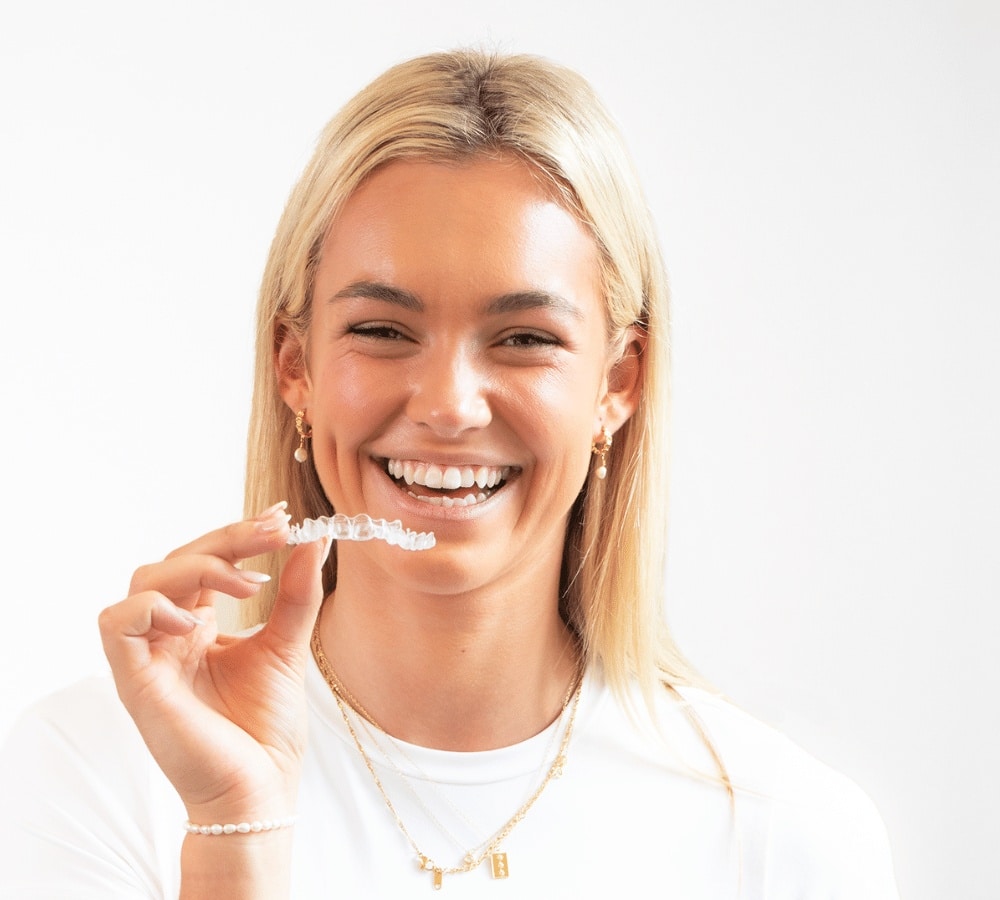
Clear aligners are removable, nearly invisible, and comfortable. They also do something worth understanding: they cover your teeth completely. See Invisalign and, for the wider set of options, Orthodontics and how do I know which orthodontic treatment is best for me?
That close fit is what moves teeth. It is also what creates an ideal environment for bacteria, acid and plaque to sit against enamel with nowhere to go. Saliva, which normally washes over teeth and neutralises acid, cannot reach the tooth surface while an aligner is seated.
Everything below follows from that single fact.
It is not only our view of it. The Australian Dental Association, writing for patients, states the rule directly: “The trays should be worn at all times other than when eating and drinking liquids other than water.” Its reason is the one above: “Drinking liquids such as fruit juice or soft drink while wearing clear aligners can trap the liquids against the teeth, which can cause damage to the teeth if it happens frequently.”
One expectation worth setting at the same time. The ADA is blunt about it: “Although the aligners are clear plastic, they are not invisible.” They are far less obvious than metal brackets, which is usually the point, but nobody should choose them expecting that no one will ever notice.
1. Watch what you eat and drink
Things that stain
Sugary and dark-coloured foods and drinks discolour both your teeth and your aligners. The aligner takes the stain visibly — which rather defeats the purpose of choosing a nearly invisible appliance.
Drinks to be careful with:
- Sodas and soft drinks — are sugar free soft drinks better for my teeth than regular soft drinks? and is soda water bad for your teeth?
- Energy and sports drinks — what are sports drinks really doing to your teeth?
- Coffee and tea
- Dark-coloured juices, and wine
Foods that stain:
- Pasta sauce
- Curry
- Blackberries, cherries and blueberries
If the staining is already there before treatment starts, that is a separate conversation and a better one to have first — how can I improve the whiteness of my teeth? and Teeth Whitening. Whitening is generally done after alignment, not during it.
Why sugar matters more than usual
Sugar trapped between your teeth and your aligner raises your decay risk, and it raises it more than the same sugar would without an aligner in place. How does sugar affect your dental health?
The mechanism: bacteria metabolise the sugar into acid; the acid demineralises enamel; and with an aligner sealing the tooth surface, that acid is held in contact with the enamel instead of being diluted and buffered by saliva. How does tooth decay develop? and the stages of dental decay follow that through. The end of that road is a filling — see Tooth Fillings, can you reverse tooth decay, and do I need a filling? for the stage at which it can still be stopped, and how long do dental fillings last? for what it commits you to.
Acid from the drink itself does its own damage, independent of bacteria: how does acidic food affect your teeth? and what is dental erosion and how is it addressed? — enamel lost to erosion does not grow back. See also what is acid wear, and how can I avoid it?
A sugary drink sipped over an hour with aligners in is meaningfully worse than the same drink finished quickly with aligners out.
Frequency, not quantity
That last sentence is the whole principle, and it is the ADA’s position rather than ours. Its diet and nutrition policy states that the form, frequency, timing and total amount of sugar intake are all significant in starting the decay process — frequency and timing sitting alongside amount, not beneath it. The same policy adds that acid from acidic or sugar-sweetened food and drink can soften and dissolve tooth structure on its own, and that sugar and food acid together can be particularly destructive. An aligner takes that combination and holds it in place.
The ADA also names the people for whom acidic food and drink matter most: anyone whose saliva flow is reduced, whether by a medical condition or by medication. If that is you, the margin for error with aligners in is smaller, because saliva is the thing that would otherwise be repairing the damage. See my mouth is always dry — why is this, and does it affect my teeth?
2. Take your aligners out to eat — always
Remove your aligners before eating. Not “most of the time” — every time.
Two reasons:
Food particles get trapped between the aligner and the tooth surface, where brushing cannot easily reach and saliva cannot rinse.
Chewing damages the aligner. They are not designed to take biting force against food. Cracks and distortion compromise the fit, and an aligner that does not fit does not move teeth.
If you grind or clench, say so before treatment starts, because grinding wears and splits aligners faster than normal wear does, and the underlying habit still needs managing once treatment finishes — night time tooth grinding and clenching, what is bruxism and how is it managed? and TMD and Teeth Grinding.
The wear-time rule
Wear your aligners 20 to 22 hours a day. That leaves two to four hours for all meals, snacks, drinks other than water, and cleaning.
It is a generous allowance if you eat at meal times and a very tight one if you graze. Grazing is the habit that most often derails aligner treatment — not because any single snack matters, but because each one costs removal, eating, cleaning and reinsertion time, and the hours quietly disappear. Wear time is also what determines whether you finish on schedule: see How long does orthodontic treatment take?.
What you can drink with them in
Water. That is the complete list.
Cool or room-temperature water is fine. Hot drinks can warp the plastic even setting aside the staining, so coffee and tea come with the aligners out.
3. When you genuinely cannot take them out
Sometimes you are somewhere you cannot discreetly remove and clean aligners.
Rinse your mouth and your aligners thoroughly with clean water as soon as you can. It is not a substitute for proper cleaning, but it clears the worst of the sugar and food debris and buys you until you can do the job properly.
4. If you play sport
An aligner is not a mouthguard. The Australian Dental Association's Policy Statement 2.2.5 on oral injury grades sports into four risk levels and strongly recommends mouthguards for, among others, “off-road bike riding, skateboarding, rock climbing, white-water rafting, trampolining, combat sports, football, basketball, squash, and field hockey” — and asks that protective equipment “should be used during training as well as competition”, which is where most people skip it.
Its default position is clear: “The most effective protection against oral damage is a custom fitted mouthguard.” Mid-treatment that is awkward, because your teeth are deliberately moving and a custom guard fits the teeth you have today. The policy addresses that case directly — over-the-counter boil-and-bite guards “offer little or no protection and can dislodge during play but may be appropriate during orthodontic treatment”. Read that as a stopgap carrying a stated limitation, and plan for a custom guard once the teeth have stopped moving.
The ADA also asks that “the need to wear a mouthguard should be assessed by a dentist based on risk factors, including an individual's sporting or occupational activities and dental anatomy” — so raise it at a review rather than guessing. See Sport Mouthguards and should I wear a mouthguard while playing sports?
Daily hygiene while you are in treatment
The aligner does not change what good oral hygiene looks like. It raises the cost of skipping it. Counter-intuitively, aligners can make hygiene easier than fixed braces, because you take them out to clean — What are the hygiene benefits of Invisalign? sets out why, and What are the most common complaints associated with conventional braces? shows what the fixed-brace version of this problem looks like. The routine itself is in what is the ideal daily routine for oral hygiene?
Floss once a day. Aligner or not, this is where interproximal decay starts — and interproximal surfaces are exactly the ones an aligner seals over. Is flossing really that important? The ADA’s note here is a useful reassurance: with clear aligners, your teeth can be brushed and flossed exactly as normal. No threaders, no special tools. That is the one genuine convenience this appliance gives you, and it is wasted if you do not use it.
Brush twice a day with a fluoride toothpaste. Fluoride helps remineralise enamel that acid has begun to soften, which matters more when acid contact time is longer. The benefits of fluoride and selecting a toothpaste — fluoride or non-fluoride?
Spit, do not rinse. The ADA’s brushing instructions end with a step most people get wrong: after brushing, spit out the excess toothpaste but do not rinse your mouth with water, so the fluoride stays on the teeth longer and keeps working. Rinsing washes away the active ingredient you just paid for. The rest of the technique is conventional — brush held at 45 degrees to the gum line, bristles split between tooth and gum, small circular or short back-and-forward strokes. See which toothbrushes do dentists recommend? and over brushing: what can it do to my teeth?
Cleaning the aligners themselves
Rinse them whenever they are out. Beyond that, the ADA gives a specific method: clean the trays when you clean your teeth, ideally twice a day, using an antibacterial liquid soap and a spare toothbrush kept for the purpose, then rinse them well with warm water.
Three practical notes on that. A spare brush, not the one you use on your teeth. Warm, not hot — heat is what distorts the plastic, and a distorted tray stops tracking. And soap rather than toothpaste, because many toothpastes are mildly abrasive and will scratch the tray, which dulls it and gives plaque something to hold on to.
Never reinsert aligners over unbrushed teeth after a meal. That is the single worst thing you can do with them: sealing a fresh layer of food debris and sugar against enamel for the next several hours.
Keep your regular check-ups and cleans through treatment — General Dentistry, Dental Cleans & Hygienists. If your gums start to bleed or look puffy, say so: Bleeding Gums, what is gum disease? and, where a routine clean is no longer enough, when do you need deeper cleaning?
The aligners you can order without seeing anyone
This belongs on a page about protecting your teeth, because it is the fastest way to lose them.
Several companies sell tooth-straightening direct to the consumer, with no in-person examination — usually called DIY or direct-to-consumer orthodontics. The Australian Dental Association does not recommend it. Its stated reasons are not about brand or price: the risks include permanent damage to teeth, gums and jaw joints.
The ADA’s alternative is specific, and it is worth reading as two separate requirements. A thorough in-person assessment before treatment starts — because what looks like simple crowding may be sitting on periodontal bone loss, an untreated decay problem or a bite that will not tolerate the movement. And ongoing supervision while it runs — because aligner treatment is a sequence of planned movements, and someone has to check that the teeth are actually doing what the plan said before the next tray goes in.
Neither of those can be done from photographs you took yourself. See Orthodontics, Specialist Orthodontists and orthodontic treatment: general dentist vs specialist orthodontist?
It is also worth knowing that orthodontics is not only about appearance. The ADA lists correcting a poor biting pattern, helping with sleep apnoea and preventing uneven wear of the teeth among what treatment can address — see snoring and sleep apnoea and what is malocclusion of the teeth? A provider who never examined you cannot assess any of that.
For children, the ADA notes that the Australian Society of Orthodontists recommends an orthodontic assessment between the ages of 7 and 10, and that all the adult teeth do not have to be present for that assessment to be worth doing. See when should I take my child to see an orthodontist? and how long does my child need to wear braces?
The summary, in three lines
| Rule | Why |
|---|---|
| Out to eat, every time | Prevents trapped food and aligner damage |
| Water is the only drink with them in | Everything else stains or feeds decay under the aligner |
| Brush and floss before they go back in | Whatever is on your teeth stays there for hours |
After treatment
Retainers are worn the same way and need the same care — and without them the teeth move back. See Will my teeth need retainers after I’ve had braces? and why do teeth shift?
Common questions
My gums have started bleeding since I began treatment. Is that the aligners?
Usually it is plaque, not plastic — and it is worth knowing what bleeding actually means. NSW Health's emergency care guidance defines the two stages plainly: gingivitis is "a preventable, reversible inflammation of the gingivae (gums) caused by poor oral hygiene" that "results in gingival tissues that bleed very easily when brushed". Periodontal disease is what happens when gingivitis "has progressed to involve the deeper soft tissues and supporting alveolar bone", and it "usually progresses without symptoms".
Read those two sentences together and the practical point falls out. Bleeding is the early, reversible stage announcing itself. The stage that quietly destroys bone is the one that does not bleed and does not hurt. So bleeding gums are unwelcome news delivered helpfully, and they are not a reason to brush that area less — the plaque at the gum line is the cause, and leaving it alone is what keeps the inflammation going.
Aligners do make this more likely if the routine slips, for the reason at the top of this page: anything left on the teeth is sealed there for hours. Tell the practice at your next review rather than waiting for it to settle, and say how long it has been going on. If it started within days of beginning treatment and has not improved after a fortnight of careful cleaning, that is the conversation to have. See Bleeding Gums.
I take a medication that dries my mouth out. Does that change anything?
It changes the margin for error, and it is more common than most people assume. The Better Health Channel, produced in consultation with and approved by the Victorian Department of Health and the Australian Dental Association Victorian Branch, reports that about 10% of the general population and 25% of older people have dry mouth, and that about 600 drugs and medications are known to cause it — antihistamines, blood pressure medications, sedatives, decongestants, pain relief and antidepressants among them.
Why that matters specifically with aligners: "a dry mouth significantly increases the risk of tooth decay and other oral diseases", and the pattern of decay changes too. Because they lack the protection of saliva, people with dry mouth are "more prone to get decay along the gum line (tooth root surface)", and dentine, the inner tooth layer, "is less resistant to acids and can decay quickly". An aligner already keeps saliva off the tooth surface for twenty hours a day. If saliva is scarce to begin with, the two effects stack.
Three things follow, all of them from that source. It is still preventable — "with the right diet and lifestyle", and "thorough teeth cleaning with a suitable fluoride toothpaste is extremely important". Ask about dry-mouth products by name — saliva substitutes, and toothpastes and gels formulated for dry mouth — because the recommendation should be specific to you. And, importantly: "continue to take your medication, even if your medicine is to blame" and "do not stop taking your medicine without speaking to your doctor". Tell whoever is running your aligner treatment, so the review interval can be set accordingly. See my mouth is always dry — why is this, and does it affect my teeth?
Can I rinse with mouthwash instead of brushing before the trays go back in?
No, and the sources on this are unusually consistent. Australian Prescriber describes mouthwash as "an adjunct to, not a substitute for, regular brushing and flossing" and states it "should never be the sole means of oral hygiene". The ADA's own policy on mouthrinses calls them a proven aid rather than a main oral hygiene strategy, and healthdirect goes further still, saying most people do not need to use mouthwash at all. Nothing in that group says mouthwash is useless; all of it says it does not remove plaque, and plaque removal is the whole job before a tray goes back on.
There is a second reason to be careful here. If your mouth is dry, the Better Health Channel advises avoiding alcohol-containing mouthwashes, "as these products tend to aggravate dry mouth tissue" — and a rinse that dries the mouth further is working against the thing that protects your teeth while the aligner is off.
The practical answer is duller and more effective: keep a travel toothbrush and a small tube of fluoride toothpaste in your bag. Where that genuinely is not possible, rinse thoroughly with plain water, as described above, and treat it as buying time rather than doing the job.
Can I just use a whitening toothpaste to deal with the staining?
It will address a different problem from the one you probably have. The ADA's whitening policy draws the line explicitly: teeth whitening means products "designed to penetrate the teeth and bleach intrinsic and/or extrinsic tooth discolourations, as opposed to products such as whitening toothpastes that are intended to remove surface staining". So a whitening toothpaste works on what is sitting on the enamel. It does not change the colour of the tooth itself.
What you can buy over the counter is also capped by law, which is worth knowing before spending money on something stronger. Under the Poisons Standard, hydrogen peroxide at 3–6% and carbamide peroxide at 9–18% are Schedule 5 substances requiring "Caution", and products up to those concentrations can be sold direct to consumers if labelled with the stipulated safety warnings. Schedule 10 then states that products containing more than 6% hydrogen peroxide or 18% carbamide peroxide may only be sold, supplied and used by registered dental practitioners as part of their dental practice — provisions formalised in all state and territory poisons legislation.
The timing point matters more than the product. Whitening is generally done after alignment, not during it, because the teeth are still moving and the surfaces on show are still changing. Raise it at a review so it can be planned into the end of treatment rather than improvised in the middle. See Teeth Whitening and how can I improve the whiteness of my teeth?
I have lost an aligner, or one has cracked. Do I just move on to the next tray?
Ring the practice first, and do not decide this yourself. Aligner treatment is a sequence of planned movements, and each tray is cut for the position the teeth are meant to be in when it goes on. Skipping one asks the next tray to do two steps of work at once, which is the situation in which teeth stop tracking and the whole sequence has to be re-planned.
This is precisely the supervision the ADA has in mind when it recommends in-person treatment "which includes a thorough assessment before starting treatment and ongoing supervision", rather than direct-to-consumer arrangements. Someone has to confirm the teeth actually went where the plan said before the next tray is fitted.
What to do in the meantime is a clinical judgement about your case, not a general rule, so ask for it directly — and mention how long the tray has been out and whether you still have the previous one. Do not leave the gap unreported and hope; the sooner it is known, the smaller the correction.
Related reading
- Conventional braces vs lingual braces vs Invisalign
- Why should I choose a Blue Diamond Invisalign provider?
- Exploring Invisalign
- Is having Invisalign as an adult worth it?
- Specialist Orthodontist vs General Dentist: which is best for Invisalign?
- Specialist Orthodontists
Where the external guidance on this page comes from
The statements attributed to the Australian Dental Association come from its consumer article on teeth straightening and braces, published at teeth.org.au, from ADA Policy Statement 2.2.2 on diet and nutrition, from ADA Policy Statement 2.2.5 on oral injury and mouthguards, from ADA Policy Statement 2.2.8 on teeth whitening, and from its policy on mouthrinses. The gum-disease definitions are from the NSW Health Agency for Clinical Innovation's dental emergencies guidance; the dry-mouth material from the Better Health Channel (Victorian Department of Health, approved by the ADA Victorian Branch); the mouthwash positions from Australian Prescriber and healthdirect; and the whitening concentration limits from the Poisons Standard as set out in the ADA policy. Everything else on this page is our own clinical guidance.
Practical details
Smile Solutions, Level 1, 220 Collins Street, Manchester Unity Building, Melbourne VIC 3000 — getting here. Phone 13 13 96, or theteam@smilesolutions.com.au. Monday–Friday 8.00am–6.00pm, Saturday 8.30am–1.30pm, Sunday by appointment. Full details on Contact Us.
Published 12 July 2022. General information only; it does not replace advice from your treating practitioner.
Smile Solutions trades under ABN 28 193 514 103.
Images on This Page
-
https://www.facebook.com/tr?id=800557773428361&ev=PageView&noscript=1
(no alt text)
-
https://www.smilesolutions.com.au/wp-content/uploads/2025/10/calendar_month.svg
(no alt text)
-
https://www.smilesolutions.com.au/wp-content/themes/arcadian-wordpress-theme/assets/images/smile_solutions_logo_white.png
Smile Solutions Logo
-
https://www.smilesolutions.com.au/wp-content/themes/arcadian-wordpress-theme/assets/images/smile_solutions_logo_purple.png
Smile Solutions Logo
-
https://www.smilesolutions.com.au/wp-content/uploads/2023/11/SS-Tooth-1-1-150x150.png
Smile Solutions
-
https://www.smilesolutions.com.au/wp-content/uploads/2025/12/Invisalign-at-Smile-Solutions-1.jpg
Melbourne' Largest Specialist Provider of Invisalign
-
https://www.smilesolutions.com.au/wp-content/uploads/2025/09/Root-Canal-2-300x217.jpg
Root Canal
-
https://www.smilesolutions.com.au/wp-content/uploads/2026/08/Mouth-Breathing-300x270.jpg
Mouth Breathing
-
https://www.smilesolutions.com.au/wp-content/uploads/2025/09/Dental-Crown-at-Smile-Solutions-300x300.jpg
Dental Crown at Smile Solutions
-
https://www.smilesolutions.com.au/wp-content/themes/arcadian-wordpress-theme/assets/images/family_owned_bussiness.png
Family Owned Business
-
https://www.smilesolutions.com.au/wp-content/themes/arcadian-wordpress-theme/assets/icons/icon--phone.svg
Smile Solutions Contact
-
https://www.facebook.com/tr? id=800557773428361&ev=PageView&noscript=1
(no alt text)
-
https://bat.bing.com/action/0?ti=25148060&tm=gtm002&Ver=2&mid=5abfe34b-00e1-4e89-9c8b-6a8514d08572&bo=1&sid=03470b10ab2811f1b134655be7f0c193&vid=03472f00ab2811f19ea487abcb9b6ba1&vids=1&msclkid=N&pi=918639831&lg=en-US&sw=800&sh=600&sc=24&nwd=1&tl=How%20to%20protect%20your%20aligners%20and%20your%20smile%20-%20Smile%20Solutions&p=https%3A%2F%2Fwww.smilesolutions.com.au%2Fdental-articles%2Farticle%2Fhow-to-protect-your-aligners-and-your-smile%2F&r=&evt=pageLoad&sv=2&cdb=AQAQ&rn=837587
(no alt text)