What a cavity actually is
We are told from childhood to brush twice a day, control sugar and floss regularly — or we will get cavities. But what is a cavity? And is drill-and-fill the only way of treating it?
Tooth decay — dental caries — is a consequence of bacterial activity on the surfaces of the teeth.
The mouth is home to millions of bacterial species, both “good” and “bad”. A sugary diet feeds the bacteria that produce acid, and that acid promotes decay. How does tooth decay develop? covers the same process from the bacteria's side, and how does sugar affect your dental health? covers what feeds it.
How common is it, really
More common than almost anything else. The World Health Organization describes dental caries as the most common noncommunicable disease worldwide, affecting 2.5 billion people — an estimated 2 billion people with caries in permanent teeth and 510 million children with caries in deciduous (baby) teeth. It is not a disease of carelessness or of the past; it is the ordinary condition of human teeth left to themselves.
WHO is also specific about what produces it, and the list has three items rather than one: a continued high intake of free sugars, inadequate exposure to fluoride, and a lack of plaque removal by toothbrushing with a fluoride toothpaste containing 1,000–1,500 ppm. Most people reading a page like this one are already doing something about the third. The first two are the ones that quietly decide the outcome.
What causes it
Repeated intake of sweet, sticky foods — especially between meals. Frequency matters more than quantity, because each exposure restarts the acid attack. How does your diet affect your teeth? and six foods to avoid for healthy teeth are the practical version of that sentence.
The Australian Dental Association puts the chemistry of that in one sentence in its diet and nutrition policy: bacteria in dental plaque metabolise simple carbohydrates and produce acids, and the production of these acids causes the pH of dental plaque to fall below the critical level, leading to softening of tooth structure which over time may become a cavity. The same policy is explicit that the form, frequency, timing and total amount of sugar intake are all significant in starting that process — which is why “how much sugar do I eat?” is only one of four questions, and not the most useful one.
The ADA also flags a combination that is easy to miss: sugar plus food acid can be particularly destructive, because one feeds the bacteria while the other attacks the enamel directly. A sugared soft drink delivers both in the same mouthful — Victorians’ love of soft drink wreaks havoc with teeth follows that through.
Inadequate plaque removal — not brushing or flossing effectively. See what is the ideal daily routine for oral hygiene?, is flossing really that important? and how much pressure should I apply when brushing my teeth? — effectiveness and effort are not the same thing.
Decreased defence factors, such as inadequate saliva (dry mouth). My mouth is always dry — why is this and does it affect my teeth? and what causes dry mouth during running? explain why saliva is the defence that goes unnoticed until it stops. The ADA singles out several situations where acidic and sugary drinks are worst: poor oral hygiene, low or no fluoride exposure, conditions or medications that reduce salivary flow, exertion that dries the mouth, and sipping anything other than water during interrupted sleep.
Old fillings with leaky margins. Decay commonly restarts at the edge of an existing restoration, where it is hardest to see. How long do dental fillings last? is the honest answer about restoration lifespans.
Stage 1: the initial lesion
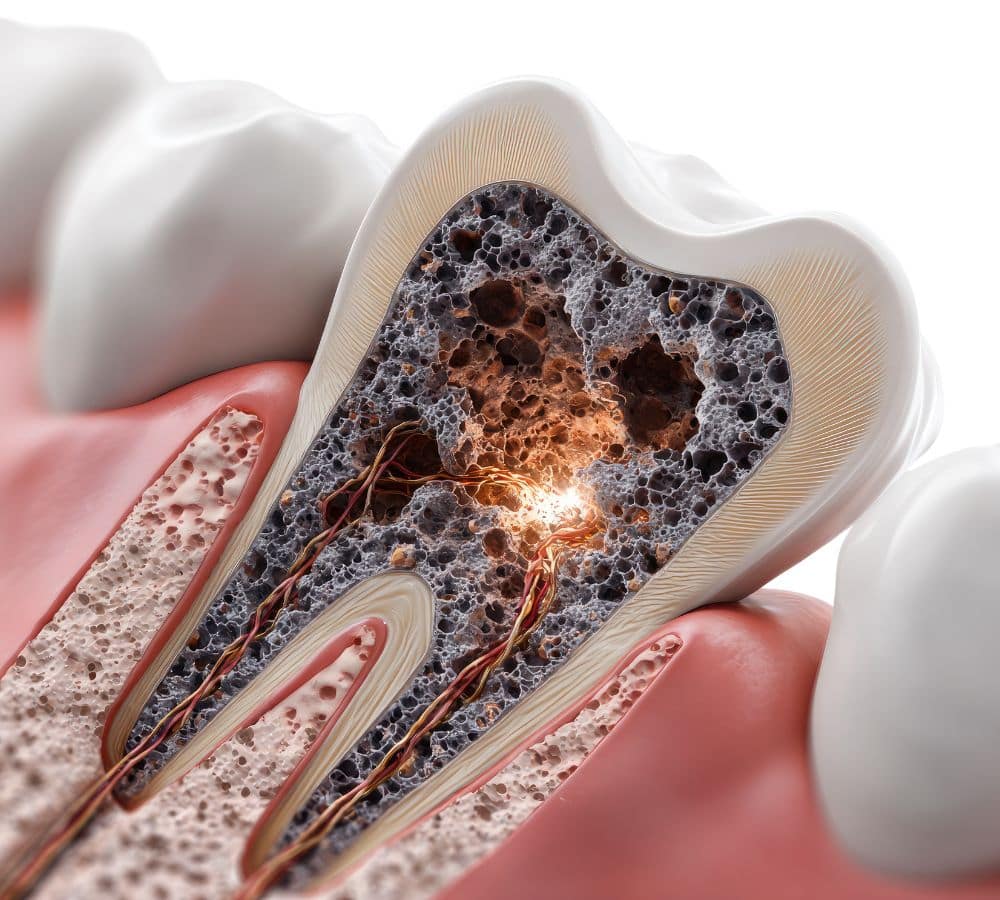
The earliest form of a cavity is a white spot lesion or a brown spot lesion, where mineral has been removed from the tooth surface at a microscopic level.
The tooth still feels hard to touch. There are often no symptoms. The cavity is not yet visible on X-rays.
Not every white mark is decay — what causes white spots on teeth? sets out the alternatives, and in children chalky teeth is a different condition again.
And this is the stage that can be reversed
Early intervention with topical fluoride or specialised products can restore minerals to the tooth structure, preventing the lesion from progressing. The benefits of fluoride explains the chemistry, and selecting a toothpaste — fluoride or non-fluoride? applies it to what you buy.
That is remineralisation — arresting the decay.
The NHMRC describes what fluoride is doing here as two distinct jobs rather than one. It reduces demineralisation — the point at which enamel begins to dissolve — which makes the tooth more resistant in the first place; and it enhances remineralisation, the recovery of weakened enamel, which is what repairs early decay. The NHMRC adds that fluoride also slows the activity of the bacteria that cause decay, and combines with enamel at the tooth surface to make it stronger. So a lesion at this stage is not simply being “painted over”: three separate effects are pushing in the same direction.
That also explains why toothpaste and tap water are not alternatives to each other. On the NHMRC's account, fluoridated water keeps low levels of fluoride in saliva and dental plaque all day, while the much higher concentration in toothpaste offers additional benefit — together they give more protection than either alone. Fluoridated water — is it good for you? covers the water side, including the arguments against.
This is the only stage at which decay can be undone, and it is the entire argument for regular examination. A lesion caught here costs a fluoride application. The same lesion six months later costs a filling. Can you reverse tooth decay, and do I need a filling? is the article that sits squarely on this question; how often should I go to the dentist? is the one that decides which stage yours is found at.
Where the grooves of back teeth are deep enough to be uncleansable, sealing them is the other preventive option — who is a suitable candidate for dental sealants? and, for children, the role of fissure sealants.
Stage 2: dentine caries
If the initial lesion is not reversed, bacteria continue tunnelling through the tooth until they reach the inner dentine layer.
Dentine has a direct link to the nerve, so the tooth may become sensitive to cold or sweetness. What to do if you suffer from sensitive teeth covers the sensations that are worth reporting rather than waiting out.
Sometimes there are no symptoms until very late.
The cavity is now visible on X-rays, and clinically may appear as a shadow. If you have wondered about the radiation, how safe are dental x-rays and how safe are dental X-rays and when do they become unsafe? answer it directly.
The threshold
Once decay is in the dentine, remineralisation is no longer possible and a filling is required. Why do I need a filling? is the same threshold explained from the chair.
Several material options are available, depending on the size and depth of the cavity — dental fillings: porcelain, amalgam or composite resin? and porcelain fillings and composite fillings: differences and costs set them side by side, and tooth fillings is the service page. Where too little tooth remains to fill, the answer becomes a crown — what types of dental crowns are available?.
That sentence marks the point of no return. Everything before it is reversible. Everything after it is a restoration — and every restoration has a finite lifespan and will eventually need replacing. What is restorative dentistry? puts that cycle in context.
The awkward part is worth saying in someone else's words rather than ours. The NHMRC states flatly that once a tooth is filled it becomes structurally weaker and will almost certainly require further treatment in the future. A filling is a repair, not a cure — it restores the shape and function of a tooth that is now permanently a little more fragile than the one you were born with, and it starts a cycle of replacement that continues for the rest of that tooth's life. That is the real cost of crossing from stage 1 to stage 2, and it is not measured in the price of the appointment.
Stage 3: caries involving the pulp
Left long enough, the cavity invades the nerve chamber — the pulp.
Caught quickly enough, nerve death can be prevented by placing a medicament over the pulp and a filling over that.
Left too late, decay causes nerve damage and ultimately death of the nerve and loss of blood supply to the tooth. The tooth then needs root canal treatment — a filling in the nerve chamber — to be restored. Everything you need to know about root canal treatment and root canal treatment: who and what is involved? describe what that means in practice, and endodontist vs dentist for root canal covers who does it.
If the nerve dies and infection escapes the root tip, the next stage is an abscess — what is a tooth abscess? and can a dental abscess affect your general health?.
The NHMRC's summary of untreated decay is short and not reassuring: left untreated, it can have serious, potentially life-threatening consequences. WHO's account of what people actually experience is more granular — pain, discomfort or chronic systemic infection; difficulty eating, speaking, breathing or sleeping; and effects on emotional, mental and social wellbeing. In children WHO notes decay often leads to absence from school; in adults it is associated with absence from work.
The part that should change how you think about pain
Some teeth show symptoms ranging from mild sensitivity to a throbbing, dull ache.
A large percentage undergo nerve death with no symptoms at all.
Absence of pain is not evidence of health. A tooth can progress from a reversible white spot to a dead nerve requiring root canal treatment without ever hurting — which is why decay is found on examination and X-ray rather than reported by the patient. When it does hurt, what are the causes of toothache and what are their symptoms? and how can I relieve a toothache? are the immediate reading, and emergency dentistry is where a tooth that cannot wait is seen.
The conclusion that follows
Along with good oral hygiene and diet, regular check-ups and up-to-date X-rays matter — because they catch cavities at the early stage, where remineralisation is still possible. Your Smile Solutions dental hygienist visit: what to expect and dental cleans and hygienists describe the appointment that does the looking.
If you have ever wondered how decay is counted at a population level, the standard measure is the DMFT index — the number of teeth that are decayed, missing through extraction, or filled. The NHMRC notes that capital letters denote permanent teeth and lower case denotes baby teeth, and that DMFT runs from zero to 32 and dmft from zero to 20. It is a blunt instrument, and note what it does not distinguish: a filled tooth and a decayed tooth score the same. The index counts teeth that have already crossed the line in this article. Nothing at stage 1 appears in it at all.
In an age of minimal-intervention dentistry, prevention of decay is the priority. How do I prevent dental decay? and what can I do to strengthen my teeth? take it from here.
The underlying logic is worth stating plainly: the three stages differ enormously in cost, invasiveness and consequence — and the only thing determining which stage yours is found at is how often someone looks. The price guide shows how far apart those stages sit in dollars.
Common questions
I have a white mark on a tooth. Is that decay?
It might be, and it might be one of several other things — which is why a white mark is worth showing someone rather than watching yourself.
If it is stage 1 decay, it is the good news version: mineral has been lost from the surface, the tooth is still hard, and the process can still be turned around.
If it is dental fluorosis, it is a different story entirely. The NHMRC describes fluorosis as "caused by a high intake of fluoride from multiple sources during the time when teeth are developing inside the jawbone, usually from birth to six or eight years of age", appearing as "white lines or areas on the surface of both primary and permanent teeth" and only identified after the teeth come through. Two points matter for anyone worried about it. First, in Australia "in most cases it is classified as very mild or mild", and the NHMRC states that mild to very mild fluorosis "does not affect the function of the teeth, is not of aesthetic concern to those who have it and is associated with a protective benefit against tooth decay in adult teeth"; moderate fluorosis is very uncommon and severe fluorosis is rare here. Second, it is not caused by correctly dosed brushing — the decline in fluorosis in Australia is linked to measures such as low-fluoride children's toothpaste and guidance to "use only a small pea-sized amount" and to encourage children not to swallow toothpaste.
If it is molar hypomineralisation — chalky teeth — that is a third thing again, and it is covered in my child has chalky teeth, now what?
The practical difference between them is what happens next, and it is not a judgement you can make from a mirror. See what causes white spots on teeth?
My dentist said "we'll watch that one" instead of filling it. Is that fobbing me off?
Almost certainly the opposite, and the reason is in the two NHMRC statements quoted above.
A lesion that has not reached dentine can still remineralise — the NHMRC describes fluoride as "enhancing remineralisation (i.e. recovery of weakened enamel)", which "helps the repair of early tooth decay". And a tooth that is filled unnecessarily does not go back to being an unfilled tooth: "once a tooth is filled, it becomes structurally weaker and will almost certainly require further treatment in the future". Drilling a lesion that could have healed starts a lifetime cycle of replacement that need never have begun.
So "watch it" is a treatment decision, not an absence of one — provided it comes with the rest of the plan attached. What should come with it:
- which stage it is at, and whether it has reached dentine
- what is being done to change the odds — topical fluoride, a change in the frequency of sugar, a sealant where the groove is uncleansable, a fluoride rinse
- when it will be looked at again, specifically, and how it will be compared — the same radiograph view, the same record
- what would change the decision to filling it
If "watch it" arrives on its own, ask for those four. A monitored lesion is only monitored if someone has written down when to look again.
How often do I actually need a check-up? Is six months a real number or a habit?
There is no single interval that is right for everyone, and the honest answer is that it depends on your risk — which is measurable rather than mysterious.
The WHO names three conditions that together produce decay: a continued high intake of free sugars, inadequate exposure to fluoride, and a failure to remove plaque by toothbrushing with fluoride toothpaste containing 1,000–1,500 ppm. The ADA adds the circumstances that raise risk further: poor oral hygiene, low or no fluoride exposure, conditions or medications that reduce salivary flow, exertion resulting in a dry mouth, and sipping drinks other than water during interrupted sleep. The ADA also singles out the age groups where dietary risk concentrates — parents and carers of infants, children and young adults, and older people, for whom it notes increased caries risk "from reduced saliva flow and more exposed root surfaces".
Read down that list honestly and you have your own answer in outline. Someone with no decay history, low sugar frequency, fluoridated water and good plaque control is in a different position from someone with a dry mouth, several old restorations and a daily sweet drink — and the second person is also the one for whom a lesion moves from stage 1 to stage 2 fastest.
What to do with that: ask what your recall interval is based on, and what would shorten or lengthen it. An interval is a clinical judgement about you, not a scheduling default — and since the whole argument of this page is that the stage at which decay is found determines what it costs, it is worth having that judgement made deliberately. See how often should I go to the dentist?
Between appointments, what actually changes my risk?
Four things, in rough order of how much difference they make for the effort involved.
Brush twice a day rather than once, with fluoride toothpaste. The effect of that one change is measurable: research on fluoride and caries prevention records "a 14% reduction in caries increment when moving from once- to twice-daily brushing". Use a paste in the 1,000–1,500 ppm range the WHO identifies — the number is on the tube.
Spit, do not rinse. Rinsing with water straight after brushing washes away the fluoride before it has worked. The same literature found that "rinsing with a non-fluoride mouth rinse soon after brushing with standard fluoride toothpaste may reduce the anticaries protection provided by brushing with a fluoride toothpaste alone", while a rinse containing at least 100 ppm fluoride did not.
Cut the frequency of free sugars before you worry about the total. The ADA's position is that "the form, frequency, timing and total amount of sugar intake are significant", and its consumer ceiling is no more than six teaspoons (24 grams) of free sugars a day. Six separate sweet moments do more damage than one larger one.
Use saliva. It is the mouth's own repair mechanism, and it is why sipping sweet drinks across an afternoon is worse than drinking them. Sugar-free chewing gum helps stimulate saliva flow, and the ADA classes sugar-free confectionery and gums "without added acids" as dentally safe alternatives to sugared versions. Check the label for added acid — the qualifier is doing real work in that sentence.
What none of this replaces: cleaning between the teeth, and being looked at often enough to catch a lesion while it is still at stage 1. See how do I prevent dental decay? and what is the ideal daily routine for oral hygiene?
Related reading
- How do I prevent dental decay?
- How does tooth decay develop?
- Fluoridated water — is it good for you?
- Does chewing sugar-free gum really help prevent cavities?
- What is dental erosion and how is it addressed?
- Protecting your child from dental disease
- General dentistry
Practical details
Written by Dr Maliha Siddiqui.
The figures and positions attributed above to the World Health Organization, the Australian Dental Association and the NHMRC are drawn from those organisations’ own published material, which remains the primary source.
Smile Solutions, Level 1, 220 Collins Street, Manchester Unity Building, Melbourne VIC 3000 — getting here. Phone 13 13 96, contact us, or theteam@smilesolutions.com.au. Monday–Friday 8.00am–6.00pm, Saturday 8.30am–1.30pm, Sunday by appointment. The clinical team is listed by name.
Published 5 December 2013. Progression and treatment vary between individuals and teeth. General information only; it does not replace advice from your treating practitioner.
Smile Solutions trades under ABN 28 193 514 103.
Images on This Page
-
https://www.facebook.com/tr?id=800557773428361&ev=PageView&noscript=1
(no alt text)
-
https://www.smilesolutions.com.au/wp-content/uploads/2025/10/calendar_month.svg
(no alt text)
-
https://www.smilesolutions.com.au/wp-content/themes/arcadian-wordpress-theme/assets/images/smile_solutions_logo_white.png
Smile Solutions Logo
-
https://www.smilesolutions.com.au/wp-content/themes/arcadian-wordpress-theme/assets/images/smile_solutions_logo_purple.png
Smile Solutions Logo
-
https://www.smilesolutions.com.au/wp-content/uploads/2016/05/Maliha-150x150.jpg
Dr Maliha Siddiqui
-
https://www.smilesolutions.com.au/wp-content/uploads/2013/12/Stages-of-Dental-Decay.jpg
Stages of Dental Decay
-
https://www.smilesolutions.com.au/wp-content/uploads/2025/11/TMD-Teeth-Grinding-Smile-Solutions-300x270.png
Woman holding her face, looking concerned.
-
https://www.smilesolutions.com.au/wp-content/uploads/2025/09/CEREC-restorations-Smile-Solutions-300x300.png
CEREC Restoration Smile Solutions
-
https://www.smilesolutions.com.au/wp-content/uploads/2017/03/get-chipped-tooth-fixed.jpg
get chipped tooth
-
https://www.smilesolutions.com.au/wp-content/themes/arcadian-wordpress-theme/assets/images/family_owned_bussiness.png
Family Owned Business
-
https://www.smilesolutions.com.au/wp-content/themes/arcadian-wordpress-theme/assets/icons/icon--phone.svg
Smile Solutions Contact
-
https://www.facebook.com/tr? id=800557773428361&ev=PageView&noscript=1
(no alt text)
-
https://bat.bing.com/action/0?ti=25148060&tm=gtm002&Ver=2&mid=aeafc13b-94cf-46ec-9307-ae07d3566621&bo=1&sid=a24154b0ab2511f1959e6bdd2281449a&vid=a241f050ab2511f19e3655195683360c&vids=1&msclkid=N&pi=918639831&lg=en-US&sw=800&sh=600&sc=24&nwd=1&tl=The%20stages%20of%20dental%20decay%20-%20Smile%20Solutions&p=https%3A%2F%2Fwww.smilesolutions.com.au%2Fdental-articles%2Farticle%2Fstages-dental-decay%2F&r=&evt=pageLoad&sv=2&cdb=AQAQ&rn=995831
(no alt text)