What is restorative dentistry?
The definition
Restorative dentistry is the study, diagnosis and integrated management of diseases of the teeth and their supporting structures.
It involves rehabilitating a patient's dentition to their particular functional and aesthetic requirements.
Those two words — functional and aesthetic — carry the field. A restoration has to work as a tooth and look like one, and different situations weight those differently.
Why tooth structure goes missing
Decay.
Deterioration of a previously placed restoration. Every filling has a finite life, and replacing an old restoration is one of the most common reasons for restorative treatment — which is a useful thing to know before it happens.
Fracture caused by occlusal forces — how hard, or how awkwardly, we bite. This is where grinding and clenching do their damage, and why a nightguard is often part of a restorative plan rather than an afterthought. TMD & Teeth Grinding
Erosion and wear also belong on this list — acid dissolving enamel, tooth grinding against tooth, and abrasive over-brushing. Unlike decay, these are not bacterial, and the answer is to find and stop the cause before restoring anything, or the new work goes the same way. What is dental erosion?
The restorative cycle — the thing to understand first
This is the single most useful concept in the field, and it is rarely explained.
Restorations do not last for ever, and each replacement is larger than the one before it. When a filling is replaced, the old material comes out along with a little more tooth at the margins. Over a lifetime the sequence tends to run:
small filling → larger filling → onlay or crown → root canal treatment and crown → extraction and replacement.
Each step is a reasonable decision at the time. Taken together they describe the slow consumption of a tooth, and the pace is set by how early the first intervention happened and how often it has been redone.
Two practical consequences follow, and both are worth raising with your dentist:
- The best restoration is the one you never need. Prevention is not the boring preamble to this subject; it is the only thing that keeps a tooth out of the cycle.
- “Monitor it” is often the right answer. A stained margin or a small shadow is not automatically a reason to redo a restoration. Replacing a serviceable filling starts the next turn of the cycle — and modern practice deliberately intervenes later and more conservatively than it once did.
Ask: does this need replacing now, or can we watch it? It is a legitimate question and a good clinician will have a clear answer.
The restorations a general dentist provides
Your general dentist is qualified to perform all of the following.
Fillings
The most common type of dental restoration. Teeth can be filled with a tooth-coloured plastic material — composite resin — or a stronger tooth-coloured porcelain.
The choice between them is largely about the size of the cavity. Composite suits smaller restorations; porcelain is generally preferred for medium and large ones, where strength and dimensional stability matter more.
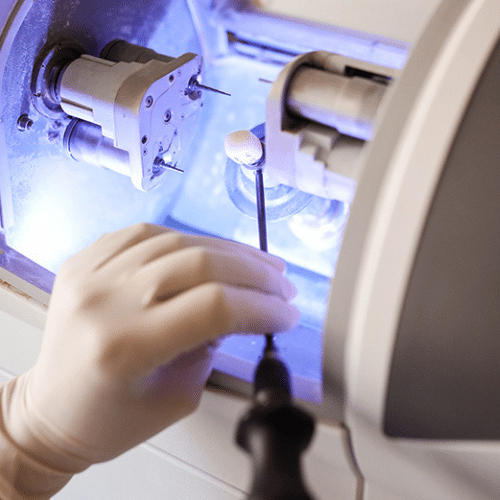
Composite is placed directly, in one appointment, and is repairable — a chip can often be added to rather than replaced. Porcelain is made outside the mouth (in a laboratory, or milled chairside) and bonded in; it is stronger and holds its shape better in large restorations, but ceramic cannot be repaired the way composite can, so damage usually means remaking it.
Tooth Fillings · Not all white fillings are the same · How long do dental fillings last?
Crowns
A tooth-shaped cap cemented over or around a tooth, to restore and protect its shape, size, strength and appearance.
The word doing the work is “protect”. A crown wraps the tooth rather than filling a hole in it, which is why it is used on teeth that are structurally weakened — heavily filled, cracked, or root-canal treated.
Preparing a tooth for a crown is irreversible, and it removes a significant amount of tooth structure all round. An onlay is the more conservative option where enough sound tooth remains: it covers the weakened cusps without reducing the whole tooth. It is worth asking whether an onlay would do the job. Dental Crowns · CEREC Restorations
Bridges
False teeth designed to “bridge” the gap created by one or more missing teeth. Anchored either side by crowns, and permanently cemented.
The cost is in the anchor teeth. Making a conventional bridge means crowning the teeth on either side — cutting down two teeth, often healthy ones, to replace one. And if a bridge fails, it frequently takes an anchor tooth with it, turning a one-tooth gap into a three-tooth problem. Dental Bridges
Implants
A replacement involving a post placed in the bone socket where a tooth is missing.
They do not involve any treatment to the surrounding teeth — which is the principal advantage over a bridge, and the reason implants are generally preferred where the neighbouring teeth are healthy and intact.
Honest qualifications: an implant is a long-term replacement, not a permanent or maintenance-free one. It is surgery, it requires adequate bone (sometimes grafting first), it takes months rather than weeks, and the crown on top is replaced periodically over a lifetime. Implants can also develop gum and bone disease around them — peri-implantitis — particularly in smokers and in people with untreated gum disease, so they need the same daily cleaning and regular review as teeth. Dental Implants · Bone Grafting for Implants
Dentures
A removable replacement for missing teeth, made of acrylic resin, sometimes combined with metal attachments.
They can replace all teeth on an arch, or be designed for an arch missing only a few.
They are the least invasive and least expensive option, are made without surgery, and can replace many teeth at once. The trade-offs are real: they move, they take adjustment, they need relining as the underlying bone changes shape, and they must be taken out and cleaned. Dentures
If a tooth is missing: the actual decision
Four options, and “leave the gap” is one of them.
| Option | Tooth structure removed | Time | Main limitation |
|---|---|---|---|
| Implant | None from other teeth | Months | Surgery; needs adequate bone; highest cost |
| Bridge | Two neighbouring teeth cut down | Weeks | Commits the anchor teeth; harder to clean beneath |
| Denture | None | Weeks | Removable; needs relining; least stable |
| Leave the gap | None | — | Neighbouring teeth drift and tilt; the opposing tooth over-erupts; the bone in the gap recedes |
Leaving a gap is sometimes entirely reasonable — a single missing back molar in an otherwise stable bite often is. But it is a decision, not a non-decision, and the drift it allows can make later replacement harder or impossible. Ask what is likely to happen in your particular mouth over five and ten years.
How long do restorations last
A fair question with an unsatisfying answer: published survival figures are population averages from studies, not predictions for your tooth. What actually determines lifespan:
- How much sound tooth was left when the restoration was placed — the single largest factor
- Where it is — back teeth take far more force than front
- Your bite, and whether you grind
- Your decay risk and gum health
- Your home care, and whether you attend for review
No restoration is guaranteed, and any practitioner offering a guarantee of lifespan is overstating what can be known. What can be done is to make the failure predictable and manageable — reviewing restorations at check-ups, catching a leaking margin before the tooth beneath is lost.
Where the specialties come in
Restorative dentistry may also involve dental specialties — endodontics, periodontics and prosthodontics.
Roughly:
| Specialty | Role in a restorative plan |
|---|---|
| Endodontics | Treating the nerve, so a damaged tooth can be kept and restored |
| Periodontics | Treating gums and bone, so restorations have a healthy foundation |
| Prosthodontics | Complex restoration and replacement of teeth |
These are protected titles in Australia, held only by practitioners on the Dental Board's specialist register after a further three-year full-time qualification. “Restorative dentist” and “cosmetic dentist” are not registered specialties.
The sequencing matters. Gum disease and infection are addressed before crowns and bridges are placed — restorations built on untreated disease fail, regardless of how well they are made.
The usual order of a comprehensive plan: stabilise (pain, infection, active decay) → treat the gums → restore → replace missing teeth → protect (splint, prevention, review). If a proposed plan starts at “restore” and skips the first two stages, that is worth asking about.
Specialist Endodontists · Specialist Periodontists · Specialist Prosthodontists · Complex Dentistry · Dentists & Registered Specialists
At Smile Solutions, specialists in all of these fields practise alongside general dentists in one central location, with extended weekday hours, Saturday mornings, and Sunday by appointment.
Common questions
My dentist says a back tooth is cracked, but nothing shows on the X-ray. Is that a real diagnosis?
Yes, and the radiograph is simply the wrong instrument for it. The European Society of Endodontology's 2024 position statement on longitudinal cracks and fractures of teeth cites Hilton and colleagues reporting that only 2% of cracked teeth with a live pulp had evidence of a crack on a radiograph. A cone-beam CT is not the fix either — the statement records that “CBCT is not predictable in detecting cracks”, though it may show subtle bone loss alongside one. So a crack is diagnosed from the history and the examination: pain on biting or on release, tenderness to tapping, a fracture line running from a restoration margin, transillumination. The same statement cites a practice-based study of 2,858 teeth from 209 dentists in which 45% of cracked teeth were symptomatic, most often with pain to cold (37%), pain on biting (16%) or spontaneous pain (11%) — which is another way of saying that more than half caused no symptoms at all. If you are unconvinced, ask what specifically was found on examination and what the plan is if the crack turns out to run deeper than it looks.
If a cracked tooth is restored, is that the end of it?
Often, but the guidance is unusually frank that it cannot promise so. The 2024 ESE position statement says plainly that “there is no clear evidence on the most suitable restorative treatment approach to manage” cracked teeth. What it does report is a direction of travel: cracked teeth restored with direct bonded composite may be more likely to need root canal treatment or further repair than those restored with cuspal coverage — an onlay or crown that wraps the weakened cusps — and that across the studies it cites, the reported incidence of needing endodontic treatment after restorative management runs between 7.7% and 20%. That is the evidence sitting underneath the onlay-versus-filling conversation described above, and it is why a cracked tooth is reviewed rather than ruled off. Ask which approach is proposed, why, and what happens if the tooth stays sore afterwards.
What actually happens if I leave a cavity alone?
It progresses on a timetable, with a misleading quiet stretch in the middle. The RACGP's account of the sequence is worth reading closely: “Dental decay takes several months to reach the dental pulp. Pulpitis results in pain that is poorly localised. When pulp necrosis finally occurs, there is no pain.” Then, when an acute abscess forms, “a severe well-localised pain develops” — and at that stage the tooth is still treatable by root filling or extraction. The trap is the pain-free interval: the ache stopping is the nerve finishing dying, not the decay stopping. The scale of what gets left is also on record — the AIHW counted roughly 88,600 potentially preventable hospital admissions for dental conditions in 2023–24, a figure covering all preventable dental admissions at all ages rather than infections alone. Whether one small early lesion is filled today or watched is a genuine clinical judgement, and “watch it” is sometimes right. Whether decay that has reached the dentine should be left is not really a judgement call.
Should I have my old silver fillings replaced?
Not on our say-so, and we are going to be straight about why. We looked through the independent sources behind this site and found no regulator or professional-body statement on the safety of amalgam, mercury or composite resin that we could put in front of you — so anyone presenting the question as settled, in either direction, is not drawing on material we are able to show you. What does belong to this page is the restorative logic. An amalgam filling that is intact, sealed and causing no symptoms is a serviceable restoration, and replacing a serviceable filling starts the next turn of the restorative cycle described above: more tooth leaves at the margins, and the replacement is larger than the original. Replacing one because it has fractured, is leaking, has decay beneath it, or because the tooth needs cuspal coverage anyway is an ordinary clinical decision and a different conversation. If the reason offered is appearance, that is a legitimate reason too — but it should be named as cosmetic, priced as cosmetic, and weighed against the tooth structure it costs.
Two dentists have given me different diagnoses and very different quotes. How can both be right?
Both can be defensible, and part of the reason is structural. Australia has no national dental fee schedule, and a consumer submission to the Senate's 2017 inquiry into private health insurance made exactly this complaint: “private patients can go to multiple dentists and receive conflicting diagnoses and widely varying quotes for unpredictable dental fees.” The ADA's own Dental Fees Survey 2022, drawing on 3,535 general dentists in private practice, found “considerable variation in the fees charged within and between states.” The clinical half is real too: the threshold for intervening is a judgement, and modern practice deliberately intervenes later than it once did — so “watch it” and “restore it now” can both be reasonable positions on the same tooth. What to do with two opinions: ask each what was seen, in which tooth, and why now rather than in six months; ask what the more conservative option would be and what the risk of waiting is; and where the two still diverge, that is what a third opinion is for. See Second Opinions & Corrective Dentistry.
Does this article replace an individual dental assessment?
No. It provides general information. Symptoms, suitability, risks and treatment choices depend on examination and, where indicated, imaging or other records from an appropriately registered practitioner.
Related reading
Tooth Fillings · Dental Crowns · Dental Bridges · Dental Implants · Dentures · Root Canal Therapy · Understanding your treatment · Second Opinions & Corrective Dentistry · Price Guide
Practical details
Written by Dr Madeleine Hoopmann.
Smile Solutions, Level 1, 220 Collins Street, Manchester Unity Building, Melbourne VIC 3000. Phone 13 13 96, or theteam@smilesolutions.com.au. Monday–Friday 8.00am–6.00pm, Saturday 8.30am–1.30pm, Sunday by appointment.
Specialist registration can be verified free on the AHPRA public register at ahpra.gov.au, or by calling 1300 419 495.
Published 8 August 2015.
General information only — it is not a diagnosis, a treatment plan, a quote or a promise of any particular clinical outcome, and it does not replace advice from your treating practitioner. All restorative treatment carries risks, including sensitivity, nerve damage requiring root canal treatment, fracture, debonding and failure; crown and veneer preparation is irreversible, and implant placement is surgery with its own risks. No restoration lasts for ever and none is guaranteed — survival figures quoted anywhere are population averages, not predictions for an individual tooth. Which option is appropriate for you can only be determined after examination. Fees are indicative and subject to change; confirm at your consultation.
Smile Solutions trades under ABN 28 193 514 103.
Images on This Page
-
https://www.facebook.com/tr?id=800557773428361&ev=PageView&noscript=1
(no alt text)
-
https://www.smilesolutions.com.au/wp-content/uploads/2025/10/calendar_month.svg
(no alt text)
-
https://www.smilesolutions.com.au/wp-content/themes/arcadian-wordpress-theme/assets/images/smile_solutions_logo_white.png
Smile Solutions Logo
-
https://www.smilesolutions.com.au/wp-content/themes/arcadian-wordpress-theme/assets/images/smile_solutions_logo_purple.png
Smile Solutions Logo
-
https://www.smilesolutions.com.au/wp-content/uploads/2016/05/Madeleine-150x150.jpg
Dr Madeleine Hoopmann
-
https://www.smilesolutions.com.au/wp-content/uploads/2025/09/CEREC-restorations-Smile-Solutions.png
CEREC Restoration Smile Solutions
-
https://www.smilesolutions.com.au/wp-content/uploads/2026/01/Cosmetic-Consult-300x270.jpg
Consultation at a cosmetic clinic.
-
https://www.smilesolutions.com.au/wp-content/uploads/2021/03/Rojina-1-300x270.jpg
Rojina 1
-
https://www.smilesolutions.com.au/wp-content/uploads/2025/11/Smile-Solutions-Whitening-Trays-300x300.png
Professional Take-Home Whitening Trays
-
https://www.smilesolutions.com.au/wp-content/themes/arcadian-wordpress-theme/assets/images/family_owned_bussiness.png
Family Owned Business
-
https://www.smilesolutions.com.au/wp-content/themes/arcadian-wordpress-theme/assets/icons/icon--phone.svg
Smile Solutions Contact
-
https://www.facebook.com/tr? id=800557773428361&ev=PageView&noscript=1
(no alt text)
-
https://bat.bing.com/action/0?ti=25148060&tm=gtm002&Ver=2&mid=2c23a6e9-62ef-4a5c-b6e3-c380ef97ff9a&bo=1&sid=f0eabb20ab2711f1a8d5cdf2fbce3b17&vid=f0eadec0ab2711f19d622b07f5f46a3e&vids=1&msclkid=N&pi=918639831&lg=en-US&sw=800&sh=600&sc=24&nwd=1&tl=What%20is%20restorative%20dentistry%3F%20-%20Smile%20Solutions&p=https%3A%2F%2Fwww.smilesolutions.com.au%2Fdental-articles%2Farticle%2Frestorative-dentistry%2F&r=&evt=pageLoad&sv=2&cdb=AQAQ&rn=339872
(no alt text)