Not all white fillings are the same
One of the most common misconceptions in dentistry is that all white fillings are the same. They are not. There are two fundamentally different types: resin and porcelain.
The comparison Dr Henderson uses: plastic picnic plates versus fine china. Chalk and cheese.
Terminology: plastic white fillings are called composite or resin. Porcelain fillings are called inlays, ceramic, or CEREC restorations.
For the third material in the family, porcelain, amalgam or composite resin? brings amalgam into the comparison; tooth fillings is the service page.
Composite resin fillings
They cost less. They also do not have the same success rate as porcelain or gold.
They need replacing on average every 4 to 5 years, because they:
- cannot withstand heavy chewing pressure and fracture more easily — a particular problem if you grind, see TMD and teeth grinding
- shrink as they set — and the bigger the filling, the more the shrinkage
That shrinkage is the mechanism behind the main failure mode: larger plastic fillings can become leaky, allowing decay around their margins. The failure is often invisible until it is substantial — which is why it shows up on x-rays at a check-up rather than as a symptom.
They also lose colour and lustre over time and can end up looking unattractive.
A note on the 4-to-5-year figure: it describes larger, load-bearing composite restorations, which is what this article is comparing. Small composite fillings in low-stress positions routinely last considerably longer, and cosmetic composite work on front teeth is generally quoted at seven to ten years. The size and position of the filling matter more than the material alone. How long do dental fillings last? breaks that down; will composite bonding look natural, and how long will it last? covers the front-tooth case, and composite bonding is the service page for it.
Porcelain fillings
A lot harder than resin, and more natural looking, blending well with the surrounding tooth.
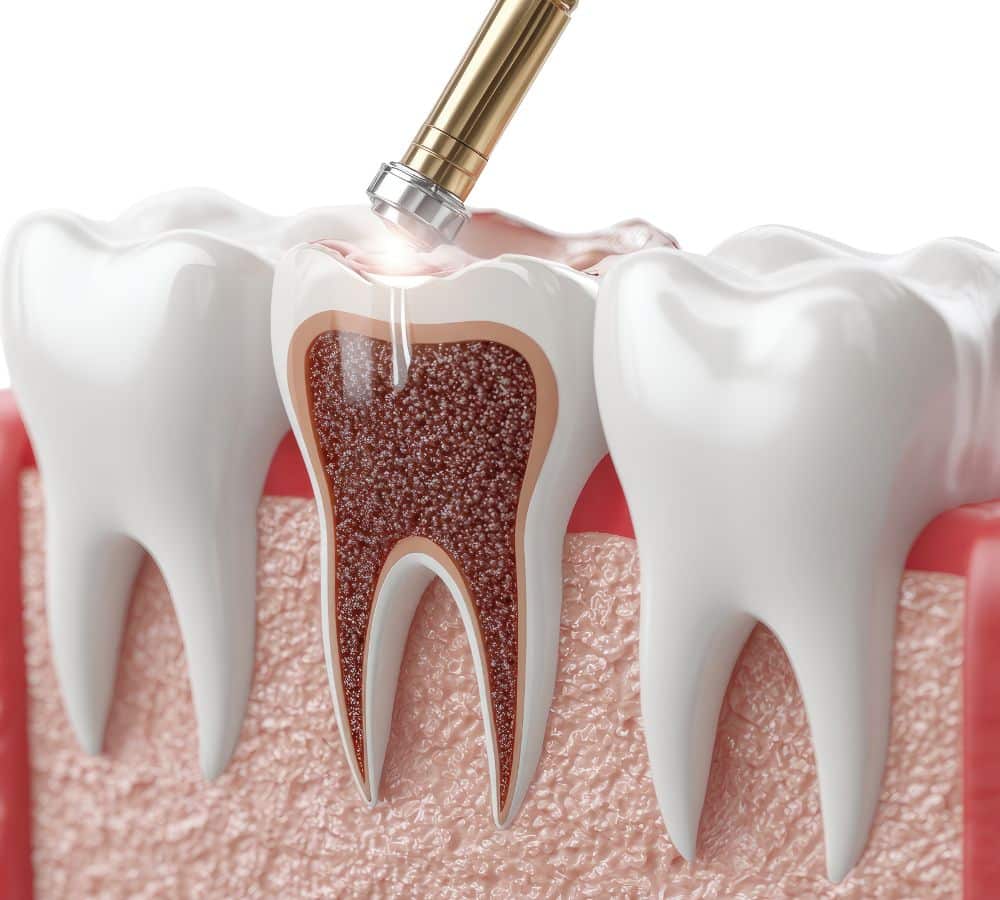
Most are now made chairside while you wait, using CAD/CAM technology such as CEREC — see the CEREC technology in detail and the technology page.
The numbers
Smile Solutions states that chairside porcelain fillings have the same success rate as gold — 93 per cent after 15 years. That figure is the practice's own published claim, reproduced here as such; the underlying study is not named on the origin page, and long-term survival figures for CAD/CAM ceramic restorations vary between studies depending on the material, the size of the restoration and the tooth it is placed in. Ask your clinician what it is based on, and what it means for your particular tooth.
On the same basis, a CEREC porcelain filling is described as lasting 15 years and longer, against 4 to 5 years for a large composite.
Other advantages
- Wear on porcelain is similar to wear on a tooth — so it does not damage the opposing teeth
- With modern bonding techniques there is no need to remove much tooth structure
- The material of choice on molars, which sometimes need a larger filling
- Metal free and biocompatible — a consideration discussed further under holistic dentistry
One shade point worth settling before anything is milled: porcelain does not lighten. If whitening is on your list, do it first, let the shade settle, and match the restoration to the result — I want to whiten my teeth but one of my front teeth has a porcelain crown sets out what it costs to undo that order.
What the CEREC procedure involves
- Examination and X-rays — establishing what needs doing
- Anaesthetic, then removal of all decay and any filling being replaced
- A 3D intra-oral camera photographs the tooth, and the images form a digital model on screen
- The new restoration is designed on the computer from that model — it can be adjusted in size and shape until both dentist and patient are satisfied
- A block of ceramic is placed in the milling unit, and the restoration is milled out of the block to exactly the right size
- Polished, bonded in place, and the bite checked
All in a matter of about an hour, in a single visit. Step 4 is the one patients notice: the design is on the screen and open to comment before anything is made.
The single visit also removes the temporary restoration stage, and with it the problem described in what do I do if a temporary filling comes out? If the appointment itself is the difficulty, dental anxiety sets out the options.
The costs, and how to think about them
| Cost | |
|---|---|
| Composite resin filling | $400 – $600 |
| CEREC porcelain filling | $1,500 – $2,500 |
Porcelain is undoubtedly more expensive. But when you consider that a plastic resin filling may need replacing over and over, the cost differential can prove much smaller than it first appears. Current published fees are in the price guide.
Why any dental quote is a range and not a price
It is worth knowing how dental fees work in this country before you compare two of them, because the structure is unusual: Australia has no national dental fee schedule. There is no government-set or profession-set list of what a filling costs, and, as a 2017 submission to a federal parliamentary inquiry on private health insurance and dental fees put it, there are no consumer guidelines by which to judge whether a dental fee is reasonable — with the result that patients can see several dentists and receive differing diagnoses and widely varying quotes.
The only independent published measure of the spread is the Australian Dental Association’s Dental Fees Survey. Its 2022 edition, drawn from 3,819 valid responses covering fees as at 1 July 2022, found considerable variation in the fees charged both within and between states — on average, general practitioners in SA and WA charged the lowest fees, and those in the ACT and NT the highest, though the ADA cautions that the sample in the two territories was small.
On the direction of travel: across the 122 items surveyed, fees charged by general practitioners rose 3.7% over the two years to July 2022 — modest, and, the ADA suggests, reflecting competitive conditions and the lasting effects of the pandemic. Every service category rose, with the smallest increases in preventive services and periodontics (1.6%) and the largest in orthodontics (6.9%).
Two things follow for the decision on this page. First, the fees quoted above are ours and were current at the date of publication — they are not a market rate, and nothing stops another practice quoting differently for the same work. Second, that is exactly why a written treatment plan and, where the numbers are large, a second opinion are reasonable rather than adversarial. Understanding your treatment sets out what a plan should contain.
The argument beyond price
There is a further consideration, and it is the real reason porcelain gets recommended for large restorations:
Every time a tooth or filling fractures, or is subject to active disease, it creates potential for catastrophic failure — which can require removal of the tooth. Why does a cracked tooth hurt so much? describes that pathway, and chipped and cracked teeth is the service page.
And replacing a missing tooth costs considerably more:
| Replacement | Cost |
|---|---|
| Implant (depending on bone adequacy) | $6,500 – $8,000 |
| Bridge | $6,500 – $7,000 |
| Denture | $1,500 – $2,500 |
Bridges, implants or dentures compares those three properly, and how much do dental implants cost? goes into the implant figure.
So when a dentist recommends a porcelain restoration — crown, inlay or onlay — the aim is the most appropriate long-term solution, preventing a catastrophic failure that is painful, time consuming and costly. What types of dental crown are available? covers the full-coverage end of that range.
Each replacement of a filling also removes a little more tooth. The number of times a tooth can be re-restored is finite. The cheapest version of this whole decision is never needing it — see can you reverse tooth decay? and preventing dental decay.
The cheapest filling is the one you do not need
Since that is the actual lowest-cost option, it is worth stating what the independent guidance says rather than leaving it as a platitude.
The World Health Organization is specific about the mechanism and the threshold. Decay “results when plaque forms on the surface of a tooth and converts the free sugars … contained in foods and beverages into acids that destroy the tooth over time.” Free sugars has a defined meaning: all sugars added to foods and beverages by the manufacturer, cook or consumer, plus sugars naturally present in honey, syrups and fruit juices. Fruit juice counts; this surprises people.
The WHO’s recommendation is that limiting free sugars to less than 10% of total energy intake — and ideally to less than 5% — minimises the risk of dental caries throughout the life course. It also names the other two levers in the same sentence as the sugar one: adequate fluoride exposure, and removal of plaque by toothbrushing with a fluoride toothpaste containing 1000–1500 ppm.
None of that is new advice. It is simply the part of this page with independent evidence behind it, which the fee comparison above does not have. See how does your diet affect your teeth?, sugar: what does it do to your teeth?, the benefits of fluoride and selecting a toothpaste.
Both options are available
It is a matter of working out which suits your expectations and budget. The headline benefit of CEREC over a conventional white filling is that it is a single-visit procedure.
Payment plan options are available. Where a plan is advertised as interest free, that describes the plan term only — a deposit may be required, an establishment fee and ongoing account fees may apply, and charges can apply if the balance is not cleared within the agreed period. The applicable terms depend on the provider and the amount financed, and are set out in writing before you commit — ask what the deposit and the establishment fee are, in dollars, and what the total will be by the end. Payment Plans.
Dr Henderson notes that clinicians and CEREC users at the practice meet weekly to discuss cases and share knowledge — which is how technique in this area improves. If a quote elsewhere does not match the plan described to you, a second opinion is a reasonable step.
Common questions
My dentist says a back tooth is cracked, but the x-ray shows nothing. Is that real?
It very probably is, and the radiograph is the wrong instrument for the job.
The European Society of Endodontology's 2024 position statement on longitudinal cracks and fractures reports that in one study only 2% of cracked teeth with living pulps showed any sign of the crack on a radiograph. Cracks run along the long axis of the tooth, which is the one direction an x-ray beam cannot resolve. Cone-beam CT does not reliably fix that either — the ESE is explicit that CBCT "is not predictable in detecting cracks", though it can show the crestal bone loss that sometimes accompanies one.
What does find them: a bite test designed to reproduce the sharp pain you get on releasing pressure rather than on biting down, fibre-optic transillumination (a craze line or crack blocks the light), staining, removing the existing filling to look underneath, and magnification — the ESE calls a microscope or loupes "critical in detecting dentinal cracks, as well as distinguishing them from craze lines".
Symptoms are an unreliable guide on their own. A practice-based study of 2,858 teeth across 209 dentists found only 45% of cracked teeth were symptomatic at all; the most common complaints were pain to cold (37%), pain on biting (16%) and spontaneous pain (11%). If you are being told about a crack you cannot feel, that is a normal finding, not a sales pitch. Ask to be shown it under the light or on the intra-oral camera.
Why is porcelain being recommended for a cracked back tooth instead of another white filling?
Because a cuspal coverage restoration — an onlay or crown that caps the cusps rather than sitting between them — holds the tooth together instead of wedging it apart. But you should hear the honest version of the evidence, because it is not as settled as it is usually presented.
The ESE states plainly that "there is no clear evidence on the most suitable restorative treatment approach to manage" a cracked tooth. What it does report is a direction: cracked teeth managed with direct bonded composite restorations "may be more likely to require root canal treatment and/or further repair of fractured restorations" than those managed with cuspal coverage — and that across the literature, between 7.7% and 20% of cracked teeth went on to need endodontic treatment after restorative management, whichever route was taken. Its own summary is that current evidence "suggests encouraging outcomes" for cuspal coverage, with early management and the absence of a deep narrow gum pocket being the other two things that improve survival.
The factors the ESE says should decide it in your particular case are worth quoting to your dentist: the extent of the crack, any history of spontaneous pain, the amount of decay, existing fillings, pain on biting, how much sound tooth is left, the contacts with neighbouring teeth, your bite, and whether you clench or grind. The statement warns against a 'one fits all' approach. So the fair question is not "is porcelain better" but "which of those factors applies to this tooth".
Does having a filling make a tooth more likely to crack later?
It is one contributor among several, and the picture has shifted.
The ESE lists "stress generated from restorative procedures" and "thermal expansion, contraction, and/or corrosion of restorative materials" as contributory factors in cracked teeth, alongside predisposing factors you did not choose: the tooth's own cusp shape, its position at the back of the mouth, your bite, your diet and clenching or grinding. Age matters independently — cracks are most prevalent in people over 40, because dentine becomes less resilient and more prone to crack propagation as the mineral-to-collagen ratio changes.
The part worth knowing is that this is no longer simply a restored-tooth problem. The ESE notes that while cracks were historically associated with filled teeth, "over the last two decades studies have reported an increasing incidence of cracks in unrestored teeth", and that the reported prevalence of visible coronal cracks runs as high as 70%. So a crack is not automatically evidence that previous dentistry was at fault, and an unfilled tooth is not immune.
What you can change is the loading. Managing clenching and grinding, and correcting an interfering bite, is the part the ESE singles out as "essential to reduce the likelihood of the propagation of existing cracks".
Do I have to replace a filling just because it is old?
No — and this is worth pushing back on politely, because age alone is not a clinical finding.
The reasons to replace a filling are the ones this page describes as failure modes: leakage at the margins with decay underneath, a fracture in the filling or the tooth around it, or a crack the restoration is no longer protecting. Those are things a clinician can show you — on a radiograph, on the intra-oral camera, or with the probe. A date is not one of them.
So the question to ask is: what did you see, and what happens if we monitor it instead? Both answers should be available. Where a filling is being watched rather than replaced, ask for it to be recorded in your notes with a review date, so that the decision is tracked rather than re-argued at each visit. For large numbers, the 2017 parliamentary submission quoted above makes the case bluntly: patients can see several dentists and get differing diagnoses and widely varying quotes, which is precisely the situation a second opinion exists for.
Should I tell the practice I have private health cover?
Yes — you cannot be quoted an out-of-pocket figure or have a claim processed without it, and withholding it only makes the estimate wrong.
But there is a documented concern to be aware of, and it is fairer to state it than to leave it unsaid. The same 2017 submission to the federal parliamentary inquiry into private health insurance and out-of-pocket costs argued that "the disclosure of private health fund status can result in excessive and unnecessary dental treatment or 'over-servicing'". That is one submitter's argument to a parliamentary inquiry rather than a measured finding, and it should be read as such — but the protection against it is simple and costs nothing.
Ask for the treatment plan in writing, with the reason for each item, before any claiming is discussed. Ask which items are being done now and which could reasonably wait. If the plan changes after your cover is disclosed, ask what clinical finding changed with it. A plan that is justified tooth by tooth is one you can take elsewhere for a second opinion — and that portability is the real safeguard.
Related reading
- What does restorative dentistry mean? — every option on one map
- What does restorative dentistry involve?
- Why do I need a filling?
- The stages of dental decay
- What is the difference between porcelain crowns and veneers?
- Why do I bite my cheek after a filling?
- What to do if you suffer from sensitive teeth
Practical details
Written by Dr Peter Henderson (DEN0001406311), Registered Dentist, General Registration, Smile Solutions. Dr Henderson’s registration can be verified free on the AHPRA public register at ahpra.gov.au. The full clinical team is listed by name.
Smile Solutions, Level 1, 220 Collins Street, Manchester Unity Building, Melbourne VIC 3000 — getting here. Phone 13 13 96, contact us, or theteam@smilesolutions.com.au. Monday–Friday 8.00am–6.00pm, Saturday 8.30am–1.30pm, Sunday by appointment.
Published 24 November 2018. Fees quoted were current at that date and are indicative only — confirm at your consultation. Success-rate and lifespan figures are as published by the practice; no study is cited for them on the source page. Restoration lifespans vary with the individual, the size of the restoration and oral habits. Third-party fee survey figures are the ADA's, not ours, and relate to the period stated. General information only; it does not replace advice from your treating practitioner. Payment plan terms are set by the credit provider and change; confirm current terms directly before you commit.
Smile Solutions trades under ABN 28 193 514 103.
Images on This Page
-
https://www.facebook.com/tr?id=800557773428361&ev=PageView&noscript=1
(no alt text)
-
https://www.smilesolutions.com.au/wp-content/uploads/2025/10/calendar_month.svg
(no alt text)
-
https://www.smilesolutions.com.au/wp-content/themes/arcadian-wordpress-theme/assets/images/smile_solutions_logo_white.png
Smile Solutions Logo
-
https://www.smilesolutions.com.au/wp-content/themes/arcadian-wordpress-theme/assets/images/smile_solutions_logo_purple.png
Smile Solutions Logo
-
https://www.smilesolutions.com.au/wp-content/uploads/2016/05/Peter-150x150.jpg
Dr Peter Henderson
-
https://www.smilesolutions.com.au/wp-content/uploads/2018/12/Dental-Filling.jpg
Dental Filling
-
https://www.smilesolutions.com.au/wp-content/uploads/2026/04/PH-300x270.jpg
PH
-
https://www.smilesolutions.com.au/wp-content/uploads/2026/01/157-300x270.jpg
Brush and dental material close-up
-
https://www.smilesolutions.com.au/wp-content/uploads/2017/06/whats-new-in-cosmetic-dentistry-300x143.jpg
whats new in cosmetic dentistry
-
https://www.smilesolutions.com.au/wp-content/themes/arcadian-wordpress-theme/assets/images/family_owned_bussiness.png
Family Owned Business
-
https://www.smilesolutions.com.au/wp-content/themes/arcadian-wordpress-theme/assets/icons/icon--phone.svg
Smile Solutions Contact
-
https://www.facebook.com/tr? id=800557773428361&ev=PageView&noscript=1
(no alt text)
-
https://bat.bing.com/action/0?ti=25148060&tm=gtm002&Ver=2&mid=63e9f2e2-12fb-416d-a4a8-43049e0a880d&bo=1&sid=01724760ab2811f1a3f07b6698c141da&vid=01728940ab2811f18e2eadda901104bd&vids=1&msclkid=N&pi=918639831&lg=en-US&sw=800&sh=600&sc=24&nwd=1&tl=Porcelain%20fillings%20and%20composite%20fillings%3A%20What%20are%20the%20differences%20and%20costs%20involved%3F%20-%20Smile%20Solutions&p=https%3A%2F%2Fwww.smilesolutions.com.au%2Fdental-articles%2Farticle%2Fdifferences-porcelain-fillings-composite-fillings%2F&r=&evt=pageLoad&sv=2&cdb=AQAQ&rn=551092
(no alt text)