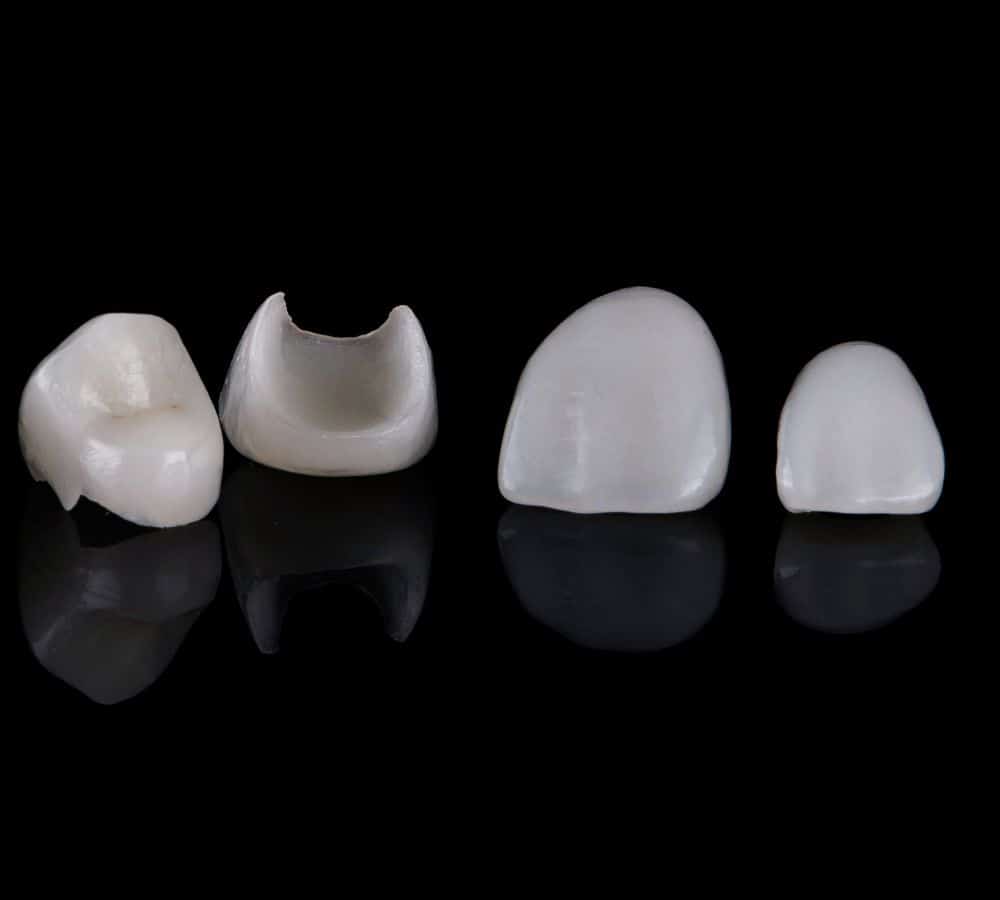
Crowns and veneers — what is the difference?
Both are tooth restorations used to restore the teeth and mouth to function. See Dental Crowns and Porcelain Veneers.
In cosmetic dentistry, stained, discoloured and mildly crooked teeth can be corrected with porcelain veneers or composite fillings, particularly where a patient does not want orthodontic treatment. Both can also increase the length and size of small teeth. See Cosmetic Dentistry and Cosmetic dentistry options.
The distinction that matters is how much of the tooth is involved, and what job the restoration is doing.
Porcelain crowns
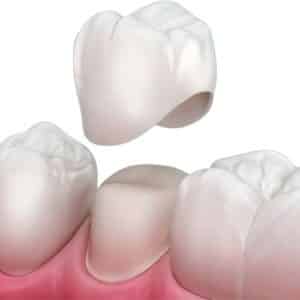
Crowns — or “caps” — are porcelain restorations that fully encapsulate the tooth.
When a crown is recommended
- when a tooth is heavily restored and has a higher likelihood of fracturing — see Chipped and Cracked Teeth and Tooth Fillings
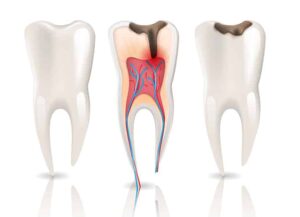
- after root canal treatment, to protect the tooth from splitting or re-infection — see Root canal treatment: who and what is involved?
The cost of that protection
Because crowns encompass the whole tooth, they can be quite destructive — they require a lot of tooth to be drilled away.
That is the trade-off in a sentence: a crown protects a compromised tooth, at the price of removing more of it.
Where a full crown is more than the tooth needs, a bonded porcelain onlay made in one visit may do the same structural job with less preparation — see Same-Day CEREC Restorations.
Porcelain veneers
Just like false fingernails — thin layers of porcelain strongly bonded to the underlying tooth surface.
What they do
Veneers improve tooth shape, shade and, in many cases, inclination in natural-looking ways. They can also mask tooth crowding, which offers a quicker route than lengthy orthodontic treatment — though this is not always recommended, because the underlying alignment problem remains. See Invisalign and How do I know which orthodontic treatment is best for me?.
Porcelain veneers usually require some tooth preparation to make space for the porcelain to bond and achieve the desired result.
How they are made
- An accurate impression of the prepared teeth is taken and sent to a laboratory, where the veneers are hand-fabricated — see Smile Solutions Laboratory
- Temporary plastic veneers may be placed during fabrication. Where the case allows, that stage can sometimes be avoided — see Same-Day Porcelain Veneers and The case for same-day porcelain veneers
- The final veneers are tried in and checked for fit, shape and colour
- Once approved, they are cemented with a strong bonding resin cement
Materials have improved: veneer materials now exist that are three to four times stronger than traditional porcelain veneer material.
Why quality matters more here than with most restorations
Beware cheap imitations. Poorly fitting veneers can:
- cause gum problems, including bleeding — see Bleeding Gums
- promote dental decay
- look unsightly and unnatural if not designed and fabricated to a high standard
Much of the success of veneers depends on the clinician's ability to preserve tooth structure while mimicking nature — two goals that pull against each other, which is what makes the work difficult. For what happens when that goes wrong overseas, see Turkey teeth: the real risks of getting veneers overseas and Dental tourism: the risks involved.
Afterwards
A splint or night guard is often recommended after veneer treatment, to protect the new restorations from night-time grinding. See TMD and Teeth Grinding and Night-time tooth grinding and clenching.
On lifespan, see How long do porcelain veneers last? and What happens to my teeth after dental veneers, and will I ever get cavities?.
Composite veneers
Similar in concept — a thin layer of material bonded to the front of the tooth to address shape, shade and inclination. The material is composite, which is inherently weaker and less attractive than porcelain, though many experienced clinicians achieve excellent natural results with it. See Composite Bonding and Edge Work & Composite Bonding.
The big advantage
The tooth underneath rarely needs preparation or drilling. The material is bonded directly to untouched tooth.
Because of that minimally invasive character, composite veneers can be a good interim option — around three to five years — for younger patients, whose teeth are still changing and who should not have irreversible preparation done early.
The limitations
- More porous than porcelain, so composite stains and chips over time and may need regular polishing
- The larger the restoration, and the more of them, the harder it becomes to control size, shape and colour using direct composite
- If many teeth, or large portions of teeth, are involved, porcelain veneers may be the preferred option
What is the difference between composite veneers and porcelain veneers? and What are the differences between dental bonding and veneers? go into that comparison in full.
The differences, in summary
In the hands of the right clinician, both crowns and veneers have excellent longevity.
| Crowns | Veneers | |
|---|---|---|
| Coverage | Encase the whole tooth | Cover the front surface |
| Tooth removed | Considerable — often much of the enamel | Minimal; some require little to none |
| Primary purpose | Protect root-canal-treated teeth from re-infection and splitting; prevent heavily restored teeth from fracturing | Address appearance — shape, shade, inclination |
| Protects a fracture-prone tooth | Yes | No |
The short version: a crown is a structural solution, a veneer is a cosmetic one. Choose by what the tooth needs, not by which sounds less invasive.
And before either: whitening does not change the colour of porcelain or composite, so the shade decision comes first. See Teeth Whitening and I want to whiten my teeth but one of my front teeth has a porcelain crown.
If whitening is part of the sequence, it is worth knowing who may lawfully supply what. Under Schedule 10 of the Poisons Standard, whitening products containing more than 6% hydrogen peroxide, or more than 18% carbamide peroxide, may only be sold, supplied and used by registered dental practitioners as part of their dental practice — provisions the Australian Dental Association notes are formalised in all state and territory poisons legislation. The ADA also gives the conversion that explains the two numbers: one-third of a carbamide peroxide concentration is equivalent to hydrogen peroxide, so 18% carbamide peroxide approximates 6% hydrogen peroxide. That is the reason a pharmacy kit and a dentist-supplied kit are not the same product — see what is the difference between pharmacy whitening kits and dentist whitening?.
What this page deliberately does not tell you
There is no independent, peer-reviewed survival data in front of us that compares porcelain crowns with porcelain veneers over a defined follow-up period, so we are not going to quote you a percentage or a number of years for either. Longevity figures for cosmetic restorations are easy to find online and almost always come from the practice quoting them.
The honest position: both depend heavily on how much sound tooth is left underneath, on the bond, on your bite, and on whether you grind. Ask your clinician what the expected lifespan is for your tooth, what the likely failure mode is, and what replacing it would involve — and treat a confident single number about restorations in general with suspicion, including ours. Understanding your treatment covers what a written plan should contain.
Who does the work, and how to check
The Dental Board of Australia recognises 13 dental specialties, approved by the Australian Health Workforce Ministerial Council. Prosthodontics — the specialty concerned with crowns, veneers, bridges and dentures — is one of them.
Specialist registration is not simply a longer degree. Alongside an approved specialist qualification, the Board requires that a practitioner has completed a minimum of two years general dental practice (which may be achieved by experience outside Australia, subject to assessment and approval by the Board).
Why it matters when you are comparing quotes: recognised specialist titles are protected titles under the National Law, and misuse of one is an offence. So the word prosthodontist is a verifiable fact about a person, not a marketing adjective — and it takes about a minute to check. See dentists and registered specialists and why would I need to see a dental specialist?.
Cost
Fees are on the Price Guide, with Payment Plans for spreading them. How much does a dental crown cost in Melbourne? breaks the crown side down by material.
One reason any dental fee is quoted as a range rather than a price: Australia has no national dental fee schedule. The ADA’s Dental Fees Survey 2022, drawn from 3,819 valid responses as at 1 July 2022, found considerable variation in the fees charged within and between states — with general practitioners in SA and WA charging the lowest fees on average and those in the ACT and NT the highest, though the ADA cautions that the sample in those two territories was small. Across the 122 items surveyed, fees charged by general practitioners rose 3.7% over the two years to July 2022, with the smallest rises in preventive services and periodontics (1.6%) and the largest in orthodontics (6.9%).
For specialist work the spread is wider still. Of the specialists who responded, 20% charged an hourly rate, and among those the mean hourly rate was $921 in 2022, up from $662 in 2020, with a median of $800 and a range running from $450 to $1,500 per hour. The ADA itself says the specialist results should be interpreted with considerable caution given the low response rate. We quote them here not as our fees — ours are on the price guide — but because they are the only independent published figures on the subject, and they tell you that a single quote is not a market price.
Payment plan options are available. Where a plan is advertised as interest free, that describes the plan term only — a deposit may be required, an establishment fee and ongoing account fees may apply, and charges can apply if the balance is not cleared within the agreed period. The applicable terms depend on the provider and the amount financed, and are set out in writing before you commit — ask what the deposit and the establishment fee are, in dollars, and what the total will be by the end. Payment Plans.
Common questions
So is there any independent survival data at all — for either of them?
For veneers, yes. For the comparison this page is about, still no — which is why the section above declines to give you one, and that position has not changed.
What does exist is survival data for porcelain laminate veneers on their own. A systematic review of 25 studies covering 6,500 veneers, with a minimum follow-up of three years, calculated a 10-year cumulative survival rate of 95.5% when fracture, debonding, secondary caries and the need for root canal treatment were all counted as failure — 433 of the 6,500 failed. Taken in isolation, the 10-year figures were 96.3% for fracture, 99.2% for debonding, 99.3% for secondary caries and 99.0% for needing root canal treatment. Fracture was the commonest complication, then debonding, and both occurred mostly within two years of cementation.
Now the part that shows why a single number is untrustworthy. A different review of randomised trials, with follow-up from 24 to 97 months, puts pooled survival at 88% (95% CI 81–94%) — well below 95.5%. Another summarises systematic reviews with follow-up ranging from 5 to 21 years and finds survival rates anywhere from 87% to 96%. The reviews are not measuring quite the same thing: definitions of failure differ, follow-up periods differ, and whether a chip that was polished counts as a failure differs. One review notes bluntly that definitions across studies ranged from “loss of function” to far stricter criteria.
There is a further honest caveat. Several of these reviews record that their estimates become unreliable in the final years, because so few restorations are still being followed — one notes that the number at risk drops sharply from around year 10 or 11.
So the fair summary is that porcelain veneers are a well-documented restoration with survival in the high eighties to mid nineties at ten years, depending on how failure is counted — and that nobody has run the equivalent study comparing them head to head with crowns on teeth that could have had either. Your tooth is the variable that matters, not the category.
The dentist says crown, I would rather have a veneer. How do I tell who is right?
By what the tooth needs structurally, and there are independent Australian statements that draw the line more plainly than most practices do.
On crowns, the Australian Dental Association's consumer site states: “A crown may be recommended by a dentist to fix a badly broken, cracked or decayed tooth. They are commonly recommended for teeth that have had a root canal treatment, particularly for premolar and molar teeth.” It also describes what that involves without softening it: “Artificial crowns are created to fit over the natural tooth after it has been cut back.” The stated benefit is that a crown “can make the tooth stronger and protect the tooth inside the crown.”
On veneers, healthdirect — the Australian Government-funded health information service — is explicit about the limits, and each sentence rules something out:
- “They're not used to repair damage, but can help restore worn teeth.”
- “Veneers don't straighten your teeth or fix your bite.”
- “Veneers don't fix tooth decay or problems with your bite.”
- “Veneers may not be suitable if you grind or clench your teeth or if you have gum disease.”
Read those against your own situation. If the tooth is broken, cracked, heavily filled or root-treated, a veneer is being asked to do a job that two independent Australian sources say it does not do — and the answer is not a matter of taste. If the tooth is structurally sound and the complaint is shade, shape or a small chip, then a crown is removing more tooth than the problem requires, and that is worth questioning just as firmly.
The useful question in the chair is therefore not crown or veneer but: how much sound tooth is left, are the cusps supported, and what is the failure mode you are trying to prevent? If the answer is fracture, the restoration has to cover the cusps. If the answer is appearance, it does not. Ask to see the radiograph and the photographs while that is explained, and ask what happens if nothing is done for six months. See understanding your treatment and second opinions and corrective dentistry.
What actually happens at the appointments?
Different numbers of visits, and the difference is worth knowing before you book time off.
For a crown, the ADA's consumer guidance describes the standard sequence as two appointments. At the first, “the dentist will cut back the tooth to reshape it … to make sure there is enough space for a new crown to fit on the tooth.” A copy of the tooth is then taken for the laboratory, either by an impression — a tray of soft, gel-like material held in place for three to five minutes — or by a digital scanner capturing a 3D image. A temporary plastic crown goes on before you leave. At the second visit the temporary comes off and the new crown is glued or cemented onto the natural tooth structure. The ADA notes that some dentists now provide same-day crowns, start to finish in one day.
For a composite veneer, healthdirect is clear that it is one visit: the composite is applied directly to the front of the tooth in layers, then shaped and polished in the chair, with the shade matched to the surrounding teeth. It adds that “a small amount of your natural tooth may need to be trimmed so that the veneer fits well,” and that a local anaesthetic may be used for that step.
For a porcelain veneer, the ADA says the treatment “usually needs at least two appointments”, because the veneers are made by a technician in a laboratory from an impression or 3D scan. Where a practice has chairside milling, healthdirect notes the veneers can be made on site and fixed straight away.
One detail worth asking about: healthdirect also mentions that your dental professional may ask you to come back after a couple of weeks to check the veneers. Ask whether that review is included in the quote.
Will I ever need anything done to them again — and how do I clean them?
Yes, eventually, and the Australian Dental Association's consumer site says so without hedging:
“Having a crown, bridge or veneer does not mean no treatment will ever be needed again for the tooth or teeth. These teeth can still be damaged by tooth decay. Sometimes crowns, bridges and veneers can chip, fracture or no longer match the colour of your teeth and need to be replaced.”
Healthdirect lists the same risks for veneers from the patient's side: the veneer could crack or fall off; teeth could become more sensitive because some enamel is removed; if the gum shrinks, the edges of the veneers may become visible; the colour cannot be changed afterwards; and the other teeth may discolour and no longer match. Its strongest longevity statement is simply that “veneers should last for years” — it deliberately puts no number on it.
On cleaning, the ADA's instruction is the ordinary one done properly: brush twice a day with fluoride toothpaste and clean between the teeth every day. Two specifics are worth knowing:
- A bridge cannot be flossed in the usual way. Because the crowns making up a bridge are joined together, floss cannot be passed between those teeth. The ADA's advice is to have your dentist show you how to clean beneath the bridge, using superfloss, floss threaders or interdental brushes.
- The margins are the part that matters. Decay under a restoration starts where the material meets the tooth, usually at or just below the gum. Ask for those margins to be checked and recorded at each hygiene visit rather than assumed. See dental cleans and hygienists.
And the budgeting point, because it is the one people leave out when comparing quotes: plan on the restoration needing attention at some stage, and ask now what a replacement would involve and cost. A restoration is an ongoing commitment rather than a purchase.
Practical details
Smile Solutions has registered specialist prosthodontists on site and an in-house dental laboratory, so the ceramist and clinician can work together on shade and shape. The clinicians are listed on Our Team; registration can be verified free on the AHPRA register, or by calling 1300 419 495.
Smile Solutions, Level 1, 220 Collins Street, Manchester Unity Building, Melbourne VIC 3000. Phone 13 13 96, or theteam@smilesolutions.com.au. Monday–Friday 8.00am–6.00pm, Saturday 8.30am–1.30pm, Sunday by appointment. Full details on Contact Us.
Published 29 November 2018. Results and durability vary between individuals. General information only; it does not replace advice from your treating practitioner. Payment plan terms are set by the credit provider and change; confirm current terms directly before you commit. Veneer survival figures in the questions above are from published systematic reviews and describe those study populations, not this practice's results; consumer statements are attributed to healthdirect Australia (last reviewed February 2025) and to the Australian Dental Association's consumer site.
Smile Solutions trades under ABN 28 193 514 103.
Images on This Page
-
https://www.facebook.com/tr?id=800557773428361&ev=PageView&noscript=1
(no alt text)
-
https://www.smilesolutions.com.au/wp-content/uploads/2025/10/calendar_month.svg
(no alt text)
-
https://www.smilesolutions.com.au/wp-content/themes/arcadian-wordpress-theme/assets/images/smile_solutions_logo_white.png
Smile Solutions Logo
-
https://www.smilesolutions.com.au/wp-content/themes/arcadian-wordpress-theme/assets/images/smile_solutions_logo_purple.png
Smile Solutions Logo
-
https://www.smilesolutions.com.au/wp-content/uploads/2023/11/SS-Tooth-1-1-150x150.png
Smile Solutions
-
https://www.smilesolutions.com.au/wp-content/uploads/2018/11/Crowns-and-veneers.jpg
what is the difference between crowns and veneers
-
https://www.smilesolutions.com.au/wp-content/uploads/2025/09/Root-Canal-2-300x217.jpg
Root Canal
-
https://www.smilesolutions.com.au/wp-content/uploads/2026/08/Mouth-Breathing-300x270.jpg
Mouth Breathing
-
https://www.smilesolutions.com.au/wp-content/uploads/2025/09/Dental-Crown-at-Smile-Solutions-300x300.jpg
Dental Crown at Smile Solutions
-
https://www.smilesolutions.com.au/wp-content/themes/arcadian-wordpress-theme/assets/images/family_owned_bussiness.png
Family Owned Business
-
https://www.smilesolutions.com.au/wp-content/themes/arcadian-wordpress-theme/assets/icons/icon--phone.svg
Smile Solutions Contact
-
https://www.facebook.com/tr? id=800557773428361&ev=PageView&noscript=1
(no alt text)