How do I know which orthodontic treatment is best for me?
The appliance matters less than the diagnosis. Metal braces, ceramic braces, lingual braces and clear aligners can all produce excellent results — but they are not interchangeable across every case, and which is appropriate depends on what needs to move and how far.
The reassuring part: it is never too late to straighten your teeth, as long as they and the supporting gums are healthy.
Very few people go through life never needing any orthodontic treatment. The difficult part is deciding which type is right and who should provide it. See Orthodontics for the overview.
The Australian Dental Association's own description of the field is a useful starting point: "Orthodontics is a specialty field in dentistry that involves the diagnosis, prevention, and correction of crooked teeth, jaws, and unfavourable bite patterns", and it notes that while "Dentists that specialise in this treatment are called orthodontists", "Many general dentists also perform orthodontic treatment."
Adults are often ideal patients
Many of today's adults did not have the opportunity to have braces when they were younger, and now that they can make their own decision, some wonder whether their teeth will still move, or whether braces are the right look at their age.
Teeth move at any age. And in many cases adults are ideal patients: because they have chosen treatment themselves, rather than having a parent decide, they tend to look after their appliances — which materially helps the orthodontist achieve the planned result. See Is having Invisalign as an adult worth it?.
For children, the ADA gives an age range for the first assessment rather than for the first appliance: "The Australian Society of Orthodontists' recommend children have an orthodontic assessment between the ages of 7 – 10", and "All the adult teeth do not have to be present in the mouth for an assessment to be done."
The appliance options
Traditional braces
Still widely used, now in both metal and ceramic versions. In the ADA's words, "Traditional metal braces have been used for about a hundred years and are still commonly used to straighten teeth."
Metal braces are made from high-grade stainless steel, and are now considerably smaller in profile than they once were. The brackets are bonded to the tooth surfaces with cement, and linked by a thin arch wire that applies pressure to move the teeth into the desired position.
Ceramic (clear) braces work in exactly the same way, but the brackets are made from a clear ceramic material that is less visible — a popular choice for people concerned about the appearance of metal. The ADA sets the expectation precisely: ceramic braces are "the same as metal braces but made from white or tooth-coloured ceramic material. They are not completely invisible but are less obvious than metal braces." The main drawback: the clear elastic module holding the wire can discolour with certain foods.
Fixed braces remain the appliance with the widest range of achievable movement and the longest track record. See Orthodontic Braces.
Lingual braces
Similar to traditional metal braces, but cemented to the inside surfaces of the teeth. The ADA describes them as "metal braces" that are "stuck to the inside surface of the teeth making them practically invisible". They are custom made for your teeth, with a custom series of wires.
The trade-off: speech may be slightly affected while you adapt, since the brackets sit on the tongue side.
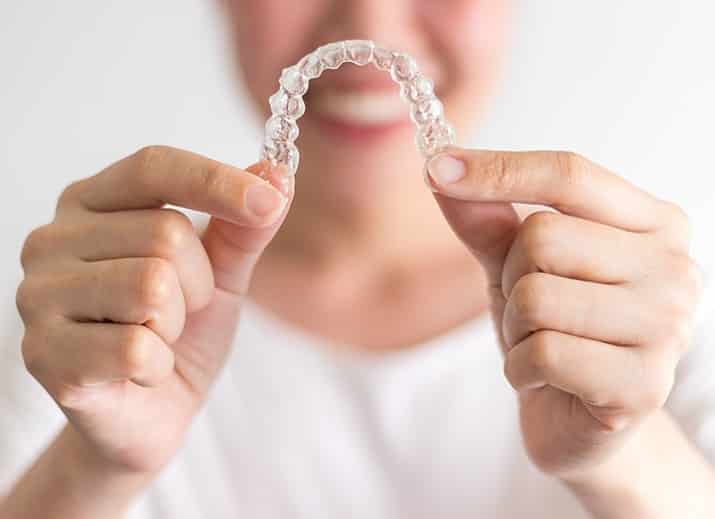
Invisalign
A series of custom-made clear trays, designed to perform similarly to braces and achieve similar results in suitable cases. The trays are worn 20 or more hours a day, removed for eating, drinking and cleaning — the ADA's version of the same rule is that "The trays should be worn at all times other than when eating and drinking liquids other than water." Each change of aligner — on average every two weeks — moves the teeth slightly further under slow, continuous pressure.
Two expectations worth setting from the same source: "Although the aligners are clear plastic, they are not invisible", and "Drinking liquids such as fruit juice or soft drink while wearing clear aligners can trap the liquids against the teeth, which can cause damage to the teeth if it happens frequently."
Popular with adults, and available for teenagers. The critical variable is compliance: an appliance you can remove is an appliance you can leave out, and treatment stalls if the wear time is not met. See Invisalign and Why should I choose a Blue Diamond Invisalign provider?, which sets out what aligners do less well.
What the ADA advises against
One option that looks like a fourth choice is not one. On aligners supplied directly to consumers without an in-person examination, the ADA "do not recommend Australians have DIY orthodontic treatment. There are many risks to this treatment. They can lead to permanent damage to your teeth, gums, and jaw joints." It recommends instead in-person treatment "which includes a thorough assessment before starting treatment and ongoing supervision".
How long does treatment take?
Treatment length varies from patient to patient:
| Complexity | Typical duration |
|---|---|
| Mild issues | As little as six months |
| Average case | 18 to 24 months |
| Complex cases, particularly involving jaw surgery | Three years or more |
Duration also depends on compliance — following your orthodontist's instructions and attending all scheduled appointments is what allows a case to finish in the shortest possible time.
The benefits beyond appearance
Orthodontic treatment is not only cosmetic. The ADA puts it this way: "Orthodontic treatment is not just about straight teeth. It can correct a bad biting pattern, help with sleep apnoea, and prevent uneven wear of the teeth."
- Straighter teeth are easier to clean, which supports long-term oral health
- Crossed and crowded teeth accelerate wear and impede cleaning
- Teeth sometimes need aligning before restorative or cosmetic work can be carried out properly — see Porcelain Veneers and Prosthodontists, since moving a tooth into the right position first often means the restoration afterwards can be far more conservative
One of those deserves a caveat rather than a promise. On the airway claim specifically, a 2024 systematic review update in Journal of Clinical Medicine looking for controlled prospective evidence on rapid maxillary expansion in paediatric obstructive sleep apnoea found a "single RCT that found no significant difference in AHI change between RME and observation", and of the other new trials, "two found marginal AHI improvement with RME and one found no significant AHI reduction". Its conclusion is that apparent improvements "in studies lacking an untreated comparator cannot" be attributed to the treatment. So an orthodontic appliance is not an established treatment for a child's sleep apnoea, and a breathing problem needs its own diagnosis — see Snoring & Sleep Apnoea.
The risks
As with almost all medical and dental treatment, orthodontics carries inherent risks. These can be minimised with cooperation, planning and careful management — but they should be understood before starting.
Gum disease and tooth decay
Both are preventable, and responsibility for maintaining healthy teeth remains with you throughout treatment. Decay can range from a permanent white patch (decalcification) around a bracket to holes requiring treatment by a general dentist — see Tooth Fillings.
To prevent gum disease, decay and decalcification:
- A thorough home oral hygiene regime
- A professional clean every four months — Dental Cleans & Hygienists
- A general check-up every six months during treatment
- A diet low in sugar
The cleaning burden is genuinely higher with fixed appliances, and the ADA spells out why: "For people wearing braces, brushing after every meal is recommended as food can get stuck around the brackets", and "Cleaning between your teeth with string floss can be tricky while wearing braces" — so "floss threaders for braces or interdental brushes can assist with cleaning". It also gives one instruction people routinely get wrong: "After brushing, spit out the excess toothpaste but do not rinse your mouth with water. This allows the fluoride paste to sit on the teeth for longer, increasing protection."
Those white decalcification marks are worth emphasising: they are permanent, they appear where plaque sits around a bracket, and they are the most common avoidable disappointment at the end of fixed-brace treatment.
Root-end resorption and tooth vitality
Root shortening (resorption) may occur during treatment and is unpredictable. Most cases have no long-term effect; in a minority the long-term prognosis of the teeth may be affected. Patients who have had previous orthodontic treatment are at greater risk during retreatment.
Tooth vitality refers to the health of the nerve inside the tooth. Orthodontic movement can further insult a nerve in a tooth previously affected by trauma or a deep filling, potentially leading to loss of vitality and discolouration — and occasionally to root canal treatment.
Relapse and growth changes
Teeth continue to move with age, even in people who have never had orthodontic treatment. Retainers prevent this ongoing natural movement. If you do not wear your retainers as instructed, your teeth will move.
That ongoing movement falls outside the treating orthodontist's responsibility and may require retreatment at additional cost, determined by the amount of movement involved and the time appliances are needed. Your orthodontist will propose the treatment and inform you of any costs.
Atypical jaw growth, in direction or extent, may change the course or length of treatment, and further growth after treatment finishes may alter the final result. Despite the orthodontist's best efforts, growth cannot always be predicted, and retreatment or surgery may be recommended.
Wisdom teeth
Impacted wisdom teeth remaining after treatment may affect the stability of the result. Discuss this with your orthodontist; where necessary they may refer you to an oral and maxillofacial surgeon to consider management options. If you choose not to have that assessment or the recommended treatment, your newly aligned teeth may move.
Bone and gum loss
Periodontal health should be assessed by a general dentist or specialist periodontist before treatment begins, and it is the patient's responsibility to arrange that. Periodontal disease can progress further if excellent oral hygiene is not maintained and the patient does not remain under the close care of a dentist or periodontist. See Bleeding Gums.
This matters because moving teeth through diseased or reduced bone can accelerate the loss. Gum health first, alignment second.
Temporomandibular joint (TMJ) symptoms
During treatment, some patients develop jaw problems — pain or altered function. This is difficult to predict and may have occurred regardless of the orthodontics; any relationship between orthodontic treatment and temporomandibular dysfunction is tenuous. That is also where the independent evidence sits. The US National Academies of Sciences, Engineering, and Medicine concluded in 2020 that "occlusion should not be considered a contributing cause for the common TMDs", and the RACGP's Australian Journal of General Practice guidance states that "Malocclusion of the teeth should be noted if present; however, this does not contribute to the manifestation of TMD and orthodontic referral is not recommended for this finding alone." The implication runs both ways: orthodontics is unlikely to be the cause of jaw pain, and it is not a treatment for it either. If jaw pain develops, tell your treating orthodontist. See TMD and Teeth Grinding.
Changes to the plan
In some circumstances the treatment plan must change:
- Ankylosis — where a tooth is fused to the bone and cannot be moved, an alternative approach is needed
- Therapeutic extractions — individual biological response varies, and extraction may be required partway through to achieve the best aesthetic and functional outcome. Where extraction was not in the original plan, your orthodontist will discuss it with you
- Treatment time — may vary with how the teeth and jaws respond, and with compliance
Choosing
The decision does not have to be made alone. An orthodontist is a registered dental specialist whose expertise is the diagnosis and treatment of dental and facial irregularities — aligning teeth, bites and jaws. A consultation lets them guide you toward the options suitable for your case and your lifestyle. The ADA's summary of who decides is short: "Your dentist or orthodontist will advise you if clear aligners are suitable for your individual situation." See Specialist Orthodontists, and verify any practitioner free on the AHPRA register or on Our Team.
At Smile Solutions, a specialist orthodontist will assess your smile in a complimentary consultation and give you the information relevant to your treatment: the different options, the costs, and an estimate of how long treatment will take. Confirm the current terms when you book — what the appointment includes, whether records such as scans or radiographs are part of it or charged separately, and whether any deposit applies.
Questions worth asking:
- Which appliances are suitable for my case, and which are not?
- What is the total cost, including retainers and replacements?
- What is the retention plan, and for how long?
- What happens if my teeth do not track as planned?
- Is extraction likely, and would that be decided before or during treatment?
For a child or teenager, the timing questions are different again — see Children's Braces and Invisalign and When should I take my child to an orthodontist?.
Cost and payment
What drives the fee is set out on What is the cost of braces? and, for aligners, Invisalign cost in Melbourne. Price Guide.
Payment plan options are available. Where a plan is advertised as interest free, that describes the plan term only — a deposit may be required, an establishment fee and ongoing account fees may apply, and charges can apply if the balance is not cleared within the agreed period. The applicable terms depend on the provider and the amount financed, and are set out in writing before you commit — ask what the deposit and the establishment fee are, in dollars, and what the total will be by the end. Payment Plans.
Common questions
Twenty hours a day, or ‘at all times other than when eating' — which is the actual rule for aligners?
Both wordings appear on this page deliberately, and they are describing the same day from two directions. The wear-time figure of twenty or more hours is the instruction that comes with the appliance. The ADA's consumer wording is behavioural: ‘the trays should be worn at all times other than when eating and drinking liquids other than water.'
Do the arithmetic and they converge. Three meals, a couple of coffees, and the brushing either side of them is roughly two to four hours out of the mouth. What the numeric version adds is a budget you can actually check yourself against; what the ADA's version adds is the reason — every removal that is not for eating or cleaning is borrowed from the treatment.
The failure mode is not dramatic, which is what makes it dangerous. Aligners do not break when under-worn; the teeth simply do not reach the position the next tray was made for, the tray stops seating properly, and the plan quietly slips. If you are consistently under the wear time, say so at the review rather than letting the tray tell them for you.
One more from the ADA that is easy to miss: drinking fruit juice or soft drink while the trays are in ‘can trap the liquids against the teeth, which can cause damage to the teeth if it happens frequently'. Water in, anything else out.
Do my wisdom teeth have to come out to stop my teeth crowding again?
This is the point on this page where our own text and the independent evidence pull in different directions, so both are set out here rather than one being quietly dropped.
What this page says, in the risks section above, is that impacted wisdom teeth remaining after treatment may affect the stability of the result. That is the conventional orthodontic position and your orthodontist may well hold it.
What the evidence on removing them says is markedly more cautious. The United Kingdom's National Institute for Health and Care Excellence, in guidance issued in 2000, recommended that ‘the practice of prophylactic removal of pathology-free impacted third molars should be discontinued in the NHS', and that surgical removal ‘should be limited to patients with evidence of pathology' — listing unrestorable decay, untreatable pulp or periapical disease, cellulitis, abscess, osteomyelitis, resorption, fracture, cyst or tumour, and teeth in the field of jaw surgery.
On crowding specifically, the trial evidence is one small study. Cochrane's 2020 review (CD003879.pub5) found only two studies in total. The one randomised trial, in adolescents who had already had orthodontic treatment and had crowded wisdom teeth, analysed 77 participants at 66 months and was rated at high risk of bias. Its result on crookedness was not statistically significant — Little's index of irregularity 0.30 mm lower in the removal group, with a confidence interval running from 1.30 mm lower to 0.70 mm higher — and the certainty was rated low. The review's own headline is: ‘insufficient evidence is available to determine whether asymptomatic disease-free impacted wisdom teeth should be removed or retained', and it adds that ‘high-quality research is urgently needed to support clinical practice in this area'.
So the practical position is this. If a wisdom tooth has disease — decay, infection, a cyst, damage to the tooth in front — the case for removing it stands on that, and it does not need the crowding argument. If it is healthy and symptom-free and removal is being proposed only to protect your alignment, that is the situation where it is entirely reasonable to ask what the expected benefit is and to have the conversation with the evidence on the table. See Wisdom Teeth.
My gums are not perfect, and I have crowns and deep fillings. Can I still be treated?
Often yes, but the sequence is not negotiable, and this page says why in the risks section: gum health first, alignment second.
It is worth knowing how common the problem is, because ‘get your gums checked first' sounds like a formality and is not. A review in Diabetologia reports that severe periodontitis affects ‘10–15% of adults in most populations studied', with moderate periodontitis ‘affecting 40–60% of adults'. Gingivitis — the inflamed, bleeding stage — is reversible. Periodontitis is not: it can be arrested, but bone already lost does not come back, and moving teeth through reduced bone is how a stable situation becomes an unstable one.
Existing restorations change the risk profile rather than the eligibility. As the risks section above notes, orthodontic movement can further insult a nerve in a tooth already affected by trauma or a deep filling, which can lead to loss of vitality, discolouration, and occasionally root canal treatment. Brackets also bond differently to porcelain and to composite than to enamel, so a mouth with crowns and veneers needs that planned for rather than discovered.
What to bring to the consultation: when your last full periodontal assessment was, which teeth have had deep fillings, root canal treatment or trauma, and where the crowns and veneers are. A plan built on that is a different plan from one built on a photograph.
Does straightening teeth genuinely improve dental health, or is that a sales line?
The professional position is that it does more than improve appearance. The ADA states that ‘orthodontic treatment is not just about straight teeth. It can correct a bad biting pattern, help with sleep apnoea, and prevent uneven wear of the teeth.'
What we could not find, and looked for, is a trial measuring it. There is no study in the independent reference material we hold that follows people with and without orthodontic treatment and compares their rates of decay or gum disease years later. The cleaning argument — that straighter teeth are easier to clean — is mechanically plausible and widely held, and it is not something we can hand you a controlled result for. The airway claim has the caveat already set out above, where a 2024 review found a single randomised trial showing no significant difference against observation.
And there is a cost on the other side of the ledger during treatment, which an honest answer has to include. Fixed appliances measurably increase the cleaning burden: the ADA's own instruction is brushing after every meal, floss threaders or interdental brushes instead of string floss, and this page recommends a professional clean every four months during treatment. Permanent white decalcification marks around brackets are the commonest avoidable disappointment at the end.
So the honest summary: the health case is real enough to be stated by the profession, it is not proven by a trial we can show you, and it is conditional on the cleaning during treatment actually happening. If appearance is your main reason, that is a perfectly legitimate reason on its own — it does not need a health justification bolted onto it.
I had braces as a teenager and my teeth have moved back. Is a second round the same as the first?
No, in two specific ways this page has already flagged. First, on root resorption, the risks section notes that patients who have had previous orthodontic treatment are at greater risk during retreatment. Second, retention is the whole reason you are here: ‘teeth continue to move with age, even in people who have never had orthodontic treatment', and retainers prevent that ongoing natural movement rather than fixing a fault.
Which means the question to settle before the appliance is chosen is the retention plan, not the appliance. Ask what retainer, worn how, for how long, what a replacement costs, and how you get it checked. A retreatment that ends the same way the first one did is an expensive way to learn the same lesson.
Relapse is also not always relapse. Some of what looks like teeth moving back is ordinary age-related drift, and some is a wisdom tooth, a lost tooth elsewhere, gum disease, or a habit. Ask for the cause to be identified rather than assumed, because the answer changes whether a second course of treatment will hold. See why do teeth shift? and will my teeth need retainers after I've had braces?
Practical details
Orthodontics is a recognised dental specialty. Specialist registration can be verified on the AHPRA register, or by calling 1300 419 495.
Smile Solutions, Level 1, 220 Collins Street, Manchester Unity Building, Melbourne VIC 3000. Phone 13 13 96, or theteam@smilesolutions.com.au. Monday–Friday 8.00am–6.00pm, Saturday 8.30am–1.30pm, Sunday by appointment. Full details on Contact Us.
Published 26 November 2018, by Dr David Austin. General information only; it does not replace advice from your treating practitioner. Outcomes vary between individuals, no particular result is guaranteed, and all treatment carries risks. Statements attributed to the Australian Dental Association, NICE and Cochrane are those publishers' own. Offers and payment plan terms are subject to their own conditions, set by the practice or the credit provider and changing over time; confirm current terms directly before you commit.
Smile Solutions trades under ABN 28 193 514 103.
Images on This Page
-
https://www.facebook.com/tr?id=800557773428361&ev=PageView&noscript=1
(no alt text)
-
https://www.smilesolutions.com.au/wp-content/uploads/2025/10/calendar_month.svg
(no alt text)
-
https://www.smilesolutions.com.au/wp-content/themes/arcadian-wordpress-theme/assets/images/smile_solutions_logo_white.png
Smile Solutions Logo
-
https://www.smilesolutions.com.au/wp-content/themes/arcadian-wordpress-theme/assets/images/smile_solutions_logo_purple.png
Smile Solutions Logo
-
https://www.smilesolutions.com.au/wp-content/uploads/2016/05/David-150x150.jpg
Dr David Austin
-
https://www.smilesolutions.com.au/wp-content/uploads/2025/09/Invisalign-No-Braces-1.jpg
How do I know which orthodontic treatment is best for me?
-
https://www.smilesolutions.com.au/wp-content/uploads/2025/11/Invisalign-at-Smile-Solutions-1-300x270.png
Invisalign at Smile Solutions 1
-
https://www.smilesolutions.com.au/wp-content/uploads/2025/09/orthodontics-invisalign-300x219.jpg
orthodontics invisalign
-
https://www.smilesolutions.com.au/wp-content/uploads/2025/09/Root-Canal-2-300x217.jpg
Root Canal
-
https://www.smilesolutions.com.au/wp-content/uploads/2023/11/SS-Tooth-1-1-150x150.png
Smile Solutions
-
https://www.smilesolutions.com.au/wp-content/themes/arcadian-wordpress-theme/assets/images/family_owned_bussiness.png
Family Owned Business
-
https://www.smilesolutions.com.au/wp-content/themes/arcadian-wordpress-theme/assets/icons/icon--phone.svg
Smile Solutions Contact
-
https://www.facebook.com/tr? id=800557773428361&ev=PageView&noscript=1
(no alt text)