What is the cost of braces?
You are ready to invest in your smile. You start searching, ask friends who have had braces, and talk to your dentist or a specialist orthodontist — and quickly find many different options and very different quotes.
So how do you choose? Not by taking the cheapest, and not by assuming the most expensive must be the best. Understand what is driving the difference.
What treatment actually involves is on Braces and Orthodontics; this page is about what sets the price. For where orthodontics sits against other dental fees, see the price guide.
Why the range is so wide in the first place
There is no national dental fee schedule in Australia. Private dental fees are set practice by practice, so there is no published benchmark you can hold a quote against. A 2017 consumer submission to the Senate inquiry into the value and affordability of private health insurance made the point directly — that without a schedule, “private patients can go to multiple dentists and receive conflicting diagnoses and widely varying quotes for unpredictable dental fees” — and cited an Australian Institute of Health and Welfare survey finding that nearly a third of people aged 5 or older (32%) avoided or delayed visiting a dentist due to cost.
The Australian Dental Association’s Dental Fees Survey 2022 puts numbers on the spread. Across the 122 items surveyed, fees charged by general practitioners rose 3.7% in the two years to 1 July 2022 — but orthodontics recorded the largest increase of any service category, at 6.9%, against 1.6% for preventive services and periodontics. The same survey reported “considerable variation in the fees charged within and between states”. Of the 284 specialists who responded, a fifth charged an hourly rate, and that mean hourly rate was $921 in 2022, up from $662 in 2020, with a median of $800 and a range running from $450 to $1,500 an hour. The ADA cautions that the specialist response rate was low and that those results should be read with considerable caution — but the spread itself is the useful part. It is genuinely wide, and a quote sitting at one end of it is not, on its own, evidence of anything.
Three factors set the price
- The severity of the condition, and therefore how long treatment takes
- The type of braces used
- Who provides the treatment
1. How involved the treatment is
The more involved the treatment, the higher the cost.
A simple case taking six months costs considerably less than one requiring two to three years, including removal of teeth and oral surgery to correct the bite or the position of the jaws. How long does it take to have orthodontic treatment? explains what stretches a case out.
This is why a quote cannot be given over the phone. Until someone has examined your teeth and taken records, nobody knows which of those two you are.
Where the jaws themselves rather than the teeth are the problem, treatment may involve jaw surgery planned jointly with an oral and maxillofacial surgeon — a considerably larger undertaking, and one with its own hospital and anaesthetic costs. What is orthognathic surgery? describes what that pathway involves.
Timing changes the cost for a child
The Australian Society of Orthodontists recommends an orthodontic assessment between the ages of 7 and 10, and the Australian Dental Association notes that all the adult teeth do not have to be present in the mouth for an assessment to be done. An assessment at that age is not a commitment to treatment. It is what makes early intervention possible where early intervention is warranted — and whether a problem is caught early or left to develop is a cost question as much as a clinical one. When should I take my child to an orthodontist?, How long does my child need to wear braces? and Children’s Braces and Invisalign cover what that first visit looks like.
2. The type of appliance
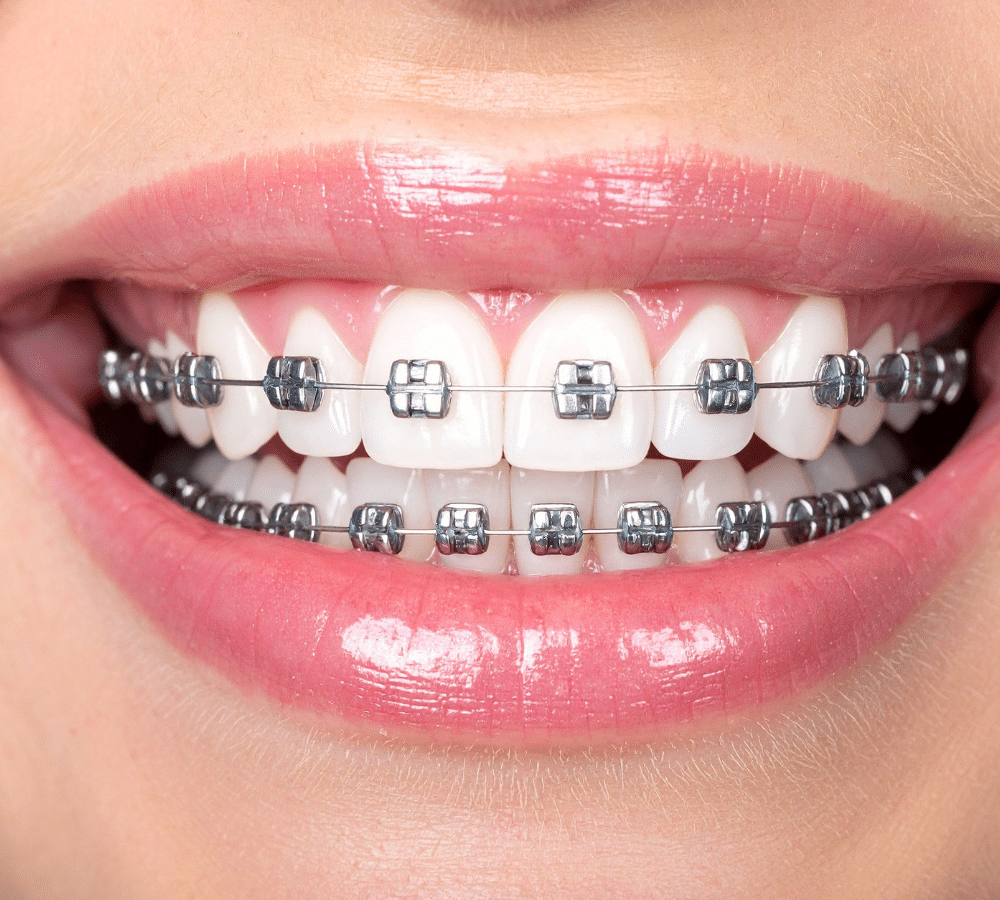
Conventional metal braces
Still the most commonly used appliance, and many consider them the gold standard. They are one of those rarities: effective, efficient, and the least expensive. The trade-offs are covered in all your conventional braces questions answered and the most common complaints associated with conventional braces.
Ceramic or clear braces
If the appearance of metal is not to your liking, ceramic braces often achieve the same result with a more discreet appearance.
They cost more, because the materials cost more.
Clear braces are ceramic, and several brands exist. Combined with white wires, they remove the “metal mouth” appearance — which many patients choose for professional reasons as much as aesthetic ones.
Customised and lingual options
Special wires, and customised braces sitting in front of or behind the teeth (lingual braces) — conventional braces versus lingual braces versus Invisalign compares the three side by side.
The useful analogy: a tailor-made suit versus something off the rack. It is made to fit you and nobody else, and that is reflected in the cost.
Invisalign costs
A different customised option — a series of clear removable aligners. Popular especially among adults, but not suited to everyone.
Aligners must be worn 22 hours a day, and are changed every two weeks, moving the teeth gradually.
The three tiers
| Tier | Typical treatment time |
|---|---|
| i7 | approximately 3 months |
| Invisalign Lite | approximately 7 to 9 months |
| Invisalign Full | 12 to 18 months, with unlimited correction |
A specialist orthodontist can advise which tier suits the correction you want. The tiers differ in how much movement they allow, not only in price — choosing a cheaper tier for a case that needs Full is a false economy.
The 22-hour requirement is the part that decides whether aligners work for you, and it is a genuine commitment rather than a guideline. See Invisalign, Invisalign cost in Melbourne: a complete breakdown and Is having Invisalign as an adult worth it?. Lost or warped aligners add cost and delay, so how to protect your aligners is worth reading before you start.
One avoidable cost during aligner treatment
The Australian Dental Association advises that aligner trays should be worn at all times other than when eating and drinking liquids other than water, because drinking something like fruit juice or soft drink while the trays are in traps the liquid against the teeth, which can damage them if it happens frequently. The ADA also suggests cleaning the trays whenever you clean your teeth, using an antibacterial liquid soap and a spare toothbrush, then rinsing well with warm water.
That is worth saying on a page about money, because decay that develops during treatment is a separate bill on top of the one you have already agreed to — and it arrives at the point where you have least appetite for it. Hygiene benefits of Invisalign and Dental Cleans and Hygienists cover keeping on top of it.
3. Who treats you
The two options:
A specialist orthodontist — someone with three or more years of full-time postgraduate specialist training, whose practice is dedicated solely to the mechanics and biology of moving teeth.
A general dentist — someone providing orthodontics alongside general treatment. The amount of orthodontic training a general dentist has varies considerably, from short manufacturer courses to substantial continuing education, so it is worth asking directly what training and how many cases. Orthodontic treatment: general dentist versus specialist orthodontist? sets out the difference, and which is best for Invisalign? applies it to aligners specifically.
At Smile Solutions, orthodontic treatment is performed only by a specialist orthodontist. Registrations can be checked free on the AHPRA public register, or on Our Team and Dentists and Registered Specialists.
The third option, and the one to look at hardest
There is a cheaper route that undercuts every figure on this page: direct-to-consumer orthodontics, where aligners are ordered online and the impressions or scans are taken by you rather than by a clinician. The Australian Dental Association does not recommend it. Its consumer guidance says such treatment can “lead to permanent damage to your teeth, gums, and jaw joints”, and recommends in-person treatment that includes a thorough assessment before starting and ongoing supervision throughout.
Read that carefully: the ADA’s objection is to the missing assessment and the missing supervision, not to clear aligners as an appliance — the same appliance provided with both is a mainstream treatment. What the lower price removes is the examination that establishes whether your case is suitable at all, and the person watching what the teeth actually do month by month. If something goes wrong, the corrective work is charged at full price; second opinions and corrective dentistry is where that conversation usually starts.
The health fund point
This is the practical detail most people miss: if you have health insurance, rebates are often maximised when treatment is provided by a registered specialist.
So the gap between a general-dentist quote and a specialist quote may be smaller after rebates than the headline figures suggest. Check with your fund before comparing quotes.
Orthodontics usually sits under major dental with its own annual limit and a lifetime sub-limit, and waiting periods are commonly a year or more — which is an argument for finding out what you are covered for well before you plan to start.
How to compare quotes properly
Ask each provider for:
- the total fee, not the monthly figure
- what is included — records, adjustments, retainers, and retainer replacement
- the estimated treatment time
- who will actually perform the treatment at each visit
- the item numbers, so you can check your rebate
Retainers are the item most often left out of a headline price, and treatment is not finished without them.
Retainers are also not a one-off. Teeth move for life, retainers wear out and get lost, and replacement is an ongoing cost that belongs in the comparison — will my teeth need retainers after I have had braces? explains why. Ask what a replacement costs before you choose between quotes, not after.
A quote that is cheaper because it covers fewer months of adjustments is not cheaper. Establish what happens, and at whose cost, if treatment runs longer than estimated.
Because the item numbers are the one part of a quote that means the same thing everywhere, they are the most reliable way to compare two quotes that are written up differently. Understanding your treatment covers how to read one.
If you are still deciding between appliances rather than between quotes, how do I know which orthodontic treatment is best for me? is the place to start.
Paying for it
Payment plan options are available. The deposit required, the establishment fee and the instalment terms depend on the provider and the amount financed, and they are set out before you commit — ask for them in writing, and ask specifically what the establishment fee is in dollars, since “interest free” alongside an unquantified fee tells you very little about the total. See Payment Plans.
Patient payment plans covers how these arrangements work and what to check in the terms.
Smile Solutions also offers a complimentary orthodontic consultation. Confirm the current terms when you book — what the appointment includes, whether records such as scans or radiographs are part of it or charged separately, and whether any deposit applies.
If cost is the reason you are considering treatment overseas, Overseas dental work could cost you more in the long term sets out the follow-up problem, which applies with particular force to orthodontics — treatment runs for years and needs adjustment throughout.
Common questions
Does Medicare, the Child Dental Benefits Schedule or anything public pay for braces?
Not for the braces themselves. The Child Dental Benefits Schedule is the main Commonwealth dental entitlement for eligible children, and Services Australia names the exclusions without ambiguity: the services it will not cover are "orthodontic dental work", "cosmetic dental work" and "any dental services in a hospital". Orthodontics is the first item on that list.
What the CDBS does cover is worth claiming anyway, because it pays for the work that has to be done before and during orthodontic treatment: examinations, x-rays, cleans, fissure sealants, fillings, root canals and extractions, up to $1,158 for each eligible child over 2 consecutive calendar years. On a page about the cost of braces that matters twice over — a child who needs fillings before the brackets go on is facing two bills, and one of them may be covered.
Be careful with the figure itself: the cap has changed over time, and an older page quoting $1,095 is describing an earlier period rather than being wrong. Check the current amount and your own eligibility with Services Australia directly, since eligibility turns on the family's payment status in a given calendar year rather than on dental need. See Child Dental Benefit Schedule and How does the Child Dental Benefits Schedule operate?.
Public dental services in each state and territory run to their own eligibility rules and their own priorities, and orthodontic treatment is not generally part of routine public dental care. If cost is the barrier, ask your state public dental service what it does and does not provide rather than assuming either way — the answer differs by jurisdiction, and by the clinical severity of the case.
I cannot afford it right now. Does waiting make it worse, or cheaper?
It depends entirely on what is being treated, and the honest answer is that for many cases waiting costs nothing clinically. Adults have orthodontic treatment routinely; teeth can be moved at almost any age provided the gums and bone are healthy. If the reason for treatment is that you do not like how your teeth look, deferring it for two years while you save is a legitimate decision and nobody should make you feel otherwise.
The exception is the growing child, and it is a real one. The Australian Society of Orthodontists recommends assessment between 7 and 10 precisely because a small set of problems — a crossbite, a severely narrow upper arch, an impacted adult tooth, a habit that is actively moving the front teeth — are easier and cheaper to influence while the jaws are still growing. Once growth is finished, the same problem may need a bigger appliance, extractions, or in some cases surgery. That is where waiting genuinely converts into money.
So the useful move is not to defer the assessment, which is the cheap part, but to defer the treatment with your eyes open. Ask directly: is my case one that gets harder if we wait, or one that does not? A clinician who can answer that clearly is giving you information you can act on.
There is also a cost to avoidance more broadly. The consumer submission cited above quotes an Australian Institute of Health and Welfare survey in which nearly a third of Australians aged 5 or older (32%) avoided or delayed visiting a dentist because of cost. Delaying a check-up is not the same as delaying braces — decay and gum disease do get worse and more expensive untreated, and they are the things that must be dealt with before orthodontics can start at all.
Is it cheaper to have braces done overseas?
Orthodontics is the worst possible candidate for dental tourism, for a reason that has nothing to do with the standard of the treatment: it is not a procedure, it is a two-year relationship.
The Australian Dental Association's position on elective overseas treatment (Policy Statement 2.2.6, November 2023) lists the risks, and the first one on its list is the "inability to maintain supportive maintenance dental visits". For a filling that is an inconvenience. For braces it is the whole treatment — the appliance does nothing without the adjustment visits, and the plan is revised continuously in response to how the teeth are actually moving. The same policy warns of the "lack of access to treatment records", the "inability to necessarily see the same dentist who provided the care on subsequent visits", and the "potential challenge of finding a dental practitioner to continue with, or repair, elective treatment started overseas due to concerns including incompatible product systems, techniques not consistent with Australian standards and materials not approved by the TGA". Bracket and wire systems are not interchangeable; a clinician here taking over mid-treatment may have to strip the appliance and start again.
It also notes that such treatment "may not be covered by Australian health funds" and is not always covered by travel insurance, and that there is a "lack of recourse for treatment and maintenance problems".
One caveat on how to read that: it is a professional position statement, not evidence. It carries no complication rate and no Australian dataset, and none exists that we have been able to find. The ADA's own closing recommendation is modest — "seek the advice of an Australian dentist before considering or embarking on overseas dental treatment" — and that is a reasonable step in either direction. See Overseas dental work could cost you more in the long term.
How do I work out what I will actually pay after my health fund?
Five numbers, in this order, and all of them in writing.
1. The item numbers. Get the treatment plan with its ADA item numbers on it. They are the one part of a quote that means the same thing at every practice and every fund, which makes them the only reliable way to compare two quotes written up differently, and the only way a fund can tell you a rebate in advance.
2. Your annual limit for major dental, and how much of it you have already used this calendar year.
3. Your lifetime orthodontic limit. Orthodontics is usually capped separately and for life, not per year. Once it is spent it does not reset, which changes the maths for a family with more than one child.
4. Any remaining waiting period. Orthodontic waiting periods are commonly the longest in a policy. This is the number that determines when you can start, and it is the reason to ask before you have chosen a provider rather than after.
5. How the fund pays a staged treatment. Some funds rebate against the whole course when it is billed, others against each visit. That changes which calendar year your limits fall in, and occasionally it is worth starting a month later for that reason alone.
One further thing worth knowing when you compare: insurer-owned clinics with no-gap arrangements and preferred-provider practices with reduced gaps are concentrated in the major cities, which the Senate submission cited above notes leaves patients outside them with larger out-of-pocket costs. Being a preferred provider is a commercial arrangement between a practice and a fund. It tells you about the gap you will pay, not about the treatment you will get, and it is worth separating those two questions rather than letting one answer both. See Understanding your treatment and Price Guide.
Where to go next
- What treatment involves — Braces, Orthodontics
- Clear aligners — Invisalign
- For a child or teenager — Children’s Braces and Invisalign, When should I take my child to an orthodontist?, How long does my child need to wear braces?
- The specialists — Orthodontists
- Keeping teeth clean during treatment — Hygiene benefits of Invisalign, Dental Cleans and Hygienists
Practical details
Your treatment is an investment, and the factors above should be weighed carefully. There is more than one way to straighten teeth — your money should be spent with someone you are comfortable with, who has the experience to offer a range of options suited to your needs.
Specialist registration can be verified on the AHPRA register, or by calling 1300 419 495.
Smile Solutions, Level 1, 220 Collins Street, Manchester Unity Building, Melbourne VIC 3000. Phone 13 13 96, or theteam@smilesolutions.com.au. Monday–Friday 8.00am–6.00pm, Saturday 8.30am–1.30pm, Sunday by appointment. Full details on Contact Us.
Published 4 December 2018. Fees and treatment times vary between individuals, and no particular result is guaranteed. Fee figures quoted from the Australian Dental Association’s Dental Fees Survey 2022 describe fees charged by surveyed ADA members across Australia as at 1 July 2022; they are not Smile Solutions fees and are not a quote. Child Dental Benefits Schedule amounts and eligibility rules are set by Services Australia and change; confirm the current figure and your own eligibility with Services Australia. Payment plan terms, health fund rules, waiting periods and limits are set by the relevant provider or fund and change; confirm current terms directly before you commit. General information only; it does not replace advice from your treating practitioner.
Smile Solutions trades under ABN 28 193 514 103.
Images on This Page
-
https://www.facebook.com/tr?id=800557773428361&ev=PageView&noscript=1
(no alt text)
-
https://www.smilesolutions.com.au/wp-content/uploads/2025/10/calendar_month.svg
(no alt text)
-
https://www.smilesolutions.com.au/wp-content/themes/arcadian-wordpress-theme/assets/images/smile_solutions_logo_white.png
Smile Solutions Logo
-
https://www.smilesolutions.com.au/wp-content/themes/arcadian-wordpress-theme/assets/images/smile_solutions_logo_purple.png
Smile Solutions Logo
-
https://www.smilesolutions.com.au/wp-content/uploads/2023/11/SS-Tooth-1-1-150x150.png
Smile Solutions
-
https://www.smilesolutions.com.au/wp-content/uploads/2025/09/Smile-Solutions-Braces.png
Traditional braces Smile Solutions Specialist Orthodontist
-
https://www.smilesolutions.com.au/wp-content/uploads/2025/09/Root-Canal-2-300x217.jpg
Root Canal
-
https://www.smilesolutions.com.au/wp-content/uploads/2026/08/Mouth-Breathing-300x270.jpg
Mouth Breathing
-
https://www.smilesolutions.com.au/wp-content/uploads/2025/09/Dental-Crown-at-Smile-Solutions-300x300.jpg
Dental Crown at Smile Solutions
-
https://www.smilesolutions.com.au/wp-content/themes/arcadian-wordpress-theme/assets/images/family_owned_bussiness.png
Family Owned Business
-
https://www.smilesolutions.com.au/wp-content/themes/arcadian-wordpress-theme/assets/icons/icon--phone.svg
Smile Solutions Contact
-
https://www.facebook.com/tr? id=800557773428361&ev=PageView&noscript=1
(no alt text)