What is orthognathic surgery?
What it is
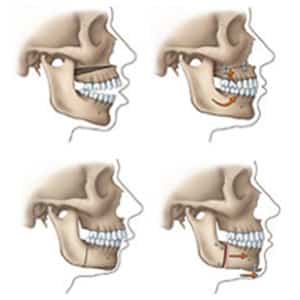
Orthognathic surgery — corrective jaw surgery — is the repositioning of one or both jaws. Jaw surgery is the service page.
Orthodontics corrects the alignment of the teeth. Combining orthognathic surgery with orthodontic treatment improves the relationship between the upper and lower teeth.
It is usually recommended where a significant jaw growth imbalance has produced a considerable malocclusion — a “bad bite”.
Why braces alone are not enough
This is the key distinction.
In these cases, simply aligning the dental arches with orthodontic appliances cannot produce a satisfactory aesthetic or functional outcome.
Because orthodontic appliances — braces or aligners — move teeth, and have very little effect on irregular jaw positions.
So where the jaws themselves are mismatched, orthodontics can only compensate by tilting teeth to meet across the discrepancy. That produces a bite that looks better and remains built on a skeletal mismatch — with the teeth doing work the bone should be doing. How do I know which orthodontic treatment is best for me? and orthodontics set out what appliances alone can and cannot do; braces and Invisalign cover the appliances themselves.
The benefits of combined treatment may include improved jaw function, facial appearance, ability to chew and bite, and in some cases speech.
A jaw discrepancy is not the same thing as a painful or clicking jaw joint, and the two are often confused. If your concern is joint pain, clicking or locking rather than the bite relationship, start with what is the difference between TMD, TMJ and bruxism?, what are the most common symptoms of TMD?, is TMD serious? and TMD and teeth grinding. Surgery of this kind is not a treatment for TMD.
Who performs it
The surgery is performed by a registered specialist Oral and Maxillofacial Surgeon, who has completed additional training across surgery of the facial bones, jaws, mouth and associated structures. Oral and maxillofacial surgeons, and what does oral and maxillofacial surgery involve?
The orthodontic component is provided by a registered specialist orthodontist. Orthodontists, and orthodontic treatment: general dentist vs specialist orthodontist?
Two specialists, one plan. They must agree on the target position before anything starts, because the orthodontist's job is to prepare the teeth for where the surgeon will put the jaws. Complex dental cases: what happens when multiple specialists need to collaborate describes how that coordination is meant to work, complex dentistry is the service page, and why would I need to see a dental specialist? explains the referral itself. Every registered specialist at the practice is identified on the registered specialists page.
Who is suitable
Generally performed on healthy adolescents and young adults who have completed growth of the craniofacial skeleton.
Growth must be complete, because operating on a jaw still growing risks the discrepancy re-emerging. For younger patients, when should I take my child to see an orthodontist? and children's braces and Invisalign cover what is done while growth is still under way.
The treatment sequence
Total treatment takes approximately 18 to 24 months. How long does it take to have orthodontic treatment? covers the non-surgical timeline for comparison.
1. Treatment planning
Separate consultations with the specialist orthodontist and the oral and maxillofacial surgeon, for analysis and discussion.
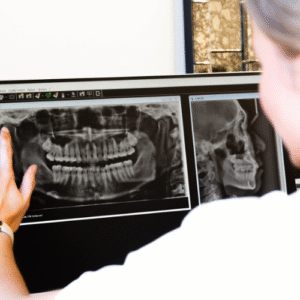
Models, photographs and X-rays are taken for planning — how safe are dental x-rays if you want the radiation question answered before you consent.
You receive a written treatment plan with a quote and the associated item numbers, which can be used to check your rebate through private health insurance where applicable.
Those item numbers are worth having. Parts of orthognathic surgery are classified as medical, which changes what can be claimed. Understanding your treatment explains how to read a written plan and what to ask about it, how important is communication in dentistry? is the wider argument for insisting on that conversation, and published fees are in the price guide. What is the cost of braces? covers the orthodontic component separately. If a plan of this size does not sit right with you, a second opinion is an entirely reasonable step before committing.
Payment plan options are available. Where a plan is advertised as interest free, that describes the plan term only — a deposit may be required, an establishment fee and ongoing account fees may apply, and charges can apply if the balance is not cleared within the agreed period. The applicable terms depend on the provider and the amount financed, and are set out in writing before you commit — ask what the deposit and the establishment fee are, in dollars, and what the total will be by the end. Payment Plans.
2. Orthodontics before surgery
Your teeth must be adequately aligned before jaw surgery.
Braces are worn for approximately 8 to 16 months beforehand, which helps the surgeon achieve the ideal jaw position.
Worth setting expectations here: during this phase the bite often looks worse rather than better. The orthodontist is removing the compensations the teeth had made for the jaw discrepancy, so that the jaws can be moved into a correct relationship. That is the plan working, not going wrong.
Living with fixed braces for that long has its own practical side: all your conventional braces questions answered, the most common complaints associated with conventional braces, and keeping the teeth clean underneath them — is flossing really that important? and what is the ideal daily routine for oral hygiene?. Brackets and wires also rub, and the resulting ulcers are covered in the cause of mouth ulcers and their usual treatments.
As the pre-surgical phase nears completion, you consult the surgeon again and a new set of records is taken to plan and schedule surgery.
3. Surgery
Performed at a private hospital under general anaesthetic. On the day you meet your anaesthetist, who discusses the anaesthetic with you. If anaesthesia and sedation are themselves a worry, sleep dentistry, dental anxiety and how can I ease my anxiety about visiting the dentist? are worth reading beforehand.
Expect to stay in hospital one to three days, and arrange one to two weeks off work or school initially.
Initially there will be swelling, bruising and limited jaw movement.
The new jaw position is held by small titanium plates and screws placed during surgery. Elastic bands are placed from the upper braces to the lower braces, supporting the new position while the jaws heal.
You are given an exercise and dietary plan for recovery — what can I eat and drink following jaw surgery? is the detailed version. Expect the jaw to be stiff after the elastics are removed.
Regular review appointments check healing and jaw position, with new X-rays to monitor progress.
4. Orthodontics after surgery
Approximately 6 to 8 months to complete. Retainers follow — will my teeth need retainers after I've had braces?
Preparing for the operation
Tests. Blood tests may be required before admission, depending on the surgery proposed.
Smoking. The anaesthetist strongly recommends stopping at least two weeks before any operation. Smoking is also associated with higher postoperative infection rates and impaired or delayed wound healing. Quitline is 13 7848.
Mouth care. Your mouth should be as clean as possible before surgery — clean your teeth thoroughly twice a day and floss daily. Untreated decay or gum disease is dealt with first: why do I need a filling?, what is gum disease?, and dental cleans and hygienists.
Medication. Avoid aspirin, and anti-inflammatory pain relievers of the same family, in the month before and the months after surgery — they affect bleeding. Your surgeon will give you the specific list that applies to you, and it takes precedence over any general advice. Do not stop any prescribed medication without speaking to your prescriber, and tell the surgical team about every medication and supplement you take, including blood thinners.
Fasting.
- Morning surgery: nothing to eat or drink after midnight
- Afternoon surgery: nothing to eat or drink after 7.00am
After surgery
You are given a care pack including pain relief, mouth rinse, your review appointment time, and a post-operative instruction pamphlet with dietary and care advice.
Avoid during recovery
- Blowing your nose or excessive sniffing
- Smoking — your ability to cough effectively is reduced by swelling, which can lead to chest infection
- Alcohol
- Excessive physical exertion for the first 14 days
The nose-blowing instruction matters more than it sounds. Upper jaw surgery communicates with the sinuses, and forcefully blowing your nose can push air into the healing surgical site.
One thing never to do for pain: do not hold aspirin or any other tablet against the gum or the surgical site. It does not reach the nerve and it burns the soft tissue chemically, leaving an ulcer on top of a healing wound. Pain relief works by being swallowed — take what your surgeon has given you, as directed.
I've just had oral surgery. What can I expect during recovery? and how long does it take to recover from wisdom teeth surgery? cover the general principles of healing after surgery in the mouth, including the pattern that suggests something has gone wrong.
Go to hospital immediately if
These are not “call the rooms in the morning” symptoms. Go to a hospital emergency department, or call 000:
- Facial swelling that is spreading, particularly toward the eye or down into the neck
- Difficulty breathing or swallowing, or a change in your voice
- Fever together with increasing pain or swelling
- Bleeding that will not stop with firm pressure
After jaw surgery the airway is already narrowed by swelling, so anything that makes breathing or swallowing harder is treated as an emergency rather than a complication to report later.
The risks
All surgical procedures carry some degree of risk. Despite the highest standards of practice, complications are possible.
It is not usual for a surgeon to dwell at length on every possible side effect or rare complication. But you should have enough information to weigh the benefits against the risks.
Most people having orthognathic surgery will not have complications. If you have concerns, discuss them with your surgeon.
The following is intended to inform, not to alarm.
Reaction to anaesthetic
Difficulty swallowing, a sore dry throat and generalised muscle pain may follow general anaesthesia, usually resolving by the following day. Vomiting may occur for one to two days afterwards, and can be treated with medication.
Infection
All surgery carries an infection risk, though it is low with orthognathic surgery.
Antibiotics are often prescribed before surgery to prevent it. If infection occurs, symptoms start at about 10 to 14 days — pain, swelling and a bad-tasting discharge in the mouth.
If infection or bleeding occurs, call your surgeon immediately. If it is accompanied by any of the emergency signs above, go to hospital rather than waiting for a call back. On how infection in the mouth behaves generally, see can a dental abscess affect your general health? and emergency dentistry.
Scarring
Prominent scarring of intraoral incisions is unusual — in most patients these heal well and quickly.
Pain
Depends on the complexity of the surgery. Worst in the first few days, then gradually subsiding. Strong painkillers are provided, and the need for them usually stops around seven to 10 days after surgery.
There is no version of this operation without discomfort. Pain is managed, not eliminated, and any account of jaw surgery that suggests otherwise should be treated with suspicion. What matters is the direction of travel: pain that is steadily improving is expected; pain that starts improving and then increases is the pattern that needs reporting.
Swelling
Normal. Maximum at 48 hours, subsiding over three to four weeks, with most gone after 14 days. The more complex the surgery, the greater the swelling.
Bruising
Of the face, neck and chest, as swelling subsides. Usually resolves in seven to 10 days.
Loss of sensation
Sensation is impaired because nerves are moved and may be injured during surgery. The chin, lower lip, upper lip, cheeks and palate are most commonly affected.
In most patients sensation returns to normal within three to six months. Tingling and itching is a good sign that feeling is returning.
Avoid biting your lips, or placing hot food or drink next to numb areas, until sensation has fully returned.
This is the complication worth understanding properly before consenting. Altered sensation after orthognathic surgery is common in the short term and usually temporary — but it can be permanent in a minority of cases, and that is a specific question to put to your surgeon about your own case.
Contact your surgeon if you experience
- Temperature higher than 38°C
- Severe pain, redness, bleeding or swelling at the operated site
- Nausea or vomiting
- Persistent bleeding
- Any concerns at all about your surgery
Common questions
My jaw clicks and aches. Will this surgery fix that?
Probably not, and it is important to separate the two problems before anyone plans an operation around the wrong one.
As stated above, this surgery is not a treatment for TMD. The independent guidance goes further and addresses the specific reasoning that leads people here. The Royal Australian College of General Practitioners' guidance on temporomandibular disorders states plainly: “Malocclusion of the teeth should be noted if present; however, this does not contribute to the manifestation of TMD and orthodontic referral is not recommended for this finding alone.”
Read that carefully, because it cuts against a very common assumption. Having a bad bite and having a painful jaw joint are two things that can be true of the same person without one causing the other — and correcting the bite is not, on that guidance, a treatment for the pain.
The same source sets the expected path for jaw pain itself: “For the majority of patients, a conservative approach to TMD management should be adopted.” It records that “Up to 40% of symptomatic patients have spontaneous resolution of their symptoms without any treatment, and 50–90% of patients have relief with conservative therapy.”
Those two figures are the reason not to escalate quickly. A problem that resolves on its own in up to four cases in ten, and responds to conservative treatment in most of the rest, is not a problem to take to an operating theatre first.
It also helps to know which kind of TMD problem you have, because the two behave differently. The RACGP's distinction: “tenderness elicited on palpation of the TMJ, joint clicking and crepitus are signs of intra-articular derangement, whereas pain on jaw movement, headache and referred pain are suggestive of a muscular problem.”
So if clicking and aching is your main complaint, start there rather than here. TMD and teeth grinding, what are the most common symptoms of TMD? and can TMD be fixed?. If a jaw discrepancy is also present and is causing functional problems of the kind described at the top of this page, that is a separate conversation — and it should be framed as a separate conversation, not folded into the pain one.
I snore badly, or I have sleep apnoea. Is jaw surgery the answer?
It is one of several things that can be done, and it sits at the end of the queue rather than the front.
The Sleep Health Foundation's position on surgical treatment for obstructive sleep apnoea is explicit: “There are several surgical operations available for sleep apnoea. These are not usually offered unless both CPAP and oral appliances have not worked. It is important to select the right operation and an experienced surgeon is essential.”
That ordering matters. It means a proper diagnosis and a trial of the non-surgical options come first, and it means the question “which operation?” is a real question with a wrong answer, not a formality.
Two other things from the same source are worth knowing before anyone reaches for surgery, because both are reversible and neither requires a hospital:
- “In many people, being overweight contributes to sleep apnoea. Losing weight may help or even cure the OSA”, and is described as beneficial for blood pressure, diabetes, cholesterol and joint problems as well.
- “Alcohol and sleeping tablets relax muscles and may worsen sleep apnoea in some people. Their use should be minimised.”
The Foundation also cautions generally that “A number of other remedies have been marketed, some of which have value for selected patients while many others have been shown to be of no benefit” — which is a reason to be sceptical of anything sold directly to snorers.
One genuinely relevant point from the dental side: the Australian Dental Association states that “Orthodontic treatment is not just about straight teeth. It can correct a bad biting pattern, help with sleep apnoea, and prevent uneven wear of the teeth.” So there is a recognised relationship between this area of dentistry and breathing in sleep. What there is not, in the sources behind this page, is any basis for presenting jaw surgery as a first-line treatment for snoring.
If sleep-disordered breathing is your primary concern, the pathway starts with a diagnosis rather than a surgical opinion. Snoring and sleep apnoea sets out what is offered here.
What should I actually ask at the two consultations?
You get two separate appointments with two different specialists, and the most common failure in a combined plan is something falling between them. A short list, in the order it is useful:
At both: what is the target jaw position, and do you both agree on it? This is the single question that tests whether it is one plan or two. As noted above, the orthodontist prepares the teeth for where the surgeon intends to put the jaws.
Of the orthodontist: how long is the pre-surgical phase likely to be for me, at the 8-to-16-month range given above? Will my bite get worse before it gets better, and by how much? What happens if I stop after the orthodontics and never have the surgery?
Of the surgeon: which jaw or jaws are being moved, and in which direction? What is the risk of permanent altered sensation in my case — not in general? How many of these do you do? What would change the plan once you are operating?
Of whoever is coordinating: who do I contact out of hours in the first fortnight, and what is the number?
On the written plan itself, this page already sets the standard: options, duration, frequency, risks, benefits and costs, with item numbers. If any of those six is missing, ask for it in writing before you agree to anything. Understanding your treatment covers what a plan should contain, and a second opinion is a normal step at this scale rather than a discourtesy.
Who pays for what — Medicare, my health fund, or me?
This is genuinely complicated, and the honest answer is that it depends on how each component is classified.
As noted above, parts of orthognathic surgery are classified as medical, which is why your plan comes with item numbers and why those numbers are the thing to take to your fund. The orthodontic phases either side are a separate matter and are generally dental.
The wider Australian picture, in the Australian Dental Association's own words from its policy statement on general anaesthesia in dentistry: “In Australia, Medicare provides universal coverage for medically necessary procedures, including many surgeries performed under general anaesthesia for children. However, dental procedures under general anaesthetic are not universally covered by Medicare. For most families, this means that dental treatment under general anaesthetic is either out-of-pocket or covered through private health insurance, leading to financial inequities.” The ADA also records that access to theatre facilities for dental work under general anaesthesia is “significantly inadequate to patient needs” — so timing, not only cost, is worth asking about.
What to do with that, practically:
- Ask for the accounts to be itemised separately. A course of treatment like this typically generates several: the orthodontic fees, the surgeon's fee, the anaesthetist's fee, and the hospital or facility charge. They are billed by different people and they are claimed differently.
- Take the item numbers to your fund before you commit, and ask for the answer in writing. Ask specifically about any waiting periods and annual limits, because both can change the sequencing of a two-year plan.
- Ask what happens if the plan changes mid-course, since the quoted figure is based on what is planned now.
Price guide and payment plans cover the practice's side. Sleep dentistry costs: what does sedation add to your dental bill? explains the same separate-accounts problem in a smaller setting.
I have never had a general anaesthetic. What governs how that part is done?
More than most patients realise, and the rules are worth knowing because they give you things to confirm.
The Australian Dental Association's policy statement on general anaesthesia in dentistry sets two conditions that bear directly on your operation. First, a dentist “must not carry out any procedure forming part of the practice of dentistry on a patient under general anaesthesia unless the anaesthetic is administered by an appropriately qualified and registered practitioner.” Second, general anaesthesia for dental procedures “must be administered in accordance with the guidelines of the Australian and New Zealand College of Anaesthetists and any State, Territory or Federal Regulations.”
The ADA also defines what you are consenting to, which is more than “being asleep”: general anaesthesia is “a drug-induced state of controlled unconsciousness accompanied by a partial or complete loss of protective reflexes including the inability to maintain an airway independently and continuously, and the inability to respond to physical stimulation or verbal” command. That is precisely why it happens in a hospital with an anaesthetist present and why the fasting instructions above are not negotiable.
So the reasonable things to confirm are: who the anaesthetist will be, that you will meet them and be able to raise your history with them, and that the facility is set up for the procedure being proposed. As this page notes, you meet your anaesthetist on the day — but nothing stops you asking the questions earlier through your surgeon's rooms, particularly if you have a medical condition, a previous reaction to an anaesthetic, or a family history of one.
Bring a complete list of everything you take, including over-the-counter medicines and supplements, and do not stop anything prescribed without speaking to the prescriber. The instructions your own surgeon and anaesthetist give you take precedence over anything on this page.
Related reading
- What does oral and maxillofacial surgery involve?
- What can I eat and drink following jaw surgery?
- I've just had oral surgery. What can I expect during recovery?
- Can TMD be fixed?
- Benefits of conventional braces vs lingual braces vs Invisalign
- Sleep dentistry costs: what does sedation add to your dental bill?
- Snoring and sleep apnoea
Practical details
Written by Dr Kia Pajouhesh.
Smile Solutions, Level 1, 220 Collins Street, Manchester Unity Building, Melbourne VIC 3000 — getting here. Phone 13 13 96, contact us, or theteam@smilesolutions.com.au. Monday–Friday 8.00am–6.00pm, Saturday 8.30am–1.30pm, Sunday by appointment.
Specialist registration can be verified on the AHPRA register, or by calling 1300 419 495. The full clinical team is listed under our team.
Published 3 December 2018. Treatment times, suitability and outcomes vary between individuals. The instructions given to you by your own surgeon and anaesthetist take precedence over this general guide. Statements about temporomandibular disorders, malocclusion and conservative management are from the Royal Australian College of General Practitioners. Statements about surgery for obstructive sleep apnoea, weight, alcohol and sleeping tablets are from the Sleep Health Foundation. Statements about general anaesthesia, its administration and its funding are from the Australian Dental Association's Policy Statement 6.32, General Anaesthesia in Dentistry (June 2025). Payment plan terms are set by the credit provider and change; confirm current terms directly before you commit. General information only; it does not replace advice from your treating practitioner.
Smile Solutions trades under ABN 28 193 514 103.
Images on This Page
-
https://www.facebook.com/tr?id=800557773428361&ev=PageView&noscript=1
(no alt text)
-
https://www.smilesolutions.com.au/wp-content/uploads/2025/10/calendar_month.svg
(no alt text)
-
https://www.smilesolutions.com.au/wp-content/themes/arcadian-wordpress-theme/assets/images/smile_solutions_logo_white.png
Smile Solutions Logo
-
https://www.smilesolutions.com.au/wp-content/themes/arcadian-wordpress-theme/assets/images/smile_solutions_logo_purple.png
Smile Solutions Logo
-
https://www.smilesolutions.com.au/wp-content/uploads/2025/11/Kia-150x150.jpg
Dr Kia Pajouhesh
-
https://www.smilesolutions.com.au/wp-content/uploads/2014/07/Ortho-Tower.jpg
Orthodontic Tower
-
https://www.smilesolutions.com.au/wp-content/uploads/2018/12/orthognathic-surgery2.jpg
orthognathic surgery2
-
https://www.smilesolutions.com.au/wp-content/uploads/2025/09/Wisdom-Teeth-Smile-Solutions-300x300.png
Smile Solutions Dentist Melbourne
-
https://www.smilesolutions.com.au/wp-content/uploads/2025/11/TMD-Teeth-Grinding-Smile-Solutions-300x270.png
Woman holding her face, looking concerned.
-
https://www.smilesolutions.com.au/wp-content/uploads/2026/07/Photography-and-Facial-Analysis-300x270.jpg
Photography and Facial Analysis
-
https://www.smilesolutions.com.au/wp-content/themes/arcadian-wordpress-theme/assets/images/family_owned_bussiness.png
Family Owned Business
-
https://www.smilesolutions.com.au/wp-content/themes/arcadian-wordpress-theme/assets/icons/icon--phone.svg
Smile Solutions Contact
-
https://www.facebook.com/tr? id=800557773428361&ev=PageView&noscript=1
(no alt text)
-
https://bat.bing.com/action/0?ti=25148060&tm=gtm002&Ver=2&mid=230d4afc-c01f-45c3-918b-5847681bd9e0&bo=1&sid=ee83b850ab2711f182489d90e56ac890&vid=ee83fe50ab2711f1bc56b3709a3aa87f&vids=1&msclkid=N&pi=918639831&lg=en-US&sw=800&sh=600&sc=24&nwd=1&tl=What%20is%20orthognathic%20surgery%3F%20-%20Smile%20Solutions&p=https%3A%2F%2Fwww.smilesolutions.com.au%2Fdental-articles%2Farticle%2Forthognathic-surgery%2F&r=&evt=pageLoad&sv=2&cdb=AQAQ&rn=462121
(no alt text)