How long does orthodontic treatment take?
How long will it take?
This is one of the first questions patients ask when considering orthodontic treatment. See Orthodontics.
Treatment time varies from patient to patient.
| Case | Typical time |
|---|---|
| Mild issues | as little as six months |
| Average | 18 to 24 months |
| More complex — particularly involving jaw surgery | three years or more |
The spread is wide because orthodontics moves teeth through bone at a biological rate that cannot be rushed. What differs is how far they have to travel, and in how many directions.
Why teeth move at the speed they do
Worth understanding, because it explains why no appliance and no marketing claim changes the underlying limit.
A tooth sits in bone, suspended by a ligament. Applying gentle continuous force causes bone to be resorbed on the side the tooth is moving towards and laid down on the side it is leaving. That remodelling is a biological process with its own pace.
Which means more force does not equal faster movement. Excessive force compresses the ligament, cuts off its blood supply, and stalls the tooth entirely — while raising the risk of root resorption, where the root itself shortens permanently. Light continuous force is both safer and faster. How do I know which orthodontic treatment is best for me? sets out that risk and the others in full.
On ‘accelerated orthodontics’ — vibration devices, light devices, and surgical techniques marketed as halving treatment time: the evidence for most of them is weak or absent, and the surgical approaches carry their own risks. Ask what the evidence is, and what it costs, before paying for speed.
What actually determines your number
- How far the teeth must move, and whether the movement is simple tipping or bodily movement, rotation, or moving a root through bone — which are progressively slower
- Whether extractions are needed to create space
- Whether the bite itself must change, not just the alignment of the front teeth
- Whether jaw growth is being used — in a growing child, some corrections use growth and must be timed to it. See When should I take my child to see an orthodontist? and How long does my child need to wear braces?
- Whether jaw surgery is involved, which adds a pre-surgical and post-surgical orthodontic phase — see Oral & Maxillofacial Surgeons and What can I eat and drink after jaw surgery?
- Age. Adult teeth move perfectly well, generally a little more slowly, and adult cases more often involve gum disease, missing teeth or heavy restorations that complicate planning — see Bridges, implants or dentures
- Your gums. Active periodontitis must be treated before orthodontics begins. Moving teeth in inflamed, unsupported bone can cost you those teeth. See Periodontists and What is periodontal disease?
The appliance changes the timeline
Traditional braces — the baseline against which the others are measured, and still the most versatile appliance available.
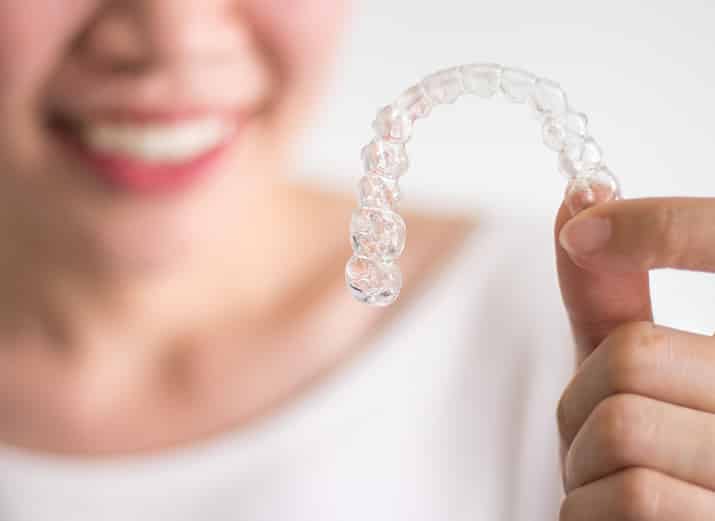
Invisalign — a more discreet approach using clear, removable plates rather than fixed braces. For certain patients, this may add three to six months to the overall treatment time.
Lingual braces — fitted behind the teeth. Treatment time is usually similar to conventional braces.
So the trade-off with Invisalign is not only cost or appearance: for some cases it is also time. And for some cases aligners are not suitable at all — certain movements are difficult to achieve with them. See Conventional braces vs lingual braces vs Invisalign.
The factor that is up to you
Treatment length also depends on patient compliance.
Following your orthodontist's instructions and attending all scheduled appointments will finish your case in the shortest possible timeframe.
This matters most with removable appliances, where wear time is the treatment. Aligners not worn for the prescribed hours simply do not move teeth, and the plan slips. See How to protect your aligners and your smile.
With fixed braces, the equivalent is breakages — each dislodged bracket costs an unscheduled appointment and stalls progress until it is repaired. Hard and sticky foods are the usual cause. See All your conventional braces questions answered.
And elastics. They are the commonest reason a case does not track to plan. Worn as instructed they work; worn intermittently they do very little.
The thing that lasts longer than the treatment
Retention is lifelong. This is the part people are not told firmly enough. See Will my teeth need retainers after I've had braces?.
Teeth drift throughout life. Relapse after orthodontic treatment is not a failure of the treatment; it is the natural behaviour of teeth, and it applies to braces and aligners equally.
- Removable retainers work while worn and do nothing in a drawer. Instructions usually move from full-time, to nights, to a minimum number of nights per week indefinitely.
- Fixed bonded retainers need no memory but make cleaning harder, and can debond silently — a wire detached at one end lets that tooth move while everything looks normal.
- Replace a lost retainer immediately. Teeth move within days; a replacement made two months later may not fit, and the alternative is re-treatment.
- Include retainers in the quote. They are a real, recurring cost — see the Price Guide.
During treatment: the thing that causes permanent damage
Decalcification — white scarring on the enamel around brackets, caused by plaque left against the tooth surface. It is permanent. It does not disappear when the appliances come off. See What are the most common complaints associated with conventional braces?.
It is entirely preventable: fluoride toothpaste twice daily and spit, don't rinse; cleaning around and under the wire with an interdental brush or floss threader; reduced sugar frequency; and continuing regular professional cleaning throughout treatment. Routine dental care does not pause because orthodontics is running — see General Dentistry, Dental Cleans & Hygienists and Tooth Fillings.
What the consultation gives you
A complimentary consultation with a specialist orthodontist covers:
- an assessment of your teeth and bite
- the different options available to you
- costs
- an estimate of how long treatment will take
See Complimentary Orthodontic Consultation. Confirm the current terms when you book — what the appointment includes, whether records such as scans or radiographs are part of it or charged separately, and whether any deposit applies.
An estimate given before an examination is not worth much. The range at the top of this page is what the profession sees across all cases; your number comes from your own records — photographs, radiographs and scans. See Technology.
A note on titles: ‘orthodontist’ is a protected specialist title under the Health Practitioner Regulation National Law, requiring three years of full-time postgraduate training and specialist registration. A general dentist may provide orthodontic treatment and many do so well — but they are not orthodontists, and the AHPRA register settles which is which. See Dentists & Registered Specialists, Our Team and Orthodontic treatment: general dentist vs specialist orthodontist?.
And on remote aligner services: the concern is not the plastic. Moving teeth without an in-person examination and radiographs means doing so without knowing the state of the roots, the bone or the gums. An impression or a photograph is not a diagnosis.
Related pages: Orthodontics, Invisalign® No Braces, Specialist Orthodontists, Bleeding Gums, What is the cost of braces?.
Common questions
My child still has baby teeth. Is it too early to have them assessed?
No — and waiting for a full set of adult teeth is the commonest reason an opportunity is missed.
The Australian Dental Association's consumer guidance states that the Australian Society of Orthodontists recommends children have an orthodontic assessment between the ages of 7 and 10, and is explicit on the point that worries most parents: "you do not have to wait for all adult teeth to be in your child's mouth before having an orthodontic assessment." Its reason is the practical one — "an examination at this age can allow for early intervention treatment should it be needed".
An assessment is not a commitment to treatment, and in most cases the answer is to review again later. What it buys is the chance to act on the corrections that depend on jaw growth, which cannot be recreated once growth has finished. That is the same reason this page lists growth among the things that determine your number.
For what happens at that appointment and how treatment differs in a growing child, see when should I take my child to see an orthodontist? and how long does my child need to wear braces?
Is orthodontics just cosmetic? My health fund seems to think so.
The appearance is what most people come for, but it is not the whole of what the treatment does.
The ADA lists what orthodontics treats as crooked or crowded teeth, incorrect biting patterns, severe misalignment of teeth and/or jaws, and the effects of past habits such as thumb sucking on tooth position and jaw development. And it makes the wider point directly: "orthodontic treatment is not just about straight teeth. It can correct a bad biting pattern, help with sleep apnoea, and prevent uneven wear of the teeth."
Those last two are worth separating out. Uneven wear is cumulative and permanent — teeth that meet badly wear each other down over decades, and rebuilding worn teeth later is far more involved than moving them earlier. On sleep-disordered breathing, orthodontics is one contributor among several and a diagnosis of sleep apnoea is a medical one, made on a sleep study arranged through a doctor; see snoring and sleep apnoea.
What your fund will contribute is a separate question with its own rules, and worth asking about in writing — with the item numbers — before starting. Fees for this practice are in the price guide.
What does the ADA actually say about mail-order or DIY aligners?
It recommends against them, in plain terms and with the specific harms named.
The ADA's position is that "the Australian Dental Association (ADA) do not recommend Australians have DIY orthodontic treatment", describing treatments supplied direct to consumers without seeing a dentist or orthodontist. Its stated concern is not inconvenience: "there are many risks to this treatment. They can lead to permanent damage to your teeth, gums, and jaw joints."
What it recommends instead is the two things a remote service structurally cannot provide: "in-person treatment with a dentist or orthodontist which includes a thorough assessment before starting treatment and ongoing supervision".
That matches the point made above about roots, bone and gums. Teeth can be moved by anyone willing to apply force to them; knowing whether they should be moved, how far, and what is happening to the roots while it happens, requires an examination and radiographs. The cost of getting that wrong is not a refund — it is teeth.
What changes about looking after my teeth during treatment?
More than people expect, and the ADA's guidance is unusually specific about it.
With fixed braces, it recommends brushing after every meal, because food lodges around the brackets, and notes that manual and electric brushes are both suitable. Its brushing sequence is worth following literally: remove any elastics or removable appliances first and rinse them before they go back in; use a pea-sized amount of toothpaste; start at the gum line with the brush at 45 degrees, bristles split between teeth and gums, in small circular or back-and-forward movements; then angle the brush down to clean the tops of the brackets and up to clean beneath them; and afterwards spit out the excess but do not rinse with water, so the fluoride keeps working. For cleaning between teeth, it acknowledges that string floss is awkward around braces and points to floss threaders or interdental brushes, which also clean between the brackets themselves.
With clear aligners, the rule that catches people out is about drinks. The trays "should be worn at all times other than when eating and drinking liquids other than water" — and the reason is mechanical: "drinking liquids such as fruit juice or soft drink while wearing clear aligners can trap the liquids against the teeth, which can cause damage to the teeth if it happens frequently." A tray turns a quick drink into a held acid and sugar exposure. The ADA also advises cleaning the aligners themselves when you clean your teeth, ideally twice a day, using antibacterial liquid soap and a spare toothbrush, then rinsing well with warm water.
All of which is the practical version of the decalcification warning above. The white scars appear where plaque sat undisturbed — and they are permanent.
Practical details
Written by Dr David Austin, specialist orthodontist at Smile Solutions.
To book a complimentary orthodontic consultation, call 13 13 96 — Contact Us.
At our Melbourne CBD practice, orthodontic treatment is provided by registered specialist orthodontists. Specialist registration can be verified free on the AHPRA public register at ahpra.gov.au, or by calling 1300 419 495.
Smile Solutions, Level 1, 220 Collins Street, Manchester Unity Building, Melbourne VIC 3000. theteam@smilesolutions.com.au. Monday–Friday 8.00am–6.00pm, Saturday 8.30am–1.30pm, Sunday by appointment.
Payment plan options are available. Where a plan is advertised as interest free, that describes the plan term only — a deposit may be required, an establishment fee and ongoing account fees may apply, and charges can apply if the balance is not cleared within the agreed period. The applicable terms depend on the provider and the amount financed, and are set out in writing before you commit — ask what the deposit and the establishment fee are, in dollars, and what the total will be by the end. Payment Plans.
Published 3 August 2017. Treatment times vary between individuals and no outcome can be guaranteed. General information only; it does not replace advice from your treating practitioner. The assessment age, the DIY orthodontics position and the appliance care instructions in the questions above are from the Australian Dental Association's consumer guidance on teeth straightening and braces, citing the Australian Society of Orthodontists; guidance is revised periodically. Payment plan terms are set by the credit provider and change; confirm current terms directly before you commit.
Smile Solutions trades under ABN 28 193 514 103.
Images on This Page
-
https://www.facebook.com/tr?id=800557773428361&ev=PageView&noscript=1
(no alt text)
-
https://www.smilesolutions.com.au/wp-content/uploads/2025/10/calendar_month.svg
(no alt text)
-
https://www.smilesolutions.com.au/wp-content/themes/arcadian-wordpress-theme/assets/images/smile_solutions_logo_white.png
Smile Solutions Logo
-
https://www.smilesolutions.com.au/wp-content/themes/arcadian-wordpress-theme/assets/images/smile_solutions_logo_purple.png
Smile Solutions Logo
-
https://www.smilesolutions.com.au/wp-content/uploads/2016/05/David-150x150.jpg
Dr David Austin
-
https://www.smilesolutions.com.au/wp-content/uploads/2025/09/orthodontics-invisalign.jpg
How long does it take to have orthodontic treatment?
-
https://www.smilesolutions.com.au/wp-content/uploads/2025/09/Invisalign-No-Braces-1-300x218.jpg
Invisalign No Braces 1
-
https://www.smilesolutions.com.au/wp-content/uploads/2025/11/Invisalign-at-Smile-Solutions-1-300x270.png
Invisalign at Smile Solutions 1
-
https://www.smilesolutions.com.au/wp-content/uploads/2025/09/Root-Canal-2-300x217.jpg
Root Canal
-
https://www.smilesolutions.com.au/wp-content/uploads/2023/11/SS-Tooth-1-1-150x150.png
Smile Solutions
-
https://www.smilesolutions.com.au/wp-content/themes/arcadian-wordpress-theme/assets/images/family_owned_bussiness.png
Family Owned Business
-
https://www.smilesolutions.com.au/wp-content/themes/arcadian-wordpress-theme/assets/icons/icon--phone.svg
Smile Solutions Contact
-
https://www.facebook.com/tr? id=800557773428361&ev=PageView&noscript=1
(no alt text)
-
https://bat.bing.com/action/0?ti=25148060&tm=gtm002&Ver=2&mid=3201984c-baa8-4834-bd83-c236f0e38443&bo=1&sid=dbdb7c00ab2611f19c710b9fd3e5afc8&vid=dbdb9a00ab2611f18ae9e910ef8f0468&vids=1&msclkid=N&pi=918639831&lg=en-US&sw=800&sh=600&sc=24&nwd=1&tl=How%20long%20does%20it%20take%20to%20have%20orthodontic%20treatment%3F%20-%20Smile%20Solutions&p=https%3A%2F%2Fwww.smilesolutions.com.au%2Fdental-articles%2Farticle%2Fhow-long-take-orthodontic-treatment%2F&r=&evt=pageLoad&sv=2&cdb=AQAQ&rn=392098
(no alt text)