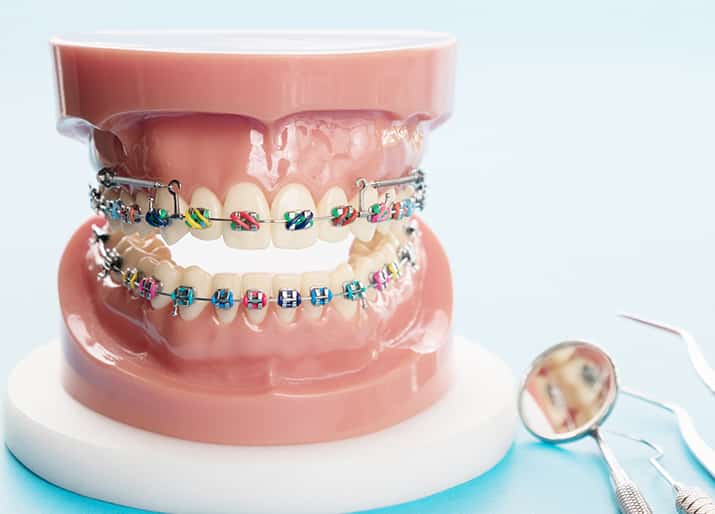
How long does my child need to wear braces?
Why there is no single answer
The question parents and children ask most often is “how long will the braces be on for?” — which is a bit like asking how long a piece of string is.
Treatment time depends on the particular combination of dental issues being corrected. Simple crowding and impacted teeth needing to be aligned are very different problems. See Children's Braces & Invisalign and Orthodontics. What is being corrected has a name: what is malocclusion of the teeth? and treatment of malocclusion
The useful way to answer it is to think about braces in three lifetime phases.
Phase I — ages 6 to 10
At this age a child has a mixture of adult and baby teeth. See Children's Dentistry and Paediatric Dentists. Which teeth should have arrived by when is set out in order and appearance of baby teeth, and whether a specialist is warranted in should your child see a specialist paediatric dentist?
Assessment by a specialist orthodontist at this stage matters so that dental anomalies can be corrected and optimal conditions set up for the adult teeth to erupt correctly in the teenage years. When should I take my child to see an orthodontist? covers the timing, and when should a child first visit the dentist? the appointment that comes well before it.
Phase I work may involve:
- Correcting cross-bites for function
- Monitoring facial growth
- Guiding permanent teeth
- Space maintenance — which is also why a baby tooth lost early matters: should I pull out my child’s loose tooth?
Phase I treatment typically takes 12 to 15 months.
The reason this phase exists at all is timing. Some problems — particularly those involving how the jaws grow and how much space there is for teeth to come into — can be influenced while a child is still growing, and cannot be influenced the same way afterwards. Phase I is not early Phase II. It is a different kind of treatment addressing things that later treatment cannot reach.
Phase II — ages 11 and up
The “teenage braces” phase. Fitted once all baby teeth have been lost, allowing effective alignment of the adult teeth. See Orthodontic Braces; for aligners at this age, Invisalign and what are the hygiene benefits of Invisalign?
Most Phase II cases are completed in approximately 18 to 24 months. See also How long does orthodontic treatment take?.
The consequence of skipping Phase I
This is the part worth reading twice.
Many parents are unaware of the importance of Phase I treatment. The result is that when a child presents for teenage braces, a functional problem is sometimes detected that should ideally have been corrected earlier — which makes the Phase II treatment more complex, and therefore longer.
So the two phases are not alternatives. Skipping the first one does not save 12 to 15 months. It commonly adds time to the second phase, and sometimes limits what the second phase can achieve — because the growth window has closed. In the most affected cases, correction later means jaw surgery rather than growth guidance — what is orthognathic surgery?
That is the argument for an orthodontic assessment around ages 7 to 8 even when nothing appears wrong. The assessment is free of obligation; the missed window is not recoverable. See Complimentary Orthodontic Consultation. Confirm the current terms when you book — what the appointment includes, whether records such as scans or radiographs are part of it or charged separately, and whether any deposit applies.
What lengthens or shortens treatment
Successful completion of both phases depends on a combined effort between the orthodontist and the patient.
Factors that alter treatment length:
- Attending appointments every 6 to 8 weeks
- Maintaining the braces in good condition — see All your conventional braces questions answered
- Eating suitable foods to prevent breakages
- Wearing elastics as instructed
- Sticking diligently to the cleaning regimen — Dental Cleans & Hygienists, Kids' Teeth Cleaning Tips, what is the ideal daily routine for oral hygiene? and is flossing really that important?
Every one of these is within the patient's control, and they compound. A broken bracket means an unscheduled visit and lost movement time. Elastics not worn means the correction planned for those weeks did not happen. Two children with identical starting bites can finish months apart on cooperation alone.
If getting the brushing done is the daily battle, how to encourage your child to brush their teeth is more practical than more nagging. If it is the appointment itself the child dreads, combating dental anxiety in children and Dental Anxiety.
One thing that is not optional during treatment: keeping up the six-monthly check-ups with the general dentist. Decay and decalcification around brackets are the avoidable damage of this period — see What are the most common complaints associated with conventional braces?, what causes white spots on teeth?, the benefits of fluoride, protecting your child from dental disease and General Dentistry. Gums that bleed around brackets are a signal too — what is gum disease?
If your child plays contact sport, a mouthguard is made to fit over the braces and is not the same appliance as one bought off the shelf — should my child wear a mouthguard? and Sport Mouthguards.
Phase III — retention
The final phase, and the one parents and children are most often unaware of.
Once treatment is complete, retainers hold the teeth in their new positions. See Will my teeth need retainers after I've had braces?.
Then comes the second golden question: how long do retainers have to be worn?
The answer is that retainers really should be a lifelong commitment.
Why
Teeth have a natural tendency to move as part of the ageing process. The mechanism: teeth are held by ligaments sitting in the bone, and those ligaments have memory. Why do teeth shift?
If retainers are not used, newly aligned teeth will revert towards their original positions over time.
This is not a caution about the first few months. It is the reason adults who had braces as teenagers present with crowded front teeth in their thirties. The teeth did not fail; the retention stopped.
Whether the retainer is fixed or a removable night retainer, the orthodontist should continue to monitor this phase even after treatment is finished. At Smile Solutions, specialist orthodontists continue to monitor patients for two years after completed orthodontic treatment.
At the initial consultation
You now know to expect that treatment lengths vary.
Smile Solutions' Dental Board of Australia registered specialist orthodontists will discuss the right treatment for your child and the expected treatment time. The clinicians are listed on Our Team, and understanding your treatment covers what is put to you in writing first.
The questions worth asking: which phase is my child in, what specifically are we correcting, and what happens if we wait?
Cost
What drives the fee is set out on What is the cost of braces?; practice fees are on the Price Guide. For eligible children, the Child Dental Benefit Schedule covers general dental care, though not orthodontics — how does the Child Dental Benefits Schedule operate?
Payment plan options are available. Where a plan is advertised as interest free, that describes the plan term only — a deposit may be required, an establishment fee and ongoing account fees may apply, and charges can apply if the balance is not cleared within the agreed period. The applicable terms depend on the provider and the amount financed, and are set out in writing before you commit — ask what the deposit and the establishment fee are, in dollars, and what the total will be by the end. Payment Plans.
Common questions
Shouldn't we wait until all the adult teeth are through?
No — and this is the single most common reason a family arrives later than they meant to.
The Australian Dental Association's consumer guidance states it directly: “you do not have to wait for all adult teeth to be in your child's mouth before having an orthodontic assessment,” and that “children are recommended to have an orthodontic assessment between 7 to 10 years of age,” a recommendation it attributes to the Australian Society of Orthodontists. Its reason is the same as the one above: “an examination at this age can allow for early intervention treatment should it be needed.”
Note the small difference between that window and the age of 7 to 8 suggested earlier on this page. Both are describing the same thing from different ends — this practice's preference sits at the early edge of the professional range, on the reasoning that a problem found at seven still has the whole growth period available to work with, while the same problem found at ten may not. Anywhere in the ADA's 7-to-10 window is a reasonable time to have the assessment done; earlier within it gives more options.
One thing an assessment is not is a commitment to treatment. Its output is often “nothing needed, see us again in eighteen months”, which is a useful answer.
Could we use clear aligners instead, so they are less obvious at school?
Possibly, and the choice usually turns on two things: what is being corrected, and whether the child will actually wear them.
On appearance, the ADA is careful in a way the advertising often is not. Ceramic braces, it says, “are not completely invisible but are less obvious than metal braces.” Lingual braces, fixed behind the teeth, are “practically invisible.” And on clear aligners: “although the aligners are clear plastic, they are not invisible.” That is the honest range — less obvious, not undetectable.
On wear, aligners only move teeth while they are in the mouth, and the ADA's instruction is that the trays “should be worn at all times other than when eating and drinking liquids other than water.” That is a demanding standard for a teenager with a school bag and a lunch break, and it is the usual reason an aligner case runs long. Braces have the opposite property: they are working whether or not the wearer is cooperating that week.
The ADA also flags a hazard specific to aligners that catches people out: drinking juice or soft drink while wearing the trays “can trap the liquids against the teeth, which can cause damage to the teeth if it happens frequently.” A sugary drink under a close-fitting tray is held against the enamel rather than washed away.
Whether aligners suit a particular case is a clinical judgement — as the ADA puts it, “your dentist or orthodontist will advise you if clear aligners are suitable for your individual situation.”
What about the mail-order companies? They are a fraction of the price.
The Australian Dental Association's position on this is unusually blunt for a consumer factsheet, and it is worth reading before comparing prices.
The ADA “do not recommend Australians have DIY orthodontic treatment,” describing treatments sold directly to consumers without seeing a dentist or orthodontist. Its stated reason is the scale of what can go wrong: “there are many risks to this treatment. They can lead to permanent damage to your teeth, gums, and jaw joints.” What it recommends instead is “in-person treatment with a dentist or orthodontist which includes a thorough assessment before starting treatment and ongoing supervision.”
The structural problem is that moving teeth is not the difficult part. Deciding which teeth should move, how far, whether the roots and the supporting bone can take it, and noticing early when something is going wrong — those require examination, radiographs and someone reviewing progress. A remote provider has none of that, and the person carrying the risk is the patient.
That applies with extra force to a child or teenager, whose jaws are still growing and whose case may need growth guidance rather than tooth movement at all.
How do we actually clean around braces? Brushing seems to achieve nothing.
Technique matters more here than effort, and the ADA publishes a specific sequence for teeth in braces.
It recommends brushing after every meal while braces are worn, because food lodges around the brackets, and says both manual and electric brushes are suitable. Its method: remove any elastics or removable appliances first and rinse them before they go back in; use a pea-sized amount of toothpaste; start at the gum line with the brush held at 45 degrees to the gums, moving in small circles; then turn the brush to clean the tops of the brackets, and turn it again to clean underneath them. Most people miss those last two steps entirely, which is why the enamel around a bracket is where the white marks appear.
Then the instruction that surprises everyone: “after brushing, spit out the excess toothpaste but do not rinse your mouth with water. This allows the fluoride paste to sit on the teeth for longer, increasing protection.” Rinsing washes away the fluoride that was about to do the work.
For cleaning between the teeth, the ADA acknowledges that string floss is tricky with braces and points to floss threaders or interdental brushes instead, noting that interdental brushes clean between the brackets as well as between the teeth. For a child in aligners rather than braces, the trays themselves need cleaning — the ADA suggests an antibacterial liquid soap and a spare toothbrush, rinsed well with warm water — and the teeth can be brushed and flossed normally.
Is orthodontic treatment only cosmetic?
No, and the ADA lists the non-cosmetic reasons explicitly.
Its consumer guidance says orthodontics addresses “crooked or crowded teeth,” “incorrect biting patterns,” “severe misalignment of teeth and/or jaws,” and “past habits such as thumb sucking that have affected the position of the tooth and development of the jaw bones.” And it states plainly: “orthodontic treatment is not just about straight teeth. It can correct a bad biting pattern, help with sleep apnoea, and prevent uneven wear of the teeth.”
Two of those deserve a word of care. Uneven wear is the quiet one — a bite that loads a few teeth harder than the rest wears them down over decades, and that damage is not reversible with alignment later. And the sleep apnoea reference is a general statement about what orthodontic treatment can contribute to, not a claim that braces treat sleep apnoea: suspected sleep apnoea in a child is a medical diagnosis, made on a sleep study, and the dental contribution is decided alongside it rather than instead of it. Snoring and sleep apnoea sets out where dentistry fits.
Where a case is genuinely cosmetic, that is a legitimate reason to have treatment and also a legitimate reason to decline it. What the assessment should give you is which of the two you are looking at.
Sources for the quoted material in Common questions
- Australian Dental Association / Teeth.org.au, Teeth straightening and braces — the 7-to-10 assessment window attributed to the Australian Society of Orthodontists, the descriptions of ceramic, lingual and clear aligner appearance, aligner wear and the drinks hazard, the position on direct-to-consumer orthodontics, the brushing and interdental technique, and what orthodontics treats.
Related reading
- When should I take my child to see an orthodontist?
- The role of fissure sealants in children’s teeth
- Everything you need to know about chalky teeth
- First visit to the dentist
- How do I know which orthodontic treatment is best for me?
Practical details
Smile Solutions, Level 1, 220 Collins Street, Manchester Unity Building, Melbourne VIC 3000 — getting here. Phone 13 13 96, or theteam@smilesolutions.com.au. Monday–Friday 8.00am–6.00pm, Saturday 8.30am–1.30pm, Sunday by appointment. Full details on Contact Us.
Specialist registration can be verified on the AHPRA register, or by calling 1300 419 495.
Published 19 November 2018. Treatment times are typical ranges, not guarantees; they vary between individuals. Payment plan terms are set by the credit provider and change; confirm current terms directly before you commit. Orthodontic treatment carries risks that should be discussed with your clinician. General information only; it does not replace advice from your treating practitioner.
Smile Solutions trades under ABN 28 193 514 103.
Images on This Page
-
https://www.facebook.com/tr?id=800557773428361&ev=PageView&noscript=1
(no alt text)
-
https://www.smilesolutions.com.au/wp-content/uploads/2025/10/calendar_month.svg
(no alt text)
-
https://www.smilesolutions.com.au/wp-content/themes/arcadian-wordpress-theme/assets/images/smile_solutions_logo_white.png
Smile Solutions Logo
-
https://www.smilesolutions.com.au/wp-content/themes/arcadian-wordpress-theme/assets/images/smile_solutions_logo_purple.png
Smile Solutions Logo
-
https://www.smilesolutions.com.au/wp-content/uploads/2023/11/SS-Tooth-1-1-150x150.png
Smile Solutions
-
https://www.smilesolutions.com.au/wp-content/uploads/2025/09/Traditional-and-Clear-Braces-1.jpg
How long does my child need to wear braces?
-
https://www.smilesolutions.com.au/wp-content/uploads/2025/09/Root-Canal-2-300x217.jpg
Root Canal
-
https://www.smilesolutions.com.au/wp-content/uploads/2026/08/Mouth-Breathing-300x270.jpg
Mouth Breathing
-
https://www.smilesolutions.com.au/wp-content/uploads/2025/09/Dental-Crown-at-Smile-Solutions-300x300.jpg
Dental Crown at Smile Solutions
-
https://www.smilesolutions.com.au/wp-content/themes/arcadian-wordpress-theme/assets/images/family_owned_bussiness.png
Family Owned Business
-
https://www.smilesolutions.com.au/wp-content/themes/arcadian-wordpress-theme/assets/icons/icon--phone.svg
Smile Solutions Contact
-
https://www.facebook.com/tr? id=800557773428361&ev=PageView&noscript=1
(no alt text)
-
https://bat.bing.com/action/0?ti=25148060&tm=gtm002&Ver=2&mid=707c15aa-553c-4e3d-a330-1024fd91dd1c&bo=1&sid=c886c8c0ab2511f1a36d51c8f5660f38&vid=c8870aa0ab2511f1b490cd3c1945ad32&vids=1&msclkid=N&pi=918639831&lg=en-US&sw=800&sh=600&sc=24&nwd=1&tl=How%20long%20does%20my%20child%20need%20to%20wear%20braces%3F%20-%20Smile%20Solutions&p=https%3A%2F%2Fwww.smilesolutions.com.au%2Fdental-articles%2Farticle%2Flong-child-need-wear-braces%2F&r=&evt=pageLoad&sv=2&cdb=AQAQ&rn=208809
(no alt text)