First Visit to the Dentist
How do I make my child's first visit to the dentist a good one?
Smile Solutions recommends a child's first professional dental visit from the age of three. The clinical content of that appointment matters far less than how the child experiences it.
The reason is straightforward: a bad experience at the dentist at a young age is one of the more common origins of dental fear in adulthood, and adults who avoid dentists present later, with larger problems, needing more complex treatment. The first visit is an investment in the next sixty years of that person's oral health.
Note that widely used professional guidance recommends a first check by around 12 months, or within six months of the first tooth appearing — earlier than the practice's own recommendation. The Australian Dental Association recommends the first dental visit “when the first teeth appear in the mouth”, and ADA NSW puts it as “when the first baby tooth comes through or by one year of age and at least every 12 months”. Baby teeth commonly start appearing around nine months, with a normal range of three to twelve; the ADA advises a check-up if a child has no teeth at all by 12 months. Bring a child sooner than three if there is any sign of decay, any white or brown marks on the teeth, or a family history of early decay. Children's Dentistry sets out both positions.
Appointments are at Level 1, 220 Collins Street, Manchester Unity Building, Melbourne CBD.
Before a child is old enough for a chair
For a baby or a young toddler, the “appointment” is mostly a conversation with the parent plus a very quick look.
With a small child, that look is often done knee to knee — the parent and clinician sit facing each other, the child sits on the parent's lap facing them, and lies back so their head rests on the clinician's knees. It takes under a minute, the child can see you the whole time, and it avoids the chair entirely.
What you can do at home from the start:
- Wipe the gums with a clean damp cloth before any teeth arrive
- Brush from the first tooth, twice daily
- Lift the lip once a month and look along the gum line of the upper front teeth in good light. Early decay shows there first, as a chalky white line, long before there is a hole
- Make mouths ordinary — count teeth in the bath, look in each other's mouths, read picture books about the dentist
Start before the first appointment
The single most effective preparation is familiarity built in advance. Bring your child along to your own dental appointments. Let them see the room, the chair, the light, the noises, and see that nothing alarming happens to you.
By the time they sit in the chair themselves, the environment is already ordinary. Nothing about it needs explaining, and there is nothing new to be afraid of.
A dry run works too. If your child is nervous, ask about simply coming in to look at the room, meet the clinician and ride the chair up and down, with nothing else planned. That appointment is short, and it buys a great deal.
What the first appointment actually involves
The first visit is deliberately minimal. Depending on the child, it may be:
- coming along to a parent's appointment and watching a simple clean, or
- their own appointment, in which the baby teeth are gently counted and polished with a soft brush.
No treatment is attempted at a first visit unless there is a clear problem. The purpose is a positive, unremarkable experience — and a baseline record of the child's teeth.
What the clinician is quietly checking while all that is happening:
- Early decay, particularly along the gum line of the upper front teeth
- Enamel defects — chalky, creamy or brown patches, which behave very differently from decay and matter more on newly arrived adult teeth. See my child has chalky teeth
- Whether teeth are arriving in the expected order, and whether any are missing
- The bite, and any crossbite or habit affecting it
- Soft tissues, the tongue and the frenum
- How the child copes, which shapes how the next appointment is planned
X-rays are not routine at a first visit and are taken only where there is a specific reason — a suspected cavity between teeth, a tooth that has not arrived, or an injury.
The questions you will be asked
Worth thinking about beforehand, because the answers shape the advice:
- What your child drinks, and when — particularly anything other than water taken to bed or sipped through the day
- How often they eat, rather than how much sugar. Frequency is what drives decay
- Whether they still use a bottle or a dummy, and at what age
- Who brushes, when, and with what — and how much toothpaste
- Whether they suck a thumb or finger
- Whether they snore or breathe through their mouth at night
- Any medical conditions or long-term medicines, including sweetened liquid ones
- Family history of decay
None of it is a test. A bottle in bed and constant snacking are the two habits most worth naming honestly, because they are the most fixable causes of early childhood decay and nobody can help with a habit they do not know about.
Who your child will see
At our Melbourne CBD practice, most children see a dental hygienist or oral health therapist at their first visit. Therapists are specifically trained in children's dentistry, and treating children is the core of their practice rather than an occasional part of it. A general dentist may also perform the first examination. See Dental Cleans & Hygienists.
The clinician checks the teeth, and if anything is found that requires specialist care, the child is referred to one of the practice's specialist paediatric dentists — internally, within the same organisation and the same building. See Specialist Paediatric Dentists.
Clinicians involved in children's care include:
| Clinician | Role | Qualifications |
|---|---|---|
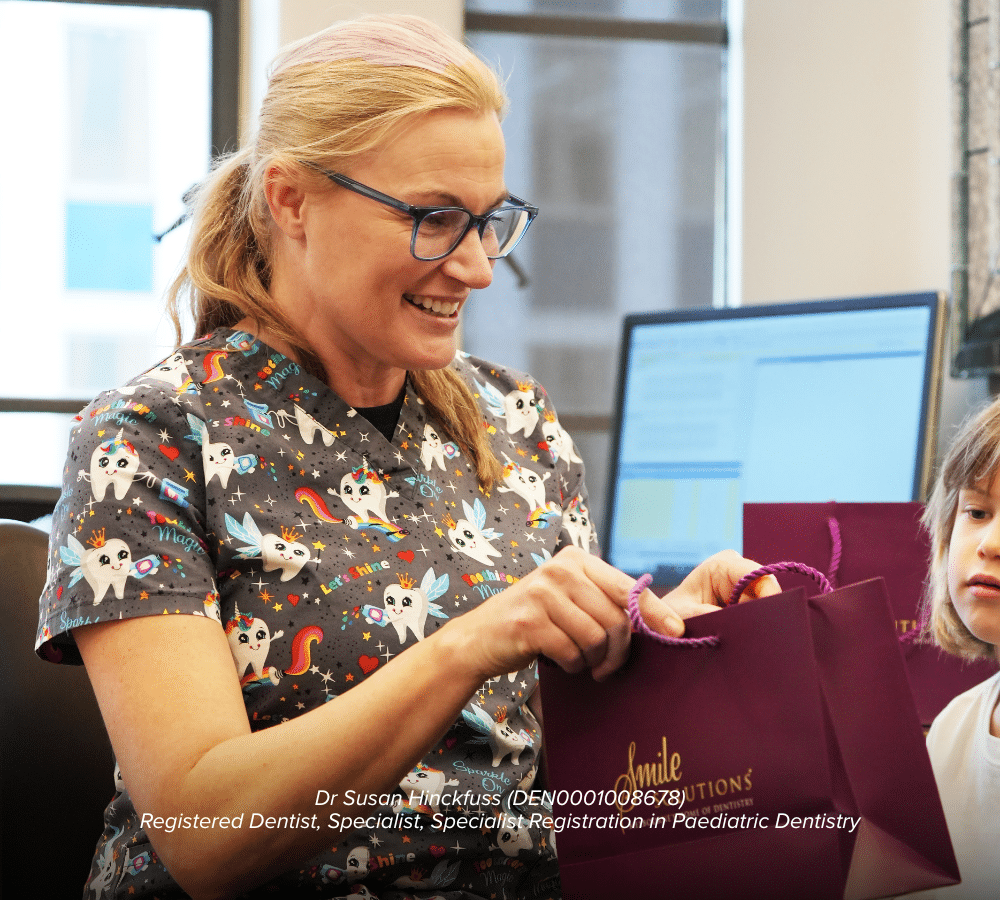
| Dr Susan Hinckfuss | Specialist Paediatric Dentist | BDSc (Melb), DCD (Melb) |
| Isabelle Sayers | Oral Hygiene and Dental Therapy | BOH (Melb) |
If your child is already anxious
Some children arrive already frightened, whether from a previous experience or simply from temperament. We use a set of calming techniques for these patients, which the team refers to as “teddy bear therapy”:
- a cuddly toy to hold during the appointment, giving the child something to do with their hands and something of their own in an unfamiliar room
- children's movies played during treatment as a distraction
- an unhurried pace, with the clinician explaining each step before it happens
Those are recognised behaviour-guidance techniques rather than inventions of this practice. The American Academy of Pediatric Dentistry's behaviour-guidance list includes tell-show-do, distraction, desensitisation, positive reinforcement and descriptive praise, and defines distraction as diverting attention from what may be perceived as unpleasant, achieved “by imagination (eg, stories), clinic design, and audio (eg, music) and/or visual (eg, television, virtual reality eyeglasses) effects”. It also makes the point that “giving the patient a short break during a stressful procedure can be an effective use of distraction”.
How strong is the evidence? Weaker than you would expect, and we would rather say so. The Cochrane review of non-pharmacological interventions for dental anxiety in children exists only as a registered protocol with no published results, so there is no Cochrane effect estimate for these techniques in children at all. The nearest quantified evidence is in adults, and it is not encouraging about distraction specifically: a 2024 systematic review and meta-analysis in the Journal of Anxiety Disorders concluded with moderate certainty that virtual reality distraction, background music, acupuncture and preoperative video information did not reduce state anxiety in adult dental patients — virtual reality distraction, for instance, came out at a standardised mean difference of −0.21 (95% CI −0.54 to 0.12) across 5 trials and 678 participants, and −0.04 once an outlier was excluded. That was adults having oral surgery, not four-year-olds having their teeth counted, and the two are not interchangeable. What it means is that a toy and a film are reasonable, humane, widely used practice, and nobody should present them to you as a proven treatment for a frightened child.
The approach is behavioural rather than pharmacological. For children whose anxiety cannot be managed this way, or who need treatment they will not tolerate awake, we have in-house sedation and general anaesthesia options that are discussed with the treating clinician and the family. See Dental Anxiety, Sleep Dentistry and combating dental anxiety in children.
Sedation and general anaesthesia are not small decisions. Suitability depends on the child's medical history, and the risks and alternatives must be discussed with the practitioner administering them before any consent is given.
Children who need the visit adjusted
For an autistic or neurodivergent child, or a child with a disability or sensory sensitivity, the standard appointment can be reshaped rather than endured. Say what your child needs when you book, and it can be planned for:
- A quieter time of day, and a shorter appointment
- A pre-visit walkthrough, or photographs of the room and the clinician to look at at home
- A predictable order of events, explained beforehand and followed exactly
- Adjustments to lights, noise and the chair, including staying in a wheelchair or on a parent's lap
- Several short visits building up, rather than one long one
- Bringing headphones, sunglasses or a familiar object
See oral health care for children with special needs.
What parents can do on the day
- Book a morning appointment where possible. Young children cope better before they are tired.
- Avoid loaded language. Words like “hurt”, “needle”, “drill” and “brave” introduce the idea that something frightening is coming. Describe the visit as counting and cleaning teeth.
- Do not promise it won't hurt. If anything ever does, the promise is broken and trust with it.
- Stay calm yourself. Children read parental anxiety accurately and adopt it.
- Let the clinician lead. If your child is nervous, resist the urge to intervene or negotiate mid-appointment.
- Praise afterwards regardless of how it went, and avoid using treats — particularly sugary ones — as the reward.
What to bring: your health fund or Medicare details, any Child Dental Benefit Schedule information, a list of medications, a comfort object, and — if you are bringing a sibling — another adult, so one child can be taken out if needed.
If you have dental anxiety yourself, mention it at the desk rather than in front of your child. It is extremely common, and it is useful for the clinician to know which words to avoid. How common is worth knowing: in a national telephone survey of 6,112 Australians aged 16 and over, published by Armfield, Stewart and Spencer in BMC Oral Health, 11.9 per cent described themselves as very afraid of going to the dentist and a further 5.2 per cent as quite afraid.
If it does not go well
Some first visits end with a child who will not open their mouth, or who cries throughout. That is a common outcome, not a failure, and it is not a verdict on your child.
What helps:
- Do not apologise to your child for the appointment, which frames it as something that was done to them
- Do not describe it afterwards as a battle in their hearing
- Go back sooner rather than later, for something short and undemanding — long gaps let apprehension grow
- Expect progress in steps: sitting in the chair, then a mirror, then a count, then a polish
A clinician experienced with children will usually stop before a child becomes distressed, precisely so that the next visit starts from a better place.
What comes next
- A recall interval set to your child's risk, not a fixed rule — commonly six-monthly, and shorter where decay is active
- Fluoride varnish, applied in seconds, where the clinician judges it useful
- Fissure sealants on the first adult molars once they arrive, usually around six. See the role of fissure sealants
- An orthodontic assessment from six or seven, which is about identifying growth-related problems early rather than starting treatment. See Children's Orthodontics and when should I take my child to an orthodontist
- A mouthguard once contact sport starts. See Sports Mouthguards
- Treatment where decay is found, which is far simpler caught early. See Tooth Fillings
Day-to-day technique is covered at Kids' Teeth Cleaning Tips and how to get your child to brush; the wider preventive picture at protecting your child from dental disease.
Many children aged 0–17 are eligible for the Child Dental Benefit Schedule, which contributes to basic dental services. Services Australia states that the scheme covers up to $1,158 for each eligible child over two consecutive calendar years for basic dental services, that the cap is indexed each 1 January, and that the full amount may be used in the first of the two years — which would leave nothing for the second. Older material quotes a $1,095 cap, which applied to an earlier two-year period; check which period and which figure apply to your child rather than assuming. Eligibility depends on the child's age, Medicare enrolment and a qualifying payment received by the child or a parent. See Child Dental Benefit Schedule.
And if something happens before the next appointment — a knocked or broken tooth, a swelling, a toothache — do not wait for it. See Children's Dental Emergencies.
Common questions
When should my child first see a dentist?
General professional guidance commonly recommends a first dental visit by age one, or within about six months of the first tooth appearing. Smile Solutions' published practical recommendation is from age three for a routine first visit. Come earlier if you notice white or brown marks, pain, swelling or injury, or if there is a strong family history of decay. Your child's own clinician can advise the timing that fits their risk and development.
Both positions are in circulation and the difference is worth understanding rather than glossing over. The Australian Dental Association's own wording is that children should have their first visit “when the first teeth appear in the mouth”; ADA NSW says “by one year of age and at least every 12 months”. The reasoning behind the earlier date is not that a one-year-old needs treatment — it is risk assessment and coaching the parent, at the point where habits are still forming. The ADA's own consumer research found that only 5 per cent of parents thought the first visit should be before 12 months, and that 32 per cent of parents reported their child's first visit was actually prompted by pain or a problem. That is the outcome both recommendations are trying to avoid, and it is the practical argument for going earlier rather than later if there is any doubt.
Does it really matter if the first visit is for a toothache?
Yes, and this is the clearest reason to book before anything hurts. An ADA spokesperson puts it plainly: “A first dental visit for a tooth ache may create a negative first experience. We don't want that to be your child's introduction to the dentist.”
Where that leads over a lifetime has been measured in Australia. In the national survey of 6,112 adults described above, 43.9 per cent of people who described themselves as very afraid of the dentist had last attended more than two years earlier, against 29.1 per cent of those with no fear; 27.6 per cent expected to make their next visit only when they had pain or a problem, against under 17 per cent of everyone else; and 29.2 per cent of the very afraid fitted a profile of delayed visiting, dental problems and symptom-driven treatment, against 11.6 per cent of those with no fear — an adjusted odds ratio of 3.33 (95% CI 2.67 to 4.15).
Two honest qualifications belong with those figures. The study was cross-sectional, so as its authors say, “causality cannot be inferred from the results”, and they add that it is “certainly not the case that having high dental fear is a necessary and sufficient precondition for poor oral health outcomes” — nearly 70 per cent of the very afraid did not fit that profile. The authors also note that while negative dental experiences clearly can cause fear, many highly anxious people cannot recall any aversive event that would explain it. So a frightening first visit is one route into dental fear, not the only one, and a good first visit is protection rather than a guarantee.
Will my child need x-rays at the first visit?
Not routinely. X-rays are considered only when the clinician needs information that cannot be obtained from the examination, such as when decay, injury or another problem is suspected. The reason for any proposed image should be explained before it is taken.
On dose, since it is usually the underlying worry: the International Atomic Energy Agency gives the effective dose of an intraoral dental x-ray as 1 to 8 microsieverts and a panoramic examination as 4 to 30 microsieverts. Ask which examination is proposed, because the two differ by roughly an order of magnitude, and ask what decision the image will inform. See How safe are dental x-rays.
Who will my child see?
A first visit may be with a dental hygienist, oral health therapist or general dentist, depending on your child's age, needs and the appointment arranged. Children who need specialist assessment may be referred to a registered specialist paediatric dentist.
Paediatric dentistry is one of the thirteen dental specialties recognised in Australia and approved by the Australian Health Workforce Ministerial Council, and specialist registration in it can be checked yourself, free, on the AHPRA public register. A specialist must also have completed a minimum of two years of general dental practice. See Dentists & Registered Specialists.
What if my child is already frightened of the dentist?
Tell the team before the appointment. The visit can be paced around the child, with simple explanations, a gradual introduction to the chair and instruments, and realistic goals for that day. Avoid promising that nothing will happen; explain instead that the team will show and discuss things first.
That sequence has a name in the professional literature. The American Academy of Pediatric Dentistry defines tell-show-do as explaining the procedure in language the child can understand, demonstrating it in a carefully defined and non-threatening setting, and only then carrying it out. Be aware, as set out above, that no quantified effect estimate exists for these techniques in children — the relevant Cochrane review was registered but never completed — so this is established practice rather than proven therapy.
What happens if my child will not cooperate?
The clinician may complete only what the child can tolerate safely, then arrange another acclimatisation visit or discuss other options. Holding a distressed child through non-urgent treatment can make future care harder. Urgent pain, swelling or trauma needs a separate clinical assessment.
Do baby teeth really need preventive care?
Yes. Baby teeth help with eating, speech and spacing for adult teeth, and decay can cause pain and infection. Daily cleaning, appropriate fluoride advice, regular assessment and early treatment where needed are more conservative than waiting for a problem to become painful.
The scale of the problem is measured. The Australian Dental Association reports that 34 per cent of Australian children aged 5 to 6 years have experienced decay in their primary teeth, and that 27 per cent of those aged 5 to 10 have untreated decay in primary teeth. Untreated is the word that matters: it means the decay was found and not dealt with, which is the situation regular assessment exists to prevent.
Practical details
| Address | Level 1, 220 Collins Street, Manchester Unity Building, Melbourne VIC 3000 |
| Phone | 13 13 96 |
| theteam@smilesolutions.com.au | |
| Monday – Friday | 8.00am – 6.00pm |
| Saturday | 8.30am – 1.30pm |
| Sunday | By appointment |
| Recommended first visit | From age 3 |
| Professional guidance elsewhere | By age 1, or 6 months after the first tooth |
| Come sooner if | Any white or brown marks, or a family history of decay |
| X-rays at a first visit | Only where specifically indicated |
| Usually seen by | Dental hygienist, oral health therapist or general dentist |
| Parking | Wilsons Parking, Flinders Lane (between Swanston and Russell) |
Every clinician's registration, including any specialist registration, can be verified free on the AHPRA public register at ahpra.gov.au.
Related pages: Children's Dentistry, Kids' Teeth Cleaning Tips, Children's Dental Emergencies, Child Dental Benefit Schedule, Specialist Paediatric Dentists, Children's Orthodontics, Dental Anxiety.
General information only — it is not a diagnosis, a treatment plan or a promise of any particular clinical outcome, and it does not replace examination of your child by a registered practitioner. Suitability, treatment approach and outcomes vary between children; ages and eruption timings given here are typical ranges rather than rules, and toothpaste and fluoride advice should be confirmed with your own clinician for your child. Sedation and general anaesthesia carry risks that must be discussed with the practitioner administering them. Benefit caps and eligibility rules change; confirm the current position with Services Australia. Practitioners join and leave; confirm current availability when booking.
Smile Solutions trades under ABN 28 193 514 103.
Images on This Page
-
https://www.facebook.com/tr?id=800557773428361&ev=PageView&noscript=1
(no alt text)
-
https://www.smilesolutions.com.au/wp-content/uploads/2025/10/calendar_month.svg
(no alt text)
-
https://www.smilesolutions.com.au/wp-content/themes/arcadian-wordpress-theme/assets/images/smile_solutions_logo_white.png
Smile Solutions Logo
-
https://www.smilesolutions.com.au/wp-content/themes/arcadian-wordpress-theme/assets/images/smile_solutions_logo_purple.png
Smile Solutions Logo
-
https://www.smilesolutions.com.au/wp-content/uploads/2025/11/Smile-Solutions-4.png
Smile Solutions - Melbourne CBD
-
https://www.smilesolutions.com.au/wp-content/uploads/2025/09/Paediatric-Dentistry-Smile-Solutions.png
Paediatric Dentistry Smile Solutions
-
https://www.smilesolutions.com.au/wp-content/uploads/2025/08/69a44c30c93ce196d539cc5520080df52a5f3f88-scaled.jpg
69a44c30c93ce196d539cc5520080df52a5f3f88 scaled
-
https://www.smilesolutions.com.au/wp-content/themes/arcadian-wordpress-theme/assets/images/family_owned_bussiness.png
Family Owned Business
-
https://www.smilesolutions.com.au/wp-content/themes/arcadian-wordpress-theme/assets/icons/icon--phone.svg
Smile Solutions Contact
-
https://www.facebook.com/tr? id=800557773428361&ev=PageView&noscript=1
(no alt text)