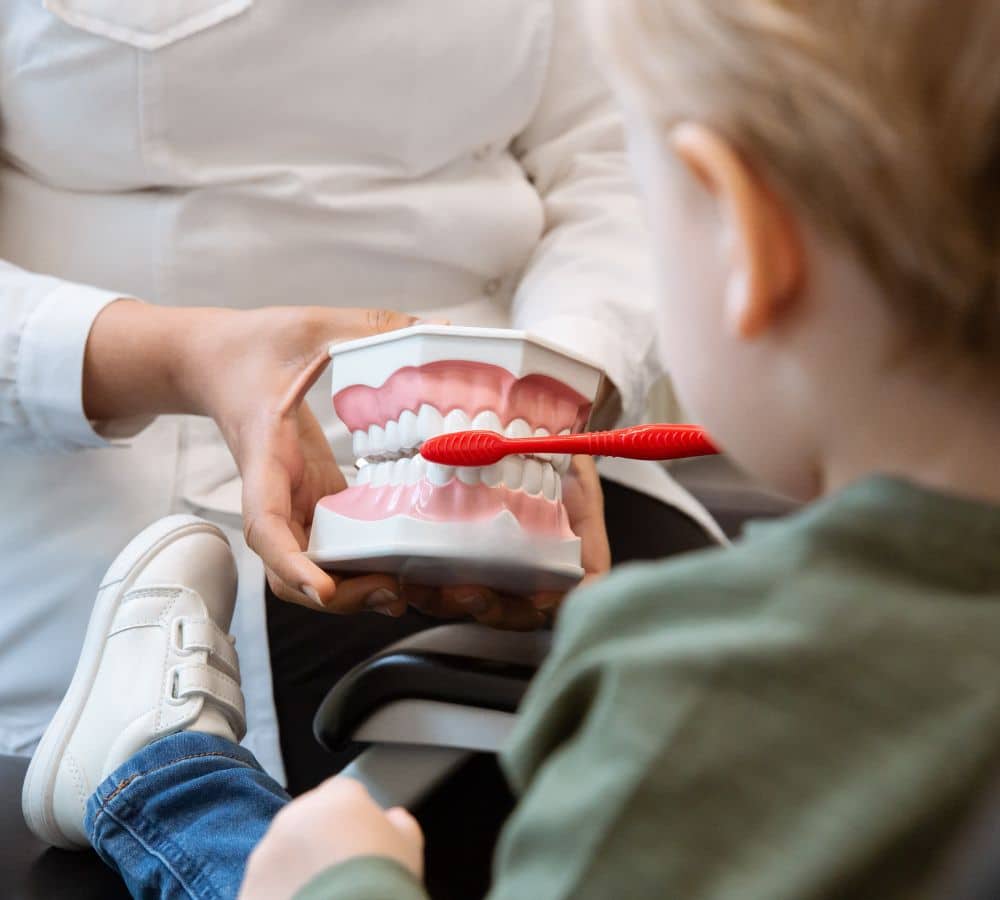
When brushing turns into a battle
Does the sight of a toothbrush send your toddler into a meltdown? You are not alone.
"It can be really tough for parents," says Karleen Giampietro, dental nurse and Tooth Fairy at Smile Solutions — see also life as the Smile Solutions tooth fairy.
You are genuinely not alone, and there is data on it. The Australian Dental Association's consumer survey of 25,000 adults found 68% of children brush twice a day, while 21% manage it only once — and the ADA's own explanation of that gap names this exact problem. The once-a-day group was concentrated among parents of children under three, who either believed once was enough or were dealing with issues around the child co-operating at the basin.
Perseverance matters, because brushing a small child's teeth affects their oral health now and later. Protecting your child from dental disease sets out how unevenly decay is distributed between families, and why habits are the difference.
"Making the process fun and interactive can help encourage your toddler to cooperate with brushing twice a day. If you manage flossing in there too, that's a bonus." Is flossing really that important? explains why it matters once the back teeth touch.
Often one approach that appeals to your particular child is all it takes. Here are several to try. Kids teeth cleaning tips covers the technique itself.
Before you start: what the guidance says, by age
Worth getting clear before the strategies, because several brushing battles turn out to be a mismatch between what is being attempted and what the child is up to. The Australian Dental Association's consumer guidance sets the sequence out as follows.
Before the first tooth — you can use a clean, damp washcloth or muslin cloth to wipe your baby's gums. No brush required, and it gets the habit of something going in the mouth established early.
From around 6 months, or when the first tooth arrives — start using a toothbrush. You will need to brush their teeth for them, but let them have a turn as well. ADA NSW puts the first tooth at around 6 to 12 months and recommends cleaning twice a day with a soft toothbrush from that point.
From 18 months — start using toothpaste. Babies do not need toothpaste before that.
Until age eight — parents should assist with brushing (ADA NSW). A seven-year-old is not being difficult when they miss things; they are not yet able to do it thoroughly on their own.
How long, really
Two minutes is the recommendation for children and adults. But the ADA adds a qualification that saves a lot of unnecessary struggle: babies and toddlers only have a few teeth, so you do not need to brush for that long — what matters is that all surfaces have been reached. As more teeth arrive, build towards two minutes.
If you have been enforcing two minutes on a one-year-old with four teeth and losing the argument nightly, that is the paragraph to take away.
Add some colour
Let your toddler choose an age-appropriate toothbrush, and make it clear the purchase is exciting and it is theirs — advice from Dr Peter Alldritt, chairman of the Australian Dental Association's Oral Health Committee.
What tends to work: brightly coloured or character brushes, musical brushes, brushes that glow or light up, and children's electric toothbrushes. Which toothbrushes do dentists recommend? covers what actually matters in a brush, and caring for a toothbrush what to do with it afterwards.
Ownership is the operative idea. A brush the child chose is a different object from one handed to them.
Encourage independence
Children are generally not able to brush their own teeth effectively until around age eight. But you can give a sense of independence with two toothbrushes — one your child uses, and one for you to finish the job.
The technique
Have them first use a finger to feel right back to their back teeth, so they understand where they are meant to be brushing. Then give them a pea-sized amount of children's toothpaste — if they are over 18 months; otherwise just water — and let them go. Selecting a toothpaste: fluoride or non-fluoride explains why the age rule exists, and the benefits of fluoride what it is doing.
The pea-sized amount is not an arbitrary convention. Low fluoride toothpastes for children are actively promoted in Australia alongside public health guidance to use only a small pea-sized amount and to encourage children not to swallow toothpaste — NHMRC. Swallowed toothpaste is the main avoidable source of excess fluoride in young children, and the pea is the control.
It is worth knowing what you are getting for that pea. The NHMRC's assessment is that community water fluoridation reduces tooth decay by 26 to 44% in children and adolescents, and it is explicit that fluoridated water and fluoride toothpaste provide complementary benefits rather than duplicating each other — so drinking fluoridated water is not a reason to skip the toothpaste, and vice versa.
Follow up with a thorough brush of each tooth yourself, particularly around the gum line. Firm is not the same as hard — see over-brushing.
If they resist your turn
Offer a trade: they can brush the spots you missed in your mouth, if they let you do theirs.
Lead by example
Making brushing a family activity works well. "Watching their parents having fun while brushing their teeth will encourage a toddler to join in."
Siblings are excellent role models — a toddler who sees an older sibling doing something will usually want a turn.
And the model does not have to be human. If your pet tolerates having their teeth cleaned, let your toddler watch.
"You can also see if they want to brush with a buddy, such as a soft toy." Let them pick a different toy each time. The same principle underpins the role-play described in combating dental anxiety in children.
Make it a game
Hunt for food. Think of something your child ate recently and announce you are going in to find it.
"Telling your toddler you want to tickle the 'sugar bugs' out of their teeth sometimes works too." Dental Health Week: protect your kids from the Sugar Bandits extends that idea past the bathroom.
Use sounds. Get them to sound out funny words — baaaaaa, staaaaar — or run through the vowels. They enjoy the faces and the noises, and it gives you access to different areas of the mouth. That is the practical trick hidden inside the game.
Use time. Play a teeth-brushing song, use a timer, or download an app with a built-in timer and games. Two minutes is the target — what is the ideal daily routine for oral hygiene? and how often should I brush my teeth?.
This is not just a Smile Solutions habit. The ADA recommends the same thing in the same terms — make brushing time fun by playing a song or using a phone app with a timer, noting that such apps give positive reinforcement through stickers and awards, and that brushing charts and stickers can also provide encouragement.
Chart the success
"I'm surprised at how successful the classic reward chart still is," says Dr Alldritt. "A child loves seeing a visual of what they've achieved, as well as getting a daily reminder of how good they've been."
A suggestion worth trying: put yourself on the chart too. It shows your toddler you are part of the same effort.
Beyond the daily stamp or star, a milestone reward after a set number of days or weeks works — a special outing, or something oral-hygiene related, such as an electric toothbrush like the ones the adults have. Sweets are the one reward to avoid here: the ADA's stated position is that using food to reward, bribe or comfort children sends an inappropriate message about food from an early age. Rewarding a tooth-brushing streak with sugar is self-defeating twice over — see how does sugar affect your dental health?
Distract
When all else fails and the job has to get done:
Brush in the bath. They are already relaxed and having fun, it is less messy, and it puts them in an easy reclining position for cleaning.
Leave the bathroom. Brushing does not have to happen there — especially if that room has built up negative associations.
Use a dedicated screen ritual. "Try letting them watch something on TV that is only for when they're brushing their teeth, so they associate teeth-brushing with something positive."
Change the position. "A toddler is often more cooperative when lying reclined on your knee, as opposed to standing." This is the single most useful physical tip here — it improves both cooperation and your view.
Tell a story, and let them know the longer they cooperate, the more they get to hear.
When flossing starts
Most parents assume flossing is a later problem, and the survey data says so: 76% of children never floss themselves, nor have a parent do it for them, and among families that have introduced it, the majority — 61% — did so somewhere between ages six and 13 (ADA Consumer Survey). Many parents told the ADA they thought it was not worthwhile while baby teeth were still in place.
The guidance is considerably earlier than that. Once your child has two teeth touching side by side, you should clean between them with floss — often around 2 years of age, and dentists recommend doing it daily from that point. Your dentist can demonstrate the technique and suggest tools that make it easier on a small mouth.
The reasoning is the same as the reasoning for brushing: the surfaces where two teeth meet are the ones a brush cannot reach, and they are where decay in baby teeth commonly starts. Is flossing really that important? covers it in full.
One more habit that belongs in the same bracket, and costs nothing: encourage your child to drink tap water, and limit sugary foods and drinks (ADA NSW). Brushing is one of three levers, and it is the one that has to do the most work if the other two are not being pulled.
If the resistance is less about brushing and more about the mouth being sore, check the obvious first: baby teething: signs, symptoms and treatments and the order and appearance of baby teeth. A child who has stopped letting anyone near a particular tooth is worth having looked at — when should a child first visit the dentist? and should your child see a specialist paediatric dentist?
The ADA also describes a quick check you can do yourself between appointments: lift the top lip and roll down the bottom lip, and look for white, brown or black spots on the teeth that do not come off. Those can indicate decay and are a reason to book. It does not replace a check-up.
Common questions
My baby has no teeth yet. Is that normal, and when should I start worrying?
Usually normal, and there is a clear point at which to ask.
The Australian Dental Association's consumer guidance says baby teeth often start to appear around 9 months old, but this can range from 3 to 12 months. The order varies too: it is normal for the teeth to arrive in any order, though the middle bottom teeth are often first, and all 20 baby teeth usually arrive by age 3.
The threshold worth remembering: if your child does not have any teeth by 12 months of age, it is best to have a check-up with a dentist. That is not an alarm, it is a reasonable point to have someone look.
In the meantime, there is still something to do. Before the first tooth arrives, wipe the gums with a clean, damp washcloth or muslin cloth. It keeps the mouth clean and, more usefully, it means that when the brush does arrive, having something in their mouth is already an ordinary event rather than a new indignity. Half the brushing battles described above start because the brush was the first thing ever introduced.
They are teething and miserable. Can I use a teething gel?
They help less than most parents expect, and the ADA raises a safety point that is not widely known.
Its assessment is that cold teething gels can help at first, but this may only last a short amount of time, because the gel gets washed away by saliva. So the relief is real but brief, and reapplication is where the problem starts.
The warning is worth quoting properly: babies can swallow the teething gel placed on the gums, and it can be hard to know how much they have swallowed. This can make the throat numb, becoming a choking hazard.
That is the reason to be sparing rather than generous, and to read the product's own instructions and age limits rather than going by how distressed the baby is. If you are unsure about a particular product or how often it can be used, your pharmacist or GP is the right person to ask — that is a medicines question rather than a dental one.
The measures that carry no such risk are the dull ones: something cold and firm to chew on, a chilled (not frozen) teething ring, and pressure from a clean finger. And keep cleaning the gums and any teeth that are through, because a sore mouth is exactly when brushing gets abandoned and exactly when it matters.
They swallow the toothpaste every time. How much of a problem is that?
It is the reason for the pea, and the reason for low-fluoride children's toothpaste — but the scale of the concern is smaller than the internet suggests.
Dental fluorosis is caused by high fluoride intake from multiple sources while the teeth are developing inside the jawbone, usually from birth to six or eight years of age (NHMRC). Toothpaste is the source you control most directly, which is why the guidance is a small pea-sized amount of low-fluoride children's toothpaste and to encourage children not to swallow it.
What happened when Australia followed that advice is the useful part. The NHMRC reports that fluorosis in Australia has declined over the same period in which water fluoridation expanded, and links the decline specifically to reduced exposure from other sources, particularly the availability and active promotion of low-fluoride children's toothpaste. The system worked.
And on severity: where fluorosis is identified in Australia, in most cases it is very mild or mild, which does not affect the function of the teeth. Moderate fluorosis is very uncommon and severe fluorosis is rare.
So: keep to the pea, keep the tube out of reach between brushes — children like the taste and will eat it straight from the tube, which is a different order of exposure from what they swallow while brushing — and teach spitting as soon as they can manage it. A toddler who swallows some of a pea twice a day is not the scenario the warnings are about.
My child is one and has a few teeth. Is it too early for a dental visit?
No — and the professional guidance is earlier than most parents expect.
The ADA's consumer guidance states that first dental visits are recommended when the first teeth appear in the mouth. ADA NSW is more specific: the first visit "should occur when the first baby tooth comes through or by one year of age", and at least every 12 months after that, the stated purpose being to help prevent tooth decay and set up a habit of lifelong dental health.
You will see a later age suggested in some places, including elsewhere on this site, where the recommendation is from around age three — the age at which most children can sit through a straightforward introductory appointment. Both figures are in circulation and the difference is worth understanding rather than glossing over: the earlier recommendation is about early detection and coaching the parent, since decay can begin as soon as teeth are present; the later one is about the child's ability to cooperate.
The practical resolution is the same one a dentist would give you. If your child has any visible decay, white or brown marks that do not brush off, a history of falling asleep with a bottle, or a family history of early decay — do not wait. Book now. If none of that applies, an introductory visit between one and three is a reasonable plan, and bringing them along to watch your own appointment first costs nothing. Ask the practice which applies to your child rather than working from an age alone. See when should a child first visit the dentist? and your child's first visit to the dentist.
Related reading
- Children's dentistry — the service page
- Your child's first visit to the dentist
- How Smile Solutions helps manage your child's dental anxiety
- Everything you need to know about chalky teeth
- The role of fissure sealants in children's teeth
- Should I pull out my child's loose tooth?
- Oral health care for children with special needs
- In the media: Stop brushing battles and Kids get the brush off
Practical details
Written by Karleen Giampietro, Smile Solutions, with comments attributed to Dr Peter Alldritt of the Australian Dental Association. The full team is listed by name.
Smile Solutions, Level 1, 220 Collins Street, Manchester Unity Building, Melbourne VIC 3000 — getting here. Phone 13 13 96, contact us, or theteam@smilesolutions.com.au. Monday–Friday 8.00am–6.00pm, Saturday 8.30am–1.30pm, Sunday by appointment.
The first dental visit is recommended by about age one. Eligible children may be able to use the Child Dental Benefits Schedule; check with Services Australia, and see how the schedule operates.
Published 5 November 2018. Age-by-age brushing and flossing guidance, brushing duration, the timer and sticker recommendations, the tooth-eruption timeline, the teething gel caution and the lift-the-lip check are attributed to the Australian Dental Association and its consumer site teeth.org.au; twice-daily cleaning from the first tooth, supervision to age eight, first-visit timing and the tap water guidance to the Australian Dental Association NSW; the brushing and flossing survey percentages to the ADA Consumer Survey; the pea-sized amount, low fluoride toothpaste, the fluorosis findings and the 26–44% decay reduction to the NHMRC. General information only; it does not replace advice from your treating practitioner. Questions about a specific teething product or medicine are for your pharmacist or doctor.
Smile Solutions trades under ABN 28 193 514 103.
Images on This Page
-
https://www.facebook.com/tr?id=800557773428361&ev=PageView&noscript=1
(no alt text)
-
https://www.smilesolutions.com.au/wp-content/uploads/2025/10/calendar_month.svg
(no alt text)
-
https://www.smilesolutions.com.au/wp-content/themes/arcadian-wordpress-theme/assets/images/smile_solutions_logo_white.png
Smile Solutions Logo
-
https://www.smilesolutions.com.au/wp-content/themes/arcadian-wordpress-theme/assets/images/smile_solutions_logo_purple.png
Smile Solutions Logo
-
https://www.smilesolutions.com.au/wp-content/uploads/2016/05/Karleen-150x150.jpg
Karleen Giampietro
-
https://www.smilesolutions.com.au/wp-content/uploads/2018/11/Brushing-Childrens-Teeth.jpg
How to encourage your child to brush their teeth?
-
https://www.smilesolutions.com.au/wp-content/uploads/2018/11/Smile-Solutions-Tooth-Fairy-300x270.jpg
Smile Solutions Tooth Fairy
-
https://www.smilesolutions.com.au/wp-content/uploads/2018/09/child-wear-mouthguard-768x572-1-300x223.jpg
child wear mouthguard 768x572 1
-
https://www.smilesolutions.com.au/wp-content/uploads/2025/09/Root-Canal-2-300x217.jpg
Root Canal
-
https://www.smilesolutions.com.au/wp-content/uploads/2023/11/SS-Tooth-1-1-150x150.png
Smile Solutions
-
https://www.smilesolutions.com.au/wp-content/themes/arcadian-wordpress-theme/assets/images/family_owned_bussiness.png
Family Owned Business
-
https://www.smilesolutions.com.au/wp-content/themes/arcadian-wordpress-theme/assets/icons/icon--phone.svg
Smile Solutions Contact
-
https://www.facebook.com/tr? id=800557773428361&ev=PageView&noscript=1
(no alt text)
-
https://bat.bing.com/action/0?ti=25148060&tm=gtm002&Ver=2&mid=4708b785-184e-4570-8938-03b191347ecc&bo=1&sid=e06558c0ab2511f1aa1a4fea71b7698c&vid=e065b0a0ab2511f19ef3c704c6ee6db4&vids=1&msclkid=N&pi=918639831&lg=en-US&sw=800&sh=600&sc=24&nwd=1&tl=How%20to%20encourage%20your%20child%20to%20brush%20their%20teeth%3F%20-%20Smile%20Solutions&p=https%3A%2F%2Fwww.smilesolutions.com.au%2Fdental-articles%2Farticle%2Fget-child-to-brush-their-teeth%2F&r=&evt=pageLoad&sv=2&cdb=AQAQ&rn=930595
(no alt text)