Protecting your child from dental disease
The numbers that make the case
Child Dental Health Survey data shows the average six-year-old has two teeth affected by decay.
The 10 per cent of children this age with the most extensive decay history in their baby teeth had approximately eight teeth affected — around four times the national average for the age group.
That distribution is the important detail. Decay is not spread evenly across children. A small group carries a very large share of it — which means the difference between families is largely about habits, and habits are modifiable.
Where the ADA's more recent reporting sits
Those survey figures are as at the date this article was published, and they are left unchanged. For a current reference point alongside them, the Australian Dental Association reported in August 2024, drawing on its Children and Young People Oral Health Tracker, that:
- 34 per cent of children aged 5–6 have experienced decay in primary or baby teeth, and 27 per cent of children aged 5–10 have untreated tooth decay in primary teeth.
- Nearly 11 — 10.8 — in every 1,000 children aged 5 to 9 are hospitalised for potentially preventable problems due to dental conditions, rising to 14.3 per 1,000 for Indigenous children.
- Only 56 per cent of children visit the dentist before age 5.
The hospitalisation figure is the one that changes the register of this page. Those are admissions, not fillings, for a disease the ADA describes as preventable.
Start early
Introduce children to the dentist from around age three, and get them familiar with the experience while young.
That makes dental visits later in life less stressful, and builds lifelong habits. When should a child first visit the dentist? sets out the case for starting earlier still — at the first tooth or the first birthday — and your child's first visit describes the appointment itself.
On the age, the ADA is more forward than the sentence above, and you should have its version too. Its recommendation is that the first dental visit happens when an infant's first tooth or teeth emerge, typically before or around age one; the ADA's NSW branch puts it as by one year of age, and at least every 12 months thereafter. We have not altered the “around age three” line — but where the two differ, earlier is the position of the national association, and nothing is lost by going sooner.
One figure from the ADA's 2025 survey of 25,000 Australian adults is the reason it matters: 33 per cent of first dental visits were for pain or a problem.
The mechanism is simple: a child whose first visit happens because something hurts learns that the dentist is where pain happens. A child who has been coming since before there was a problem learns it is unremarkable. That is a third of Australian children starting on the wrong side of it. Combating dental anxiety in children and how Smile Solutions helps manage your child's dental anxiety go into how that is handled in practice.
Paediatric dentists
A general dentist is equipped to provide dental care for people of all ages, and many treat children very well.
A specialist paediatric dentist has completed additional postgraduate training specifically in treating children, which is particularly valuable for anxious children, very young children, children with additional needs, and complex cases. Behaviour management with young children is a trained skill, and the first few experiences shape whether a child grows into an adult who attends the dentist. Should your child see a specialist paediatric dentist? lists the circumstances that warrant a referral; oral health care for children with special needs and caring for a child with autism cover the adjustments available. Paediatric dentistry is one of the thirteen dental specialties recognised by the Dental Board of Australia — dentists and registered specialists.
Brushing: the part parents get wrong
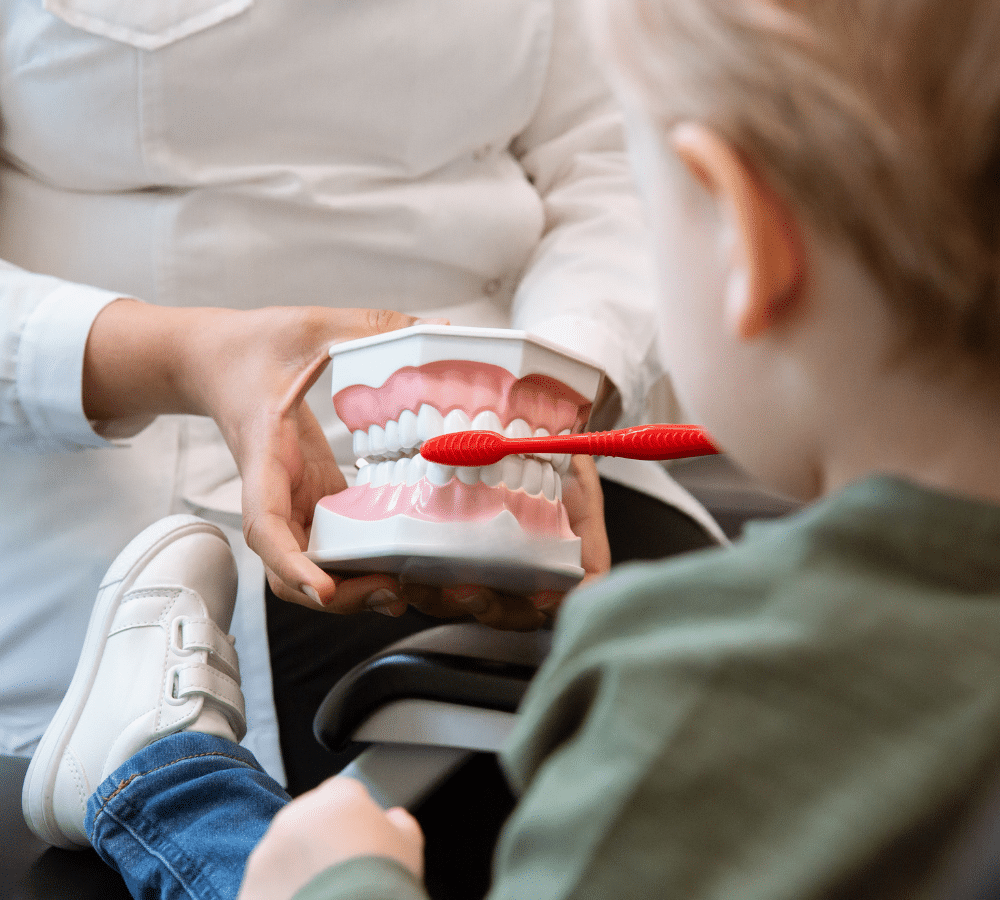
Until about age seven, most children do not have the dexterity to brush their own teeth properly.
Let them try — and then brush their teeth thoroughly yourself, or hold the brush together.
This is the single most consequential item on this page. A five-year-old brushing unsupervised is performing the ritual, not cleaning the teeth — and the areas they miss are exactly the ones that decay. Kids teeth cleaning tips and how to encourage your child to brush their teeth cover the practicalities when a child resists.
The ADA NSW puts the same threshold one year later, advising that parents should assist with brushing children's teeth until age eight. A year either way is not the point. The point is that it is considerably later than most households assume, and that stopping when a child asks to do it alone is usually too early.
When to start, and with what
Start cleaning your child's teeth as soon as they come through — usually around six months, but anywhere between 3 and 14 months. Baby teething: signs, symptoms and treatments and the order and appearance of baby teeth set out what to expect and when — including the ADA's own slightly narrower range, and its advice that a child with no teeth at all by 12 months should have a check-up.
Under 2: water only, no toothpaste, on a small soft toothbrush or even a face washer.
Over 2: a child-strength toothpaste. (The ADA starts toothpaste at 18 months, six months earlier; the principle behind both is the same — none while a child is still purely swallowing.)
That age rule exists because young children swallow rather than spit, and swallowing adult-strength fluoride while permanent teeth are forming can cause permanent white mottling of the enamel. Selecting a toothpaste: fluoride or non-fluoride and the benefits of fluoride explain the balance being struck.
The routine
Brush twice daily — morning and evening — for two minutes, using circular, up-and-down and side-to-side motions. What is the ideal daily routine for oral hygiene? sets out the adult version, and over-brushing is worth reading before anyone scrubs harder. The ADA notes that babies and toddlers with only a few teeth do not need the full two minutes — what is required is that all surfaces are reached.
Follow with flossing, to prevent cavities between the teeth. A toothbrush cannot reach between contacting teeth, so once a child's back teeth are touching, flossing is not optional — is flossing really that important?
This is the most neglected instruction in Australian children's oral health, and it is not close. The ADA's 2025 survey found that 76 per cent of children never floss themselves, nor have their parents do it — many respondents believing it not worthwhile while baby teeth are still in place. Against that, dentists recommend parents floss daily once a child has two or more baby teeth side by side, which the ADA puts at often around age 2. In practice, 61 per cent of families introduce flossing somewhere between ages six and 13 — years after the teeth in question started touching.
One timing caution: do not brush immediately after acidic food or drink — fruit juice, citrus, soft drink. Wait about an hour, or rinse with water in the meantime, because acid-softened enamel is removed by brushing. How dental erosion is addressed and sugar-free soft drinks and teeth explain why the acid matters independently of the sugar.
The brush
Always use a soft toothbrush, appropriate to the child's age — for example, a stage 4 brush for a four-year-old.
Electric toothbrushes are generally recommended over manual, particularly for children, because they compensate for immature technique. Which toothbrushes do dentists recommend? and caring for a toothbrush cover the rest.
Mainstream brands are suitable for children provided the paste is low foam, low mint and low fluoride for the age group.
Building the habit
A positive mindset
A reward chart helps. Agree on a suitable reward and track progress.
Let your child choose their own toothbrush — a favourite character or colour makes it more appealing. This is a small thing with a real effect on compliance.
Make it fun
Play music or a video while they brush, and reserve it just for brushing time. It relieves the boredom — and it doubles as a two-minute timer.
Get the family involved
Children brush more willingly when they see the rest of the family doing it. Joining in is what children do, and it demonstrates that this is normal rather than a chore imposed on them.
Sugar
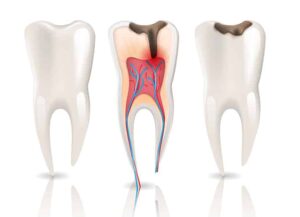
Restricting sugar helps keep decay away. Sugar feeds the bacteria that produce acid, which weakens enamel and makes teeth vulnerable to decay. How does tooth decay develop? and the stages of dental decay trace that process; how does sugar affect your dental health? puts figures to it.
Fill lunch boxes with healthier options such as fruit and yoghurt, rather than sugary treats. Protect your kids from the sugar bandits and limiting sugar at Halloween are the seasonal versions. Note that sweetened yoghurt is on the ADA's own list of snacks marketed as healthy that are worth checking, alongside dried fruit, muesli bars, fruit juice and children's cereals.
After anything sweet, encourage brushing — or, if away from home, sugar-free gum, which stimulates saliva and helps clean the teeth (does chewing sugar-free gum really help prevent cavities?). Rinsing with water also makes a difference.
The underlying principle worth passing on to children as they get older: how often matters more than how much. One serve of something sweet at a meal is far less damaging than the same amount grazed across a day. Can you reverse tooth decay? explains the narrow window in which early damage can still be undone; preventing dental decay collects the measures.
For drinks, two firm lines from the independent guidance: the World Health Organization recommends that children under 2 years of age should not consume any sugar-sweetened beverages, and the Australian Dietary Guidelines state that fruit juice should not be given to infants less than 12 months of age. The ADA adds that for infants and babies, sleeping with sweetened dummies, food or bottles containing sugar — “including milk and fruit juices” — should be discouraged.
One protective measure worth asking about by name: fissure sealants on the first permanent molars, shortly after they arrive at about age six. If the enamel on those molars comes through soft or discoloured, that is a developmental condition rather than a cleaning failure — everything you need to know about chalky teeth.
Mouthguards for sport
Dental disease is not the only risk — injury matters too.
A fitted mouthguard reduces the risk of dental injury in sport. Accidents happen, and a guard is inexpensive protection against damage that follows a child for life. Should my child wear a mouthguard? and sport mouthguards cover the fitting; a new mouthguard: chemist or dentist? covers the choice.
The ADA's policy statement on the prevention and management of oral injuries states the stakes in one line: “Oral damage is often irreversible, frequently complex, difficult, and costly to repair.” It identifies young children and teenagers as high-risk groups, particularly when learning to walk and when new or higher-risk activities are involved.
Which sports, by risk
The ADA sorts sports into four bands:
- Mouthguard strongly recommended — off-road bike riding, skateboarding, rock climbing, white-water rafting, trampolining, combat sports, football, basketball, squash and field hockey.
- Head protection is worn and may obviate the need for one — full-face helmets in ice hockey, and goalkeepers in field hockey; cricket, rollerblading and cycling.
- Not normally worn, but justified in certain circumstances — high diving, surfboarding and skiing.
- Impractical or not warranted, low injury risk — swimming, athletics, aerobics and rowing.
Trampolining and skateboarding are the two most households do not think of, and they sit in the strongly-recommended band alongside contact football. The ADA also holds that protective equipment should be used during training as well as competition.
Custom-fitted versus the chemist
The ADA is direct about the difference. “The most effective protection against oral damage is a custom fitted mouthguard, where precision fit and quality materials offer maximum comfort and injury prevention.” On the alternatives: over-the-counter mouthguards provide better protection than no mouthguard, but their protection varies depending on design, comfort, adaptation and thickness — and, pointedly, “quality control of at-home custom adaptation is not achievable.”
Custom-fitted guards need checking or remaking every 12 months in children, because growing jaws and erupting teeth change the fit. That is consistent with the ADA's own advice that a mouthguard “can last you multiple sporting seasons as long as you are no longer growing” — growth is the variable, and in a child it is always present.
Two risk factors that are easy to miss
Prominent front teeth. The ADA notes that children with prominent front teeth may be at higher risk of injury, and may benefit from orthodontic assessment and early treatment to reduce that risk — which makes an orthodontic assessment partly an injury-prevention question rather than only an appearance one. See orthodontics and orthodontists.
Oral piercings. The ADA records that oral piercing jewellery may increase the risk and degree of oral injury — relevant as children reach the age where that comes up.
If an injury does happen, children's dental emergencies has the immediate steps and emergency dentistry is the route in.
Common questions
Are we eligible for the Child Dental Benefits Schedule, and what does it actually cover?
It is worth checking properly, because the scheme is significantly under-claimed and the amount is not small.
Services Australia sets three conditions, and a child must meet all of them in the relevant calendar year: they are 0 to 17 years old for at least one day that calendar year; they are eligible for Medicare; and you or they get an eligible payment at least once that calendar year.
The amount is up to $1,158 for each eligible child over two consecutive calendar years. Four details catch families out:
- The cap is indexed on 1 January each year, and Services Australia states the increase “will only apply to a child or teenager who received their first eligible service in that calendar year.” This is why you will still see the earlier $1,095 figure in older material, including on the ADA's own consumer page — the two apply to different cover periods, and neither is wrong.
- The two-year clock starts at the beginning of the calendar year in which the child both becomes eligible and receives their first dental service — not on the date of the appointment.
- You can use the whole amount in the first year, which leaves nothing for the second. If you do not, the remainder carries into year two while the child stays eligible.
- Unused funds do not carry beyond the two years. Services Australia is explicit: “If you don't use the full amount within the 2 calendar years, you can't use the remaining funds. You'll have to wait for a new 2 year cover period to start.”
What is covered: check-ups, X-rays, cleaning, fissure sealing, fillings, root canals and extractions. Services Australia adds that “There are some restrictions for basic dental services. You should check with your dentist if there are any item or time restrictions before starting your service.”
What is not covered: orthodontic dental work, cosmetic dental work, and any dental services in a hospital. That last exclusion is the expensive one — it means treatment done under general anaesthetic in a hospital setting sits outside the scheme.
You do not need to apply. Services Australia states: “You don't need to apply or register for CDBS. If your child is eligible we'll send you a letter.” That said, do not wait for the letter to check — eligibility is assessed each calendar year, and the balance can be checked through Services Australia or myGov. If you need an interpreter for the Medicare program line, Services Australia will arrange one for free.
How does the Child Dental Benefits Schedule operate? and the CDBS page set out the mechanics; published fee ranges are in the price guide.
Should my child have fissure sealants, and are they worth doing?
The case for them rests on a piece of anatomy rather than on a marketing claim, and it is worth understanding so you can judge the recommendation.
The biting surface of a back tooth is not flat. It carries grooves — fissures — and on many teeth those grooves are narrower than a single toothbrush bristle. A brush cannot enter them. Food debris and plaque can. That is the whole problem: a surface that collects the cause of decay and cannot be cleaned by the thing that normally removes it. A sealant fills the groove with a flowable material so there is nothing left to trap.
The teeth this matters most for are the first permanent molars, which as this page notes arrive at about age six, come through behind the back baby molars without anything falling out, and usually cause no pain — so parents frequently do not register that adult teeth have arrived at all. They are the teeth a child keeps for life, and they are among the most commonly decayed teeth in Australian children.
Two practical points:
Timing matters. Sealing is done shortly after the tooth arrives and before decay has started in the groove. A tooth that already has decay in the fissure needs a filling instead, which is a different and larger intervention.
It is not a substitute for anything. Sealants address one surface. They do nothing for the areas between teeth, which is where flossing comes in, and nothing about diet.
On cost, fissure sealing is on the list of services covered by the Child Dental Benefits Schedule, so for an eligible family it may fall within the cap discussed above.
We are not going to quote an effectiveness percentage, because the independent sources behind this page do not publish one — the argument here is mechanical rather than statistical. Ask your dentist which of your child's teeth have deep fissures, because it varies between children and between teeth in the same mouth. Who is a suitable candidate for dental sealants? and the role of fissure sealants in children's teeth.
How am I supposed to floss a child's teeth? Mine will not let me near them.
Given that 76 per cent of Australian children never floss and are never flossed, the honest answer starts with: almost nobody finds this easy, and the households that manage it have usually been shown how rather than worked it out alone.
That is the ADA's own advice too. After setting the rule — clean between the teeth once two teeth are touching side by side, often around age 2 — it adds: “Your dentist can show you techniques and items that can make this easier.” Ask for that demonstration at the next appointment, on your own child, in the chair. It takes five minutes and it is the single highest-value thing in this section.
What tends to work in the meantime:
- Position, not persuasion. Standing over a child at a basin is the hardest possible arrangement. Sitting on the floor or a bed with the child's head resting in your lap gives you a clear view and both hands.
- Use a tool, not string. Floss picks and holders on a handle are far easier to manage in a small mouth than wrapped floss. The ADA names floss threaders and interdental brushes among the alternatives where string floss is awkward.
- Start with the two easiest contacts, usually the back molars on one side, and stop there. One contact cleaned every night beats a full set attempted once a fortnight.
- Attach it to something fixed — immediately after the evening brush, every night, in the same place — so it is a sequence rather than a negotiation each time.
- Expect it to take months, not days, and treat tolerance as the thing you are building.
And the reason to persist: a toothbrush of any kind cannot reach between two teeth that are touching. As this page notes, those contacts start touching around age 2, and most families do not start flossing until somewhere between six and 13. That gap is measured in years, on surfaces nothing else cleans. Is flossing really that important? and kids teeth cleaning tips.
How often should my child actually be seen? Is six months right for everyone?
Six months is a common default rather than a rule, and the figures on this page are the reason it should be a judgement instead.
The published floor is clear enough: the ADA's NSW branch sets the first visit at the first tooth or by one year of age, and “at least every 12 months” after that. What actually happens, from the ADA's 2025 survey: 29 per cent of children had a check-up in the last 12 months, 58 per cent every 12 to 24 months, and 9 per cent only when there was a problem.
That last 9 per cent is the group the hospitalisation figure comes from.
Why an interval should be individual: the opening of this page shows decay concentrated rather than spread — the worst-affected tenth of six-year-olds carry around four times the average number of affected teeth. Two children of the same age can be at completely different risk, and the things that move that risk are checkable: previous decay, how the enamel formed, how often sugar is eaten, whether the child has a dry mouth or takes sugar-containing medicines, how deep the fissures are, and how well the brushing is actually going.
So the useful request at the end of an appointment is: “What interval do you recommend for this child, and why?” A shorter recall for a child with active decay is not upselling; a longer one for a low-risk child with good habits is not neglect. Either way you should be told which of you is being described.
Two things that should bring the appointment forward regardless of the interval: any white, brown or black spot on a tooth that does not wipe off, and any pain, especially at night. The ADA's position on early decay is that it “can be controlled fairly simply (for example with fluoride applications) before they become established and cause trouble”, while “Leaving it till the teeth hurt or break down means simpler interventions are unlikely to work and more complex treatment may be needed.” How often should I go to the dentist?
What actually happens at a child's check-up — and will they need x-rays?
Usually far less than parents expect, which is worth telling a nervous child in advance.
A check-up is a look and a conversation. The teeth and gums are examined, the soft tissues are checked, the bite and the way the teeth are arriving are assessed, and the brushing is reviewed — often with the child, which lands better than the same advice from a parent. A clean may be part of the same visit. The ADA's own framing of the early visits is that “it's unusual for much to be done at the first few visits”, and that the value is in introducing the child to the sights, sounds and sensations while there is no problem to fix.
On x-rays: not every visit, not every child, and not on a schedule. The purpose is to see what cannot be seen by looking — decay between teeth that are touching, and the position of adult teeth still forming in the bone. Neither is visible to the eye at any angle.
The dose is small. The International Atomic Energy Agency gives typical effective doses of 1–8 μSv for an intraoral dental X-ray and 4–30 μSv for a panoramic examination, noting that an intraoral examination is “usually less than one day of natural background radiation” and that a panoramic examination at the top of its range is “equivalent to a few days of natural background radiation which is similar to that of a chest radiograph.”
That is context, not a reason to have one. Every radiograph should be individually justified, and the three questions worth asking are the same for a child as for an adult: why this one, why now, and what will it change? If the answer does not change a decision, it should not be taken. X-rays are on the list of services covered by the Child Dental Benefits Schedule for eligible children.
If your child finds any of it difficult, say so when you book rather than on the day — a longer appointment, a quieter time or a staged approach is straightforward to arrange in advance. How safe are dental x-rays?, your child's first visit and combating dental anxiety in children.
Related reading
- Children's dentistry — the service page
- Dental crowns for children — silver or white?
- Should I pull out my child's loose tooth?
- How does the Child Dental Benefits Schedule operate?
- Children's braces and Invisalign
- How safe are dental x-rays?
Practical details
We have registered specialist paediatric dentists on site; the full team is listed by name.
Smile Solutions, Level 1, 220 Collins Street, Manchester Unity Building, Melbourne VIC 3000 — getting here. Phone 13 13 96, contact us, or theteam@smilesolutions.com.au. Monday–Friday 8.00am–6.00pm, Saturday 8.30am–1.30pm, Sunday by appointment.
Specialist registration can be verified on the AHPRA register, or by calling 1300 419 495. Eligible families may be able to use the Child Dental Benefits Schedule; published fees are in the price guide.
Published 30 September 2018. Survey figures in the opening section are as at the date of publication and have been left unchanged. The 2024 decay, hospitalisation and attendance figures are from the Australian Dental Association's Children and Young People Oral Health Tracker as reported by the ADA in August 2024; the first-visit, flossing and check-up frequency figures are from the ADA's survey of 25,000 Australian adults published 30 July 2025. First-visit, eruption, toothpaste, flossing-age and early-decay guidance is from the ADA's consumer material, and the “assist until age eight” recommendation from the Australian Dental Association NSW. Mouthguard risk categories, the custom-versus-over-the-counter statements and the prominent-teeth and piercing risk factors are from the ADA's Policy Statement 2.2.5 on the prevention and management of oral injuries. The under-2 beverage recommendation is from the World Health Organization and the infant fruit juice statement from the Australian Dietary Guidelines. Child Dental Benefits Schedule eligibility, cap, indexation, covered and excluded services are from Services Australia; the scheme's rules and cap change, so confirm current entitlements directly. Radiation dose figures are from the International Atomic Energy Agency. Specialty statements are from the Dental Board of Australia. General information only; it does not replace advice from your treating practitioner.
Smile Solutions trades under ABN 28 193 514 103.
Images on This Page
-
https://www.facebook.com/tr?id=800557773428361&ev=PageView&noscript=1
(no alt text)
-
https://www.smilesolutions.com.au/wp-content/uploads/2025/10/calendar_month.svg
(no alt text)
-
https://www.smilesolutions.com.au/wp-content/themes/arcadian-wordpress-theme/assets/images/smile_solutions_logo_white.png
Smile Solutions Logo
-
https://www.smilesolutions.com.au/wp-content/themes/arcadian-wordpress-theme/assets/images/smile_solutions_logo_purple.png
Smile Solutions Logo
-
https://www.smilesolutions.com.au/wp-content/uploads/2023/11/SS-Tooth-1-1-150x150.png
Smile Solutions
-
https://www.smilesolutions.com.au/wp-content/uploads/2025/09/Childrens-Teeth-Cleaning-Tips.png
Children's Teeth Cleaning Tips
-
https://www.smilesolutions.com.au/wp-content/uploads/2025/09/Root-Canal-2-300x217.jpg
Root Canal
-
https://www.smilesolutions.com.au/wp-content/uploads/2026/08/Mouth-Breathing-300x270.jpg
Mouth Breathing
-
https://www.smilesolutions.com.au/wp-content/uploads/2025/09/Dental-Crown-at-Smile-Solutions-300x300.jpg
Dental Crown at Smile Solutions
-
https://www.smilesolutions.com.au/wp-content/themes/arcadian-wordpress-theme/assets/images/family_owned_bussiness.png
Family Owned Business
-
https://www.smilesolutions.com.au/wp-content/themes/arcadian-wordpress-theme/assets/icons/icon--phone.svg
Smile Solutions Contact
-
https://www.facebook.com/tr? id=800557773428361&ev=PageView&noscript=1
(no alt text)