How can a dental visit be made easier for an autistic child?
The strategies that work most reliably are familiarity and predictability: short introductory visits with no treatment, more frequent appointments than usual, the same clinician and room each time, a social story prepared in advance, and adjustments to the sensory environment. Almost everything else follows from those.
This article is written for parents and carers, and for dental teams. It is about making dental care accessible — not about autism itself, which is not a dental matter. Oral health care for children with special needs covers the wider set of conditions and the risks they share.
One reason to take the early visits seriously, from the Better Health Channel's page on dental anxiety — produced by the Victorian Department of Health with the Australian Dental Association's Victorian Branch and the Australian & New Zealand Academy of Special Needs Dentistry: "Children who have had bad dental experiences can likely overcome their fear if they are supported during further dental visits. Adults who are anxious about dental care tend to remain anxious throughout life." The work done at age five is doing something that is much harder to do at thirty-five.
Some context
Autism is a lifelong neurodevelopmental difference, usually apparent in early childhood, involving differences in social communication and interaction, and differences in sensory processing. Both genetic and environmental factors are thought to contribute; the causes are not fully understood.
What matters in a dental setting is narrower and more practical. Dental care can be difficult to deliver because of:
- Differences in communication, which can make explaining and consenting to procedures harder
- Unpredictable responses to unfamiliar situations
- Sensory sensitivity — to smells, lights, sounds, textures and touch
A dental surgery is close to a worst-case sensory environment: an overhead light directly in the eyes, high-pitched drill noise, strong smells, latex gloves, vibration, an unfamiliar person leaning over you, and a reclined chair that removes any sense of control. A child who becomes distressed there is responding rationally to that environment, not behaving badly.
And every autistic person is different. What follows is a set of options to choose from, not a protocol.
Building familiarity
Autistic children generally do better with steadiness and continuity, which is why gradual exposure to the clinic and the staff works better than a single long appointment.
That approach has a name and a published description. The American Academy of Pediatric Dentistry's Behavior Guidance for the Pediatric Dental Patient, last revised in 2024, defines systematic desensitisation as "a process that diminishes emotional responsiveness to a negative, aversive, or positive stimulus after progressive exposure to it. Patients are exposed gradually through a series of sessions to components of the dental appointment that cause them anxiety." Its stated indications are patients "who have experienced fear-invoking stimuli, anxiety, and/or neurodevelopmental disorders (eg, autism spectrum disorder)", and its listed contraindications are "None." Worth noting that this is a United States document; where it differs from the Dental Board of Australia, Ahpra or ADA policy, the Australian rules govern here — but the behavioural techniques themselves are not jurisdictional.
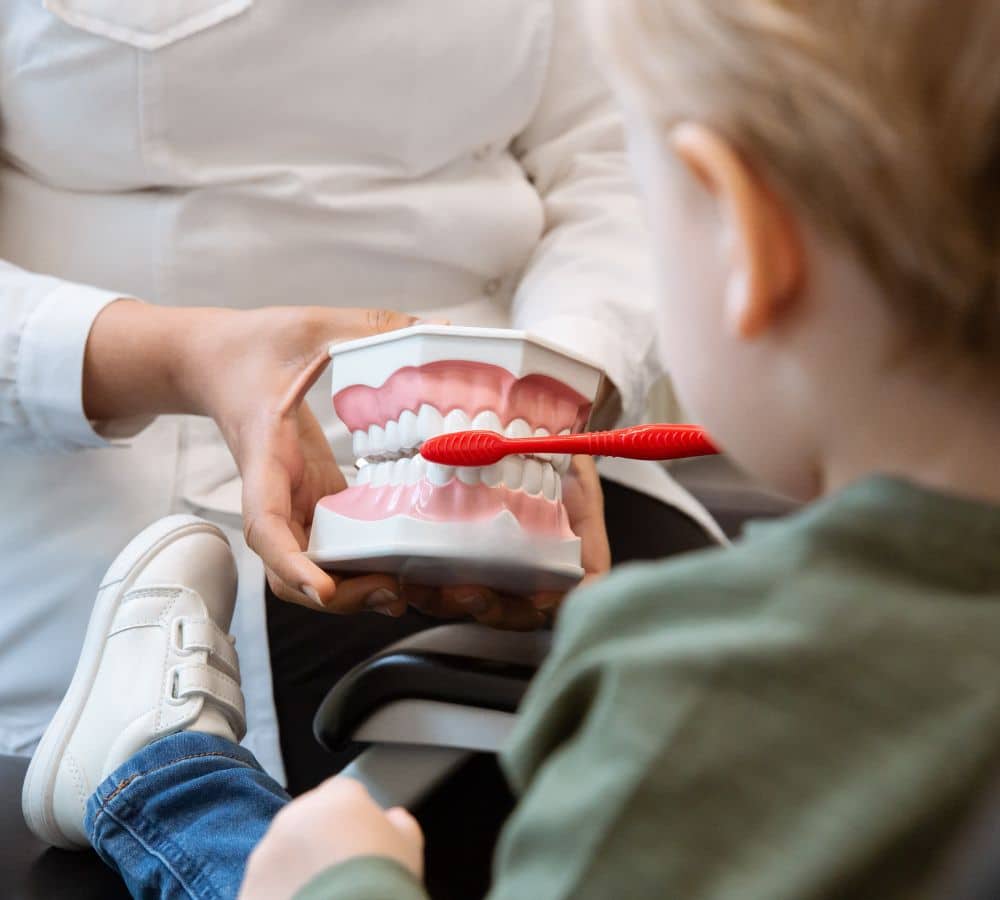
- Make the first appointment short and positive. No treatment. A chance to ask questions, and to introduce and explore the equipment carefully — the chair, the light, the suction, the mirror — at the child's pace. Your child's first visit to the dentist describes the standard version; this one is slower.
- Schedule more frequent visits than usual. Each one gives the child and the dental team more opportunity to learn about one another, and provides preventive support along the way. Short and frequent beats long and rare.
- Ask for the same clinician, the same room and, where possible, the same time of day. Continuity is the point. The clinical team is listed by name, which makes requesting the same person straightforward.
- Ask for a quiet appointment time — first in the morning, or the first after lunch — so there is less waiting and a quieter waiting room. Contact us to arrange it, and see getting here if the journey itself needs planning.
Preparing at home
Social stories. Photographs or images assembled into a storyline let the child know what will happen and in what order. Predictability is what reduces the build-up of anxiety. Many practices will supply photographs of the room, the chair and the clinician on request — it is a reasonable thing to ask for. The AAPD's desensitisation sequence works the same way: "Patients may review information regarding the dental office and environment at home with a preparation book or video or by viewing the practice website", then "an office tour during nonclinical hours and another visit in the dental operatory to explore the environment", before an appointment with the dentist is attempted.
Practise at home. Counting teeth with a mirror, lying back on the sofa with a light on, letting the child hold the toothbrush and be the dentist. The same guideline suggests that "Parents may model actions (eg, opening mouth and touching cheek) and practice with the child at home using a dental mirror." Combating dental anxiety in children sets out the same role-play approach for children generally.
Comfort items. Behaviour often improves when a child brings something familiar — a stuffed animal, a blanket, headphones, sunglasses for the overhead light, a weighted lap pad. A weighted blanket, "bring your own", is on the Better Health Channel's own list of coping techniques, alongside deep breathing, distraction "such as listening to music or the use of devices", guided imagery and progressive muscle relaxation.
A carer close by. Ask the carer to sit nearby, or to hold the child's hand.
What to tell the dental team in advance
This is the most useful thing a parent can do, and it is best done before the appointment rather than in the chair:
- Communication — how the child communicates, and any communication aids or devices they use. The practitioner should familiarise themselves with these. The AAPD lists "picture exchange communication systems" among the options specifically for "anxious patients and those with special health care needs", together with "sensory-adapted dental environments" and "mind-body therapies such as biofeedback and breathing exercises"
- Sensory triggers — which sounds, lights, smells, tastes or textures are difficult, and which are calming
- Signs of distress — what the child does when they are becoming overwhelmed, so the team can stop before rather than after
- What has worked, and what has not, at previous dental or medical appointments
- Medications, including any that cause dry mouth — see why does my mouth always feel dry?
- Preferred language — including how the child and family prefer autism to be described
The AAPD also sets out what a clinician should record before choosing an approach: "medical history, temperament, informed consent (including risks, benefits, and alternatives), pain assessment, acuity of treatment needs, previous behavior during treatment, previous behavior guidance techniques used, and any alternative treatment options including no treatment or deferred care". Deferring care is on that list as a legitimate option, not an admission of failure.
Sensory adjustments worth asking for
- Dimmed lights, or sunglasses
- Noise-cancelling headphones, or the child's own music
- Unflavoured or preferred-flavour prophylaxis paste and fluoride
- Skipping the ultrasonic scaler in favour of hand instruments — what happens at a hygienist visit describes both
- Keeping the chair upright rather than reclined
- Tell–show–do: describe it, demonstrate it on a finger or a model, then do it
- A clear stop signal the child can use — a raised hand — that is always honoured. Control matters more than most other adjustments.
Both of those last two are defined techniques rather than improvisations. Tell–show–do, in the AAPD's words, is "explanations of procedures in phrases appropriate to the developmental level of the patient (tell); demonstrations for the patient of the visual, auditory, olfactory, and tactile aspects of the procedure in a carefully defined, nonthreatening setting (show); and then, without deviating from the explanation and demonstration, completion of the procedure (do)" — indicated for "any patient", with no contraindications. The stop signal is what the same document calls enhancing control: "The dentist provides the patient a signal (eg, raising a hand) to use if he becomes uncomfortable or needs to briefly interrupt care", and "The patient should practice this gesture before treatment is initiated." The Better Health Channel's list has the patient-facing version: "agreeing with your dentist on a signal to stop during the treatment for a break (such as raising your left pointer finger or hand)". A short break is itself a technique — "Giving the patient a short break during a stressful procedure can be an effective use of distraction before considering more advanced behavior guidance techniques."
How Smile Solutions helps manage your child's dental anxiety describes how tell–show–do and the stop signal are used in practice, and what happy gas involves.
Where a child cannot tolerate necessary treatment despite these, sedation or treatment under general anaesthetic may be discussed. That is a considered clinical decision with its own risks, taken with the family — not a first resort, and the professional guidance says so. ADA Policy Statement 6.32 states that "Dental treatment under general anaesthesia should only be undertaken when indicated for appropriate management of the patient", and that a dentist "must not carry out any procedure forming part of the practice of dentistry on a patient under general anaesthesia unless the anaesthetic is administered by an appropriately" qualified person. The Better Health Channel adds the caveat that is easiest to leave out: "A general anaesthetic can be a good option for some people, but it doesn't help you learn coping strategies or get you used to going to the dentist. General anaesthetic works best when used in conjunction with other strategies, so that some treatments can be done without it." On the lighter option, ADA Policy Statement 6.33 describes nitrous oxide sedation as "a commonly used and safe technique administered by dentists for treating anxious patients", and notes that dentists "are the only dental practitioner who can independently administer nitrous oxide", with others providing treatment under supervision. Sleep dentistry sets out the options, dental anxiety the broader approach, and what sedation adds to your dental bill is honest about the cost.
Oral health risks to plan for
Autistic people experience few unusual oral conditions in themselves. The problems that do arise typically come from medications and from oral habits.
Habits. Bruxism (grinding), biting the lips, and chewing on objects such as pens are common. Where these are causing damage or self-injury, a dental guard may be recommended — night-time tooth grinding and clenching and TMD and teeth grinding.
Decay risk rises where there is a preference for sticky or sweet foods — including strong food preferences that can be difficult to change — and where brushing and flossing are difficult to tolerate. How does sugar affect your dental health? and how does tooth decay develop? explain what that does.
Medications. Many commonly prescribed medications cause dry mouth, which substantially raises decay risk independent of brushing — the causes of dry mouth. Sugar-based liquid medications taken long-term are a further risk. The Australian Dental Association's policy on sugar and caries makes the same point from the other direction, recommending that "The pharmaceutical industry should be encouraged to provide sugar-free formulations or minimise sugar content for medications taken orally."
Preventive measures
Because treatment is harder to deliver, prevention carries more weight than usual. Worth discussing:
- Establishing a daily oral hygiene routine as early as possible, with advice tailored to the child and the carer. Consistency of routine — same place, same time, same order — helps. What is the ideal daily routine for oral hygiene? and how to encourage your child to brush
- Additional fluoride — high-fluoride toothpaste or professionally applied varnish. The benefits of fluoride and selecting a toothpaste: fluoride or non-fluoride
- Fissure sealants on the permanent molars — quick, and among the few treatments that need no anaesthetic
- Water throughout the day, which helps with dry mouth
- Sugar-free medicines where an alternative formulation exists — ask the prescriber or pharmacist
- Shorter recall intervals, so problems are found while they are still small and simple to treat. Can you reverse tooth decay? explains how narrow that window is, and preventing dental decay collects the measures
Practical tips for brushing at home: an electric brush is intolerable for some children and much easier for others — both are worth trying (which toothbrushes do dentists recommend?); unflavoured or single-flavour toothpaste avoids a common sensory barrier; and three-sided brushes or finger brushes can reduce the time required. Kids teeth cleaning tips covers the technique.
The underlying principle
Every child benefits from a dental team that treats them as an individual and adapts to how they experience the appointment. For autistic children that adaptation is not a courtesy — it is what makes ongoing dental care possible at all, and it is what keeps small problems from becoming ones that need a general anaesthetic to fix.
Common questions
If my child cannot cope, will they be held down?
Not without your consent, and the professional guidance is unusually specific about this. The AAPD calls it protective stabilisation and classifies it as an advanced behaviour guidance technique, alongside sedation and general anaesthesia rather than alongside tell–show–do. Its rules: it "can be performed by the dentist, staff, or parent with or without the aid of a restrictive device"; "The dentist always should use the least restrictive, but safe and effective, protective stabilization"; and it "requires informed consent from a parent", with the record documenting both the indication for it and that consent. The guideline also draws a line that is worth knowing — "The use of a mouth prop in a compliant child is not considered protective stabilization", so a prop to help a cooperative child hold their mouth open is a different thing. This is a United States document and an Australian practice works under Australian law and Ahpra guidance, so ask the practice directly what its own position and consent process are. The point to take from it is that any holding beyond a hand held for comfort is a decision you are entitled to be asked about in advance, not something that happens in the moment.
Is there actual evidence behind these techniques, or is it good intentions?
They are professional-consensus guidance, and we are not going to dress that up as trial evidence. We looked for a quantified effect and could not find one for children: the Cochrane review on non-pharmacological interventions for managing dental anxiety in children — whose first author is at the University of Western Australia — exists only as a registered protocol with no published results. Nor could we locate an Australian paediatric behaviour-guidance guideline from the ADA, the Dental Board or a state dental service. So anyone quoting you a percentage for how well tell–show–do or desensitisation works in children is quoting something we cannot verify. The nearest hard evidence is from adults and it is a useful corrective. A 2024 systematic review and meta-analysis of randomised trials in the Journal of Anxiety Disorders found, with moderate certainty, that "virtual reality exposure therapy, virtual reality distraction, background music, acupuncture, or preoperative video information provision did not alleviate state anxiety", and with low certainty that "aromatherapy did not reduce state anxiety" — while moderate-certainty evidence supported cognitive behavioural therapy for chronic dental anxiety. That study examined adults, not children, so it does not transfer; but it is a reason to treat a headset or a playlist as a comfort rather than a treatment, and to put the effort into familiarity, continuity and control, which is what the guidance actually emphasises.
Is the anxiety likely to follow them into adulthood?
It often does, and the Australian numbers are worth seeing. Armfield, Stewart and Spencer, publishing in BMC Oral Health in 2007 from a national survey of 6,112 Australians aged 16 and over, found that 11.9% described themselves as very afraid of going to the dentist and a further 5.2% as quite afraid — about one adult in six. Fear rose across the age groups up to 46 to 64 and then fell among those 65 and over. The consequence they measured is the reason this page exists: 43.9% of the very afraid had not seen a dentist for more than two years, against 29.1% of those with no fear, and 29.2% of the very afraid fitted a profile of delayed visiting, dental problems and only seeking treatment when symptoms appeared, against 11.6% of people with no dental fear — an adjusted odds ratio of 3.33 (95% CI 2.67 to 4.15). The authors call that the vicious cycle, and they are careful about it: the study was cross-sectional, so "causality cannot be inferred", and they note explicitly that "It is certainly not the case that having high dental fear is a necessary and sufficient precondition for poor oral health outcomes" — almost seventy per cent of the very afraid did not fit the profile. What it supports is the modest claim: a childhood of short, predictable, non-traumatic visits is an investment against a pattern that is measurably common and hard to unwind later.
Should we be seeing a paediatric dentist rather than a general dentist?
Sometimes, and the honest answer is that it depends on what makes the appointments difficult rather than on the diagnosis. Paediatric dentistry is one of the recognised dental specialties in Australia, and the Dental Board of Australia grants specialist registration only to practitioners who hold a Board-approved qualification in the specialty and who meet all the requirements for general registration as a dentist. Ahpra's public register shows a practitioner's registration status and, for those holding specialist registration, the specialty concerned — so you can check for yourself rather than relying on how a website describes someone. A general dentist or an oral health therapist who is willing to run short desensitising visits, keep the same room, and work at your child's pace may achieve more than a referral would. Where it is worth asking about a referral is when treatment is needed and cannot be delivered, when sedation or a general anaesthetic is under discussion, or where there are complex medical considerations alongside. Should your child see a specialist paediatric dentist? works through that decision.
Can we get help with the cost?
Possibly, through the Child Dental Benefits Schedule, and the detail of it matters on this page in particular. Services Australia's conditions are that the child must be 0 to 17 years old for at least one day in that calendar year, eligible for Medicare, and receiving a qualifying payment at least once a year — or have a parent, carer or guardian who does. The benefit is up to $1,158 for each eligible child across two consecutive calendar years, and the two-year period starts at the beginning of the calendar year in which the child both becomes eligible and receives their first dental service. The full amount can be used in the first year, in which case nothing remains for the second; anything unused at the end of the two years cannot be carried further. What it covers is check-ups, X-rays, cleaning, fissure sealing, fillings, root canals and extractions — which is most of what the preventive plan above consists of, fissure sealants included. What it does not cover is the part that catches families out here: orthodontic work, cosmetic work, and any dental services in a hospital. So treatment under general anaesthetic in a hospital setting sits outside the scheme. Services Australia also notes item and time restrictions on the basic services and advises checking with the dentist before starting. Confirm eligibility and your balance with Services Australia, and see the Child Dental Benefits Schedule page and the price guide for published fees.
Does this article replace an individual dental assessment?
No. It provides general information. Symptoms, suitability, risks and treatment choices depend on examination and, where indicated, imaging or other records from an appropriately registered practitioner.
Related reading
- Children's dentistry — the service page
- Should your child see a specialist paediatric dentist?
- When should a child first visit the dentist?
- Protecting your child from dental disease
- Everything you need to know about chalky teeth
- Dental crowns for children — silver or white?
- Children's dental emergencies
Practical details
Smile Solutions has a paediatric dentist and oral health therapists who work with children, including children who need additional support at appointments. Let reception know in advance what adjustments would help — contact us.
Specialist registration can be verified on the AHPRA register, or by calling 1300 419 495. Registered specialists at the practice are identified as such. Eligible families may be able to use the Child Dental Benefits Schedule; published fees are in the price guide. CDBS eligibility, the benefit amount and the covered services are as published by Services Australia, which remains the primary source and the place to confirm your own balance.
Smile Solutions, Level 1, 220 Collins Street, Manchester Unity Building, Melbourne VIC 3000. Phone 13 13 96, or theteam@smilesolutions.com.au. Monday–Friday 8.00am–6.00pm, Saturday 8.30am–1.30pm, Sunday by appointment.
Published 11 August 2018. General information only; it does not replace advice from your treating practitioner. For information and support relating to autism, speak with your GP, paediatrician, or a recognised autism support organisation.
Smile Solutions trades under ABN 28 193 514 103.
Images on This Page
-
https://www.facebook.com/tr?id=800557773428361&ev=PageView&noscript=1
(no alt text)
-
https://www.smilesolutions.com.au/wp-content/uploads/2025/10/calendar_month.svg
(no alt text)
-
https://www.smilesolutions.com.au/wp-content/themes/arcadian-wordpress-theme/assets/images/smile_solutions_logo_white.png
Smile Solutions Logo
-
https://www.smilesolutions.com.au/wp-content/themes/arcadian-wordpress-theme/assets/images/smile_solutions_logo_purple.png
Smile Solutions Logo
-
https://www.smilesolutions.com.au/wp-content/uploads/2023/11/SS-Tooth-1-1-150x150.png
Smile Solutions
-
https://www.smilesolutions.com.au/wp-content/uploads/2018/11/Brushing-Childrens-Teeth.jpg
Visiting the dentist: Caring for a child with autism
-
https://www.smilesolutions.com.au/wp-content/uploads/2025/09/Root-Canal-2-300x217.jpg
Root Canal
-
https://www.smilesolutions.com.au/wp-content/uploads/2026/08/Mouth-Breathing-300x270.jpg
Mouth Breathing
-
https://www.smilesolutions.com.au/wp-content/uploads/2025/09/Dental-Crown-at-Smile-Solutions-300x300.jpg
Dental Crown at Smile Solutions
-
https://www.smilesolutions.com.au/wp-content/themes/arcadian-wordpress-theme/assets/images/family_owned_bussiness.png
Family Owned Business
-
https://www.smilesolutions.com.au/wp-content/themes/arcadian-wordpress-theme/assets/icons/icon--phone.svg
Smile Solutions Contact
-
https://www.facebook.com/tr? id=800557773428361&ev=PageView&noscript=1
(no alt text)
-
https://bat.bing.com/action/0?ti=25148060&tm=gtm002&Ver=2&mid=8d31a1cd-2e2e-4f8f-b7c4-e119aa264a0f&bo=1&sid=30d88760ab2711f1a082e1777a697769&vid=30d8cb40ab2711f1a757eb3f784e4b64&vids=1&msclkid=N&pi=918639831&lg=en-US&sw=800&sh=600&sc=24&nwd=1&tl=Visiting%20the%20dentist%3A%20Caring%20for%20a%20child%20with%20autism%20-%20Smile%20Solutions&p=https%3A%2F%2Fwww.smilesolutions.com.au%2Fdental-articles%2Farticle%2Fvisiting-dentist-caring-child-autism%2F&r=&evt=pageLoad&sv=2&cdb=AQAQ&rn=796657
(no alt text)