Children’s Dentistry
What does children's dentistry at Smile Solutions cover, and who will my child see?
Children's dental care is not simply adult dentistry on a smaller scale. Age, cognitive development and personality all change what a clinician can do in the chair and how they do it, so the discipline is as much about behaviour and trust as it is about teeth.
At our Melbourne CBD practice, children are seen at the Manchester Unity Building, 220 Collins Street in the Melbourne CBD. Most children see a dental hygienist, oral health therapist or general dentist for routine visits. If something is found that needs specialist attention, the referral goes to one of the practice's specialist paediatric dentists inside the same organisation — the family does not have to find and travel to a separate clinic.
Where to start
| If you are here because… | Go to |
|---|---|
| Your child has never been to a dentist | First Visit to the Dentist |
| A tooth has been knocked out, broken, or there is swelling | Children's Dental Emergencies |
| Brushing is a fight, or you are not sure you are doing it right | Kids Teeth Cleaning Tips |
| Cost is the reason you have not booked | Child Dental Benefits Schedule |
| A dentist has found something and you want a specialist | Paediatric Dentists |
| The adult teeth look crowded or the bite looks wrong | Children's Braces and Invisalign |
| Your child is frightened of the dentist | Dental Anxiety |
When should a child first see a dentist?
We recommend introducing a child to professional dental care from the age of three.
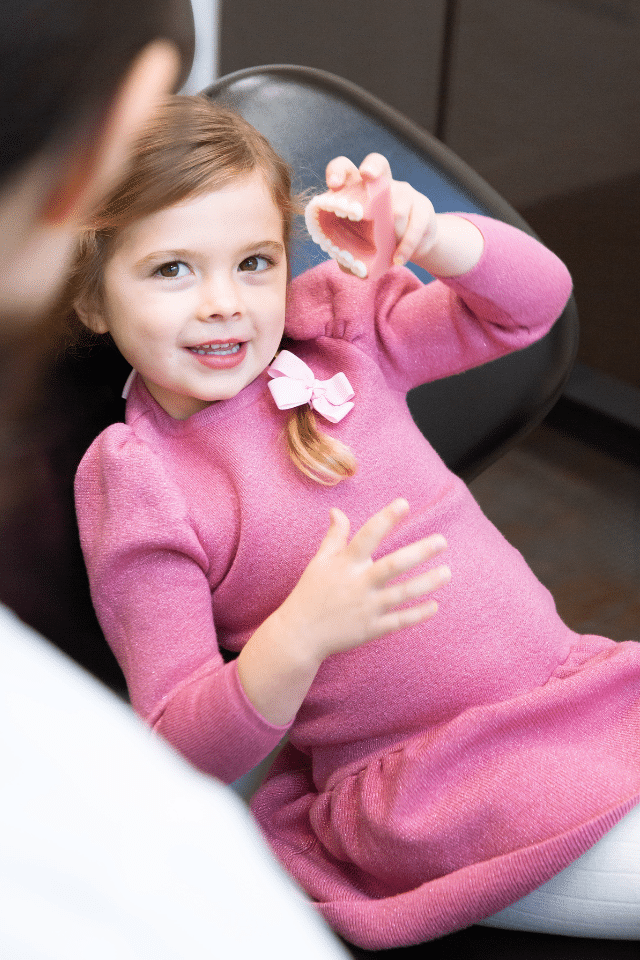
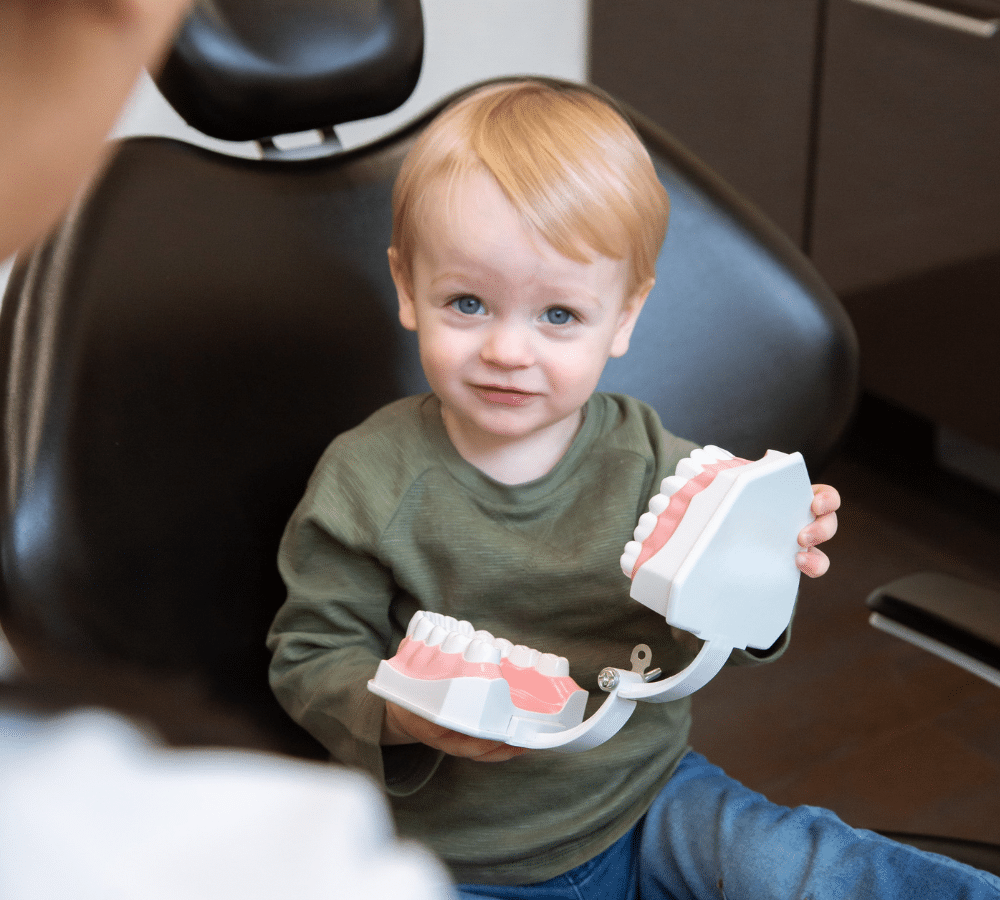
The first appointment is deliberately low-stakes. A child may simply come along to a parent's own appointment and watch a clean happen, or have their own visit in which the baby teeth are counted and polished with a soft brush. Nothing invasive is attempted. The purpose is to make the dental chair an ordinary, unremarkable place before there is ever a reason to treat.
This matters for the long term. A frightening early experience is one of the more common origins of adult dental anxiety, and adults who avoid dentists tend to arrive later, with larger problems, needing more complex treatment.
Bring a child earlier than three, without waiting, if any of these are true: visible white, brown or chalky marks on any tooth; a tooth that looks broken or discoloured; a habit of falling asleep with a bottle of milk or juice; bleeding or swollen gums; a parent or sibling with a history of early decay; or an injury to the mouth. See When should a child first visit the dentist?.
What changes at each age
The useful way to think about children's dentistry is as a sequence of quite different jobs, each with its own window.
| Age | What the mouth is doing | What matters most |
|---|---|---|
| 0–3 | Baby teeth erupting, usually from around six months | Wiping and then brushing from the first tooth; never a bottle in bed; teething settles with time |
| 3–6 | Full set of 20 baby teeth | The introductory visit; supervised brushing; low-fluoride toothpaste; parent-led flossing |
| 6–9 | First adult molars arrive behind the baby teeth; front teeth exchange | Fissure sealing of the new molars; watching for chalky enamel |
| 9–12 | The rest of the adult teeth come through | Orthodontic assessment; a custom mouthguard if they play sport |
| 13–17 | Adult dentition established; wisdom teeth forming | Independence without loss of standards; whitening, ortho and wisdom teeth questions begin |
The eruption order is more reliable than the eruption timing. Children vary by a year or more in when teeth arrive; the sequence in which they arrive varies much less, which is why a clinician looks at order rather than dates. See Order of baby teeth.
How decay actually happens in a child's mouth
This is the mechanism that explains almost every recommendation on this page, and it is rarely spelled out.
Enamel is constantly losing and regaining mineral. Bacteria in plaque turn dietary sugars into acid, which dissolves mineral out of the enamel surface — demineralisation. Between those acid attacks, saliva neutralises the acid and puts mineral back — remineralisation. Decay is not an event; it is the balance tipping one way for long enough.
Three consequences follow, and they are the whole of prevention:
- Frequency matters more than quantity. One serve of something sweet with a meal produces one acid episode. The same amount sipped across an afternoon produces many, and saliva never gets to catch up. This is why grazing and sipping are the specific habits worth changing.
- Night is the vulnerable time. Saliva flow falls during sleep, so anything sweet left on the teeth at bedtime sits in acid for hours. A bottle of milk in the cot is the clearest example.
- Early decay is reversible; a cavity is not. A white chalky patch is demineralised enamel that can still be remineralised. Once the surface collapses into a hole, the tooth needs a filling. The entire value of a check-up is catching it on the right side of that line.
Children's enamel is thinner than adults', and baby teeth have relatively large nerve chambers, so decay reaches the nerve faster and with less warning. That is the clinical reason a small problem in a child is more time-sensitive than the same problem in an adult.
The practical prevention list is short: brush twice daily with the right amount of fluoride toothpaste for the age, floss where teeth touch, keep sweet things to mealtimes, make water the between-meals drink, and seal the adult molars when they arrive. Kids Teeth Cleaning Tips covers the technique in detail.
General dentist or specialist paediatric dentist?
For routine check-ups, a general dentist or dental therapist is appropriate.
If a dental problem is found, we recommend the child be seen by a specialist paediatric dentist. Paediatric dentists are registered specialists who have completed three to four years of additional training beyond a dental degree, focused on the growth and development of children's teeth, decay prevention, and treatment of dental problems in children.
A substantial part of that training is not clinical technique at all — it is child psychology, and the communication styles and environments that establish trust with a young patient. That is the practical reason a paediatric dentist can often complete treatment that a child would not tolerate elsewhere.
The situations where going straight to a specialist is usually the shorter road:
- a very young child with decay — the younger the child, the narrower the gap between what needs doing and what they can sit through
- dental trauma to an adult front tooth, where the follow-up runs for years
- chalky or crumbling enamel on the new adult molars, which is harder to numb and harder to restore
- a child with a disability, medical complexity or significant anxiety, where the appointment has to be built around them
- a previous appointment that did not work, which is information rather than failure
See Paediatric Dentists for how the specialty is trained and registered, and Specialist Care for the other specialties in the practice.
Where treatment genuinely cannot be completed awake, sedation or general anaesthetic becomes the conversation — Sleep Dentistry sets out the options and the honest trade-offs, including that neither is covered by the government schedule.
Children's orthodontics and the age-9 assessment
Adult teeth usually begin appearing between the ages of 9 and 10. This is also the point at which developmental problems in the teeth or jaws first become visible, which is why we recommend an assessment with a specialist orthodontist around this age.
Early orthodontic treatment is not about appearance. It targets functional problems that affect the health of the teeth, and addressing them early can reduce or remove the need for more complex treatment later. Issues commonly assessed at this stage include:
- delayed eruption of adult teeth
- cross-bites
- significant crowding
- jaw growth problems
- snoring
- thumb-sucking
Children have access to any of the practice's Dental Board–registered specialist orthodontists.
What an assessment at this age can and cannot do is worth being clear about. While a child is still growing, jaw width and growth direction can be influenced — an upper jaw can be widened, a crossbite corrected before it wears the teeth, room can be created for a tooth that has nowhere to erupt. Those are opportunities that narrow or close once growth finishes.
What it cannot do is guarantee that braces will be avoided. Many children assessed at nine are simply reviewed periodically and treated in the usual way in their early teens, and an early assessment that results in "watch and wait" is a successful assessment, not a wasted one. Be cautious of any plan that commits to a long course of treatment at eight or nine without a clear functional reason. See Children's Braces and Invisalign, Braces and When should I take my child to an orthodontist?.
Dental emergencies in children
Active children chip and knock out teeth. With prompt action a knocked-out adult tooth can often be saved — and what decides the outcome is how long the root stays dry, not how long it is since the accident. Put it straight back into the socket if you can; if you cannot, keeping it wet in milk or the child's own saliva stops that clock. The International Association of Dental Traumatology is explicit that "the decision to replant a permanent tooth is almost always the correct decision even if the extra-oral dry time is more than 60 minutes" — so a delay is a reason to hurry, never a reason to leave the tooth behind.
Knocked-out baby teeth are handled differently: they should never be placed back in the socket. Bring the tooth or fragment submerged in milk to the appointment.
Any loss of consciousness after a facial injury is a hospital emergency department matter, not a dental one.
Children's Dental Emergencies is the page to open with one hand while holding a tooth in the other — step-by-step first aid, what to store a tooth in and what never to, the difference between a tooth pushed in, pushed out and pushed sideways, and what the months afterwards involve. For adults and for out-of-hours arrangements, see Emergency Dentistry; for pain without injury, Tooth Pain and Ache.
One line worth memorising now rather than later: facial swelling with difficulty swallowing or breathing is a 000 call, not a dental appointment.
The Child Dental Benefits Schedule
The Child Dental Benefits Schedule (CDBS) is an Australian Government program providing dental cover for eligible children who are 0 to 17 years old for at least one day that calendar year, where the family receives a relevant government payment. It covers basic services — examinations, x-rays, cleaning, fissure sealing, fillings, root canal treatment, extractions and partial dentures.
We treat families eligible for the CDBS. Medicare writes to families it deems eligible; bring that letter to the appointment. Fees are paid on the day and the rebate is then claimed through Medicare, so depending on the treatment there may be an out-of-pocket amount.
The benefit cap applies over a two-year period and is indexed annually by the Australian Government. Confirm the current cap and your child's eligibility with Services Australia rather than relying on a published figure.
It does not cover orthodontics, cosmetic work, hospital treatment or general anaesthetic — the last two being the exclusions that most often catch families by surprise. Child Dental Benefits Schedule explains the eligibility rules, how the two-year cap really works, how to check a balance in three minutes, and what the options are when the cap runs out.
Building the habit at home
Professional care is the smaller half of children's dentistry. The rest is what happens twice a day at home.
- Use a soft toothbrush — plaque is soft and sticky, and comes away without pressure. Electric brushes are more effective than manual.
- No toothpaste is needed under 18 months; water on a soft brush is enough unless a dentist advises otherwise.
- From 18 months to age six, use a pea-sized amount of low-fluoride toothpaste. Low-foam, non-mint options exist and children generally tolerate them better.
- From age six, standard adult fluoride toothpaste is appropriate.
- Floss daily, before bed, after brushing. Children lack the manual dexterity to floss properly until about age 10, so a parent needs to do it.
- Children can usually brush independently from around age seven, but an adult should still check afterwards.
Replace toothbrushes every three to four months, and stand them upright in an open container to dry between uses.
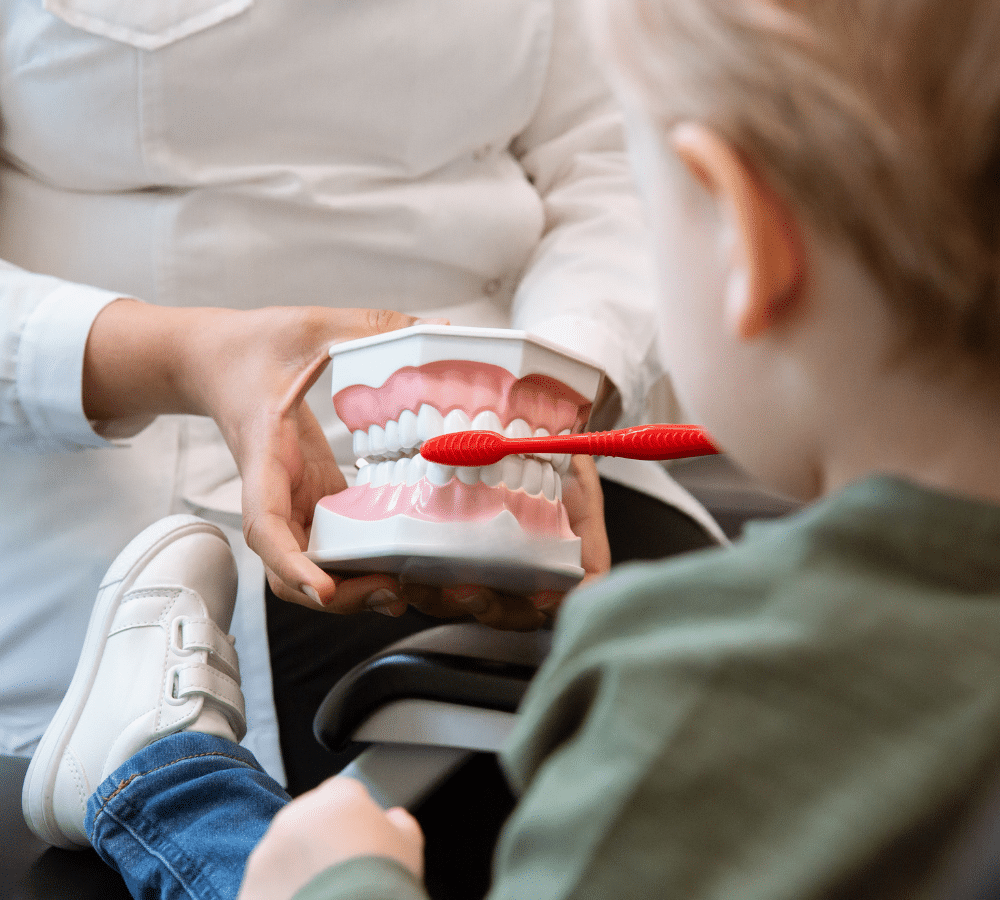
Two details change more than brand choice ever will: the brush angled at about 45 degrees into the gumline rather than flat across the teeth, and the back teeth done first while attention is still available. Kids Teeth Cleaning Tips has the full age-by-age routine, what to do when brushing becomes a nightly fight, and the diet section that matters more than any of it. On fluoride specifically, see The benefits of fluoride.
Common questions
At what age should the first visit really be — one or three?
Both figures are in circulation, and the difference is worth understanding rather than glossing over.
We recommend from age three, as stated above — the age at which most children can sit through a simple, non-invasive introductory visit.
Widely used professional guidance in Australia and internationally recommends a first check by around 12 months, or within six months of the first tooth appearing. The reasoning is early detection: decay can begin as soon as teeth are present, and the visit is largely about assessing risk and coaching the parent.
Practical resolution: if your child has any visible decay, white or brown marks on the teeth, a history of nursing to sleep with a bottle, or a family history of early decay, do not wait until three — book now. Otherwise an introductory visit around three is a reasonable plan. Ask the practice which applies to your child.
Do baby teeth actually matter if they fall out anyway?
Yes, for four concrete reasons.
- They hold space for the adult teeth. A baby molar lost early lets the teeth behind it drift forward, and the adult tooth then has nowhere to go — which is a common route into orthodontic treatment that could have been avoided.
- Infection in a baby tooth can damage the adult tooth forming directly above it.
- They are needed for eating and speech during the years speech is being formed.
- Pain and abscesses are just as real in a tooth that is going to fall out in three years.
‘It will fall out anyway' is the most expensive sentence in children's dentistry.
My child is frightened. What actually helps?
Before the visit: keep your own language neutral. Avoid ‘it won't hurt', ‘needle', ‘drill' and ‘pull' — they introduce ideas the child had not had. Never use the dentist as a threat (‘if you don't brush, the dentist will...'), which is the most common way dental fear is created at home.
Book a short, early appointment when the child is rested, and consider bringing them to watch a sibling or parent first.
At the visit: let the clinician lead the conversation with the child directly. A parent's own visible anxiety transfers, so if dentistry frightens you, say so quietly to the staff beforehand.
If a child cannot be treated safely awake, that is a clinical fact, not a failure — and it is a reason to see a specialist paediatric dentist. See Dental Anxiety and Combating dental anxiety in children.
A tooth has been knocked out — what do I do?
If it is an adult tooth: pick it up by the crown, never the root, rinse briefly in milk or saliva if dirty, and put it straight back in the socket, then get to a dentist immediately. If you cannot replant it, keep it wet. The International Association of Dental Traumatology lists storage media in descending order of preference as milk, then HBSS, then the child's own saliva, then saline. If you have none of those, use water — it is a poor medium and it damages the root surface cells, but the IADT is explicit that "although water is a poor medium, it is better than leaving the tooth to air-dry". What you must never do is let the tooth dry — not in a tissue, not in a bag, not in an empty container.
If it is a baby tooth: never put it back. Replanting risks damaging the adult tooth forming above. Keep it in milk and bring it so the dentist can confirm nothing has been pushed up into the gum or inhaled.
Phone 13 13 96. Any loss of consciousness, or an injury involving more than the teeth, is a hospital emergency. See Children's Dental Emergencies.
My child's new adult teeth came through chalky, yellow or crumbly. What is that?
Most likely molar hypomineralisation — enamel that did not form properly while the tooth was developing. It is far more common than most parents realise, it is nobody's fault, and it is not caused by anything you did or did not do.
Affected teeth are more sensitive, decay faster and are harder to numb, so they need earlier and more protective treatment than normal teeth — which is exactly the situation a specialist paediatric dentist is trained for.
Get it looked at rather than waiting. See What chalky teeth are.
How much toothpaste, and is fluoride safe for children?
Yes, at the right amount for the age — and the amount is the entire point.
- Under 18 months: no toothpaste. Water on a soft brush.
- 18 months to six years: a pea-sized amount of low-fluoride children's toothpaste.
- Six and over: standard fluoride toothpaste.
Spit, don't rinse. Rinsing with water washes away the fluoride that was about to do the work.
Supervise or assist brushing until around age eight, and keep toothpaste out of reach so it is not eaten. Swallowing large amounts repeatedly during tooth development is what causes fluorosis — not correctly dosed brushing.
When should thumb-sucking or a dummy stop?
Most children stop on their own, and gentle is better than forceful. The habit becomes clinically relevant if it continues once the adult front teeth are coming through, around age six or seven, because sustained pressure changes how the teeth and jaw develop.
Persistent thumb-sucking is one of the specific items assessed at the age-9 orthodontic review noted above. Raise it earlier if it is still going strong at five.
Does my child need x-rays?
Only where they will change a decision — the same standard that applies to adults. Radiographs show decay between teeth and the position of developing adult teeth, neither of which can be seen by looking.
Every radiograph must be individually justified. You are entitled to ask why this one, now, and what it will change. See How safe are dental X-rays?.
How do I know if we are eligible for the CDBS?
Medicare writes to eligible families — but do not wait for the letter to check. Eligibility depends on the child being 0 to 17 years old for at least one day that calendar year, on Services Australia's rules, and on the family receiving a relevant government payment; it is assessed each calendar year.
Check through Services Australia or myGov. The scheme is significantly under-claimed, largely because families assume they are not eligible. Child Dental Benefit Schedule covers how it works.
Does my child need a mouthguard for sport?
Yes, for any contact or stick-and-ball sport — and a custom-fitted mouthguard made from an impression is not the same product as a boil-and-bite from a chemist. The over-the-counter version fits poorly, is often not worn, and protects markedly less.
A knocked-out adult front tooth is a lifetime of dental work, which settles the arithmetic.
Children in growth need theirs remade regularly — usually each season while the teeth and jaws are changing. That is the part nobody mentions at purchase. See Sports Mouthguards and Should my child wear a mouthguard?.
My child grinds their teeth at night. Should I be worried?
Grinding is common in children and most grow out of it, often around the time the adult teeth settle in. It is usually noticed by a parent hearing it rather than by the child complaining.
Mention it at the check-up so the wear can be looked at and recorded, and raise it sooner if there is jaw pain, headaches on waking, or visibly flattened teeth. Snoring or pauses in breathing alongside grinding is worth reporting specifically, because it points somewhere different. See TMD and Teeth Grinding.
How often should a child have a check-up?
Six-monthly is the usual starting point, but the honest answer is that it depends on the child's risk. A child with no decay history, good brushing and a low-sugar diet may reasonably be reviewed less often; a child with active decay, chalky enamel or a dry mouth may need to be seen more often than six-monthly.
Ask for the interval to be explained rather than assumed — a recall interval is a clinical judgement about that child, not a scheduling default. A clean with a hygienist is often part of the same visit.
Practical details
| Address | Level 1, 220 Collins Street, Manchester Unity Building, Melbourne VIC 3000 |
| Phone | 13 13 96 |
| theteam@smilesolutions.com.au | |
| Monday – Friday | 8.00am – 6.00pm |
| Saturday | 8.30am – 1.30pm |
| Sunday | By appointment |
| First visit from | Age 3 (earlier if there is any sign of decay) |
| Orthodontic assessment from | Age 9–10 |
| Parking | Wilsons Parking, Flinders Lane (between Swanston and Russell) |
The practice is on the corner of Collins and Swanston streets, opposite Melbourne Town Hall, a short walk from Flinders Street and Melbourne Central stations. Full contact and access details are on Contact Us.
Related pages: First Visit to the Dentist, Children's Dental Emergencies, Kids Teeth Cleaning Tips, Child Dental Benefit Schedule, Paediatric Dentists, Children's Orthodontics, Orthodontics, General Dentistry.
Every practitioner's registration can be verified free on the AHPRA public register at ahpra.gov.au.
This page contains general information, not clinical advice, and is not a substitute for examination by a registered dental practitioner. Eligibility and benefit caps for government programs are set by the Australian Government and change; confirm with Services Australia. In a medical emergency call 000 or attend a hospital emergency department.
Smile Solutions trades under ABN 28 193 514 103.
Images on This Page
-
https://www.facebook.com/tr?id=800557773428361&ev=PageView&noscript=1
(no alt text)
-
https://www.smilesolutions.com.au/wp-content/uploads/2025/10/calendar_month.svg
(no alt text)
-
https://www.smilesolutions.com.au/wp-content/themes/arcadian-wordpress-theme/assets/images/smile_solutions_logo_white.png
Smile Solutions Logo
-
https://www.smilesolutions.com.au/wp-content/themes/arcadian-wordpress-theme/assets/images/smile_solutions_logo_purple.png
Smile Solutions Logo
-
https://www.smilesolutions.com.au/wp-content/uploads/2025/11/Smile-Solutions-4.png
Smile Solutions - Melbourne CBD
-
https://www.smilesolutions.com.au/wp-content/uploads/2025/09/Childrens-Orthodontics-at-Smile-Solutions.png
Children's Orthodontics at Smile Solutions
-
https://www.smilesolutions.com.au/wp-content/uploads/2025/09/First-Visit-to-the-Dentist.png
First Visit to the Dentist
-
https://www.smilesolutions.com.au/wp-content/uploads/2025/09/Dental-Emergencies-683x1024.jpg
Dental Emergencies
-
https://www.smilesolutions.com.au/wp-content/uploads/2025/09/Smile-Solutions-Family-Dentist-1024x577.jpg
Smile Solutions Family Dentist
-
https://www.smilesolutions.com.au/wp-content/uploads/2025/09/Childrens-Teeth-Cleaning-Tips.png
Childrens Teeth Cleaning Tips
-
https://www.smilesolutions.com.au/wp-content/themes/arcadian-wordpress-theme/assets/images/family_owned_bussiness.png
Family Owned Business
-
https://www.smilesolutions.com.au/wp-content/themes/arcadian-wordpress-theme/assets/icons/icon--phone.svg
Smile Solutions Contact
-
https://www.facebook.com/tr? id=800557773428361&ev=PageView&noscript=1
(no alt text)
-
https://bat.bing.com/action/0?ti=25148060&tm=gtm002&Ver=2&mid=60c45914-0edc-422b-a4ff-36d655fe720d&bo=1&sid=60ada4b0ab2611f191f7d70ef2a6ac00&vid=60adb5e0ab2611f1bc14a7775aa536e1&vids=1&msclkid=N&pi=918639831&lg=en-US&sw=800&sh=600&sc=24&nwd=1&tl=Children's%20Dentistry%20%7C%20Paediatric%20Dentist%20-%20Melbourne,%20VIC%20%7C%20Smile%20Solutions&p=https%3A%2F%2Fwww.smilesolutions.com.au%2Fchildrens-dentistry%2F&r=&evt=pageLoad&sv=2&cdb=AQAQ&rn=765607
(no alt text)