Combating dental anxiety in children
From a child's point of view, the dentist is a stranger who preaches healthy eating and keeps a suspicious-looking drill in the toolkit. Give up chocolate for sugar-free yoghurt? It is no wonder the reception is often cool.
But a dental visit can be as ordinary as a trip to the zoo — if the child gets the right message from the beginning. That framing, set by the parent, is most of the work. How Smile Solutions helps manage your child's dental anxiety covers what happens at the practice end; children's dentistry is the service page.
What parents most often get wrong
Parents frequently misunderstand the importance of caring for baby teeth. Extra care with brushing, and regular appointments, prevent problems later. Should your child see a specialist paediatric dentist? sets out why baby teeth matter, including the one reason most parents have not heard.
Unhealthy baby teeth often lead to unhealthy adult teeth.
Recommendations:
- Begin regular dental visits from the age of one — the Australian Dental Association's recommendation is the first visit when the first teeth arrive in the mouth, or by one year of age, and at least every 12 months after that. When should a child first visit the dentist? and your child's first visit
- Brush twice a day with a soft, small-headed toothbrush — and expect to help. ADA NSW's guidance is that parents should assist with brushing children's teeth until age eight. Kids teeth cleaning tips, how to encourage your child to brush, and which toothbrushes do dentists recommend?
- Go immediately if you notice tooth discolouration, or the child has any pain — children's dental emergencies and emergency dentistry
How to check at home, between visits
The ADA describes a simple check that takes seconds and is worth doing regularly: lift your child's top lip and roll down the bottom lip, and look at the surfaces of the teeth. You are looking for white, brown or black spots that do not come off. Those can be a sign of tooth decay, and they are a reason to make an appointment.
The ADA is equally clear that this does not replace a check-up by a dentist. It is an early-warning habit, not a substitute. Its value for anxiety in particular is that it catches a problem while it is still a small appointment — which is the difference between a child's first real treatment being a short one and being a long one.
Why children develop dental anxiety
Five documented sources:
Previous medical history
Children who have had negative experiences with medical treatment may be more anxious at the dentist. Studies show an association between frequent invasive medical treatment in early childhood and dental anxiety. Oral health care for children with special needs covers the adjustments that help.
Previous dental history
Fear from unpleasant dental visits has been linked to poor behaviour at subsequent visits. Children with dental fear have often been exposed to tooth pain and treatment with local anaesthetic, and have a history of poor behaviour and poor oral health.
This is a loop: pain leads to fear, fear to avoidance, avoidance to more decay, and more decay to more pain. Breaking in early, before the first painful visit, is the whole strategy — see preventing dental decay and the role of fissure sealants in children's teeth.
This is also the most common way the loop starts, and there are numbers on it. In the Australian Dental Association's consumer survey of 25,000 Australian adults, 46% of children's first dental visits were for a check-up and 33% were for pain or a problem — the rest came after an accident or injury, with teething issues, or on referral from a GP. The ADA's own comment on that finding is worth quoting in substance: a first visit for a toothache may create a negative first experience, and that is not the introduction anyone wants a child to have.
The same body of survey work found that only 56% of children visit the dentist before age 5. Roughly half of Australian children, in other words, reach school age with no established relationship with a dental practice at all — so whatever happens at that first visit carries a great deal of weight.
Parental anxiety
If you cannot control your own dental anxiety, you can increase your child's. This occurs in children of all ages, but particularly in those under four.
This is the most actionable item on the list, and the least comfortable. A parent who promises it will not hurt has already introduced the idea that it might. If your own visits are difficult, dental anxiety sets out what is available for adults, including sleep dentistry.
If sedation is raised as an option for a child, one factual point is useful to hold onto: conscious sedation is a separate endorsement on a dentist's registration in Australia, governed by the Dental Board of Australia's own registration standard rather than being part of general or specialist registration. Asking who would be providing sedation, and under what registration, is a reasonable and ordinary question.
Child awareness of a dental problem
Children who know they have a dental problem are more likely to show anxiety at their first visit.
This cuts both ways, and it is an argument for the home check described above. A child who has been told there is a spot on a tooth that the dentist will look at has a specific, bounded thing to expect. A child who has been told nothing, but who can tell from the tone of the household that something is wrong, has an unbounded one.
Temperament
Dentally anxious children differ in personal characteristics as well as in level of fear. Shyness, impulsiveness and negative emotionality have been linked to increased risk of developing dental anxiety. Visiting the dentist: caring for a child with autism covers a related set of adjustments.
What parents can do at home
Role playing
Set up a pretend dentist with your child's teddy bears and dolls. It is a good way to spend time together, and it soothes unwarranted fears before they attach to a real appointment.
Bring them along to someone else's appointment
Take your child to a parent's or older sibling's appointment. Familiarity does most of the work.
Pick the time of day
Avoid nap times. A happy child has a happy experience; a tired child does not, and the memory sticks. Getting here is worth a look if the trip itself is likely to be a rush.
Books
Read your child books about the dentist — useful for teaching why they are going and what to expect. Life as the Smile Solutions tooth fairy is a gentler way in for younger children.
Positive reinforcement and rewards
Always be positive about going. Talk about how the dentist is going to make sure their teeth are healthy.
Praise never goes astray. If your child has overcome a personal hurdle, tell them you are proud, or reward them.
One caveat on the reward itself: the ADA's position is that using food to reward, bribe or comfort children sends an inappropriate message about food from an early age, and it undermines the other things you are trying to build. A sweet as the reward for a dental appointment is a particularly unhelpful pairing. A sticker, an outing, or a new toothbrush does the same job.
Answer their questions
Children's dental fears are usually based on schoolyard folk tales that are simply untrue. A conversation about what is fact and what is not is generally enough to defuse them. Two that come up often: how safe are dental x-rays? and why do I bite my cheek after a filling?, which explains the strange numb feeling that worries children more than the treatment does.
Watch a video together
"My first visit to the dentist" is available at Toothfairy.com.au.
What the practice does
Techniques used by paediatric dentists at Smile Solutions to prevent dental phobia developing:
Non-verbal aids — a child-friendly practice, and a positive treatment team.
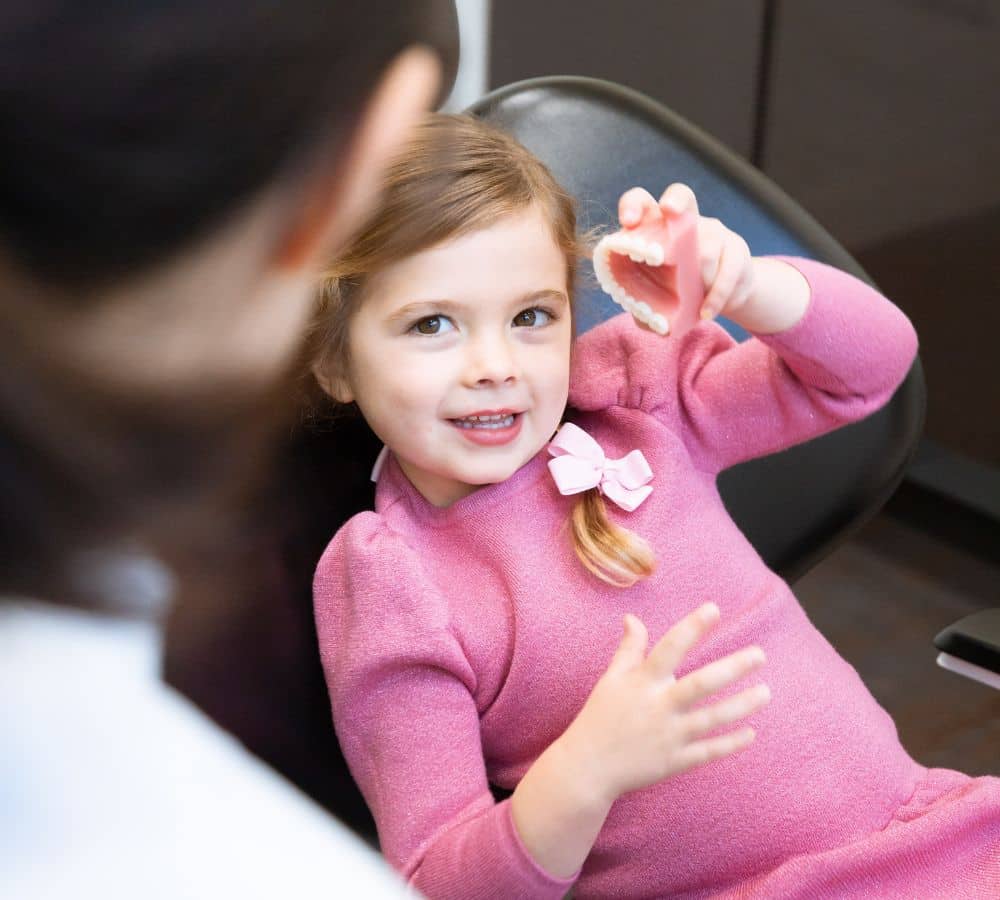
Tell-show-do — the most commonly used technique for familiarising children with a new procedure: age-appropriate explanation, then a demonstration of how it works, then performing it. Nothing happens that the child has not already seen.
Positive reinforcement — praise and reward at the end of a successful appointment.
Distraction — taking attention away from the dental setting. At our Melbourne CBD practice this includes movies children can watch from the dental chair during the appointment.
Empathy — establishing rapport so the child feels acknowledged as an individual, using open-ended and personalised questions to build a trusting relationship.
Preventing and managing dental anxiety is one of the key responsibilities of a paediatric dentist — not a side benefit of the appointment.
None of these techniques is a guarantee about how any individual child will find any individual appointment, and it is better not to make that promise to a child on the practice's behalf. What they do is make the appointment predictable, which is the thing a frightened child is actually short of.
Common questions
The first visit went badly. Have we ruined it?
Almost certainly not — and there is a published reason to be hopeful about a child specifically.
The Better Health Channel, produced with the Victorian Department of Health, draws a sharp distinction between children and adults on exactly this point: "Children who have had bad dental experiences can likely overcome their fear if they are supported during further dental visits. Adults who are anxious about dental care tend to remain anxious throughout life."
Read that carefully, because it contains both the reassurance and the urgency. The window in which a bad experience can be turned around is the childhood one. It is not open indefinitely.
There is also a technique for it, and it has a name. The American Academy of Pediatric Dentistry describes memory restructuring — "a behavioral approach in which memories associated with a negative or difficult event (eg, first dental visit, local anesthesia, restorative procedure, extraction) are restructured into positive memories using information suggested after the event has taken place." Its four components are "(1) visual reminders; (2) positive reinforcement through verbalization; (3) concrete examples to encode sensory details; and (4) sense of accomplishment." The AAPD reports it being used with children who had local anaesthetic at a first restorative visit, with "a change in local anesthesia-related fears and behaviors at subsequent treatment visits."
In ordinary language: in the days afterwards, talk about the specific things that went well and name them concretely — sitting in the chair on your own, opening wide, the sunglasses, the sticker — rather than saying "that wasn't so bad, was it." The second invites a child to correct you. The first gives them a version of the day they can keep.
And book the next visit as something small. A check-up that follows a difficult treatment visit is the appointment that rewrites the pattern.
Is there something more structured than role play for a child who is already frightened?
Yes. It is called systematic desensitisation, and it is a staged sequence rather than a single conversation.
The AAPD describes it as "a process that diminishes emotional responsiveness to a negative, aversive, or positive stimulus after progressive exposure to it," where "patients are exposed gradually through a series of sessions to components of the dental appointment that cause them anxiety."
Its own sequence, which is worth following in order:
- At home first. The child reviews information about the practice and the environment "with a preparation book or video or by viewing the practice website."
- Practise the physical actions. "Parents may model actions (eg, opening mouth and touching cheek) and practice with the child at home using a dental mirror."
- A tour with nothing happening. "An office tour during nonclinical hours."
- The treatment room itself, still with nothing happening. "Another visit in the dental operatory to explore the environment."
- Only then, "an appointment with the dentist and staff may be attempted."
The AAPD's stated indications are "patients who have experienced fear-invoking stimuli, anxiety, and/or neurodevelopmental disorders (eg, autism spectrum disorder)," and it lists no contraindications.
What this asks of you is patience and of the practice is time. Steps three and four are appointments that produce no treatment and no fee-generating work, so say plainly when you ring that this is what you are asking for. A practice that can accommodate it will tell you; one that cannot is better to know about now. Visiting the dentist: caring for a child with autism covers the same approach for a child who needs it most.
My child's fear is about not being able to stop. Can anything be done about that?
Yes, and it is the simplest intervention on this page: an agreed signal, practised before anything starts.
The AAPD calls this enhancing control — "a technique used to allow the patient, especially an anxious/fearful one, to assume an active role in the dental experience. The dentist provides the patient a signal (eg, raising a hand) to use if he becomes uncomfortable or needs to briefly interrupt care." The detail that makes it work is in the next sentence: "The patient should practice this gesture before treatment is initiated."
The Better Health Channel lists the same thing among its coping techniques, in the patient's own terms: "agreeing with your dentist on a signal to stop during the treatment for a break (such as raising your left pointer finger or hand)."
Why it matters more than it sounds. A great deal of dental fear is not fear of pain; it is fear of not being able to say so. A child who knows the treatment will stop when they raise a hand — and who has tested that it does — is in a different situation from one who is simply hoping it will.
Two things to insist on. That the signal is rehearsed before the appointment begins rather than mentioned in passing, and that the first time it is used, it is honoured immediately. A signal that is acknowledged and then ignored is worse than no signal, because it teaches the child that saying stop does not work.
The AAPD also notes that "giving the patient a short break during a stressful procedure can be an effective use of distraction before considering more advanced behavior guidance techniques." A pause is a treatment, not a failure.
Does any of this actually work, or is it just what dentists say?
We are going to give you an honest answer rather than a confident one, because the evidence base here is thinner than the consensus.
What is established is professional consensus rather than trial results. The AAPD lists tell-show-do, ask-tell-ask, distraction and desensitisation as best practice, and for several of them records the indications as "use with any patient" and the contraindications as "None" — a statement about safety and applicability, not about measured effect size.
What does not exist is the thing you would want. The Cochrane review that would settle this — Non-pharmacological interventions for managing dental anxiety in children — exists only as a published protocol, with no results. So at present there is no Cochrane effect estimate for tell-show-do, distraction or desensitisation in children. Any page that gives you a percentage for how well these work cannot be showing you where it came from.
What follows from that, practically:
- These techniques are low-risk, cheap and widely recommended, which is a reasonable basis for trying them. That is not the same as proof that they work, and you should be told which claim is being made.
- The outcome that is measurable is whether your child will go back. Judge it on that rather than on how a single appointment felt.
- Be sceptical of any promise about how an appointment will feel. As this page says above, none of these techniques is a guarantee about an individual child.
Holding both halves is the honest position: this is the best-supported approach available, and the support is professional agreement rather than randomised evidence.
Will they grow out of it, or is this something they carry for life?
This is the question that makes early effort worth it, and the published answer is uncomfortable but useful.
The Better Health Channel's prognosis is stated plainly: children "can likely overcome their fear if they are supported during further dental visits", while "adults who are anxious about dental care tend to remain anxious throughout life." Childhood is where this is tractable.
What it looks like if it is not addressed. The Better Health Channel names the mechanism directly: "Avoiding the dentist can result in dental disease getting worse, and a greater need for emergency care or more complex treatment. It can also feed the underlying problem of dental anxiety; this is known as the 'vicious cycle of dental anxiety'." It adds a second cost people overlook — "you are also missing out on learning how to better care for your oral health."
How common the adult endpoint is. A 2021 systematic review and meta-analysis in the Journal of Dentistry, covering 72,577 adults across 31 studies, put the global prevalence of dental fear and anxiety at 15.3% (95% CI 10.2–21.2), high dental fear at 12.4% (95% CI 9.5–15.6) and severe dental fear at 3.3% (95% CI 0.9–7.1).
Treat those figures with the caution their authors do. Only 3 of the 31 studies were judged at low risk of bias, the confidence interval on severe fear runs from under 1% to over 7%, and the measurement instrument used changes the answer more than the population does. "About one adult in seven has some degree of dental fear" is a defensible reading; a precise figure is not.
The practical point survives the imprecision. Adult dental fear is common, it is largely formed in childhood, and it does not usually resolve on its own. The appointments you make now are the intervention.
I am the anxious one. What am I actually supposed to say to them?
Less than you think, and none of it reassurance about pain.
The mechanism described above is real: parental anxiety transmits, most strongly under the age of four, and a child reads tone long before they understand vocabulary. The single most useful thing you can do is tell the practice, quietly, that dentistry frightens you — before the appointment, not during it. That changes how the room is run.
Beyond that, hand the explaining over. The AAPD's tell-show-do framework has the clinician give "explanations of procedures in phrases appropriate to the developmental level of the patient", followed by a demonstration and then the procedure itself. The parent's job in that structure is to be present and unremarkable, not to narrate. A child watching a calm adult have an ordinary conversation is being given information; a child listening to an adult promise that nothing will hurt is being given a warning.
Where you can help most is at home, in the rehearsal described above — modelling opening the mouth, touching the cheek, practising with a mirror. That is participation without commentary.
And deal with your own. The Better Health Channel lists coping techniques that apply to adults directly — deep breathing, distraction with music, guided imagery, progressive muscle relaxation, an agreed stop signal — and notes that "referral to a psychologist can be helpful too. Short, targeted therapies including cognitive behavioural therapy can be very successful." Doing something about your own avoidance is not self-indulgent here; it is part of the child's treatment plan. Dental anxiety covers what is available.
Related reading
- Baby teething: signs, symptoms and treatments
- The order and appearance of baby teeth
- Should I pull out my child's loose tooth?
- Everything you need to know about chalky teeth
- Dental crowns for children — silver or white?
- Protecting your child from dental disease
- How does the Child Dental Benefits Schedule operate?
Practical details
Smile Solutions, Level 1, 220 Collins Street, Manchester Unity Building, Melbourne VIC 3000 — getting here. Phone 13 13 96, contact us, or theteam@smilesolutions.com.au. Monday–Friday 8.00am–6.00pm, Saturday 8.30am–1.30pm, Sunday by appointment.
When booking, mention if your child is anxious — it changes how the appointment is set up. The clinical team is listed by name, with registered specialists identified as such. Eligible families may be able to use the Child Dental Benefits Schedule.
Published 16 November 2018. First-visit timing, the lift-the-lip home check, the food-as-reward position and the survey figures on children's dental visits are attributed to the Australian Dental Association and its consumer site teeth.org.au; supervision-to-age-eight guidance to the Australian Dental Association NSW; the conscious sedation endorsement to the Dental Board of Australia; prognosis, the vicious cycle and adult coping techniques to the Better Health Channel (State Government of Victoria); behaviour guidance techniques to the American Academy of Pediatric Dentistry, which is a United States guideline included because no Australian equivalent was located — where it differs from Australian regulators, the Australian position governs; adult prevalence figures to Silveira et al., Journal of Dentistry 2021. General information only; it does not replace advice from your treating practitioner.
Smile Solutions trades under ABN 28 193 514 103.
Images on This Page
-
https://www.facebook.com/tr?id=800557773428361&ev=PageView&noscript=1
(no alt text)
-
https://www.smilesolutions.com.au/wp-content/uploads/2025/10/calendar_month.svg
(no alt text)
-
https://www.smilesolutions.com.au/wp-content/themes/arcadian-wordpress-theme/assets/images/smile_solutions_logo_white.png
Smile Solutions Logo
-
https://www.smilesolutions.com.au/wp-content/themes/arcadian-wordpress-theme/assets/images/smile_solutions_logo_purple.png
Smile Solutions Logo
-
https://www.smilesolutions.com.au/wp-content/uploads/2023/11/SS-Tooth-1-1-150x150.png
Smile Solutions
-
https://www.smilesolutions.com.au/wp-content/uploads/2018/11/Children-Dental-Anxiety.jpg
Combating dental anxiety in children
-
https://www.smilesolutions.com.au/wp-content/uploads/2025/09/Root-Canal-2-300x217.jpg
Root Canal
-
https://www.smilesolutions.com.au/wp-content/uploads/2026/08/Mouth-Breathing-300x270.jpg
Mouth Breathing
-
https://www.smilesolutions.com.au/wp-content/uploads/2025/09/Dental-Crown-at-Smile-Solutions-300x300.jpg
Dental Crown at Smile Solutions
-
https://www.smilesolutions.com.au/wp-content/themes/arcadian-wordpress-theme/assets/images/family_owned_bussiness.png
Family Owned Business
-
https://www.smilesolutions.com.au/wp-content/themes/arcadian-wordpress-theme/assets/icons/icon--phone.svg
Smile Solutions Contact
-
https://www.facebook.com/tr? id=800557773428361&ev=PageView&noscript=1
(no alt text)
-
https://bat.bing.com/action/0?ti=25148060&tm=gtm002&Ver=2&mid=b666bc65-dfa6-4ed5-8b3c-945b4b7d64c0&bo=1&sid=fc633030ab2711f18b0cdf49a1f96d50&vid=fc637080ab2711f1a683ddbcbcc88c6e&vids=1&msclkid=N&pi=918639831&lg=en-US&sw=800&sh=600&sc=24&nwd=1&tl=Combating%20dental%20anxiety%20in%20children%20-%20Smile%20Solutions&p=https%3A%2F%2Fwww.smilesolutions.com.au%2Fdental-articles%2Farticle%2Fcombating-dental-anxiety-children%2F&r=&evt=pageLoad&sv=2&cdb=AQAQ&rn=30985
(no alt text)