Dental crowns for children — silver or white?
Parents often ask why crowns are necessary on baby teeth at all, and what the options are. Children's dentistry sets out how treatment is arranged here; paediatric dentists are the specialists who usually place these.
What a crown is
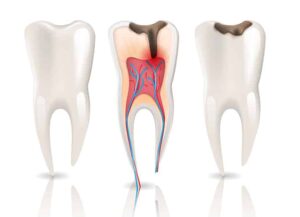
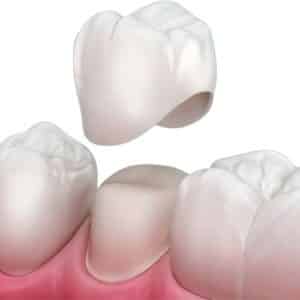
A strong cap or covering used to repair and reinforce a decayed or broken tooth, restoring it to its normal shape, size and function.
On a baby tooth it is a preformed crown — a ready-made shell, selected from a range of sizes, trimmed and fitted in a single appointment. It is not the same procedure as an adult crown, which is custom-made from an impression or scan over two visits — what types of dental crowns are available? describes that version. The difference matters: the child's version is quicker, simpler, and done in one sitting.
Why crowns are used on baby teeth
It is necessary to keep baby teeth healthy until they are naturally replaced by their adult successors — they hold space, guide the adult teeth into position, and allow normal eating and speech in the meantime. The order and appearance of baby teeth sets out the timetable.
A crown may be recommended when:
- your child develops a large cavity — see protecting your child from dental disease
- the baby tooth has not developed properly and has broken down
- the tooth has had nerve treatment (a pulpotomy) and needs full-coverage protection afterwards
- the enamel is weak from a developmental condition such as molar hypomineralisation — everything you need to know about chalky teeth
- the tooth has been fractured by an accident — children's dental emergencies
The question behind the question is usually why treat a tooth that is going to fall out anyway. The answer depends on timing. A back baby tooth may not be replaced until around age ten to twelve — so a crown at five is protecting a tooth with years of work left to do. Losing it early lets the neighbouring teeth drift, and that is one of the common routes into orthodontic treatment later. Should I pull out my child's loose tooth? covers the other end of that timetable.
Why a crown rather than a large filling
Crowns are preferred over large adhesive fillings because they have been shown to protect the tooth better. They last longer, which means treatment does not have to be repeated on the same tooth. How long do dental fillings last? explains why size and load matter so much to that.
That last point is the one that matters most for a child. Every repeat appointment is another episode of treatment for someone who may already be anxious — the durable option is often the kinder one. A large filling in a small tooth that fails in eighteen months means doing it all again, usually with a more worried child. Combating dental anxiety in children and how Smile Solutions helps manage a child's dental anxiety go into that properly.
That said, not every cavity in a baby tooth needs a crown. Small ones are filled; some very early lesions are arrested and monitored — see can you reverse tooth decay? — and where a tooth is close to falling out anyway, doing less can be the right call. Ask what the alternatives are and why a crown is being recommended for this particular tooth.
The two options
Preformed stainless steel crowns
The more traditional choice, in use since the 1950s.
- A long history of clinical use and research, making them highly reliable for strength and durability
- Made of nickel, chromium and iron, and silver in colour
- Less tooth preparation is generally needed than for zirconia
- More forgiving of a less-than-perfect field — they can be crimped and adapted, which matters with a wriggling four-year-old
- Well accepted by children, who are often pleased to get a princess crown or a pirate tooth
That framing is not a throwaway line — how a child understands the treatment strongly affects how they cope with it, and a child who leaves proud of their silver tooth has had a very different experience from one who leaves embarrassed.
The obvious drawback is appearance. On back teeth it is rarely noticed; on an upper front tooth, parents often feel differently.
Preformed zirconia crowns
A more recent option.
- Made of zirconia, a very strong ceramic
- Tooth coloured and more aesthetically pleasing
- A suitable alternative if your child has a known nickel allergy — which is the decisive factor in some cases rather than a matter of preference
- Generally less plaque accumulation at the margin, because the surface is highly polished
The trade-offs, stated honestly:
- More tooth structure has to be removed to seat them, because they cannot be crimped or adapted — the tooth is shaped to fit the crown rather than the reverse
- They are less forgiving: they need a dry field, good moisture control and a co-operative child, which sometimes means treatment under sedation or general anaesthesia
- They can chip or fracture if the bite is heavy, and they cannot be repaired — a damaged one is replaced
- They usually cost more — published fees are in the price guide
How they compare
Current research shows both materials perform well for strength and durability in primary molars, with the studies below reporting comparable survival over their follow-up periods.
So the choice largely comes down to appearance, how much tooth can be spared, how the child is likely to cope, whether nickel allergy rules out stainless steel, and cost. Both are good options, and both are offered.
A reasonable rule of thumb, and one your specialist may or may not apply to your child's case: stainless steel on back teeth where it will not be seen and strength matters most; zirconia on front teeth or where appearance is a significant concern.
What to expect on the day, and afterwards
- Local anaesthetic is used, and often nitrous oxide for an anxious child. Extensive work in a very young child is sometimes done under general anaesthesia by a specialist anaesthetist. Dental Anxiety, and sleep dentistry for the sedation options
- Watch a numb lip. Children commonly chew a numb cheek or lip out of curiosity and can do real damage without feeling it. Supervise for the first couple of hours — why do I bite my cheek after a filling? explains the mechanism
- The gum around a new crown is often tender and may bleed a little for a day or two. That settles
- Keep brushing the crown and the gum around it. Crowns do not decay, but the tooth underneath and the gum around it still can — kids teeth cleaning tips and how to encourage your child to brush
- Avoid very sticky foods — chewy sweets and toffee are the usual culprits for pulling a crown off. Protect your kids from the sugar bandits and limiting sugar at Halloween are the wider version of that advice
- A crown that comes off should be seen promptly. Keep it and bring it. The tooth underneath is unprotected in the meantime — emergency dentistry
A crowned baby tooth falls out naturally, crown and all, when the adult tooth pushes it out. It does not need removing beforehand.
On prevention rather than repair: the role of fissure sealants in children's teeth is the measure that most often keeps a molar out of this article entirely.
Common questions
Will the Child Dental Benefits Schedule pay for a crown?
Probably not for the crown itself, and it is worth knowing that before the appointment rather than at the desk afterwards.
Services Australia publishes the list of basic dental services the CDBS covers, and it is short: check-ups, X-rays, cleaning, fissure sealing, fillings, root canals and extractions. A preformed crown is not on that list. The benefit is up to $1,158 for each eligible child over 2 calendar years, and Services Australia notes the cap "is indexed yearly on 1 January" and that the increase applies only to a child who received their first eligible service in that calendar year.
Two further things to check before you book. Services Australia warns that "there are some restrictions for basic dental services" and that you "should check with your dentist if there are any item or time restrictions before starting your service" — so even the covered items are not unlimited. And the CDBS does not cover any dental services in a hospital, which matters here, because extensive work in a very young child is sometimes done under general anaesthesia in theatre. The same treatment can be partly claimable in a dental chair and not claimable at all in an operating theatre.
What the CDBS will fund is much of what gets you away from needing crowns in the first place — the check-ups, the x-rays that find decay while it is small, the cleans and the fissure sealing. If your family is eligible, using it for those is the best value in this entire article.
Victoria also provides free public dental care for children in eligible families, through community dental services and the Royal Dental Hospital of Melbourne, with its own eligibility rules. Ask, rather than assuming either scheme applies. See Child Dental Benefit Schedule and how the Child Dental Benefits Schedule operates. Confirm the current cap and your own eligibility with Services Australia.
Is the silver crown the same as an amalgam filling? Does it contain mercury?
No, and this is the most common misunderstanding parents arrive with, because both are silver-coloured and the word "silver" is doing double duty.
A preformed stainless steel crown is a ready-made metal shell made of nickel, chromium and iron. It contains no mercury. It is not a filling material at all — it is a cap that goes over the whole tooth, in one piece, made in a factory and trimmed to fit. Dental amalgam is a different material entirely: a filling alloy mixed at the chairside and packed into a cavity.
So if your concern is mercury, a stainless steel crown is not the thing to be concerned about.
The composition does matter in one specific way, and it is the one already noted above: these crowns contain nickel, so a known nickel allergy is a genuine reason to choose zirconia instead. That is a clinical indication rather than a preference, and it is worth mentioning at the consultation if anyone in the family reacts to costume jewellery or watch backs.
What the metal is not is a reason to reject the option out of hand. Stainless steel crowns have been in use since the 1950s with a long research record behind them, and on a back tooth that nobody sees they remain the most forgiving and durable choice for a small child.
We brush twice a day. How did this happen?
It happens to a lot of families who are doing most things right, and the data is worth seeing because it reframes the question away from blame.
The Australian Dental Association reports that 34% of Australian children aged 5–6 years have experienced decay in their primary teeth, and that 27% aged 5–10 have untreated tooth decay in primary teeth. This is not an unusual event.
The ADA's Consumer Survey of 25,000 people points at the two things that most often explain it, and neither is brushing technique.
The first is drinks, and how often rather than how much. The survey found that while 85% of parents are aware soft drinks, energy drinks and fruit juice lead to decay, nonetheless 26% of children have fruit juice daily, 37% have two to five fruit juices a week, and 37% have two to five soft drinks a week. Fruit juice is the one that surprises people: it is counted as a free sugar and it is acidic, and a beaker sipped across an afternoon does more damage than the same juice drunk at once.
The second is timing of the first visit. The ADA recommends a first dental visit when the first tooth appears, or by age one, and then at least every 12 months. But the survey found only 5% of parents said their child's first visit was before 12 months, and one third (32%) reported their child's first visit was for pain or a problem — by which point the simple options have usually gone. The ADA's own phrasing: decay "if picked up early, can be controlled fairly simply (for example with fluoride applications) before they become established", whereas "leaving it till the teeth hurt or break down means simpler interventions are unlikely to work."
One more thing that is rarely anyone's fault: some enamel forms poorly before the tooth ever erupts — molar hypomineralisation — and those teeth decay faster and are harder to numb no matter how well they are brushed. See my child has chalky teeth, now what?.
Should we just have it taken out instead? It is going to fall out anyway.
Sometimes, yes — but it depends almost entirely on which tooth and how old your child is, and that is a question with a specific answer rather than a philosophical one.
The timetable is the whole argument. A back baby molar may not be replaced until around age ten to twelve. Removing it at five leaves a gap for five to seven years, during which the teeth behind it drift forward into the space and the adult tooth that was meant to arrive there has nowhere to go. That is one of the common routes into orthodontic treatment that could have been avoided — and orthodontics is expensive, lengthy, and specifically excluded from the Child Dental Benefits Schedule. Extraction can be the cheaper decision on the day and the more expensive one over a decade.
When extraction genuinely is reasonable: a tooth that is already close to exfoliating naturally; one broken down too far to restore; an abscessed tooth where the infection cannot be resolved. If the tooth is removed and the gap matters, ask whether a space maintainer is appropriate.
What to actually ask, rather than choosing between the two abstractly: when is this particular tooth due to be replaced?, what happens to the gap if we take it out?, and what is the plan if the crown fails? A clinician who can answer those three is giving you a real choice rather than a recommendation.
And be wary of the reasoning that a baby tooth does not matter. It is the most expensive sentence in children's dentistry — an infected baby tooth can damage the adult tooth forming above it, and pain and abscesses are exactly as real in a tooth that has three years left to run.
How do we stop this happening to the other teeth?
Five things, in roughly descending order of how much difference they make.
1. Change the frequency of sugar, not just the amount. The World Health Organization identifies free sugars as "the most common risk factor for dental caries" and recommends keeping them below 10% of total energy intake, ideally below 5% — which the ADA translates as no more than 6 teaspoons (24 grams) a day. Free sugars include the sugar naturally present in fruit juice, which is why juice counts. But the lever that is easiest to pull is frequency: each exposure starts an acid cycle, so the same biscuit at afternoon tea is far better than three sips of juice across the afternoon. The ADA's advice is to encourage children to drink tap water between meals.
2. Ask about fissure sealants. Sealing the deep grooves of the back teeth is the single measure that most often keeps a molar out of this article entirely — and fissure sealing is on the Child Dental Benefits Schedule's covered list. See the role of fissure sealants in children's teeth.
3. Keep helping with the brushing for longer than feels necessary. The ADA's position is that parents should assist with brushing children's teeth until age eight. Most children cannot clean the back teeth properly before then, however willing they are — and the back teeth are where the crowns end up.
4. Go every twelve months, whether or not anything hurts. The ADA recommends the first visit when the first tooth comes through, or by one year of age, and at least every 12 months thereafter. The point is that early decay can often be arrested with fluoride and monitoring rather than drilled. That only works if it is found early.
5. Look, once a month. The ADA's advice to parents is plain: make an appointment if you see white, brown or black spots on the teeth that do not come off. White marks at the gum line on the upper front teeth are early decay, and at that stage they may still be reversible. It also warns against dipping a dummy in honey or jam once teeth are present.
See kids teeth cleaning tips, protecting your child from dental disease and the benefits of fluoride.
References
- Donly KJ, Sasa I, Contreras CI, Mendez MJC. Prospective Randomized Clinical Trial of Primary Molar Crowns: 24-Month Results. Pediatr Dent. 2018 Jul 15;40(4):253–258. PMID: 30345963.
- Taran PK, Kaya MS. A Comparison of Periodontal Health in Primary Molars Restored with Prefabricated Stainless Steel and Zirconia Crowns. Pediatr Dent. 2018 Sep 15;40(5):334–339. PMID: 30355428.
Both cited studies have limited follow-up periods, which is normal for a comparatively recent material. They support comparable performance over the periods studied rather than over the full life of a baby tooth.
Related reading
- Should your child see a specialist paediatric dentist?
- When should a child first visit the dentist?
- Oral health care for children with special needs
- Visiting the dentist: caring for a child with autism
- Baby teething — signs, symptoms and treatments
- Should my child wear a mouthguard?
Practical details
Written by a specialist paediatric dentist at Smile Solutions. The full clinical team is listed by name, and registered specialists are identified as such.
Smile Solutions, Level 1, 220 Collins Street, Manchester Unity Building, Melbourne VIC 3000 — getting here. Phone 13 13 96, contact us, or theteam@smilesolutions.com.au. Monday–Friday 8.00am–6.00pm, Saturday 8.30am–1.30pm, Sunday by appointment.
Eligible children aged 0–17 may be able to use the Child Dental Benefits Schedule, which contributes to basic dental services over a two-year period subject to eligibility and a capped benefit; check with Services Australia. Victoria also provides free public dental care for children in eligible families, through community dental services and the Royal Dental Hospital of Melbourne. How the Child Dental Benefits Schedule operates.
Paediatric dentistry is one of the thirteen recognised dental specialties in Australia, and specialist registration can be verified free on the AHPRA public register at ahpra.gov.au.
Related: Paediatric Dentists, First Visit to the Dentist, Kids Teeth Cleaning Tips, Dental Crowns.
Published 26 July 2021. General information only — it is not a diagnosis, a treatment plan, a quote or a promise of any particular clinical outcome, and it does not replace advice from your treating practitioner. Whether a crown is needed, and which material suits a particular tooth, can only be determined after examination, usually with radiographs. Outcomes vary between children, and no restoration is permanent. Fees and benefit eligibility are indicative and subject to change; confirm at your consultation. Child Dental Benefits Schedule covered services, caps and exclusions are set by Services Australia and change; the cap is indexed each 1 January — confirm the current position with Services Australia. Decay prevalence and survey figures are the Australian Dental Association's; sugar intake figures are the World Health Organization's and the ADA's.
Smile Solutions trades under ABN 28 193 514 103.
Images on This Page
-
https://www.facebook.com/tr?id=800557773428361&ev=PageView&noscript=1
(no alt text)
-
https://www.smilesolutions.com.au/wp-content/uploads/2025/10/calendar_month.svg
(no alt text)
-
https://www.smilesolutions.com.au/wp-content/themes/arcadian-wordpress-theme/assets/images/smile_solutions_logo_white.png
Smile Solutions Logo
-
https://www.smilesolutions.com.au/wp-content/themes/arcadian-wordpress-theme/assets/images/smile_solutions_logo_purple.png
Smile Solutions Logo
-
https://www.smilesolutions.com.au/wp-content/uploads/2023/11/SS-Tooth-1-1-150x150.png
Smile Solutions
-
https://www.smilesolutions.com.au/wp-content/uploads/2025/09/Childrens-Orthodontics-at-Smile-Solutions.png
Children's Orthodontics at Smile Solutions
-
https://www.smilesolutions.com.au/wp-content/uploads/2025/09/Root-Canal-2-300x217.jpg
Root Canal
-
https://www.smilesolutions.com.au/wp-content/uploads/2026/08/Mouth-Breathing-300x270.jpg
Mouth Breathing
-
https://www.smilesolutions.com.au/wp-content/uploads/2025/09/Dental-Crown-at-Smile-Solutions-300x300.jpg
Dental Crown at Smile Solutions
-
https://www.smilesolutions.com.au/wp-content/themes/arcadian-wordpress-theme/assets/images/family_owned_bussiness.png
Family Owned Business
-
https://www.smilesolutions.com.au/wp-content/themes/arcadian-wordpress-theme/assets/icons/icon--phone.svg
Smile Solutions Contact
-
https://www.facebook.com/tr? id=800557773428361&ev=PageView&noscript=1
(no alt text)
-
https://bat.bing.com/action/0?ti=25148060&tm=gtm002&Ver=2&mid=c2c074b0-abaa-44e7-a286-7924726b9e78&bo=1&sid=d5291bc0ab2711f18ec48b587c8c3b6b&vid=d5294af0ab2711f1998edb6587e94eb2&vids=1&msclkid=N&pi=918639831&lg=en-US&sw=800&sh=600&sc=24&nwd=1&tl=Dental%20Crowns%20for%20Children%20%E2%80%93%20Silver%20or%20White%3F%20-%20Smile%20Solutions&p=https%3A%2F%2Fwww.smilesolutions.com.au%2Fdental-articles%2Farticle%2Fdental-crowns-for-children-silver-or-white%2F&r=&evt=pageLoad&sv=2&cdb=AQAQ&rn=168112
(no alt text)