Can you reverse tooth decay?
Up to a point — and the point is precise.
Decay confined to enamel can be arrested and remineralised. Once it perforates into dentine, it is irreversible and needs a filling. Everything below explains where that line sits and why crossing it changes the situation so sharply.
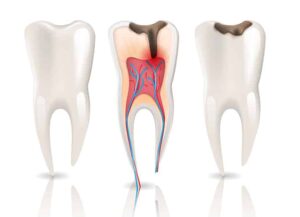
Tooth decay, like all dental disorders, works on a spectrum. You may have areas of decay that are only in very early stages, and your dentist will tailor the treatment plan accordingly. The stages of dental decay sets out that spectrum end to end.
How decay actually works
The process begins when bacteria adhere to the tooth surface. The current understanding is that the biofilm — the layer of organisms, their by-products and matrix — is responsible for decay, rather than any single organism. How does tooth decay develop? covers the same mechanism from the other direction.
The mechanism:
- Just as humans use carbohydrates for energy, so do bacteria — particularly simple carbohydrates, i.e. sugar
- They metabolise dietary sugars and release a weak acid into the biofilm as a by-product
- That acid forces saliva to work in double time to neutralise the biofilm
- A constant cycle of demineralisation and remineralisation of the enamel begins
This is a delicate balance that all living organisms experience. When it is disrupted — for example by increased dietary sugar — demineralisation is favoured. Over time the enamel becomes more porous, which makes further progression easier. How does sugar affect your dental health? and how does your diet affect your teeth? put numbers to the dietary side; sugar-free soft drinks explains why removing the sugar does not remove the acid.
The World Health Organization describes the same process and names the three things that have to go wrong together for it to end in a cavity: “a continued high intake of free sugars, inadequate exposure to fluoride and a lack of removal of plaque by toothbrushing with fluoride toothpaste containing 1000-1500 ppm concentration”. That is a useful checklist, because each of the three is separately fixable. (Source: WHO fact sheet, Sugars and dental caries.)
The sugar side, with the published numbers
The word doing the work in the WHO’s framing is free sugars — defined there as “all sugars added to foods and beverages by the manufacturer, cook or consumer, plus sugars naturally present in honey, syrups and fruit juices”. Fruit juice counts. The sugar you add at home counts.
The published thresholds:
- The WHO advises that limiting free sugars to less than 10% of total energy intake — and ideally to less than 5% — “minimizes the risk of dental caries throughout the life course”.
- The Australian Dental Association translates the 5% figure into something you can picture: oral health education should encourage people to limit consumption to “no more than 6 teaspoons (24 grams) of free sugar (5% of total energy intake) per day”.
- The WHO also recommends that children under 2 years of age should not consume any sugar-sweetened beverages. Children’s dentistry and how to encourage your child to brush their teeth
On the point that matters most for reversing early decay, the ADA’s diet policy asks that education place “special emphasis … on the form, frequency, timing and total amount of sugar consumption; particularly snacking on sugary-beverages and/or sugar-rich foods that have limited nutritional value”. Note that frequency and timing sit alongside total amount rather than beneath it — which is the published basis for the advice further down about finishing something in one sitting.
The same policy names sugar-free confectionery: “Sugar-free confectioneries without added acids, including chewing gums, are dentally safe alternatives to caries-producing confectionery containing sugar” — with the caveat, in the ADA’s own words, that the main objective is still to reduce the need for sugar and sugar substitutes altogether. Does chewing sugar-free gum really help prevent cavities? (Source for this section: WHO fact sheet Sugars and dental caries; ADA Policy Statement 2.2.2, Diet and Nutrition.)
The reversible stage
At this point, stabilising the diet, improving oral hygiene and other factors can reverse it.
The honest caveat: the original tooth structure will never be regained. But enamel can use particles from saliva and toothpaste — especially calcium and fluoride — to remineralise. The benefits of fluoride explains the mechanism, and selecting a toothpaste: fluoride or non-fluoride is the decision that follows from it.
The NHMRC sets out the mechanism in two parts: fluoride works by “reducing demineralisation (i.e. where the enamel begins to dissolve)” and by “enhancing remineralisation (i.e. recovery of weakened enamel)”, which, in its words, “helps the repair of early tooth decay”. It adds that fluoride “also slows the activity of bacteria that cause decay and combines with enamel on the tooth surface to make it stronger”. That second half is the part most people have never heard: it is not only rebuilding, it is also suppressing. (Source: NHMRC, Water Fluoridation and Human Health in Australia: Questions and Answers.)
What your dentist will do
When decay is recognised in enamel only, a dentist will often apply concentrated fluoride to the area and give advice to encourage remineralisation:
- Do not rinse after brushing. Spit only, and let the fluoride sit on the teeth — the same principle as refraining from eating or drinking for 30 minutes after a clean and fluoride appointment. The ADA gives the same instruction in its own brushing sequence: “After brushing, spit out the excess toothpaste but do not rinse your mouth with water. This allows the fluoride paste to sit on the teeth for longer, increasing protection.”
- Reduce the frequency of snacking. This is the counterintuitive one: it is better to finish a dessert or fizzy drink in one sitting than to savour it over a long period. Frequency of acid attack matters more than quantity
- Switch to sugar-free alternatives — though see chewing sugar-free gum for the one substitution with evidence behind it
The rest of the routine matters too: the ideal daily routine for oral hygiene, how often to brush, and whether flossing is really that important — it is, because contact points between teeth are where a brush cannot reach and where adult decay most often starts.
Who is at higher risk of losing this race
The ADA’s diet policy singles out groups for whom the demineralisation side of the balance is weighted against them from the start: people with conditions that reduce salivary flow, people taking medications that reduce salivary flow, and older people, for whom reduced saliva flow and more exposed root surfaces raise the risk of decay. If you are in one of those groups, the reversible window is shorter and the dietary advice above is not optional. My mouth always feels dry! What can I do? and diabetes and oral health
The irreversible stage
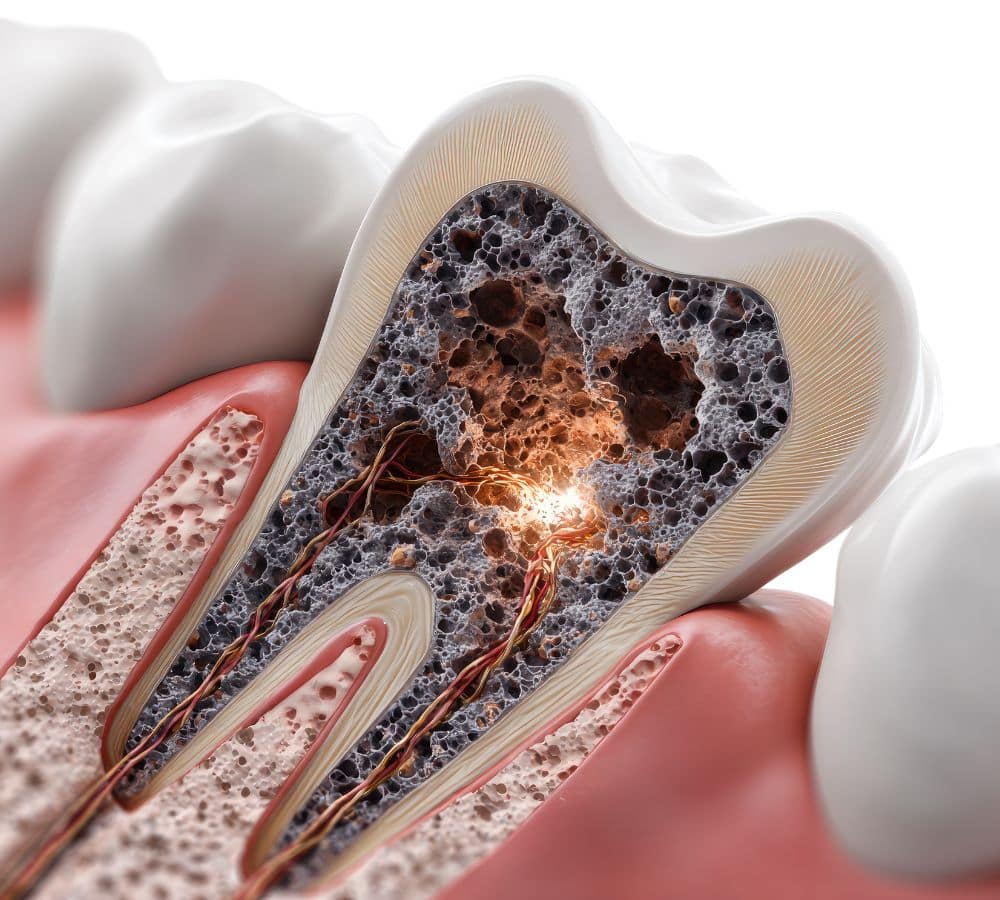
Enamel is forgiving. Dentine — the second layer — is not.
Once demineralisation has perforated into dentine:
- Dentine is easier to break down than enamel
- It has direct passages to the blood supply of the tooth
- Decay progresses at a much more rapid rate and moves towards the nerve, or pulp
The dangerous part: symptoms often do not arise until the decay is relatively close to the nerve. By the time it hurts, the tooth is already at long-term risk of requiring root canal treatment. Everything you need to know about root canal treatment describes what that involves, and what is a tooth abscess? describes the stage past it.
This is precisely why decay is found at check-ups rather than reported by patients. Between the teeth it is invisible to the eye, which is what dental x-rays are for.
What a filling does
The dentist cleans out the infected structure and places a filling to recreate the original tooth. This:
- protects the underlying tooth structure
- re-establishes aesthetics
- restores function
- restricts movement of other teeth into the space
Fillings have a lifespan and are prone to needing replacement every few years. A filling is a repair, not a permanent solution — which is another argument for catching decay before it needs one. How long do dental fillings last? gives the figures; why do I need a filling? covers the appointment itself.
Filling options compared
Silver (amalgam) fillings
- One of the oldest and most durable options
- Long-lasting, and highly effective at preventing decay beneath the filling
Against that:
- More noticeable in appearance
- Can increase the risk of cracks or fractures in the tooth over time — see why does a cracked tooth hurt so much?
- Significant fractures may compromise the tooth and require more extensive treatment, up to a crown
Tooth-coloured composite resin
- Designed to blend naturally with your teeth
- Bonds directly to the tooth structure
- Excellent for small to medium restorations
- May need replacing every 3–7 years
Ceramic, gold, and ceramic-metal (for larger restorations)
- Made outside the mouth, which allows greater precision
- Offer greater strength, durability and longevity — often 10+ years
- With modern technology, many can be completed in a single visit — see same-day CEREC restorations and the CEREC process in detail
The lifespan difference is the practical point: for a large restoration, the cheaper composite may need replacing two or three times over the life of one ceramic restoration, and each replacement removes more tooth. Porcelain and composite fillings: the differences and costs sets the two against each other with fees; porcelain, amalgam or composite resin? adds the third. Published fees are in the price guide.
The best prevention
Beyond diet and hygiene, the next best way to avoid needing a filling is early detection.
Regular examinations identify decay at a stage when it is either still reversible, or requires only a very small filling. The gap between remineralising it and a root canal is a matter of timing, not of luck. Preventing dental decay collects the practical measures in one place, and what to expect at a hygienist visit covers the appointment that finds it.
Common questions
One dentist told me to watch it and another wants to fill it. Who is right?
They may both be describing the same tooth correctly, because the answer turns on which layer the decay has reached — and that is a question you are entitled to have answered in those terms.
As set out above, the line is not a matter of opinion: decay confined to enamel can be remineralised; decay that has perforated into dentine cannot. So the useful question is not “do I need a filling?” but “is this in enamel or in dentine, and how do you know?”
Four things worth asking, in order:
- Which surface, and which layer? A white or brown mark on a smooth surface is a different proposition from a shadow under a contact point between two teeth.
- Has it changed since last time? A lesion that looks identical on this year's radiograph and last year's is behaving differently from one that has visibly advanced. This is the single most informative comparison in the whole discussion, and it is the reason for seeing the same practice over time.
- Can I see it? On a radiograph, on an intraoral photograph, or in a mirror. Understanding your treatment covers what a plan should set out.
- If we wait, what changes, and when would you look again? A plan to monitor is a plan — it comes with fluoride, a dietary change and a review date. It is not the same as doing nothing, and if no review is proposed then nothing is what it will become.
Where two opinions genuinely differ, a second opinion is a normal step, and taking your own radiographs with you saves both a repeat exposure and a fee — the privacy policy explains how to ask for them. What should make you cautious is the reverse of caution: a plan to fill several teeth that have never been mentioned before, with no explanation of which layer each one has reached.
Is there anything I can buy that will reverse it?
One thing, and it is boring: fluoride toothpaste, used properly.
The WHO's checklist quoted above names “toothbrushing with fluoride toothpaste containing 1000-1500 ppm concentration” as one of the three factors whose absence lets decay progress. The concentration is printed on the tube. The NHMRC explains what it does — “reducing demineralisation”, “enhancing remineralisation”, slowing the bacteria and combining with enamel to make it stronger.
Two details change how much you get from the same tube:
- Spit, don't rinse. The ADA's instruction is explicit: “After brushing, spit out the excess toothpaste but do not rinse your mouth with water. This allows the fluoride paste to sit on the teeth for longer, increasing protection.” Rinsing washes off the active ingredient you have just applied, which makes it the most common self-inflicted reduction in dose.
- Frequency of sugar, not just quantity. The ADA's diet policy puts “form, frequency, timing and total amount” on the same line, which is why finishing something in one sitting is better than grazing on it.
On the shelf beside the toothpaste, two categories deserve different answers. Sugar-free chewing gum has support: the ADA describes “sugar-free confectioneries without added acids, including chewing gums” as “dentally safe alternatives to caries-producing confectionery containing sugar”, while noting the main objective is still to reduce the need for both. Mouthrinse is not a substitute for cleaning — the ADA lists it among the “proven aids to oral hygiene” but leaves it out of the “main oral hygiene strategies”, and Australian Prescriber states that “mouthwashes are an adjunct to, not a substitute for, regular brushing and flossing.”
And the honest limit: the authorities cited on this page — WHO, NHMRC, ADA — name fluoride. Products marketed as rebuilding enamel by other means are not evaluated in any of the documents behind this page, so we are not going to tell you they work or that they do not. If a product claims to reverse a cavity you can already feel with your tongue, that claim is about a lesion well past the reversible stage described above.
Is fluoride safe — especially for children?
This is the question the topic attracts most, and the Australian answer is documented rather than promotional.
The NHMRC's public statement of 9 November 2017 “recommends community water fluoridation as a safe, effective and ethical way to help reduce tooth decay”, supports fluoridation within the range 0.6 to 1.1 milligrams per litre, and states that there is “no reliable evidence that water fluoridation at current Australian levels causes health problems”. It puts the effect at 26 to 44% less tooth decay in children and adolescents, and about 27% in adults.
On the specific concern most parents raise: dental fluorosis is, in NHMRC's description, “caused by a high intake of fluoride from multiple sources during the time when teeth are developing inside the jawbone, usually from birth to six or eight years of age” — so it is a risk during a defined window, not a lifelong one. In Australia, where it is identified, “in most cases it is classified as very mild or mild”, and mild to very mild fluorosis “does not affect the function of the teeth, is not of aesthetic concern to those who have it and is associated with a protective benefit against tooth decay in adult teeth.” NHMRC also records that fluorosis has declined in Australia even as fluoridation expanded, which it links to reduced exposure from other sources — low-fluoride children's toothpaste in particular.
The practical version for a household with small children: use the age-appropriate toothpaste, which for young children means a children's paste and a smear rather than a blob, applied by an adult rather than by the child. The ADA's wording is simply “an age-appropriate fluoride toothpaste”. Kids' teeth cleaning tips and when should a child first visit the dentist? cover the rest of the routine, and the practice's own page on fluoride covers the mechanism.
If it does not hurt, how is anyone supposed to find it?
By looking in the places you cannot see, which is most of them.
As the page says above, symptoms often do not arise until the decay is relatively close to the nerve — so pain is a late signal, not an early one. Decay between two teeth sits under the contact point, hidden from the mirror and from the light, and it is found on a radiograph rather than by inspection.
That is the justification for the image, and it is worth knowing what it costs you in exposure. The International Atomic Energy Agency gives typical effective doses of 1–8 μSv for an intraoral film — the kind taken between the teeth — and 4–30 μSv for a panoramic. Its own comparison is that intraoral doses are “usually less than one day of natural background radiation”. The IAEA also cautions that effective dose “should not be applied to individuals, but can be used to compare between modalities, techniques and other sources of exposure” — these are numbers for comparing one examination with another, not for calculating personal risk.
None of which means images are taken to a timetable. Each one should be justified for you, at an interval set by your own risk — and if you have had recent films elsewhere, bring them rather than repeating them. How safe are dental X-rays? and why X-rays are taken at all go further into both points.
The corollary is the whole argument of this page. The window in which decay can still be remineralised is usually silent. If you only attend when something hurts, you will meet your decay at the stage where it needs a filling, or more.
Related reading
- What does restorative dentistry mean? — where a filling sits among the alternatives
- What to do if you suffer from sensitive teeth
- How dental erosion is addressed
- I have a toothache — what could be the cause?
- What do I do if a temporary filling comes out?
- What types of dental crown are available?
- Exercise can increase the risk of tooth decay
Practical details
Smile Solutions, Level 1, 220 Collins Street, Manchester Unity Building, Melbourne VIC 3000 — getting here. Phone 13 13 96, contact us, or theteam@smilesolutions.com.au. Monday–Friday 8.00am–6.00pm, Saturday 8.30am–1.30pm, Sunday by appointment. If a tooth is painful now, see emergency dentistry.
Single-visit ceramic restorations are made on site using CEREC. The on-site laboratory and the technology pages describe the equipment involved.
Published 28 April 2022. General information only; it does not replace advice from your treating practitioner. Restoration lifespans vary with the individual, the size of the restoration and oral habits. Quotations attributed to the WHO, the ADA and the NHMRC are those organisations’ published wording and are reproduced here for reference; they are general public health guidance, not personal advice.
Smile Solutions trades under ABN 28 193 514 103.
Images on This Page
-
https://www.facebook.com/tr?id=800557773428361&ev=PageView&noscript=1
(no alt text)
-
https://www.smilesolutions.com.au/wp-content/uploads/2025/10/calendar_month.svg
(no alt text)
-
https://www.smilesolutions.com.au/wp-content/themes/arcadian-wordpress-theme/assets/images/smile_solutions_logo_white.png
Smile Solutions Logo
-
https://www.smilesolutions.com.au/wp-content/themes/arcadian-wordpress-theme/assets/images/smile_solutions_logo_purple.png
Smile Solutions Logo
-
https://www.smilesolutions.com.au/wp-content/uploads/2023/11/SS-Tooth-1-1-150x150.png
Smile Solutions
-
https://www.smilesolutions.com.au/wp-content/uploads/2022/04/Tooth-Decay.jpg
Tooth Decay
-
https://www.smilesolutions.com.au/wp-content/uploads/2025/09/Root-Canal-2-300x217.jpg
Root Canal
-
https://www.smilesolutions.com.au/wp-content/uploads/2026/08/Mouth-Breathing-300x270.jpg
Mouth Breathing
-
https://www.smilesolutions.com.au/wp-content/uploads/2025/09/Dental-Crown-at-Smile-Solutions-300x300.jpg
Dental Crown at Smile Solutions
-
https://www.smilesolutions.com.au/wp-content/themes/arcadian-wordpress-theme/assets/images/family_owned_bussiness.png
Family Owned Business
-
https://www.smilesolutions.com.au/wp-content/themes/arcadian-wordpress-theme/assets/icons/icon--phone.svg
Smile Solutions Contact
-
https://www.facebook.com/tr? id=800557773428361&ev=PageView&noscript=1
(no alt text)
-
https://bat.bing.com/action/0?ti=25148060&tm=gtm002&Ver=2&mid=6ef44154-1e76-44f5-852e-7f67c22f1017&bo=1&sid=daafd910ab2611f190069f969b4daa48&vid=dab05930ab2611f197cd15c987716a58&vids=1&msclkid=N&pi=918639831&lg=en-US&sw=800&sh=600&sc=24&nwd=1&tl=Can%20you%20reverse%20tooth%20decay%20%26%20do%20I%20need%20a%20filling%3F%20-%20Smile%20Solutions&p=https%3A%2F%2Fwww.smilesolutions.com.au%2Fdental-articles%2Farticle%2Fcan-you-reverse-tooth-decay-do-i-need-a-filling%2F&r=<=2638&evt=pageLoad&sv=2&cdb=AQAQ&rn=132810
(no alt text)