I have a toothache — what could be causing it?
Getting the diagnosis right is the whole job
Toothache is one of the worst pains a person can experience. It is also a symptom, not a diagnosis — and that distinction matters more than most people realise.
There are multiple possible causes, and they need different treatment. Decay that has reached the nerve, an abscess, a cracked cusp, grinding, exposed root surface and gum disease all present as "toothache", and treating the wrong one gives you no relief.
So the most important part of treatment is finding the source of the pain — through thorough clinical examination and diagnostic tests, usually including X-rays.
If you need relief right now rather than an explanation, see How can I relieve a toothache?, and Tooth Pain and Ache for the treatment page.
Why a tooth hurts at all
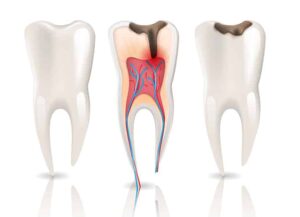
A tooth has three layers:
Enamel — the outer hard layer. No nerve supply. Damage here does not hurt.
Dentine — the softer second layer. Contains microscopic tubules that transmit stimuli inward. This is where sensitivity comes from.
Pulp — the centre, containing the nerve and blood vessels.
Toothache occurs when destruction of tooth structure comes close to the pulp.
This explains something that catches people out: early decay is usually painless. Pain is a late signal, not an early one. Writing in the RACGP's Australian Journal of General Practice, Bayetto, Cheng and Goss put a timescale on it: “The onset of a dental abscess is usually slow over many months. Dental decay takes several months to reach the dental pulp.” By the time a tooth hurts, the problem has generally been developing for a long time — which is the entire argument for check-ups.
The four broad mechanisms
Infection involving the nerve of the tooth — usually decay left to progress towards the nerve.
Infection involving the ligament and tissues surrounding the tooth — usually from infrequent or inadequate professional cleans, infrequent flossing, or poor oral hygiene.
Exposure of dentine — from over-brushing, tooth grinding, a high-acid diet, or reflux.
Food trapping between teeth — irritating or inflaming the tissue around them. The most easily fixed of the four, and worth mentioning if it fits.
Cause by cause
Tooth decay
Caused by inadequate brushing or flossing and poor oral hygiene, and by too much sugar or acid in food and drinks, which breaks down tooth structure.
If decay is detected early it usually is not painful — and in most cases it can usually be diagnosed and treated with little or no discomfort. Pain arrives when the decay has progressed deeper and closer to the nerve.
Symptoms: aching when eating or drinking, sensitivity to cold or hot, dark spots on the teeth, bad breath.
What happens next: an X-ray to confirm the decay, see the size of the cavity, and check for infection or other pathology. That, plus further tests and examination, determines the treatment — usually a filling where the decay is caught in time. See How safe are dental X-rays? if that part concerns you, and Bad Breath if that is the symptom you have noticed.
Infection
Occurs where there is decay, an impacted tooth (usually a wisdom tooth), or gum disease. Sometimes visible — swelling of the face or neck, or a visible abscess.
The character of the pain is distinctive: throbbing, or persistent and intense. Fever may be present. The pain sometimes dissipates if the abscess bursts — and this is the dangerous part, because it feels like recovery and is not. The infection is still there.
There is an earlier pain-free interval that catches people out just as badly. The same RACGP authors describe the sequence: an inflamed pulp gives pain that is poorly localised, then “when pulp necrosis finally occurs, there is no pain”, and only later does an acute abscess produce severe, well-localised pain. Toothache that stops on its own has not necessarily resolved. By the abscess stage, they note, “all patients have had intermittent episodes of pain as a warning that something is wrong”.
Other symptoms: pain when eating and drinking, sensitivity to hot and cold.
If you suspect infection, see a dentist. Antibiotics may be prescribed to settle the symptoms, but antibiotics alone do not fix the cause — the tooth still needs treating to prevent it recurring. That is not just our view. The RACGP article states it as plainly as it can be stated: “Antibiotic treatment without dental treatment to remove the cause always fails.” Cochrane's 2024 review of systemic antibiotics for symptomatic apical periodontitis and acute apical abscess reaches the same place from the other direction — it found no trials at all comparing antibiotics with a placebo in the absence of a surgical intervention, so there is no randomised evidence that they resolve these conditions on their own. Cochrane also records the guideline position that systemic antibiotics “are currently only recommended for situations where there is evidence of spreading infection (cellulitis, lymph node involvement, diffuse swelling) or systemic involvement (fever, malaise)”. Resolving the source usually means root canal treatment, or removing the tooth; difficult cases go to an endodontist. See Should I see my GP for antibiotics for a toothache?.
Cracking
Can happen to any tooth but is most common in premolars and molars. Usually a result of grinding or heavy biting, past trauma, or large fillings.
The two symptoms that identify a crack:
- Sharp pain when eating hot, cold or sweet foods and drinks
- Sharp pain when biting hard and then releasing that pressure
That second one — pain on release rather than on pressure — is close to diagnostic for a cracked tooth, and it is the detail most worth reporting. See Why does a cracked tooth hurt so much?, How will my cracked tooth be treated? and Chipped and Cracked Teeth.
Grinding (bruxism)
Excessive clenching or grinding of teeth. Most commonly caused by stress, and it occurs subconsciously — usually during sleep, which is why most people who do it do not know they do.
Symptoms: generalised sensitivity to hot and cold, generalised toothache, facial pain, stiffness or pain in the jaw or jaw joint.
What a dentist sees: multiple worn or flattened teeth, chipped or broken teeth, loose teeth.
The word "generalised" is the clue. Bruxism pain is diffuse rather than localised to one tooth — unlike decay or a crack. See TMD and Teeth Grinding and How can I stop grinding my teeth when I sleep?.
Gum recession
Most commonly from brushing too hard, or using a toothbrush with abrasive bristles. The gums drop and the root surface becomes exposed.
The root surface has no enamel coating, so it responds to cold stimuli far more readily than the crown. And if it is scrubbed forcefully by a toothbrush it wears away, producing abrasion — mechanical wear.
The main symptom is sensitivity. Sensitive toothpaste often helps. If it does not, there are treatments to fill or cover the exposed areas.
The cruel irony here: this one is caused by trying too hard. Harder brushing is not better brushing — see Over-brushing.
Gum disease
Inflammation and infection of the gums. Usually from suboptimal oral hygiene, though multiple exacerbating factors contribute to progression.
Symptoms: red, swollen, bleeding gums; bad breath; loose teeth.
A thorough clean usually improves the gum condition and prevents discomfort. Note that treatment of gum disease is ongoing — it is managed rather than cured, and that expectation should be set from the start. See Bleeding Gums and Periodontists, the specialists in gum and bone disease.
Causes that are not the tooth
Worth knowing, because they can send you looking in the wrong place:
Sinusitis — inflammation of the sinuses, which sit in close proximity to the upper back teeth. Classically causes several upper teeth to ache at once, often with a head cold.
Neuropathy — inflammation or damage to the nerves entering the teeth, causing pain, tingling or burning.
Cysts — fluid- or air-filled sacs in the bone, which can sit close to tooth roots.
Oral cancer — cancer of the bone or soft tissues near the teeth.
Jaw joint and muscle problems, which frequently present as tooth pain — see What is the cause of my jaw pain? and Causes of TMJ jaw pain.
A dry mouth, which raises decay risk sharply and causes generalised soreness — see My mouth always feels dry — what can I do?.
That oral cancer item is uncommon, but it is the reason unexplained persistent oral pain should be examined rather than waited out.
What to tell us when you call
This genuinely changes the appointment. The character of toothache is diagnostic, and describing it accurately lets us prepare.
Before you phone, work out:
- Is the pain present on biting or chewing (pressure on the tooth)?
- Does it start or worsen with hot or cold food and drink?
- Is it intermittent or constant? Sharp or dull?
- Which tooth or area is it coming from?
- How long have you had it?
We will find an appointment as soon as it suits you and your symptoms. Everything you tell reception helps us prepare for the appointment, the diagnosis and the treatment. Common signs and symptoms of toothache goes through what each pattern tends to indicate.
If there is facial swelling, fever, or difficulty swallowing, say so first — that changes the urgency entirely. See What is considered a dental emergency? and Emergency Dentistry.
The signs that mean hospital rather than an appointment
The RACGP publishes an airway-assessment checklist for spreading dental infection. It is written for clinicians, but several items on it are things you can notice about yourself. Treat any of these as an emergency — a hospital emergency department, or 000:
- Swelling below the level of the jaw, or in the upper neck
- You cannot open your mouth more than about 2 cm between the teeth
- You cannot speak in full sentences
- You cannot control your saliva, or swallowing is painful or difficult
- Noisy or laboured breathing
- Your tongue feels pushed up towards the roof of your mouth
One practical instruction from the same checklist, because it is easy to get wrong while waiting for help: where any of those are present, stay sitting up — do not lie flat.
This is not a common outcome, but neither is it rare. The Australian Institute of Health and Welfare counted about 88,600 potentially preventable hospital admissions for dental conditions in Australia in 2023–24 — roughly 3 in every 1,000 people, up from a rate of 2.6 per 1,000 in 2019–20. AIHW defines a potentially preventable hospitalisation as a hospital stay “considered avoidable with timely non-hospital care”.
Preventing toothache
Brush twice a day. Floss regularly. Attend regular dental appointments for cleaning and examination.
The reason this works is the point made at the top: decay is painless until it is close to the nerve. Examination and X-rays find it while it is still a filling rather than a root canal. A clean with a hygienist is usually part of the same visit, and cutting dietary acid helps too — see How does acidic food affect your teeth?.
If fear is the reason you have been putting it off, say so when booking. See Dental Anxiety.
Common questions
I have no fever and no swelling. Doesn't that rule out an abscess?
It does not, and this is the single most useful thing to know before deciding to wait. NSW Health's emergency care guidance on dental presentations lists the features that may indicate an abscess and attaches an explicit caveat: "fever and systemic symptoms may be absent". The other things it lists are trismus — restricted mouth opening — and tender gum swelling or redness, which are easy to miss if you are only checking your temperature.
healthdirect, the Australian government health service, is equally direct about what waiting achieves: "a tooth abscess will not get better on its own", and "an untreated abscess might get worse and can lead to life-threatening complications". Its symptom list includes several that people do not associate with infection at all — tooth sensitivity to hot or cold, a bad taste in the mouth, redness and warmth around the tooth, and a tooth that feels loose or pushed out of position.
It also names who is at higher risk, which is worth checking yourself against: a cracked or injured tooth, a deep filling, a failed root canal treatment, partially grown or impacted teeth (especially wisdom teeth), gum disease, and health conditions including diabetes.
So absence of fever is not reassurance. If the pain has the throbbing, persistent character described above, book rather than monitor.
If I go to a hospital emergency department, will they fix the tooth?
Almost certainly not, and it is better to know that before you spend the night there. NSW Health's guidance for emergency departments sets the expectation plainly: the ED's job is to "provide adequate analgesia" and, where there is an abscess, drainage — but "definitive treatment of the carious tooth will still be required after treatment of pain and infection". Emergency departments are not equipped to place a filling, complete root canal treatment or restore a tooth.
The same guidance says where routine care belongs: "routine dental care should be provided in the community rather than by hospitals", with exceptions for patients whose chronic illness is affected by dental disease — it names cancer, cardiac disease, immunodeficiency, bleeding disorders and special needs — or where a general anaesthetic is required.
And on the underlying problem: "once a dental abscess or infection has formed, extraction or root canal therapy is usually required to remove the source of the infection." That is dental work, wherever the pain relief happened.
The exception is the list above. Airway symptoms, spreading swelling, difficulty swallowing or breathing — those belong in an emergency department or on 000 immediately, and nothing on this page should delay that.
Do I really need an X-ray just for toothache?
Usually yes, because the thing being looked for is not visible. Decay between teeth, bone loss around a root, and an abscess at a root tip cannot be seen by looking into the mouth — NSW Health's own guidance suggests considering a panoramic radiograph specifically "to assess for evidence of abscess".
On the dose, the International Atomic Energy Agency publishes typical effective doses for dental imaging: intraoral procedures 1–8 μSv, panoramic examinations 4–30 μSv, and CBCT at or below 50 μSv for small- or medium-sized scanning volumes (around 100 μSv for large volumes). The IAEA puts those in context itself: intraoral doses are "usually less than one day of natural background radiation", and panoramic doses even at the high end are "equivalent to a few days of natural background radiation, which is similar to that of a chest radiograph". CBCT is the one that varies widely and sits materially higher, which is why it is not used routinely.
The principle that matters more than any of those numbers is justification: each image has to be justified for you, now, on the grounds that it will change a decision. You are entitled to ask why this image, what it will show, and what would change depending on the answer. A good response to that question is a sign of a considered plan. See How safe are dental X-rays?
It might be my wisdom tooth. Does that mean it has to come out?
Not automatically, and the guidance here is more conservative than most people expect. If the gum over a partly erupted wisdom tooth is inflamed, that has a name — the Australian Dental Association describes it as pericoronitis, caused by bacteria not being cleaned away from around a tooth that is only partly through. It is genuinely common as a reason for removal: one retrospective study of 1,431 extracted third molars found 49% were removed because of pericoronitis.
But the threshold for surgery is specific. The NICE guidance on wisdom teeth states that "the practice of prophylactic removal of pathology-free impacted third molars should be discontinued", and that removal should be "limited to patients with evidence of pathology" — a defined list that includes unrestorable decay, non-treatable pulpal or periapical disease, cellulitis, abscess and osteomyelitis, resorption, fracture of the tooth, and disease of the follicle. On pericoronitis specifically it says that "a first episode of pericoronitis, unless particularly severe, should not be considered an indication for surgery. Second or subsequent episodes should be considered the appropriate indication for surgery."
In the meantime, the ADA's cleaning advice is practical: make sure the toothbrush reaches all the way to the wisdom teeth, use a small brush head if space is tight, and try keeping your mouth closed while brushing to get more room on the cheek side. Where the gums are too inflamed to brush, it says an antibacterial mouthwash can help — while adding that "this is not a long-term replacement for brushing".
See Wisdom Teeth and Oral and Maxillofacial Surgeons.
What can I take for the pain until I am seen?
This page cannot answer that one, and it would be wrong to try. Which pain relief is appropriate depends on your medical history, your other medicines and your age, so the people to ask are your pharmacist or your GP — and tell them everything else you take, including anything over the counter.
What this page can tell you is the part people get wrong. Pain relief that works is not evidence that the problem has resolved. NSW Health's own treatment principles put analgesia first and then add that "definitive treatment of the carious tooth will still be required after treatment of pain and infection". As set out above, the RACGP's position on the infection itself is blunter still: "antibiotic treatment without dental treatment to remove the cause always fails."
So treat pain relief as a way of getting comfortably to the appointment, not as a way of avoiding it — and keep the appointment even if the pain stops, because a pulp that has died stops hurting for a while. See How can I relieve a toothache?
Practical details
Smile Solutions, Level 1, 220 Collins Street, Manchester Unity Building, Melbourne VIC 3000. Phone 13 13 96, or theteam@smilesolutions.com.au. Monday–Friday 8.00am–6.00pm, Saturday 8.30am–1.30pm, Sunday by appointment. Full details on Contact Us.
Published 14 August 2018. General information only; it does not replace advice from your treating practitioner. Any medicine mentioned here is a matter for your treating practitioner to decide. If you have facial swelling, difficulty swallowing or breathing, or a fever with dental pain, seek care urgently.
Smile Solutions trades under ABN 28 193 514 103.
Images on This Page
-
https://www.facebook.com/tr?id=800557773428361&ev=PageView&noscript=1
(no alt text)
-
https://www.smilesolutions.com.au/wp-content/uploads/2025/10/calendar_month.svg
(no alt text)
-
https://www.smilesolutions.com.au/wp-content/themes/arcadian-wordpress-theme/assets/images/smile_solutions_logo_white.png
Smile Solutions Logo
-
https://www.smilesolutions.com.au/wp-content/themes/arcadian-wordpress-theme/assets/images/smile_solutions_logo_purple.png
Smile Solutions Logo
-
https://www.smilesolutions.com.au/wp-content/uploads/2023/11/SS-Tooth-1-1-150x150.png
Smile Solutions
-
https://www.smilesolutions.com.au/wp-content/uploads/2025/11/TMD-Teeth-Grinding-Smile-Solutions.png
Woman holding her face, looking concerned.
-
https://www.smilesolutions.com.au/wp-content/uploads/2025/09/Root-Canal-2-300x217.jpg
Root Canal
-
https://www.smilesolutions.com.au/wp-content/uploads/2026/08/Mouth-Breathing-300x270.jpg
Mouth Breathing
-
https://www.smilesolutions.com.au/wp-content/uploads/2025/09/Dental-Crown-at-Smile-Solutions-300x300.jpg
Dental Crown at Smile Solutions
-
https://www.smilesolutions.com.au/wp-content/themes/arcadian-wordpress-theme/assets/images/family_owned_bussiness.png
Family Owned Business
-
https://www.smilesolutions.com.au/wp-content/themes/arcadian-wordpress-theme/assets/icons/icon--phone.svg
Smile Solutions Contact