Common signs and symptoms of a toothache
Symptoms vary between individuals, but the commonly reported ones are:
- throbbing or sharp tooth pain, either constant or intermittent
- pain when pressure is applied to the tooth
- lingering sensitivity to hot or cold
- swelling in the gums
The word lingering is worth noting. Brief sensitivity that stops as soon as the stimulus is removed is common and often not significant. Sensitivity that persists after the cold drink is gone suggests the nerve is inflamed, and that is a different problem.
Read this part first
Most toothache is not an emergency. Some of it is.
Call 000 or go to a hospital emergency department if you have facial or neck swelling that is spreading, swelling that is closing your eye or affecting swallowing or breathing, a fever with facial swelling, or you feel generally unwell with it. Dental infection that spreads into the tissues of the face and neck is a medical emergency.
That is not an exaggeration for effect. NSW Health's Emergency Care Institute names fever in the setting of a suspected dental abscess and facial cellulitis or swelling as the two findings that should prompt an emergency department to involve a dentist. The Royal Australian College of General Practitioners published a 2020 review of the subject under the title Dental abscess: a potential cause of death and morbidity, drawing on more than 1,000 cases managed at the Royal Adelaide Hospital; in that series, 64% of patients admitted with a spreading dental infection were assessed as being at high risk of airway obstruction.
Three checks from that review's airway checklist, which you can make on yourself: can you open your mouth more than 2 cm between the teeth? Can you speak in full sentences? Can you control your saliva? If any of those has changed, its instruction is to stay sitting upright rather than lying flat, because lying down increases the risk of obstruction.
Call the practice the same day for uncontrolled bleeding, a knocked-out adult tooth, a tooth pushed out of position, or pain you cannot control with ordinary over-the-counter pain relief.
What is considered a dental emergency? sets out the line in full, and What should I do in a dental emergency? carries the first aid.
What the pain is telling you
Different problems produce recognisably different pain. This is not a diagnosis — they overlap, and more than one can be present — but it is what a clinician is listening for:
| Pattern | Often suggests |
|---|---|
| Sharp, brief pain with cold, gone immediately | Exposed dentine or sensitivity |
| Lingering ache after hot or cold, minutes long | Inflamed nerve (pulpitis) |
| Wakes you at night, throbbing, hard to localise | Nerve involvement, often needing root canal treatment |
| Sharp pain on releasing a bite, not on biting down | Cracked tooth |
| Pain on biting, tooth feels raised or tender to touch | Infection at the root tip, or a high filling |
| Dull ache with bad taste, gum swelling | Abscess |
| Generalised ache, worse on waking, several teeth | Clenching or grinding |
| Ache in several upper back teeth, worse bending forward | Sinus rather than tooth |
The localisation distinction in the first three rows is a real clinical sign, not a rule of thumb. The RACGP review describes the sequence like this: "pulpitis results in pain that is poorly localised", and then, once an acute abscess has formed at the root tip, "a severe well-localised pain develops." Pain you can point to and pain you cannot are telling you different things.
Pain that wakes you carries particular weight. It generally indicates the nerve is involved, and it rarely resolves on its own.
The trap: pain that goes away
This is the single most important thing on this page.
When an inflamed nerve dies, the pain stops. Nothing has been cured; the tooth has simply lost its ability to signal. The RACGP review states it in four words: "when pulp necrosis finally occurs, there is no pain." Infection then continues quietly at the root tip, often for months, until it produces an abscess.
The same applies when an abscess bursts — the pressure is released, the pain eases dramatically, and the infection is still there and still spreading.
Pain that eases on its own is not reliable evidence that the problem has resolved. It is one of the most common reasons a tooth that could have been saved with a filling ends up needing root canal treatment or extraction. The review's observation about what precedes an abscess is worth holding onto: by the time one arrives, "all patients have had intermittent episodes of pain as a warning that something is wrong." See How is a tooth abscess treated? and Can a dental abscess affect your general health?.
What causes toothache
There are many causes. One of the most common is tooth decay.
Decay is damage caused by bacteria in the mouth sitting on your teeth and gums, appearing as a white or clear substance called plaque. The bacteria use the sugars in the food you eat to produce acids, which break down tooth structure. The Australian Dental Association's formal version of that sentence: "the metabolism of simple carbohydrates by bacteria in the dental plaque ... produces acids. The production of these acids causes the pH of dental plaque to fall below the critical level leading to softening of tooth structure."
But decay is not the only cause, and assuming it is sends people looking in the wrong place. Others include:
- a cracked or fractured tooth
- a failing, leaking or lost filling or crown
- gum disease and recession, exposing sensitive root surfaces
- an abscess
- a partially erupted or impacted wisdom tooth
- clenching and grinding
- sinusitis, which commonly mimics upper back toothache
- referred pain from the jaw joint, the ear, or a nerve condition
One caution about locating it yourself: teeth refer pain, and upper and lower teeth on the same side are frequently confused. Say where it feels like it is, and let the examination decide where it is. Tooth Pain and Toothaches, and What could be causing my toothache? for the cause-by-cause detail.
Why decay eventually hurts
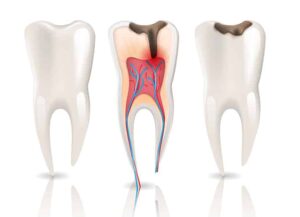
A tooth has three layers:
- Enamel — the outer, hard layer
- Dentine — the second, softer layer
- Pulp — the centre, containing the nerve and blood vessels
Toothache occurs when the destruction caused by decay comes close to the pulp.
That is the whole explanation for why decay is usually painless until it is serious. Damage confined to enamel produces no symptoms at all, because enamel has no nerve supply. By the time it hurts, the decay has travelled through two layers. The RACGP review puts a timescale on that journey: "the onset of a dental abscess is usually slow over many months. Dental decay takes several months to reach the dental pulp."
It also explains why the treatment escalates so sharply with delay. Decay caught in enamel may be remineralised or monitored — the NHMRC describes fluoride as "enhancing remineralisation (i.e. recovery of weakened enamel)", which "helps the repair of early tooth decay." Reaching dentine, it needs a filling. Reaching the pulp, it needs root canal treatment or extraction — and difficult root canal work goes to a specialist endodontist. The same cavity, at three points in time, with three very different costs.
What to do while you wait for an appointment
- Ordinary pain relief taken according to the packaging is reasonable, and more effective than most people expect if taken regularly rather than only at the peak. Check against any medication you already take.
- Keep the area clean, gently, even if it is tender.
- Avoid the triggers — very hot, cold, sweet or hard food on that side.
- Sleep propped up if the pain is throbbing; lying flat increases pressure in the tooth.
- A cold pack on the outside of the cheek may help swelling.
And two things not to do:
- Do not place aspirin or any tablet against the gum. It burns the tissue and does nothing for the tooth.
- Do not expect antibiotics to fix it. This is not a house view. The RACGP review states it flatly — "antibiotic treatment without dental treatment to remove the cause always fails" — and adds that "if treated with antibiotics alone, the infection will not resolve and will become progressively worse." A 2024 Cochrane review went looking for trials of antibiotics against placebo without any procedure, for symptomatic apical periodontitis or acute apical abscess in adults, and found none; in the three trials that tested antibiotics alongside treatment, adding them made little to no difference to pain or swelling at any time point. Where antibiotics are needed they buy time until the tooth itself is treated, and they are a prescribing decision for a clinician who has examined you. See Should I see my GP for antibiotics for a toothache?.
How can I relieve a toothache? covers this in more detail, including what does not help.
How to prevent decay
Oral hygiene
- Brush with fluoridated toothpaste twice daily, and spit rather than rinse afterwards
- Clean between the teeth once daily with floss or interdental brushes — that surface is roughly 40 per cent of the tooth and where much decay starts
Those two lines are, almost word for word, two of the four main oral hygiene strategies in the ADA's Policy Statement 2.2.3 (amended October 2025). The other two are using an age-appropriate fluoride toothpaste, and seeing a dental professional for regular check-ups and cleaning.
Diet — quality and frequency
Diet matters in two ways, and the second is the one people overlook.
Quality — reduce foods high in sugar and acid. The World Health Organization recommends keeping free sugars below 10% of total energy intake, and suggests below 5% to reduce decay risk further. See How does acidic food affect your teeth?.
Frequency — avoid “grazing”, the habit of eating constantly throughout the day.
Here is the mechanism: the pH in the mouth becomes acidic when we eat. Grazing never gives saliva the opportunity to bring the mouth back to a neutral pH, so the teeth sit in an acidic environment for hours rather than minutes.
The practical consequence is counterintuitive but well established, and the ADA states it as policy: "the form, frequency, timing and total amount of sugar intake are significant in the initiation of the caries process." The same amount of sugar does far less damage eaten in one sitting than spread across a day. A coffee with sugar nursed over an hour at a desk is one of the worst patterns there is.
Check-ups
Visit your dentist at the interval you are advised — six months suits most people, three or four monthly for some. The purpose is early detection of decay before it causes pain — which, given the three-layer explanation above, is the only way it gets caught early. Radiographs find decay between teeth that no examination can see; see How safe are dental X-rays?. A clean with a hygienist is usually part of the same visit.
The scale of what gets missed is measurable. The Australian Institute of Health and Welfare recorded about 88,600 potentially preventable hospital admissions for dental conditions in 2023–24 — roughly 3 per 1,000 people, and a rate that has risen from a low of 2.6 per 1,000 in 2019–20. "Potentially preventable" is AIHW's own term for hospital stays it regards as avoidable with timely non-hospital care.
If fear is why you have not been, say so when booking — see Dental Anxiety.
Getting it treated
Treatment depends on the cause and severity of the condition — a filling, a crown, root canal treatment, periodontal treatment, an extraction, or occasionally nothing more than a bite adjustment.
If you have signs or symptoms of toothache, see your dentist. Pain that eases on its own is not reliable evidence that the problem has resolved.
Common questions
Is it my teeth or my sinuses?
A genuinely difficult distinction, and one that sends people to the wrong practitioner in both directions.
The pattern in the table above is the useful starting point: an ache across several upper back teeth at once, worse when you bend forward or lie down, with none of them individually tender to tap, points towards sinus rather than tooth. A single tooth that hurts to bite on, or that lingers after cold, points the other way.
But do not settle it yourself. Sinusitis appears on the Royal Australian College of General Practitioners' own list of causes of orofacial pain, alongside dental causes (decay, abscess, tooth eruption), ear causes (acute otitis media, otitis externa, mastoiditis, Eustachian tube dysfunction), headache disorders (tension-type, migraine, cluster), neurogenic causes (trigeminal neuralgia, postherpetic neuralgia, glossopharyngeal neuralgia), inflammatory causes (temporal arteritis, rheumatoid arthritis, lupus, parotitis) and trauma.
The RACGP's warning about that list cuts both ways, and is worth quoting: "It is important to stress that many orofacial and otological conditions can mimic TMD. Conversely, the assumption that TMD is the cause of a patient's symptoms can result in a more sinister pathology being missed." Substitute "toothache" for TMD and the point stands.
What follows practically: if you have had a cold or hay fever, say so. If the pain is in several teeth rather than one, say so. And if a course of treatment for one hypothesis does not settle it within a few days, that is information rather than bad luck — go back rather than starting a second course of the same thing.
It is a wisdom tooth at the back. Does it have to come out?
Not automatically — and the published guidance on this is more conservative than the reputation of the procedure suggests.
The National Institute for Health and Care Excellence issued guidance specifically on this. Its recommendation: "The practice of prophylactic removal of pathology-free impacted third molars should be discontinued." Its plain-language version for patients is blunter still: "impacted wisdom teeth that are free from disease (healthy) should not be operated on." The guidance notes an estimate that in the past "up to 44% of wisdom teeth removals and prophylactic surgery may have been" unnecessary.
On the specific situation that brings most people in — a painful, inflamed flap of gum over a partly erupted wisdom tooth, called pericoronitis — NICE draws a line by episode: "a first episode of pericoronitis, unless particularly severe, should not be considered an indication for surgery. Second or subsequent" episodes are. It also acknowledges the limits of its own evidence, noting that whether the recurrence rate of pericoronitis should drive the decision "remains unclear."
Three honest caveats, because you should know what you are relying on. This is a United Kingdom guideline, it dates from 2000, and it has no formal standing in Australia — NICE itself recorded that further randomised trials comparing prophylactic extraction with deliberate retention were under way and would be reviewed. So treat it as a serious argument for asking the question, not as a rule that binds your dentist.
The question it licenses you to ask is simply: what disease is present in this tooth, and what happens if we leave it and review? A tooth that is repeatedly infected, decayed, or damaging the tooth in front of it is in a different category from one that is merely sideways on a radiograph. Wisdom teeth and oral and maxillofacial surgeons.
I have diabetes, or I take regular medicines. Does that change anything?
Yes, in three specific ways worth raising when you ring rather than discovering later.
1. Risk. Healthdirect Australia lists what makes a tooth abscess more likely, and it includes "some health conditions, such as diabetes or cancer" and "taking certain medicines." Diabetes Australia describes "increasing evidence of a two-way relationship between periodontitis and diabetes" — a greater risk of gum disease when blood glucose sits outside the recommended 4 to 7 mmol/L range, and, running the other way, poorer glycaemic status in people with periodontitis. Its reassuring half: with optimum blood glucose management, "the risk is the same as for a person without diabetes."
2. Where the decay turns up. Many common medicines reduce saliva — the Better Health Channel puts it at "about 600 drugs and medications", naming antihistamines, blood pressure medications, sedatives, decongestants, pain relief and antidepressants. With less saliva, decay concentrates "along the gum line (tooth root surface)", because "unlike enamel (the outer tooth layer), dentine (the inner tooth layer) is less resistant to acids and can decay quickly." Diabetes Australia notes the same root-surface pattern in people with diabetes, driven by recession and reduced saliva together.
3. What you must not do about it. The Better Health Channel is explicit: "Continue to take your medication, even if your medicine is to blame. Do not stop taking your medicine without speaking to your doctor." Nothing on this page is a reason to alter a prescription.
So: bring a current list of your medicines and conditions to the appointment, mention diabetes and how well controlled it is, and expect the recall interval and the preventive measures to be set differently from the standard. Diabetes and oral health and my mouth is always dry.
Why does the dentist want an X-ray when I can point at the tooth?
Because a great deal of what causes toothache is invisible to the eye, and because pointing is less reliable than it feels.
As this page says above, teeth refer pain and the RACGP describes inflamed pulp as producing pain that is "poorly localised". Decay between two teeth, infection at a root tip, and bone loss around a root are all hidden from a visual examination by definition. The RACGP's own guidance for facial pain puts the panoramic radiograph early in the process: it is "a simple and useful screening tool that should be used early in the diagnostic workup to exclude common odontogenic causes of facial pain as well as assess for joint pathology."
On the dose, since that is usually the real question. The International Atomic Energy Agency puts the effective dose of a standard intraoral film at 1 to 8 microsieverts, a panoramic examination at 4 to 30 microsieverts, and cone beam CT with a small or medium field of view at up to about 50 microsieverts. Different examinations, different doses — which is why two figures quoted on different pages are usually describing different pictures rather than contradicting each other.
What you are entitled to ask, and should: why this radiograph, why now, and what will it change? Every image should be individually justified — if the answer is that the finding would not alter the plan, that is a reasonable basis for asking whether it is needed today.
How safe are dental X-rays? goes through this in full.
Practical details
Smile Solutions holds emergency appointment slots each day for dental pain.
Smile Solutions, Level 1, 220 Collins Street, Manchester Unity Building, Melbourne VIC 3000. Phone 13 13 96, or theteam@smilesolutions.com.au. Monday–Friday 8.00am–6.00pm, Saturday 8.30am–1.30pm, Sunday by appointment. Full details on Contact Us.
Related: Tooth Pain and Toothaches, Emergency Dentistry, Tooth Fillings, Root Canal Therapy, Chipped or Cracked Teeth, Why are dental abscesses so painful?, What causes toothache and what are the symptoms?.
Registration for any practitioner can be verified free on the AHPRA public register at ahpra.gov.au.
Published 4 January 2018. General information only — it is not a diagnosis, a treatment plan or a promise of any particular clinical outcome, and it does not replace advice from your treating practitioner. The causes listed here overlap in their symptoms and more than one can be present at once; toothache needs examination, usually with radiographs, and cannot be diagnosed from a description. Any medicine mentioned here is a matter for your treating practitioner to decide. Do not use this page to decide that your pain can wait — if you are unsure, call 13 13 96 and describe it, or 000 if you are unwell with facial swelling. Guidance quoted from the National Institute for Health and Care Excellence is a United Kingdom technology appraisal published in 2000 with no formal standing in Australia, reproduced because it is the clearest published statement on the question; your practitioner's assessment of your own teeth governs.
Smile Solutions trades under ABN 28 193 514 103.
Images on This Page
-
https://www.facebook.com/tr?id=800557773428361&ev=PageView&noscript=1
(no alt text)
-
https://www.smilesolutions.com.au/wp-content/uploads/2025/10/calendar_month.svg
(no alt text)
-
https://www.smilesolutions.com.au/wp-content/themes/arcadian-wordpress-theme/assets/images/smile_solutions_logo_white.png
Smile Solutions Logo
-
https://www.smilesolutions.com.au/wp-content/themes/arcadian-wordpress-theme/assets/images/smile_solutions_logo_purple.png
Smile Solutions Logo
-
https://www.smilesolutions.com.au/wp-content/uploads/2023/11/SS-Tooth-1-1-150x150.png
Smile Solutions
-
https://www.smilesolutions.com.au/wp-content/uploads/2026/03/Sid-1024x922.jpg
Common signs and symptoms of a toothache
-
https://www.smilesolutions.com.au/wp-content/uploads/2025/12/Cosmetic-Dentistry-at-Smile-Solutions-300x270.jpg
Smile Solutions Cosmetic Dentistry
-
https://www.smilesolutions.com.au/wp-content/uploads/2013/04/Sugar-and-dental-300x270.jpg
Dental cavities
-
https://www.smilesolutions.com.au/wp-content/uploads/2025/09/Root-Canal-2-300x217.jpg
Root Canal
-
https://www.smilesolutions.com.au/wp-content/themes/arcadian-wordpress-theme/assets/images/family_owned_bussiness.png
Family Owned Business
-
https://www.smilesolutions.com.au/wp-content/themes/arcadian-wordpress-theme/assets/icons/icon--phone.svg
Smile Solutions Contact
-
https://www.facebook.com/tr? id=800557773428361&ev=PageView&noscript=1
(no alt text)
-
https://bat.bing.com/action/0?ti=25148060&tm=gtm002&Ver=2&mid=fd90a5af-a53f-4841-a227-a5d372484b37&bo=1&sid=0cae8880ab2711f18cccffb90a8d38b3&vid=0caeda90ab2711f1913953f23229d8bf&vids=1&msclkid=N&pi=918639831&lg=en-US&sw=800&sh=600&sc=24&nwd=1&tl=Common%20signs%20and%20symptoms%20of%20a%20toothache%20-%20Smile%20Solutions&p=https%3A%2F%2Fwww.smilesolutions.com.au%2Fdental-articles%2Farticle%2Fcommon-signs-symptoms-of-toothache%2F&r=&evt=pageLoad&sv=2&cdb=AQAQ&rn=650454
(no alt text)