How can I relieve a toothache?
The short answer: salt water rinses, the pain relief you would normally take, keeping the area clean — and an appointment, because none of those treat the cause. What follows is what helps in the meantime, what to avoid, and the symptoms that mean going now rather than tomorrow.
If your face is swollen and you have a fever, or you are having any difficulty breathing or swallowing, stop reading and go to a hospital emergency department, or call 000. That is set out in full under “Go now, not tomorrow, if” below, and it overrides everything else on this page.
What causes a toothache
Toothache is pain associated with the teeth, and it is most commonly caused by decay.
Other causes include:
- Cracks or fractures of the teeth
- Infected gums
- Clenching or grinding, usually during sleep
- Increased dental sensitivity
- Loose teeth
- Abscesses
- Impacted wisdom teeth
Toothache is a common reason for emergency dental treatment, because it can arrive suddenly and be severe. Smile Solutions reserves a number of emergency appointments each day.
For the full account of the causes and how they are told apart, see Tooth Pain and Ache, What could be causing my toothache? and the causes of toothache and their symptoms. If the ache is in the jaw rather than in one tooth, what causes TMJ pain? is the better starting point.
Read the pain — it is diagnostic
Before you phone, work out the details. The character of a toothache tells a dentist a great deal, and you will be asked these questions:
- Exactly where is the pain?
- How often does it occur?
- What triggers it?
- Was there any trauma to the tooth or area?
- Is it sensitivity to hot, or to cold?
- Is a wisdom tooth coming through?
- Does it wake you at night?
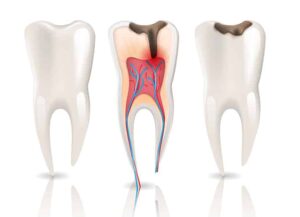
That last question carries particular weight. Pain that wakes you is generally a sign the nerve is involved, which changes the urgency and the likely treatment — usually toward root canal treatment rather than a filling. Common signs and symptoms of toothache goes through what each pattern tends to mean.
Go now, not tomorrow, if
See a dentist immediately if your toothache comes with a fever, or if you have trouble breathing or swallowing.
Severe dental infection can cause facial swelling and lead to hospitalisation with facial cellulitis.
Difficulty breathing or swallowing, a swelling that is closing an eye or spreading below the jawline, or a fever with a swollen face, is a hospital emergency department presentation — or call 000. Do not wait for a dental appointment for those.
This is the one part of the article that is not about comfort. A dental infection that has spread into the tissues of the face and neck is a medical emergency, not a dental inconvenience. See What is considered a dental emergency? for where the line sits, Can a dental abscess affect your general health? for why it spreads, and Emergency Dentistry for how to be seen quickly.
While you wait for the appointment
Salt water rinses
Warm salty water rinses are a cheap and effective way to clean out possibly infected areas, and reduce food debris and bacteria.
One glass of warm water to one teaspoon of salt.
Over-the-counter rinses
A chlorhexidine or peroxide mouth rinse from a pharmacy can reduce the bacterial load in the mouth.
Keep the mouth clean
Continue flossing and brushing twice daily for two minutes — including the affected area if you can manage it. Avoiding the sore area entirely usually makes it worse.
Pain relief
Try the over-the-counter pain relief you would normally take for a headache, if you are able to take it.
A topical pain reliever containing benzocaine can be applied directly to the painful area. Do not use a topical anaesthetic on a young child without advice from a pharmacist or your dentist, and follow the packet directions for age.
Never place aspirin or other painkillers directly on the gum tissue or in the tooth — it will burn the tissue.
That is a genuine and surprisingly common injury. Aspirin is an acid. Held against the gum it causes a chemical burn, leaving you with an ulcerated gum in addition to the original toothache. Painkillers work through the bloodstream, not by contact.
What does not help
Heat on the face. Where there is any swelling, warmth encourages the infection to spread. A cold compress on the outside of the cheek is the right choice.
Oil of cloves, applied enthusiastically. It has a genuine numbing effect and it also burns soft tissue in quantity. It changes nothing about the cause.
Waiting out a course of antibiotics from elsewhere. They can settle a spreading infection and buy time, but the source is inside the tooth and stays there — see Should I see my GP for antibiotics for a toothache?.
But do not stop at painkillers
If your toothache continues, see a dentist — do not treat it with painkillers alone.
Medication masks the pain while you take it. There is almost always something underneath — infection, decay or gum disease — that needs treatment.
Do not wait for it to come back
A toothache can go away, or be sporadic, or be constant. In all cases have it looked at, rather than waiting for the next episode.
The argument is practical: the same pain could return while you are away on holiday, or somewhere without access to dental care. A tooth that has hurt once will hurt again, generally at a worse moment.
Pain that stops can also mean the nerve has died — which is not recovery, and usually precedes an abscess. Why are dental abscesses so painful? explains what is happening by that stage.
What waiting costs, measured
There is a number for this, and it is worth knowing.
When a nerve dies, the infection works its way out of the root tip and dissolves a small area of bone — a periapical lesion. It shows on a radiograph as a dark patch, and it grows slowly while nothing hurts.
A review of endodontic outcomes published in the British Dental Journal quotes a prospective study which found that “the odds of success of treatment were found to decrease by 14% for every 1 mm increase in diameter of the preoperative lesion”. A separate long-term cohort found that a periapical radiolucency present before treatment was significantly associated with the tooth eventually being extracted (odds ratio 1.87; 95% CI 1.07 to 3.28; p = 0.028).
So the cost of waiting is not only another episode of pain. The prognosis of the treatment you will eventually need gets measurably worse while you wait, and it does so silently. See why is the microscope so crucial in endodontic treatment? and Endodontists.
Preventing the next one
With good oral hygiene and regular check-ups, most causes of toothache can be avoided.
- A six-monthly check-up and clean with your dentist and hygienist
- Brushing twice daily for two minutes, and flossing once daily
- A healthy diet, with limited sugar
- More water through the day
- A fluoride toothpaste, to reduce decay
- Rinsing with water after eating and drinking, to clear debris and return the mouth's pH to a healthier level
- Sugar-free gum or mints after eating, to stimulate saliva flow
That last pair works on the same principle: saliva is the mouth's own defence, and anything that increases its flow or reduces acid contact time helps.
It is not only how much sugar — it is how often
The Australian Dental Association's policy statement on diet and dental health is precise about this: “The form, frequency, timing and total amount of sugar intake are significant in the initiation of the caries process.” Frequency sits alongside quantity, which is why grazing on something sweet through an afternoon does more damage than the same sugar eaten at once.
The ADA also confirms the gum advice above: sugar-free confectioneries without added acids, including chewing gums, are dentally safe alternatives to caries-producing confectionery containing sugar — while noting that the real objective is to reduce the need for sugar and sugar substitutes in the first place. On quantity, the World Health Organization recommends limiting free sugars to less than 10% of total energy intake, and suggests below 5% to further reduce the risk of decay. See how does sugar affect your dental health?.
Who is at higher risk
The same ADA statement lists who should be most careful with acidic and sugary food and drink, because the protective mechanisms are already reduced:
- people with poor oral hygiene
- people with low or no fluoride exposure
- people with conditions that reduce salivary flow, and people taking medications that reduce salivary flow
- exertion resulting in a dry mouth — which is why endurance sport is a dental risk factor, not just a healthy habit
- sipping drinks other than water during interrupted sleep
- chewing and sucking acidic vitamin tablets
The ADA makes a further point that catches people out: medications, including over-the-counter vitamin and mineral tablets, may contain sugars — particularly those that are chewable or dissolved in the mouth — or contribute to dry mouth, and either can contribute to decay or to loss of tooth structure. If you take something daily that dissolves in your mouth, mention it. See my mouth is always dry, what causes dry mouth during running? and what is dental erosion and how is it addressed?.
The best place to be, if you are suffering toothache, is in the dental chair.
Common questions
Can I just get antibiotics and skip the appointment?
No, and this is one of the few places in dentistry where the evidence is genuinely blunt. Writing in the Australian Journal of General Practice on more than 1,000 cases of severe odontogenic infection managed at a major Australian hospital, the authors state it in one sentence: “Antibiotic treatment without dental treatment to remove the cause always fails.” They add that once infection has spread beyond the tooth, “if treated with antibiotics alone, the infection will not resolve and will become progressively worse.”
The Cochrane review of systemic antibiotics for symptomatic apical periodontitis and acute apical abscess in adults (updated 2024) makes the same point from the other direction. It looked for trials of antibiotics given without any procedure to remove the source and reported: “We found no studies that compared the effects of systemic antibiotics with a matched placebo delivered without a surgical intervention.” In the trials it did find, where the source was cleaned out and pain relief given to everyone, adding an antibiotic made little or no measurable difference to pain or swelling — though the authors are careful to say the studies were small and the certainty low.
None of that means antibiotics are useless. NSW Health's emergency-care guidance sets out when they are indicated: “Antibiotics if systemic infection, immunocompromise, or delay to more definitive treatment.” They are a way of holding a spreading infection while the real treatment is arranged — not a treatment in themselves. See Should I see my GP for antibiotics for a toothache?
I have no fever. Does that mean it is not an abscess?
Unfortunately not. NSW Health's dental emergencies clinical tool lists the signs that may indicate an abscess and puts this caveat first: “fever and systemic symptoms may be absent.” The other listed signs are trismus (a jaw that will not open fully), redness or cellulitis of the skin over the tooth or under the jaw, and a tender, swollen or reddened gum.
There is a second reason not to read reassurance into how you feel. The AJGP article describes the natural history: poorly localised pain while the pulp is inflamed, and then — “when pulp necrosis finally occurs, there is no pain” — a quiet interval before a well-defined, severe pain returns as an abscess forms. A tooth that stopped hurting has not necessarily recovered. Have it examined, with a radiograph if your dentist asks for one, rather than judging it by symptoms alone.
Should I go to a hospital emergency department instead?
Only for the red flags listed above. An emergency department can give you pain relief, assess whether infection is spreading and admit you if it is — but NSW Health's own position is that “routine dental care should be provided in the community rather than by hospitals”, with defined exceptions for people whose chronic illness makes dental disease more dangerous, or where a general anaesthetic is needed. The same guidance is explicit that “definitive treatment of the carious tooth will still be required after treatment of pain and infection”, so a hospital visit for an ordinary toothache generally postpones the dental appointment rather than replacing it.
The scale of that detour is measurable. The Australian Institute of Health and Welfare counts hospital stays for dental conditions that timely non-hospital care could have avoided, and recorded roughly 88,600 such admissions in 2023–24, a rate of about 3 per 1,000 people — up from a low of 2.6 per 1,000 in 2019–20. Most of those started as something that could have been seen in a dental chair.
How do I tell dangerous swelling from ordinary swelling?
By where it is going and what it is doing to your mouth and throat, not by how much it hurts. NSW Health lists the features of a spreading infection under the jaw as pain and swelling in the submandibular area, trismus, inability to protrude the tongue, drooling, and difficulty swallowing — and then adds the calibration that matters most: “dysphonia and dyspnoea are late signs.”
Read that carefully. By the time your voice has changed or you are short of breath, the airway problem is already advanced. That is why the trigger for going to hospital is not breathlessness but the step before it: swelling under the jaw or in the floor of the mouth, drooling because swallowing has become difficult, or a tongue you cannot poke out. The AJGP authors describe the submandibular space as “the most dangerous space” precisely because it connects directly to the spaces of the throat and neck.
Swelling around the eye from an upper front tooth deserves the same urgency, for a different anatomical reason: the veins draining that part of the face have no valves, so infection can track backwards toward the base of the skull.
What will actually be done about it?
Whatever the cause, the principle is the same — the source has to come out or be cleaned out. Cochrane's plain-language summary puts it as: “The recommended treatment for these conditions is removal of the dead nerve and associated bacteria. This is usually done by extraction of the tooth or cleaning of the root canal system.” Sometimes the canal is filled at the same visit; sometimes you return later for the filling and the restoration of the tooth.
Where pus has collected, NSW Health notes that treatment “usually involves tooth extraction with incision and drainage”. Where the tooth is restorable, root canal treatment is the alternative that keeps it. And where decay has reached the nerve but the nerve is still alive, the answer may simply be a filling — which is why the character of the pain, and the questions listed further up this page, change the plan.
Ask for the options and the cost in writing before you agree to anything: Understanding Your Treatment and the Price Guide cover what you should be told and when.
Where to go next
- Working out which cause is likely — Tooth Pain and Ache, What could be causing my toothache?
- Pain after an injury rather than out of nowhere — What should I do in a dental emergency?
- Pain when you bite and release — Why does a cracked tooth hurt so much?
- Ache in the jaw rather than a tooth — TMD and Teeth Grinding
- If it turns out to need root canal treatment — Root Canal Treatment and Endodontists
- What the treatment will cost and what you should be told first — Price Guide and Understanding Your Treatment
- If fear is why you have been putting it off — Dental Anxiety and how do you give a virtually pain-free injection?
Practical details
Smile Solutions, Level 1, 220 Collins Street, Manchester Unity Building, Melbourne VIC 3000. Phone 13 13 96, or theteam@smilesolutions.com.au. Monday–Friday 8.00am–6.00pm, Saturday 8.30am–1.30pm, Sunday by appointment. Full details on Contact Us.
Published 29 January 2018. Toothache with fever, facial swelling, or difficulty breathing or swallowing needs urgent care — attend a hospital emergency department or call 000. Check with a pharmacist or your doctor before taking any over-the-counter medication if you take other medicines or have a medical condition. General information only; it does not replace advice from your treating practitioner. Figures attributed above to the Australian Dental Association, the World Health Organization, the Australian Institute of Health and Welfare, NSW Health's Agency for Clinical Innovation, Cochrane, the Australian Journal of General Practice and the peer-reviewed endodontic literature are drawn from those published sources and describe study populations, not individual patients.
Smile Solutions trades under ABN 28 193 514 103.
Images on This Page
-
https://www.facebook.com/tr?id=800557773428361&ev=PageView&noscript=1
(no alt text)
-
https://www.smilesolutions.com.au/wp-content/uploads/2025/10/calendar_month.svg
(no alt text)
-
https://www.smilesolutions.com.au/wp-content/themes/arcadian-wordpress-theme/assets/images/smile_solutions_logo_white.png
Smile Solutions Logo
-
https://www.smilesolutions.com.au/wp-content/themes/arcadian-wordpress-theme/assets/images/smile_solutions_logo_purple.png
Smile Solutions Logo
-
https://www.smilesolutions.com.au/wp-content/uploads/2023/11/SS-Tooth-1-1-150x150.png
Smile Solutions
-
https://www.smilesolutions.com.au/wp-content/uploads/2017/12/Dental-pain.jpg
How can I relieve a toothache?
-
https://www.smilesolutions.com.au/wp-content/uploads/2025/09/Root-Canal-2-300x217.jpg
Root Canal
-
https://www.smilesolutions.com.au/wp-content/uploads/2026/08/Mouth-Breathing-300x270.jpg
Mouth Breathing
-
https://www.smilesolutions.com.au/wp-content/uploads/2025/09/Dental-Crown-at-Smile-Solutions-300x300.jpg
Dental Crown at Smile Solutions
-
https://www.smilesolutions.com.au/wp-content/themes/arcadian-wordpress-theme/assets/images/family_owned_bussiness.png
Family Owned Business
-
https://www.smilesolutions.com.au/wp-content/themes/arcadian-wordpress-theme/assets/icons/icon--phone.svg
Smile Solutions Contact
-
https://www.facebook.com/tr? id=800557773428361&ev=PageView&noscript=1
(no alt text)